> ## Documentation Index
> Fetch the complete documentation index at: https://arizeai-433a7140.mintlify.site/llms.txt
> Use this file to discover all available pages before exploring further.
# Why Public Benchmarks Lie: Building Your Own Eval Harness
> A model that wins on MMLU can lose on your task. Build a domain-specific harness and compare models fairly on your own data and metric.
colab.research.google.com
When a new model tops MMLU, GPQA, or the latest leaderboard, it's tempting to assume it's the right choice for *your* application. It usually isn't — at least not for the reason you think. Public benchmarks measure **generic capabilities** on **generic data** with a **generic metric**: broad academic knowledge, scored as multiple-choice accuracy, averaged over thousands of questions that look nothing like your production traffic.
Your task is narrow and specific. You aren't asking the model trivia — you're asking it to pull a handful of exact fields out of a customer email, every time, in a schema your downstream code can parse. A model that wins MMLU by two points can lose *your* task by twenty, because:
* **The data is different** — your inputs are your customers' emails, not exam questions.
* **The metric is different** — you care whether the `due_date` field is *exactly* right, not whether the prose sounds smart.
* **The failure modes are different** — a confident, plausible-sounding wrong answer is worse for you than an "I don't know," the opposite of what a knowledge benchmark rewards.
The only benchmark that predicts how a model performs on your task is **a benchmark built from your task** — and Phoenix experiments are exactly that harness. This cookbook builds one for an email text-extraction service and uses it to compare two models fairly.
This cookbook shows examples of:
* Building a small **domain dataset** of emails + correct extractions — your benchmark, not a public one
* Defining an **extraction task** with a fixed schema and prompt, parameterized only by model
* Defining **two evaluators** — string similarity *and* field-level accuracy — and seeing how they can rank the models differently
* Running the **same harness** across `gpt-5.4-mini` and the flagship `gpt-5.5` and comparing them fairly
## What makes a benchmark trustworthy
Before trusting *any* number — public or your own — ask whether the benchmark behind it has these four properties:
1. **Representative data.** The examples are drawn from your real inputs, covering the cases you actually see (including the messy and ambiguous ones), not a clean toy sample.
2. **A metric that measures what you care about.** The score moves when the output gets better *for your purpose* and stays flat when it doesn't. The wrong metric can rank a worse model first — we'll show exactly this below.
3. **Enough examples to be stable.** Two examples can't distinguish two models; the score has to be more signal than noise.
4. **Reproducible and fair.** Every model is judged on the *same* dataset, with the *same* metric, under the *same* prompt — so a difference in the score reflects a difference in the model, not the setup.
A Phoenix **experiment** is this harness: a fixed **dataset**, a **task** you vary, and one or more **evaluators**. Hold the dataset and evaluators constant, swap only the model, and the comparison is fair by construction.
## Notebook Walkthrough
We will go through key code snippets on this page. To follow the full tutorial, check out the [full notebook](https://colab.research.google.com/github/Arize-ai/phoenix/blob/main/tutorials/experiments/building_your_own_eval_harness.ipynb).
After configuring tracing with `phoenix.otel.register(...)` and instrumenting OpenAI, we build a small hand-labeled dataset, define a model-parameterized extraction task, score it two ways, and run the same harness across two models.
## Set up tracing
Register a tracer provider so every extraction call shows up as a span in Phoenix — the experiment results link back to the exact calls that produced them. `auto_instrument=True` activates the installed OpenInference instrumentors (here, OpenAI), so there's no need to call `OpenAIInstrumentor().instrument(...)` yourself. Use `AsyncClient` because the experiment task makes network-bound LLM calls.
```python theme={null}
from phoenix.client import AsyncClient
from phoenix.otel import register
register(project_name="email-extraction-eval-harness", auto_instrument=True)
px_client = AsyncClient()
```
## Build a domain dataset
This is the part public benchmarks can't do for you. Hand-label a handful of emails the way your service actually sees them — a meeting request, an invoice, a support escalation — each paired with the **exact** structured output you want back. In production you'd build this from real traffic (export traces from Phoenix, sample, and label); here we inline a small set so the example is self-contained.
The mix of free-text fields (`summary`) and categorical fields (`category`, `due_date`) is deliberate: it's what lets two reasonable metrics *disagree* later.
This is a **demonstration harness**. Eight examples is enough to show the workflow, not to draw stable conclusions (recall property 3 above). A production harness needs a larger, representative sample drawn from your real traffic before you'd trust the ranking.
```python expandable theme={null}
from datetime import datetime, timezone
import pandas as pd
from phoenix.client.utils.config import get_base_url
# EMAILS = [{"email": "...", "expected": {"sender": ..., "category": ..., "summary": ...,
# "action_required": ..., "due_date": ...}}, ...] — see the notebook for the full set.
# Flatten each example's expected extraction into top-level columns, so the dataset's
# output IS the extraction dict the evaluators compare against — not a nested wrapper.
rows = [{"email": e["email"], **e["expected"]} for e in EMAILS]
df = pd.DataFrame(rows)
OUTPUT_KEYS = ["sender", "category", "summary", "action_required", "due_date"]
dataset = await px_client.datasets.create_dataset(
name=f"email-extraction-{datetime.now(timezone.utc):%Y%m%d-%H%M%S}",
dataframe=df,
input_keys=["email"],
output_keys=OUTPUT_KEYS,
)
# Print a link straight to the dataset so you can eyeball the examples you just uploaded.
base_url = str(get_base_url()).rstrip("/")
print(f"View the dataset in Phoenix: {base_url}/datasets/{dataset.id}/examples")
```
## Define the extraction task
The task is what we hold *almost* constant: the same schema, the same prompt, the same parsing — **only the model changes**. Using structured outputs forces every model to return the exact same shape, so the comparison is about extraction quality rather than formatting luck.
`make_task(model)` returns a task function bound to one model. The experiment calls it once per dataset example; the `input` it receives is that example's input dict (`{"email": ...}`).
```python expandable theme={null}
from typing import Literal
from openai import AsyncOpenAI
from pydantic import BaseModel
openai_client = AsyncOpenAI()
class EmailExtraction(BaseModel):
sender: str
category: Literal["meeting", "invoice", "support_request", "sales", "internal_update"]
summary: str
action_required: bool
due_date: str # ISO date (YYYY-MM-DD) or the literal string "none"
PROMPT = (
"Extract structured fields from the email below. "
"sender must be the sender's email address. "
"category must be one of: meeting, invoice, support_request, sales, internal_update. "
'due_date must be an ISO date (YYYY-MM-DD) or the literal string "none". '
"action_required is true if the email asks the recipient to do something.\n\nEMAIL:\n{email}"
)
def make_task(model: str):
async def task(input) -> dict:
response = await openai_client.beta.chat.completions.parse(
model=model,
messages=[{"role": "user", "content": PROMPT.format(email=input["email"])}],
response_format=EmailExtraction,
# Leave temperature at the model default — a fair comparison varies only the
# model, and the newest models accept only their default sampling settings.
)
return response.choices[0].message.parsed.model_dump()
return task
```
## Choose metrics that measure what you care about
This is where benchmarks quietly lie. Score the **same** outputs two ways:
* **`jaro_winkler`** — string similarity on the free-text `summary` field. Cheap and forgiving — the kind of "looks about right" metric people reach for first — and the right tool for a `summary`, which can be correct while worded differently.
* **`field_accuracy`** — the fraction of the **operational** fields (`sender`, `category`, `action_required`, `due_date`) that match *exactly* (case-insensitive). This is what downstream code depends on: a `due_date` that's "close" is still a wrong date. `summary` is deliberately left out — exact-matching a summary would punish good extractions for harmless rewording.
The two metrics measure genuinely different things, so they *can* rank the models differently: a model might write better summaries (higher `jaro_winkler`) while miscategorizing more emails (lower `field_accuracy`), or vice versa. When they disagree, the metric that should decide is the one tied to your downstream needs — here, `field_accuracy`.
```python theme={null}
import jarowinkler
# jaro_winkler scores only the free-text summary; field_accuracy judges only the
# operational fields downstream code actually depends on. The two never overlap,
# so they can move independently.
OPERATIONAL_FIELDS = ["sender", "category", "action_required", "due_date"]
def jaro_winkler(output, expected) -> float:
"""Forgiving string similarity on the free-text summary (reworded-but-correct still scores high)."""
return jarowinkler.jarowinkler_similarity(
str(output.get("summary", "")),
str(expected["summary"]),
)
def field_accuracy(output, expected) -> float:
"""Fraction of OPERATIONAL fields that match exactly (case-insensitive)."""
matches = sum(
1
for k in OPERATIONAL_FIELDS
if str(output.get(k)).strip().lower() == str(expected[k]).strip().lower()
)
return matches / len(OPERATIONAL_FIELDS)
EVALUATORS = [jaro_winkler, field_accuracy]
```
The two metrics can rank the same outputs in opposite order. Made deterministic — two candidate extractions for one invoice email: one with the right operational fields but a reworded `summary`, one that looks almost identical but has the `due_date` off by a day:
```python theme={null}
expected = {
"sender": "billing@cloudhost.com", "category": "invoice", "action_required": True,
"due_date": "2025-06-30", "summary": "CloudHost invoice #88231 for $4,200 is due June 30.",
}
# A: every operational field right, but the summary is fully reworded (harmless).
candidate_a = {**expected, "summary": "Please arrange payment for the recent cloud hosting charges before the close of the current billing period."}
# B: summary identical, but the due_date is off by a day.
candidate_b = {**expected, "due_date": "2025-07-01"}
# field_accuracy prefers A (1.000 vs 0.750 — every operational field correct).
# jaro_winkler prefers B (1.000 vs 0.461 — its summary is word-for-word identical).
# But B's one-day date slip is exactly what breaks downstream code: same outputs,
# opposite rankings, and the strict metric is the one that's right.
```
## Run the same harness across models
Same dataset, same evaluators, same prompt — change only the `model` argument. That's what makes this a fair comparison instead of an anecdote.
```python theme={null}
experiment_full = await px_client.experiments.run_experiment(
dataset=dataset, task=make_task("gpt-5.5"), evaluators=EVALUATORS, experiment_name="gpt-5.5"
)
experiment_mini = await px_client.experiments.run_experiment(
dataset=dataset, task=make_task("gpt-5.4-mini"), evaluators=EVALUATORS, experiment_name="gpt-5.4-mini"
)
```
## Compare fairly
Phoenix prints a per-experiment summary and lets you compare both runs example-by-example in the UI. Rolling the scores up per metric makes the disagreement explicit:
```python theme={null}
from collections import defaultdict
def average_scores(experiment) -> dict:
sums, counts = defaultdict(float), defaultdict(int)
for run in experiment["evaluation_runs"]:
result = run.result
if result and result.get("score") is not None:
sums[run.name] += result["score"]
counts[run.name] += 1
return {name: sums[name] / counts[name] for name in sums}
```
With only eight examples the two models may or may not separate cleanly on a given run — that's exactly why you *look* rather than assume. The lesson holds regardless: if the two metrics **rank the models differently**, the public-leaderboard instinct ("just take the higher-scoring model") could have led you to the wrong choice — *which* model is "better" depends on the metric, and the metric that should win is the one that reflects your downstream needs (here, `field_accuracy`). If they **agree**, you now have evidence grounded in *your* data and *your* metric. Either way, you trust the result because you built the harness.
## Reading the results in Phoenix
Open the dataset's **Experiments** tab to see the runs side by side. Each experiment is a row; each evaluator becomes its own **score column** (so `field_accuracy` sits next to `jaro_winkler`), alongside operational columns — average **latency**, **cost**, and **error rate** — that matter for a real model choice but never show up on a public leaderboard.
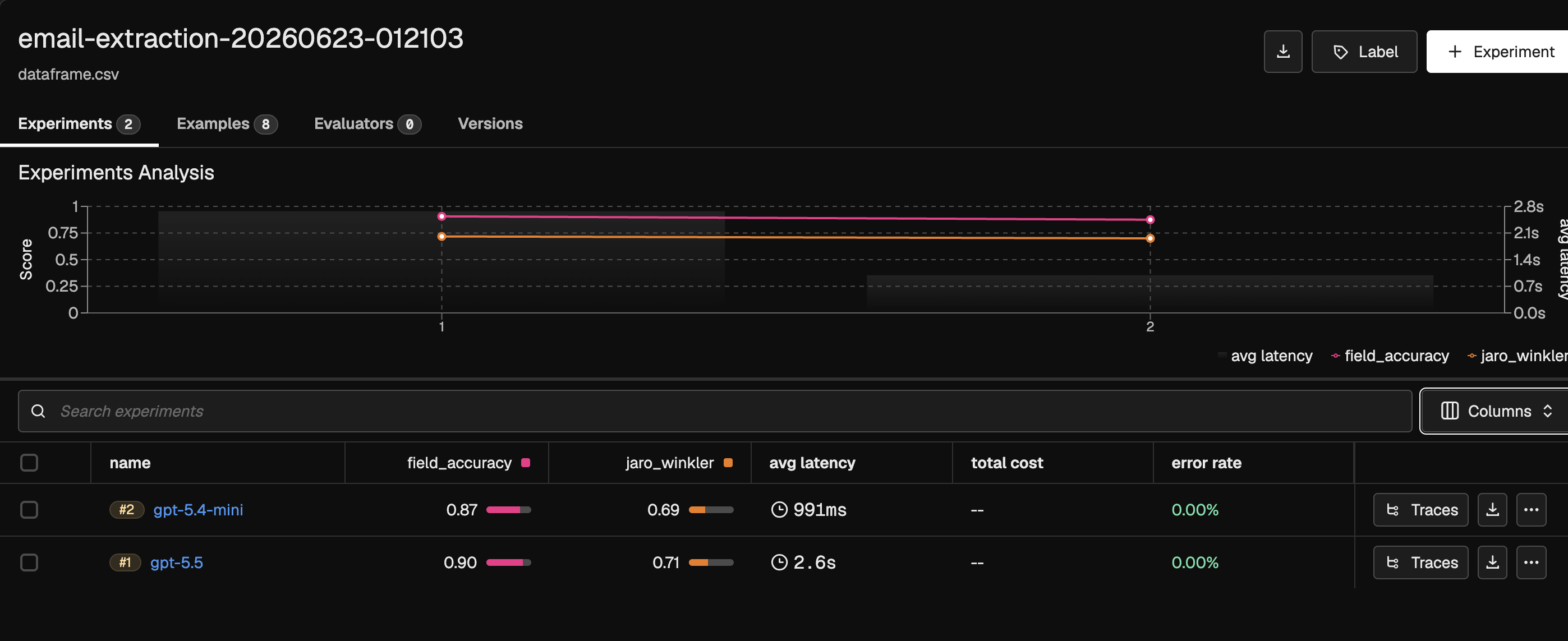
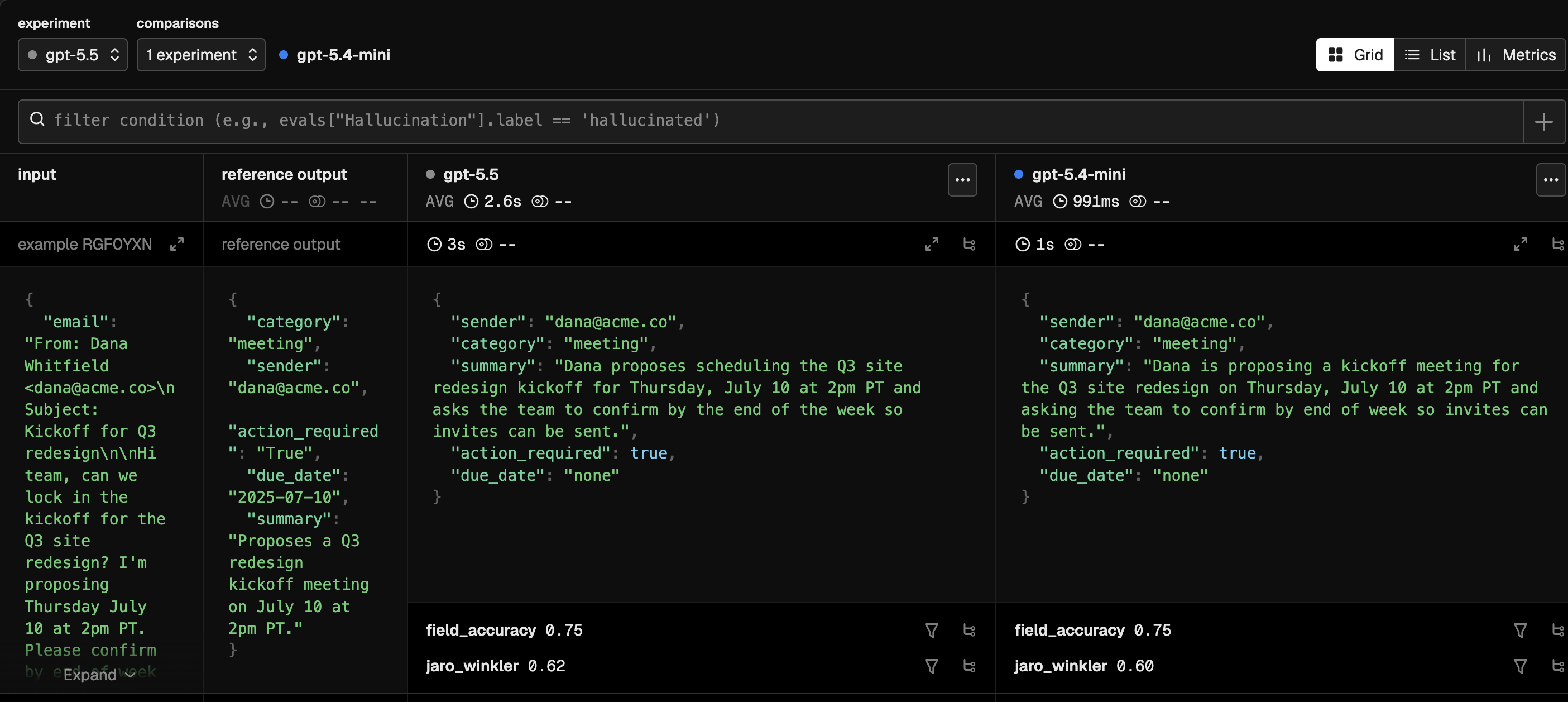
The two metrics *can* rank the models differently — a model that writes better summaries (higher `jaro_winkler`) might still miscategorize more emails (lower `field_accuracy`), or vice versa. When they disagree, sort by the metric tied to your downstream needs (`field_accuracy`) rather than the forgiving one, and click any row to drop into the example-level view: the input email, the model's extraction, and each evaluator's score for that single example. That's where you *see why* one model wins — a `due_date` the model dropped, a sender it over-captured — instead of trusting an aggregate.
## Where to go next
The harness is reusable — everything below holds the dataset and evaluators constant and changes one thing at a time, so each comparison stays fair:
* **Iterate the prompt.** Vary `PROMPT` instead of `model` to find the wording that extracts most reliably.
* **Add models and providers.** Drop another model name — or another provider's client — into `make_task` and rerun. The leaderboard ranking rarely survives contact with your task.
* **Grow the dataset.** Move from eight inline examples to a representative sample exported from your real traffic, so the scores become stable enough to trust (property 3).
* **Make it a standing benchmark.** Rerun the same harness on every model upgrade or prompt change to catch regressions before they reach production.
## Takeaway
A public benchmark tells you how a model does on *someone else's* task, with *someone else's* metric. That number rarely transfers to production. The fix isn't a better leaderboard — it's a small, trustworthy harness of your own:
* **Representative data** — a dataset built from your real inputs.
* **A metric that measures what you care about** — and the discipline to notice when a convenient metric (string similarity) disagrees with the real one (field accuracy).
* **Enough examples** to make the score stable.
* **A fair, repeatable setup** — same dataset, same evaluators, same prompt; vary only the model. (Run-to-run sampling adds a little noise, but with the dataset, prompt, and evaluators held fixed, a difference in score still traces to the model — that's the point, not bit-for-bit reproducibility.)
A Phoenix experiment gives you all four. Once you have it, comparing models — or prompts, or providers — is just swapping one argument and reading a number you can actually defend.