> ## Documentation Index
> Fetch the complete documentation index at: https://arizeai-433a7140.mintlify.site/llms.txt
> Use this file to discover all available pages before exploring further.
# AG2 Tracing
> Auto-instrument your AG2 multi-agent application for seamless observability
export const projectName_0 = "ag2-tracing"
[AG2](https://github.com/ag2ai/ag2) (formerly AutoGen) is an open-source Python framework for
building multi-agent LLM applications. It centers on the `ConversableAgent`, which agents use to
chat with one another, call tools, and coordinate through group chats and sequential
conversations.
Phoenix instruments AG2 through the `openinference-instrumentation-ag2` package. Calling
`AG2Instrumentor().instrument()` patches `ConversableAgent` and emits spans for chats, replies,
and tool executions, nesting them correctly through group chat orchestration.
This instrumentor supports AG2 0.14, which is imported as `autogen`. AG2 1.0 uses a new
middleware architecture that is not covered yet.
## Install
```bash theme={null}
pip install openinference-instrumentation-ag2 openinference-instrumentation-openai "ag2[openai]" arize-phoenix-otel arize-phoenix
```
AG2 delegates its LLM calls to the underlying model client. Pair the AG2 instrumentor with the
instrumentor for that provider — `openinference-instrumentation-openai` in the examples below —
so the LLM spans appear nested under the agent spans. If your agents call a different provider,
install and register that provider's OpenInference instrumentor instead.
## Setup
Use the `register` function to connect your application to Phoenix. Because AG2 relies on a
separate model instrumentor for LLM visibility, keep `auto_instrument=True` so both the AG2 and
model instrumentors are activated from your installed dependencies.
Connect your application to Phoenix with the `register` function:
{`from phoenix.otel import register
# configure the Phoenix tracer
tracer_provider = register(
project_name="${projectName_0}", # Default is 'default'
auto_instrument=True # Auto-instrument your app based on installed OI dependencies
)`}
## Run AG2
From here you can use AG2 as normal, and Phoenix will trace each agent chat, reply, and tool
call. The example below runs a single agent with the quickstart `run()` API:
```python theme={null}
import os
from autogen import ConversableAgent, LLMConfig
llm_config = LLMConfig(
{"api_type": "openai", "model": "gpt-4o-mini", "api_key": os.environ["OPENAI_API_KEY"]}
)
agent = ConversableAgent(
name="helpful_agent",
system_message="You are a helpful assistant.",
llm_config=llm_config,
)
response = agent.run(message="What is the capital of France?", max_turns=1, user_input=False)
response.process()
```
## What gets traced
The instrumentor patches `ConversableAgent` and produces three span kinds:
| AG2 method | Span name | Span kind |
| ----------------------------------------------------------------------------- | ------------------------ | --------- |
| `initiate_chat` / `a_initiate_chat` (also used by `run` and `initiate_chats`) | `.initiate_chat` | `AGENT` |
| `generate_reply` / `a_generate_reply` | `.generate_reply` | `AGENT` |
| `execute_function` / `a_execute_function` | `` | `TOOL` |
Tool spans carry `tool.name`, `tool_call.id`, `tool_call.function.arguments`, and
`tool.parameters` with resolved parameter types. The instrumentor also supports suppressing
tracing, propagating context attributes (`using_session`, `using_user`, `using_attributes`), and
masking sensitive data with a `TraceConfig`.
## Examples
### Tool calling
An LLM-driven tool call, split across an agent that decides to call the tool and a user proxy
that executes it — the registration split AG2 uses throughout its tools guide.
```python expandable theme={null}
import os
from typing import Annotated
from autogen import ConversableAgent, LLMConfig
from phoenix.otel import register
# auto_instrument activates the installed AG2 and OpenAI OpenInference instrumentors
register(project_name="ag2-tool-calling", auto_instrument=True)
llm_config = LLMConfig(
{"api_type": "openai", "model": "gpt-4o-mini", "api_key": os.environ["OPENAI_API_KEY"]}
)
RATES = {("USD", "EUR"): 0.92, ("EUR", "USD"): 1.09, ("USD", "JPY"): 157.0}
assistant = ConversableAgent(
name="assistant",
system_message=(
"You convert currencies using the provided tool. Once you have the answer, "
"state it and reply TERMINATE."
),
llm_config=llm_config,
)
user_proxy = ConversableAgent(
name="user_proxy",
human_input_mode="NEVER",
is_termination_msg=lambda message: "TERMINATE" in (message.get("content") or ""),
)
@user_proxy.register_for_execution()
@assistant.register_for_llm(description="Convert an amount between two currencies.")
def get_exchange_rate(
amount: Annotated[float, "The amount to convert"],
base: Annotated[str, "The currency code to convert from, e.g. USD"],
quote: Annotated[str, "The currency code to convert to, e.g. EUR"],
) -> str:
rate = RATES.get((base.upper(), quote.upper()))
if rate is None:
return f"No exchange rate available for {base} to {quote}."
return f"{amount} {base.upper()} is {amount * rate:.2f} {quote.upper()}."
user_proxy.initiate_chat(assistant, message="How much is 250 USD in EUR?", max_turns=4)
```
### Group chat
An `AutoPattern` group chat where a manager routes between specialist agents. The trace shows the
manager's speaker-selection decisions interleaved with each specialist's reply:
```
_User.initiate_chat [AGENT]
chat_manager.generate_reply [AGENT]
finance_bot.generate_reply [AGENT]
ChatCompletion [LLM]
checking_agent.initiate_chat [AGENT]
speaker_selection_agent.generate_reply [AGENT]
ChatCompletion [LLM]
summary_bot.generate_reply [AGENT]
ChatCompletion [LLM]
```
```python expandable theme={null}
import os
from typing import Any
from autogen import ConversableAgent, LLMConfig
from autogen.agentchat import initiate_group_chat
from autogen.agentchat.group.patterns import AutoPattern
from phoenix.otel import register
# auto_instrument activates the installed AG2 and OpenAI OpenInference instrumentors
register(project_name="ag2-group-chat", auto_instrument=True)
llm_config = LLMConfig(
{"api_type": "openai", "model": "gpt-4o-mini", "api_key": os.environ["OPENAI_API_KEY"]}
)
TRANSACTIONS = [
"Transaction: $500 to Staples. Memo: Quarterly supplies.",
"Transaction: $23,000 to CyberSins Ltd. Memo: Confidential.",
"Transaction: $1,500 to Initech. Memo: Routine payment.",
]
FINANCE_SYSTEM_MESSAGE = """
You are a financial compliance assistant reviewing transactions.
Flag a transaction as suspicious when the amount is over $10,000 or the memo is vague.
Approve the rest. Review every transaction in one reply, then hand off to summary_bot.
"""
SUMMARY_SYSTEM_MESSAGE = """
You are a financial summary assistant. Summarize the reviewed transactions as a markdown
table with Vendor, Memo, Amount, and Status columns, followed by the approved and
rejected counts. End your reply with "==== SUMMARY GENERATED ====".
"""
def is_termination_msg(message: dict[str, Any]) -> bool:
return "==== SUMMARY GENERATED ====" in (message.get("content") or "")
finance_bot = ConversableAgent(
name="finance_bot", system_message=FINANCE_SYSTEM_MESSAGE, llm_config=llm_config
)
summary_bot = ConversableAgent(
name="summary_bot", system_message=SUMMARY_SYSTEM_MESSAGE, llm_config=llm_config
)
pattern = AutoPattern(
initial_agent=finance_bot,
agents=[finance_bot, summary_bot],
group_manager_args={"llm_config": llm_config, "is_termination_msg": is_termination_msg},
)
result, _, _ = initiate_group_chat(
pattern=pattern,
messages="Please review these transactions:\n" + "\n".join(TRANSACTIONS),
max_rounds=6,
)
```
### Sequential chats
`initiate_chats` runs a queue of chats in order, passing each chat's summary into the next as
carryover. Each chat in the queue gets its own `AGENT` span, so the trace shows the whole
pipeline:
```python expandable theme={null}
import os
from autogen import ConversableAgent, LLMConfig
from phoenix.otel import register
# auto_instrument activates the installed AG2 and OpenAI OpenInference instrumentors
register(project_name="ag2-sequential-chats", auto_instrument=True)
llm_config = LLMConfig(
{"api_type": "openai", "model": "gpt-4o-mini", "api_key": os.environ["OPENAI_API_KEY"]}
)
researcher = ConversableAgent(
name="researcher",
system_message="List the key facts about the topic in three short bullets.",
llm_config=llm_config,
)
writer = ConversableAgent(
name="writer",
system_message="Turn the research you are given into a two-sentence summary.",
llm_config=llm_config,
)
editor = ConversableAgent(
name="editor",
system_message="Tighten the summary you are given into a single sentence.",
llm_config=llm_config,
)
coordinator = ConversableAgent(name="coordinator", human_input_mode="NEVER")
# Each chat's summary is carried into the next chat in the queue.
results = coordinator.initiate_chats(
[
{
"recipient": researcher,
"message": "Research the benefits of tracing LLM applications.",
"max_turns": 1,
"summary_method": "last_msg",
},
{
"recipient": writer,
"message": "Write the summary.",
"max_turns": 1,
"summary_method": "last_msg",
},
{
"recipient": editor,
"message": "Edit it down.",
"max_turns": 1,
"summary_method": "last_msg",
},
]
)
```
### Structured outputs
Passing a pydantic model as `response_format` on `LLMConfig` makes the agent reply with JSON
matching that schema. The agent span's output value is the serialized model, so the trace shows
exactly what downstream code will parse:
```python expandable theme={null}
import json
import os
from autogen import ConversableAgent, LLMConfig
from phoenix.otel import register
from pydantic import BaseModel
# auto_instrument activates the installed AG2 and OpenAI OpenInference instrumentors
register(project_name="ag2-structured-output", auto_instrument=True)
class TransactionAuditEntry(BaseModel):
vendor: str
amount: float
memo: str
status: str
reason: str
class AuditLogSummary(BaseModel):
total_transactions: int
approved_count: int
rejected_count: int
transactions: list[TransactionAuditEntry]
llm_config = LLMConfig(
{"api_type": "openai", "model": "gpt-4o-mini", "api_key": os.environ["OPENAI_API_KEY"]},
response_format=AuditLogSummary,
)
TRANSACTIONS = """
Transaction: $500 to Staples. Memo: Quarterly supplies.
Transaction: $23,000 to CyberSins Ltd. Memo: Confidential.
Transaction: $1,500 to Initech. Memo: Routine payment.
"""
summary_bot = ConversableAgent(
name="summary_bot",
system_message=(
"You are a financial summary assistant that generates audit logs. Reject "
"transactions over $10,000 or with a vague memo, and approve the rest."
),
llm_config=llm_config,
)
response = summary_bot.run(
message=f"Produce the audit log for these transactions:\n{TRANSACTIONS}",
max_turns=1,
user_input=False,
)
response.process()
audit_log = AuditLogSummary.model_validate_json(response.messages[-1]["content"])
print(json.dumps(audit_log.model_dump(), indent=2))
```
## Observe
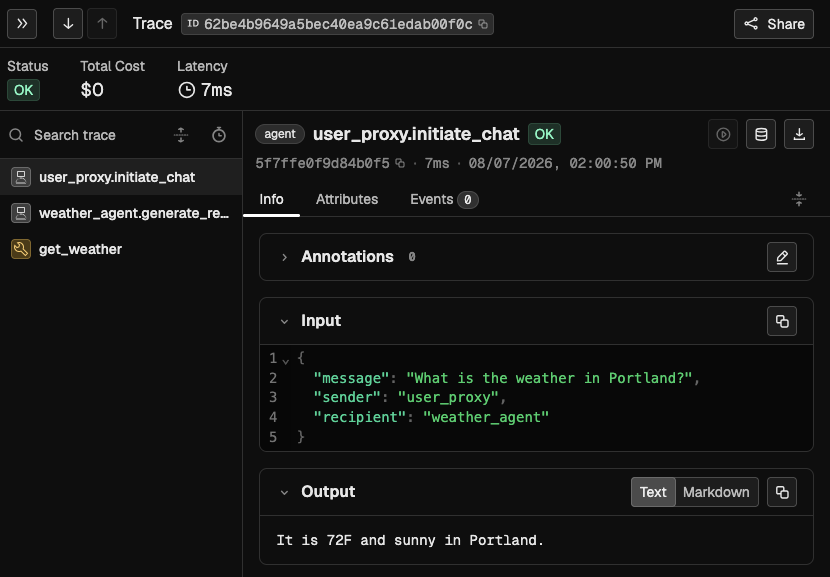
Now that you have tracing set up, all AG2 agent chats, replies, and tool calls are streamed to
Phoenix for observability and evaluation. Each `ConversableAgent` chat and reply appears as an
`AGENT` span, with tool executions nested underneath as `TOOL` spans.
 ## Migrating from `openinference-instrumentation-autogen`
`openinference-instrumentation-ag2` replaces `openinference-instrumentation-autogen`. The
`autogen` package is now a thin, deprecated compatibility facade that delegates to
`AG2Instrumentor`. Move to `openinference-instrumentation-ag2` and use `AG2Instrumentor` directly.
## Resources
* [OpenInference package](https://pypi.org/project/openinference-instrumentation-ag2/)
* [Example scripts](https://github.com/Arize-ai/openinference/tree/main/python/instrumentation/openinference-instrumentation-ag2/examples)
## Migrating from `openinference-instrumentation-autogen`
`openinference-instrumentation-ag2` replaces `openinference-instrumentation-autogen`. The
`autogen` package is now a thin, deprecated compatibility facade that delegates to
`AG2Instrumentor`. Move to `openinference-instrumentation-ag2` and use `AG2Instrumentor` directly.
## Resources
* [OpenInference package](https://pypi.org/project/openinference-instrumentation-ag2/)
* [Example scripts](https://github.com/Arize-ai/openinference/tree/main/python/instrumentation/openinference-instrumentation-ag2/examples)