> ## Documentation Index
> Fetch the complete documentation index at: https://arizeai-433a7140.mintlify.site/llms.txt
> Use this file to discover all available pages before exploring further.
# 10.01.2026: Trace Tree Evals and Decision Spans
> Find failed evals while scanning the trace tree, trace decision-model calls as DECISION spans, and manage project annotation configs from the TypeScript client.
Phoenix now shows eval results where you debug traces: on the span rows themselves. You can scan a
trace for failed or mixed evals before opening a span, and decision-model calls now appear as
`DECISION` spans instead of looking like ordinary LLM calls.
**Breaking change in arize-phoenix 20.17.0: Python 3.11 or newer is now required.** `arize-phoenix`
no longer installs on Python 3.10, so plan the runtime upgrade before installing this release.
SQLAlchemy 2.1.1 or newer is also required. In filters, a JSON number now matches its string
spelling on both SQLite and PostgreSQL, and on SQLite `1` and `1.0` no longer compare equal.
# Eval Results in the Trace Tree
September 30, 2026
**Available in arize-phoenix 20.18.0+**
Large traces are hard to debug when eval results only appear after you open each span. Phoenix now
puts annotation summaries under each span row, so you can start with the bad eval and then open the
span that caused it.
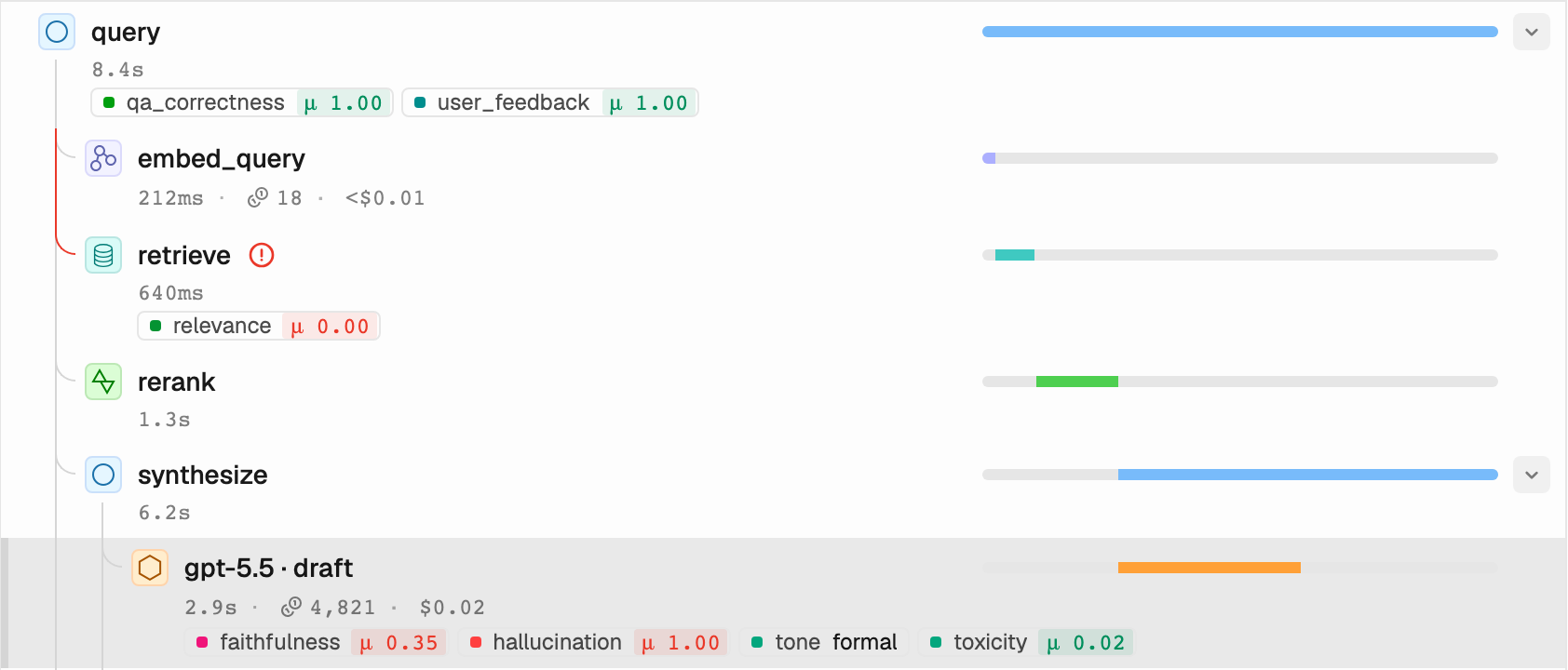 * **Scan before opening a span.** Each row can show compact badges with the mean score and the
most common label for its annotations.
* **Start with the failures.** Unfavorable results appear first, and extra badges collapse behind a
`+N` count when the tree is narrow.
* **Hover a row for detail.** The span preview lists the full annotation set next to the token and
cost breakdown.
* **See new eval configs right away.** When you link an annotation config to a project, its
results show up in the trace tree without a page reload.
Add human and LLM annotations to spans
Run evals over traces and log the results
# Decision Spans
October 1, 2026
**Available in arize-phoenix 20.19.0+**
Routers, classifiers, and rubric scorers do a different job than chat models. Phoenix now recognizes
the OpenInference `DECISION` span kind for calls that score or pick among options, so these calls
are easier to find and no longer look like normal text generation.
* **Scan before opening a span.** Each row can show compact badges with the mean score and the
most common label for its annotations.
* **Start with the failures.** Unfavorable results appear first, and extra badges collapse behind a
`+N` count when the tree is narrow.
* **Hover a row for detail.** The span preview lists the full annotation set next to the token and
cost breakdown.
* **See new eval configs right away.** When you link an annotation config to a project, its
results show up in the trace tree without a page reload.
Add human and LLM annotations to spans
Run evals over traces and log the results
# Decision Spans
October 1, 2026
**Available in arize-phoenix 20.19.0+**
Routers, classifiers, and rubric scorers do a different job than chat models. Phoenix now recognizes
the OpenInference `DECISION` span kind for calls that score or pick among options, so these calls
are easier to find and no longer look like normal text generation.
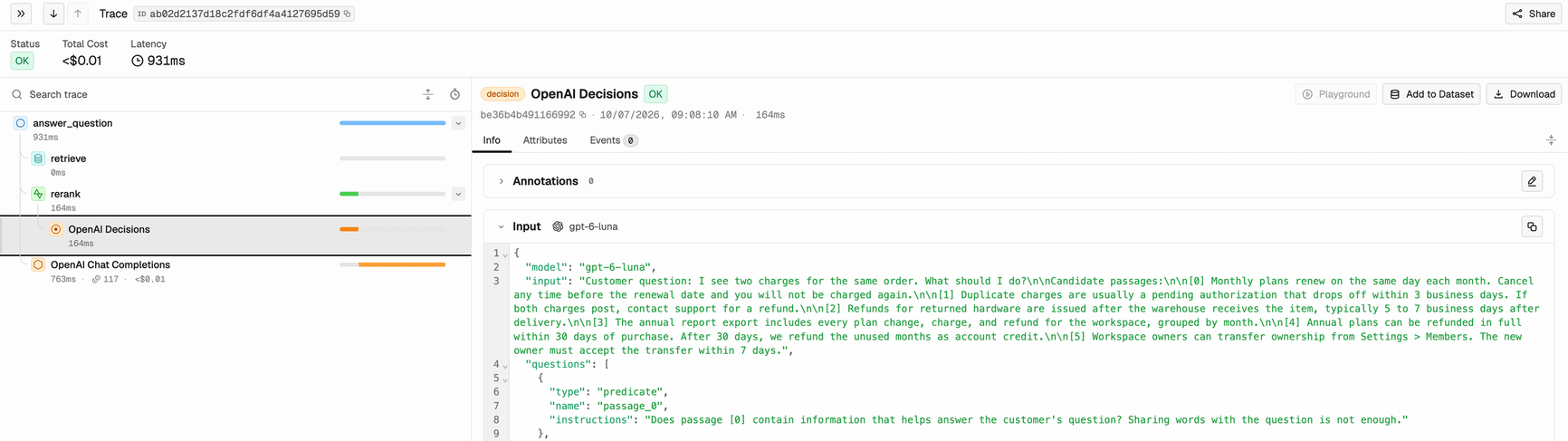 * **Decision spans get their own icon and detail view.** The detail view shows the decision input
and output cards instead of the LLM message layout.
* **The span view names the decision model.** Phoenix uses `decision.model_name` when it is set,
then the provider-reported model, then the requested model.
* **Filter by `DECISION` anywhere you inspect spans.** The span kind works in the UI, the REST API,
and `px span list --span-kind DECISION`.
* **OpenInference instrumentors emit decision spans** for the OpenAI Decisions API and
[TypeSafe AI System One](/docs/phoenix/integrations/llm-providers/typesafe), another decision-model
provider. The `decision.*` attributes may still change as more decision-model providers appear.
DECISION and the other OpenInference span kinds
Trace the OpenAI Decisions API
# TypeScript Client: Project Annotation Configs
September 30, 2026
**Available in @arizeai/phoenix-client 7.16.0+ (requires Phoenix server 17.16.0+)**
Teams often assign different eval configs to different projects. The TypeScript client can now
manage those assignments from setup scripts or CI, so a project shows the evals that matter for
that workflow as soon as traces arrive.
```typescript theme={"theme":{"light":"github-light-default","dark":"github-dark-default"}}
import {
assignProjectAnnotationConfig,
listProjectAnnotationConfigs,
setProjectAnnotationConfigs,
unassignProjectAnnotationConfig,
} from "@arizeai/phoenix-client/projects";
await assignProjectAnnotationConfig({
projectName: "support-bot",
configName: "correctness",
});
const configs = await listProjectAnnotationConfigs({ projectName: "support-bot" });
console.log(configs.map((config) => config.name));
await unassignProjectAnnotationConfig({
projectName: "support-bot",
configName: "correctness",
});
await setProjectAnnotationConfigs({ projectName: "support-bot", configIds: [] });
```
* **`assignProjectAnnotationConfig` is safe to rerun.** Select the config by `configName`,
`configId`, or `config`. Use `configId` when the name contains `/`.
* **`setProjectAnnotationConfigs` replaces the assignment set.** It adds and removes assignments to
match `configIds`, and it never deletes the configs themselves.
* **`listProjectAnnotationConfigs` returns the full set.** The helper pages through every assigned
config for you.
Every helper on the projects subpath
# Additional Improvements
September 30 to October 1, 2026
**Available in arize-phoenix 20.17.0–20.19.0**
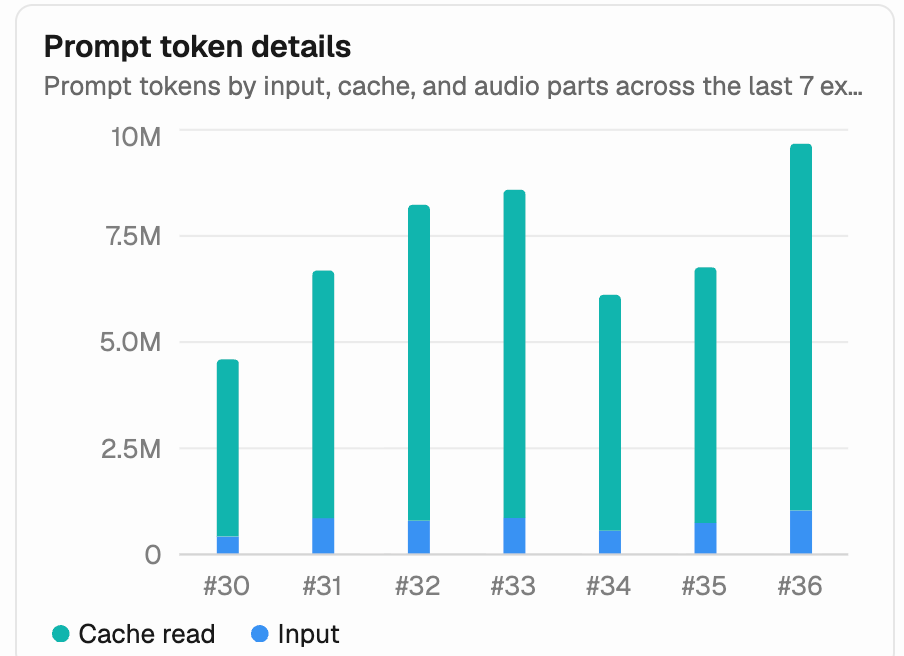
* **Experiment metrics include prompt and completion token detail charts**, which split tokens into
input, cache, output, reasoning, and audio parts across recent experiments.
* **Decision spans get their own icon and detail view.** The detail view shows the decision input
and output cards instead of the LLM message layout.
* **The span view names the decision model.** Phoenix uses `decision.model_name` when it is set,
then the provider-reported model, then the requested model.
* **Filter by `DECISION` anywhere you inspect spans.** The span kind works in the UI, the REST API,
and `px span list --span-kind DECISION`.
* **OpenInference instrumentors emit decision spans** for the OpenAI Decisions API and
[TypeSafe AI System One](/docs/phoenix/integrations/llm-providers/typesafe), another decision-model
provider. The `decision.*` attributes may still change as more decision-model providers appear.
DECISION and the other OpenInference span kinds
Trace the OpenAI Decisions API
# TypeScript Client: Project Annotation Configs
September 30, 2026
**Available in @arizeai/phoenix-client 7.16.0+ (requires Phoenix server 17.16.0+)**
Teams often assign different eval configs to different projects. The TypeScript client can now
manage those assignments from setup scripts or CI, so a project shows the evals that matter for
that workflow as soon as traces arrive.
```typescript theme={"theme":{"light":"github-light-default","dark":"github-dark-default"}}
import {
assignProjectAnnotationConfig,
listProjectAnnotationConfigs,
setProjectAnnotationConfigs,
unassignProjectAnnotationConfig,
} from "@arizeai/phoenix-client/projects";
await assignProjectAnnotationConfig({
projectName: "support-bot",
configName: "correctness",
});
const configs = await listProjectAnnotationConfigs({ projectName: "support-bot" });
console.log(configs.map((config) => config.name));
await unassignProjectAnnotationConfig({
projectName: "support-bot",
configName: "correctness",
});
await setProjectAnnotationConfigs({ projectName: "support-bot", configIds: [] });
```
* **`assignProjectAnnotationConfig` is safe to rerun.** Select the config by `configName`,
`configId`, or `config`. Use `configId` when the name contains `/`.
* **`setProjectAnnotationConfigs` replaces the assignment set.** It adds and removes assignments to
match `configIds`, and it never deletes the configs themselves.
* **`listProjectAnnotationConfigs` returns the full set.** The helper pages through every assigned
config for you.
Every helper on the projects subpath
# Additional Improvements
September 30 to October 1, 2026
**Available in arize-phoenix 20.17.0–20.19.0**
* **Experiment metrics include prompt and completion token detail charts**, which split tokens into
input, cache, output, reasoning, and audio parts across recent experiments.
 * **`PHOENIX_ALLOW_EXTERNAL_RESOURCES=false` now skips the WebAssembly sandbox download** and the
UI's GitHub star count and update check. Set `PHOENIX_WASM_BINARY_PATH` to use the WebAssembly
sandbox offline.
* **`Dataset.experiments` in GraphQL accepts `sort` and `sequenceNumbers`**, so you can fetch
experiments by their dataset sequence number without paging.
* **PXI marks a bash tool span as an error** when its command exits with a non-zero code.
* **Live streaming pauses while a trace or session drawer is open**, so the tables behind it stop
refreshing.
* **Experiment JSON and CSV exports no longer fail** when a run errored. Errored runs export with a
`null` output.
* **Spans that send both OpenInference and `gen_ai.*` messages no longer get garbled messages.**
Phoenix keeps the instrumentation's own message list instead of mixing the two.
* **Evaluator input mappings keep their Path or Text mode** when you erase and retype a template
variable.
* **Categorical annotation configs ignore blank category rows** when you save them, and saving a
playground prompt to an existing prompt prefills metadata from its latest version.
* **`PHOENIX_ALLOW_EXTERNAL_RESOURCES=false` now skips the WebAssembly sandbox download** and the
UI's GitHub star count and update check. Set `PHOENIX_WASM_BINARY_PATH` to use the WebAssembly
sandbox offline.
* **`Dataset.experiments` in GraphQL accepts `sort` and `sequenceNumbers`**, so you can fetch
experiments by their dataset sequence number without paging.
* **PXI marks a bash tool span as an error** when its command exits with a non-zero code.
* **Live streaming pauses while a trace or session drawer is open**, so the tables behind it stop
refreshing.
* **Experiment JSON and CSV exports no longer fail** when a run errored. Errored runs export with a
`null` output.
* **Spans that send both OpenInference and `gen_ai.*` messages no longer get garbled messages.**
Phoenix keeps the instrumentation's own message list instead of mixing the two.
* **Evaluator input mappings keep their Path or Text mode** when you erase and retype a template
variable.
* **Categorical annotation configs ignore blank category rows** when you save them, and saving a
playground prompt to an existing prompt prefills metadata from its latest version.