> ## Documentation Index
> Fetch the complete documentation index at: https://arizeai-433a7140.mintlify.site/llms.txt
> Use this file to discover all available pages before exploring further.
# 10.13.2026: Docker Sandboxes and MCP GraphQL Tools
> Run code evaluators in Docker's hosted sandbox environment, test Claude Haiku 5.5 in the playground, and let MCP clients inspect Phoenix data through GraphQL.
This release has two practical goals: make server-side code evaluators easier to run for teams that
already use Docker, and help MCP-connected agents answer deeper questions about Phoenix data. You can
authenticate once in Phoenix, run Python and TypeScript evaluators in Docker's hosted sandbox
environment, and keep Phoenix controls for cleanup and outbound network access. MCP clients also get
GraphQL schema discovery, read-only queries, and permitted mutations, alongside Claude Haiku 5.5 and
Mistral cost tracking.
# Docker Sandboxes for Code Evaluators
October 8, 2026
**Available in arize-phoenix 20.20.0+**
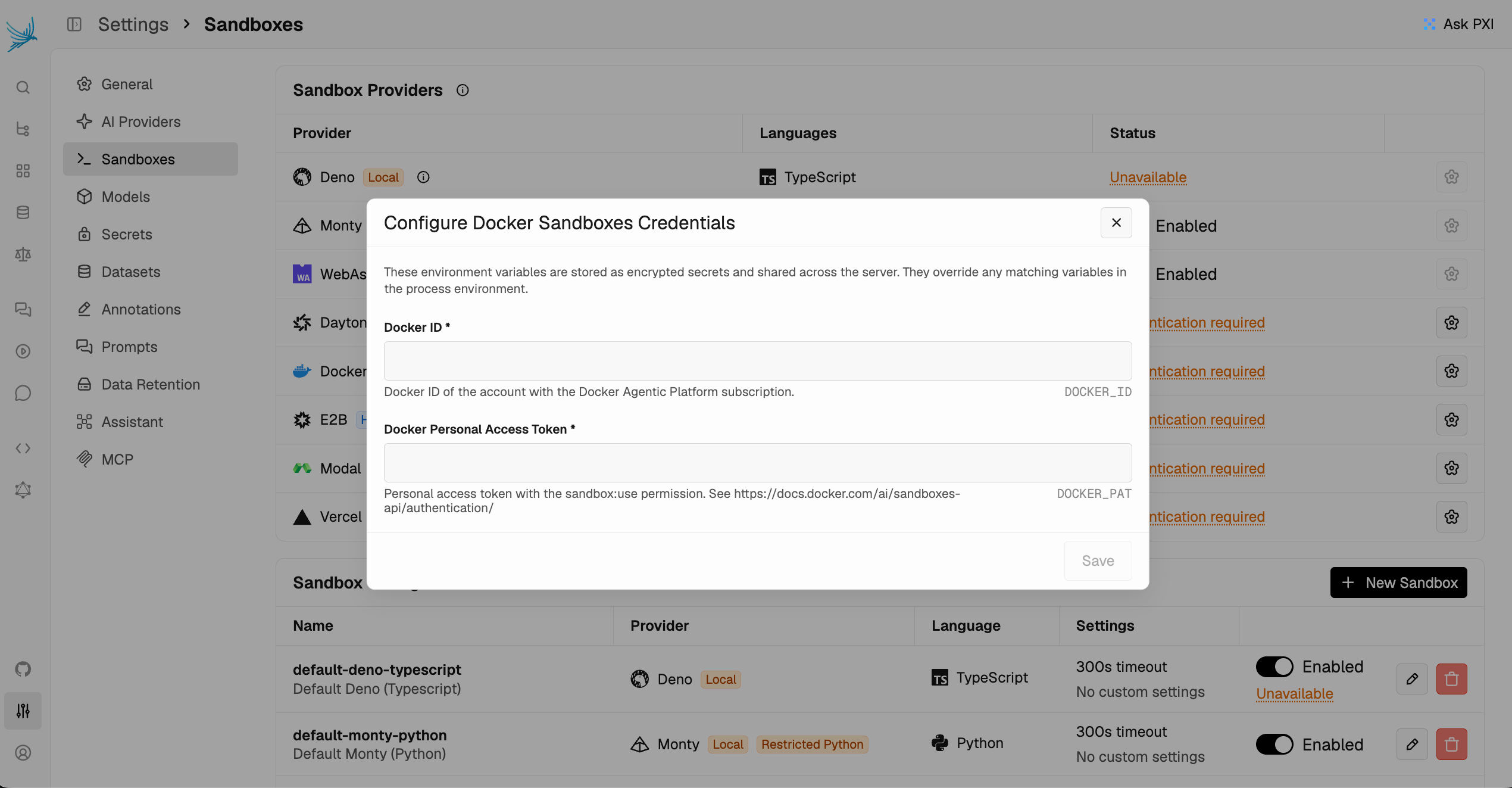
Docker Sandboxes gives code evaluators a hosted runtime when your team already has Docker Agentic
Platform access. Add your Docker credentials in **Settings → Sandboxes**, then choose **Docker
Sandboxes** on the sandbox configuration you use for Python or TypeScript evaluators. Phoenix still
owns the evaluator flow: it sends the run to Docker, applies the network setting, and cleans up when
the run finishes.
 * **Run both evaluator languages.** Python runs on `python:3.13-slim` and TypeScript on
`node:24-slim`.
* **Authenticate once.** Add your Docker ID as `DOCKER_ID` and a personal access token
with the `sandbox:use` permission as `DOCKER_PAT`, either in Settings or as server environment
variables.
* **Control network access.** **Deny** attaches a `phoenix-deny-all-egress` network policy
that stops sandbox traffic from leaving the environment.
* **Clean up automatically.** Phoenix deletes each sandbox when the evaluator finishes. Docker also
expires every sandbox after 10 minutes.
Requirements, setup, and sandbox behavior
Write Python and TypeScript evaluators that run on the server
# Claude Haiku 5.5 and Mistral Cost Tracking
October 8 to 11, 2026
**Available in arize-phoenix 20.20.0+ (Claude Haiku 5.5) and 20.21.0+ (Mistral pricing)**
You can test Claude Haiku 5.5 in the playground and see token cost on Mistral spans without adding
custom pricing.
* **Claude Haiku 5.5 is in the playground** for the Anthropic and Amazon Bedrock providers, with
adaptive thinking support.
* **Retired Anthropic models no longer appear in model lists.** Phoenix removes Claude Opus 4.1,
Sonnet 3.7, Sonnet 3.5, Haiku 3.5, and Haiku 3.
* **Mistral AI calls now show a cost.** Phoenix prices Mistral spans from the built-in model price
list, the same way it handles other providers.
How Phoenix prices tokens on your spans
# MCP Server: GraphQL Tools and More SQL Tables
October 8, 2026
**Available in arize-phoenix 20.20.0+**
Use GraphQL when an MCP client needs structured Phoenix data that REST does not expose. The agent can
inspect the schema and run authorized queries from the MCP server, instead of falling back to shell
access or one-off scripts.
* **Discover and query the schema.** `describeGraphqlSchema` searches by free text or exact type
names, and `executeGraphqlQuery` runs read-only queries with the caller's permissions.
* **Run permitted mutations when writes are enabled.** `executeGraphqlMutation` can run any mutation the
caller's role allows. Phoenix does not expose this tool on read-only deployments.
* **Ask SQL questions over more Phoenix tables.** `executeSql` can query trace annotations, evaluators,
prompts and prompt versions, dataset splits and labels, experiment tags, jobs and logs, sandbox
configs, and trace retention policies.
* **PXI uses analytics SQL for data questions**, so it spends fewer turns answering aggregate
questions about your traces.
Connect an MCP client and see the full tool list
# Additional Improvements
October 8 to 13, 2026
**Available in arize-phoenix 20.20.0–20.21.3, arize-phoenix-evals 3.9.1+, and @arizeai/phoenix-client 7.16.1+**
* **Evaluator metadata stays attached.** The server keeps metadata nested under `result`, and the
TypeScript client sends metadata at the top level.
* **Stale input mappings no longer break evaluator runs** when you remove a variable from the
template or `evaluate()` signature.
* **Experiment resume cleans up replaced runs** by dropping evaluations from an errored run when a
new run takes its place.
* **Experiment metric comparisons are consistent** because Phoenix measures the base experiment and
compare experiment the same way.
* **Span ingestion recovers from database failures more reliably** and reports failed spans and the
last successful insert as Prometheus metrics.
* **Projects from span ingestion are easier to scan** because Phoenix gives each new project a random
gradient.
* **`arize-phoenix` installs fewer heavy dependencies** because SciPy and scikit-learn are no longer
included by default.
* **Synchronous eval runs retry rate-limit errors** instead of failing the whole run on the first 429.
* **Run both evaluator languages.** Python runs on `python:3.13-slim` and TypeScript on
`node:24-slim`.
* **Authenticate once.** Add your Docker ID as `DOCKER_ID` and a personal access token
with the `sandbox:use` permission as `DOCKER_PAT`, either in Settings or as server environment
variables.
* **Control network access.** **Deny** attaches a `phoenix-deny-all-egress` network policy
that stops sandbox traffic from leaving the environment.
* **Clean up automatically.** Phoenix deletes each sandbox when the evaluator finishes. Docker also
expires every sandbox after 10 minutes.
Requirements, setup, and sandbox behavior
Write Python and TypeScript evaluators that run on the server
# Claude Haiku 5.5 and Mistral Cost Tracking
October 8 to 11, 2026
**Available in arize-phoenix 20.20.0+ (Claude Haiku 5.5) and 20.21.0+ (Mistral pricing)**
You can test Claude Haiku 5.5 in the playground and see token cost on Mistral spans without adding
custom pricing.
* **Claude Haiku 5.5 is in the playground** for the Anthropic and Amazon Bedrock providers, with
adaptive thinking support.
* **Retired Anthropic models no longer appear in model lists.** Phoenix removes Claude Opus 4.1,
Sonnet 3.7, Sonnet 3.5, Haiku 3.5, and Haiku 3.
* **Mistral AI calls now show a cost.** Phoenix prices Mistral spans from the built-in model price
list, the same way it handles other providers.
How Phoenix prices tokens on your spans
# MCP Server: GraphQL Tools and More SQL Tables
October 8, 2026
**Available in arize-phoenix 20.20.0+**
Use GraphQL when an MCP client needs structured Phoenix data that REST does not expose. The agent can
inspect the schema and run authorized queries from the MCP server, instead of falling back to shell
access or one-off scripts.
* **Discover and query the schema.** `describeGraphqlSchema` searches by free text or exact type
names, and `executeGraphqlQuery` runs read-only queries with the caller's permissions.
* **Run permitted mutations when writes are enabled.** `executeGraphqlMutation` can run any mutation the
caller's role allows. Phoenix does not expose this tool on read-only deployments.
* **Ask SQL questions over more Phoenix tables.** `executeSql` can query trace annotations, evaluators,
prompts and prompt versions, dataset splits and labels, experiment tags, jobs and logs, sandbox
configs, and trace retention policies.
* **PXI uses analytics SQL for data questions**, so it spends fewer turns answering aggregate
questions about your traces.
Connect an MCP client and see the full tool list
# Additional Improvements
October 8 to 13, 2026
**Available in arize-phoenix 20.20.0–20.21.3, arize-phoenix-evals 3.9.1+, and @arizeai/phoenix-client 7.16.1+**
* **Evaluator metadata stays attached.** The server keeps metadata nested under `result`, and the
TypeScript client sends metadata at the top level.
* **Stale input mappings no longer break evaluator runs** when you remove a variable from the
template or `evaluate()` signature.
* **Experiment resume cleans up replaced runs** by dropping evaluations from an errored run when a
new run takes its place.
* **Experiment metric comparisons are consistent** because Phoenix measures the base experiment and
compare experiment the same way.
* **Span ingestion recovers from database failures more reliably** and reports failed spans and the
last successful insert as Prometheus metrics.
* **Projects from span ingestion are easier to scan** because Phoenix gives each new project a random
gradient.
* **`arize-phoenix` installs fewer heavy dependencies** because SciPy and scikit-learn are no longer
included by default.
* **Synchronous eval runs retry rate-limit errors** instead of failing the whole run on the first 429.