
SHAP stands for Shapley Additive Explanations, a framework derived from cooperative game theory for explaining machine learning predictions. SHAP assigns each input feature a contribution value such that the contributions sum to the difference between the model’s output on that instance and a chosen baseline. Positive contributions push the prediction above the baseline; negative contributions pull it below.
Engineers reach for SHAP when they need a consistent story for “why this score” that works across model types, with implementations tuned for trees, neural nets, and model-agnostic perturbation. SHAP names the method; SHAP values are the numbers it produces on each feature for each row.
Build better agents with Arize
Trace, evaluate, and learn. Build agents that work with Arize AX and start tracing your runs today.
Prefer open source? Try Arize Phoenix for self-hosted, open source agent observability.
Key takeaways
- SHAP connects Shapley values from game theory to ML feature attributions with explicit additivity.
- The sum of feature attributions equals prediction minus baseline under the SHAP framework.
- Multiple explainers implement SHAP for different model classes (TreeSHAP, Kernel SHAP, etc.).
- SHAP explains model behavior, not causal mechanisms in the real world.
- Use SHAP for local debugging, audits, and cohort analysis; pair with drift and performance monitoring.
Game theory intuition
Imagine each feature is a player joining a coalition to produce a payout equal to the model prediction. Shapley values fairly divide the payout across players by averaging marginal contributions across all orderings in which players can arrive.
SHAP adapts that idea to ML: coalitions correspond to subsets of features present vs replaced with background values. The Shapley value for a feature is its average marginal effect on the prediction as features are added in different orders.
The additive property means you can present explanations as a ledger: baseline prediction plus each feature’s SHAP term equals the instance prediction (within the explainer’s output parameterization).
SHAP values vs the SHAP framework
Language slips easily here:
- SHAP (Shapley Additive Explanations) is the overall method and software ecosystem.
- SHAP values are the per-feature numbers for a specific prediction.
- Explainers are algorithms that compute those numbers for a model class.
Kernel SHAP is one explainer: flexible, slow, model-agnostic. TreeSHAP is another: fast and exact for tree ensembles. Pick the explainer that matches your model and latency budget; the SHAP branding applies to the shared Shapley objective, not one algorithm.
Core properties practitioners rely on
SHAP implementations emphasize axioms that distinguish Shapley-based attributions from ad hoc importance scores:
- Local accuracy (additivity): contributions sum to the deviation from baseline for the explained instance.
- Missingness: features absent from a coalition do not receive credit for predictions made without them.
- Consistency: if a feature’s marginal contribution never decreases when the model changes, its attribution should not decrease.
These properties help when regulators or customers expect explanations where pieces reconcile to the final score. They do not prove the model is fair or causal.
Local, global, and cohort explanations
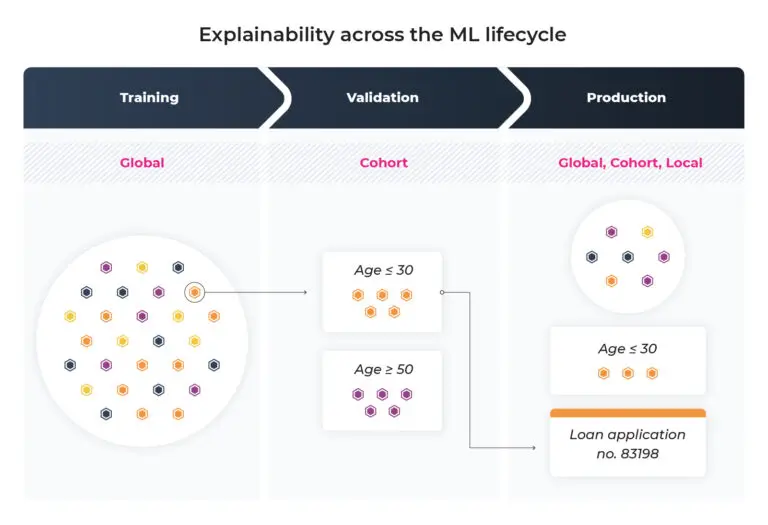
Local SHAP explains one row: which features drove this denial, this ranking, this anomaly score?
Global views aggregate SHAP magnitudes across many rows (mean absolute SHAP, beeswarm plots). Global plots guide feature pruning but can obscure interactions.
Cohort SHAP conditions on slices: errors only, high-value customers, recent production week. Slice attribution catches issues global plots average away.
Always state the baseline dataset used to define “missing” features. SHAP values are not portable across baselines without recomputation.
Choosing an explainer
| Need | Typical choice |
|---|---|
| XGBoost / LightGBM / Random Forest | TreeSHAP |
| Any model, small width, offline audit | Kernel SHAP |
| Deep neural network | DeepSHAP, gradient SHAP variants |
| Linear model | Exact linear SHAP |
When SHAP feels too slow, verify you are not running Kernel SHAP on tree models or on thousands of rows with default sample counts. The framework is broad; the explainer choice dominates runtime.
SHAP in ML ops and debugging
SHAP supports development workflows more often than per-request APIs:
- Validate that models use intended signals, not proxy leaks.
- Explain false positives to investigators with feature-level narratives.
- Compare attributions before and after retraining on the same eval rows.
Combine SHAP review with model, concept, and data drift monitoring. Drift shows that inputs changed; SHAP shows whether the model’s reliance on features changed on examples you inspect. Neither replaces labeled metrics.
Fold explanation checks into AI model lifecycle management: run SHAP on a standard audit notebook before promotion and after major drift alerts.
For classification near decision boundaries, SHAP clarifies which features pushed scores across the cutoff. That pairs with practices for shipping classification models with confidence where threshold policy and explanation samples should align.
Limits and honest caveats
SHAP describes the model function, which may encode bias or spurious correlations. High SHAP on a protected proxy does not justify using that proxy in policy.
Correlated features receive split credit that humans may find arbitrary. Group related columns or run ablations when redundancy is high.
High-dimensional inputs (text, wide embeddings) yield many small attributions. Summarize by human-meaningful groups when presenting.
SHAP does not replace LIME, integrated gradients, or domain-specific saliency; it offers a Shapley-grounded additive story. Choose the tool that matches model type, audience, and compute budget.
FAQ
What does SHAP stand for?
SHAP stands for SHapley Additive exPlanations, linking Shapley values from game theory to additive feature attributions for model predictions.
Are SHAP values the same as feature importance?
Tree gain importance is a global structural statistic. SHAP values are per-instance attributions with a defined additive relationship to predictions. Global SHAP summaries can resemble importance ranks but answer a different question.
Do I need game theory background to use SHAP?
No. The libraries expose explainers with sensible defaults. Understanding that values sum to prediction minus baseline helps you interpret plots and catch configuration errors.
Can SHAP explain LLM outputs?
Standard tabular SHAP applies to structured features fed to models. Explaining token-level LLM behavior uses different attribution tools. You can SHAP engineered features (length, toxicity score, retrieval count) on LLM-assisted classifiers.
Is SHAP deterministic?
TreeSHAP on fixed trees is deterministic. Kernel SHAP and sampling-based explainers depend on random seeds and sample counts; fix seeds and document settings for reproducibility.