

Chapter summary
Last updated on September 5, 2026.
Traditionally, evaluating LLM and generative AI systems has been slow, expensive, and subjective. Human annotators are expensive. LLM-as-a-Judge uses large language models themselves to evaluate outputs from other models.
Whether you’re prototyping your first prompt chain or running agents in production, one question never goes away: is this actually working?
The evaluation problem doesn’t start at production. It starts the moment you begin building. Teams that treat evals like tests that they write early and run continuously iterate faster and catch regressions before they compound.
This matters more as AI systems grow more autonomous.
Anthropic analyzed millions of agent interactions and found that the longest-running sessions nearly doubled in length from under 25 minutes to over 45 minutes at the 99.9th percentile. Agents are doing more, running longer, and making more decisions on their own.
That means more surface area for things to go wrong–from the first dev build to the thousandth production session.
LLM-as-a-Judge fits naturally here. It lets you run semantic evaluations at scale, whether you’re testing a prompt locally or monitoring live traffic. Build the eval framework once, then carry it through the rest of the lifecycle.
TL;DR
LLM-as-a-Judge is an evaluation technique that uses a language model to score another model’s outputs against criteria you define in plain language — making it possible to evaluate gen-AI systems at production scale without the human review bottleneck.
- What it is: A judge model applies a written rubric to outputs and returns structured scores. You define what “good” looks like once; the judge applies it consistently across thousands of traces.
- Why it matters: Human reviewers max out at a few hundred responses per day. Code-based evals handle structured checks but miss the semantic nuance — helpfulness, tone, groundedness, reasoning quality — that decides whether an LLM response is actually good.
- Where it fits: Semantic evaluations like hallucination detection, RAG relevance, tool-call correctness, agent planning, and user frustration. Use code evals for deterministic checks (latency, schema, tokens) and LLM judges for everything else.
How to build one that works: Start from real failure modes in your traces, pick the right metric, write a clear rubric, and validate the judge against a golden dataset (aim for 75–90% agreement with human labels) before you scale it. The worked version of that loop, including open coding, a faithfulness judge, and when Agent-as-a-Judge is warranted, is How to build agent evals from traces. - Where to deploy it: The same evaluator should run during development, in pre-release gates, and on live production traffic — so pre-launch and post-launch scores are directly comparable.
- Biggest pitfalls: Skipping validation, feeding the judge the wrong inputs (e.g., a hallucination eval without retrieved context), and treating a 100% pass rate as success instead of a sign the eval isn’t hard enough.
Bottom line: Build the LLM-as-a-Judge evaluator once, early, around your real failure modes — then carry it through every stage of the AI development lifecycle.
What is LLM-as-a-Judge?
LLM-as-a-Judge is an evaluation approach where you use a language model to assess the quality of another model’s outputs.
Instead of writing rule-based checks or relying on human reviewers, you define your criteria in plain language and let the judge score outputs at scale.
For example, you might use a judge to check whether a customer support response actually resolved the user’s issue, or whether a RAG system’s answer is grounded in the retrieved documents. You get structured output you can act on across thousands of responses.
Here’s an example centered around evaluating a RAG response
| User query: “What is our refund policy?”
Retrieved context: “Customers can request a refund within 30 days of purchase.” Model response: “You can request a refund within 60 days.” |
In this case, we’ll use the following judge prompt: “Does the response accurately reflect the retrieved context? Answer YES or NO and explain.”
And when we run it, the judge’s output says: “NO — the response contradicts the context. The policy states 30 days, not 60.”
This is the core idea: you define what “good” looks like in plain language, and the judge applies it consistently at scale.

Why trust an AI to judge an AI?
It’s a fair question. But consider the alternative: human annotators are the gold standard, and they’re also the bottleneck. A human reviewer might evaluate a few hundred responses per day. Your application can generate that volume in minutes. At production scale, human review alone cannot keep up.
Code evals fill some of the gap. They’re fast, deterministic, and great for structured outputs where success is unambiguous and more so about the running parameters of it such as latency and tokens-per-second.
But most of what makes an LLM response good or bad lives in the nuance, whether the answer was actually helpful, whether the tone was appropriate, whether the reasoning was sound. And code can’t measure that.
But LLM judges can. They bring human-level semantic understanding to evaluation without the human bottleneck. That’s why they’ve become the backbone of evaluation infrastructure for AI systems at every stage of development.
Online vs. offline evaluation
LLM-as-a-Judge can be used in two distinct evaluation settings:
- Offline Evaluation is ideal for experimentation, benchmarking, and model comparisons. It happens after inference and supports complex, detailed analyses with minimal latency constraints.
- Online Evaluation is used in real-time or production environments, like dashboards or live customer interactions. Such contexts require LLMs to make quick, consistent judgments, often with stricter constraints on latency, compute, and reliability. Understanding this distinction helps teams choose the right prompting strategy, model, and evaluation architecture for their use case.
Understanding this distinction helps teams choose the right prompting strategy, model, and evaluation architecture for their use case.
Trace vs. span level evaluation
LLM-as-a-judge can be used for span-level scoring of individual steps in a workflow and trace-level LLM evaluations of an entire workflow end-to-end:
- Span-level evaluation focuses on individual steps within an LLM application (like a single model call, retrieval, or use of a tool), letting teams pinpoint where errors or hallucinations occur in a multi-step workflow.
- Trace-level evaluations examine the entire chain of operations triggered by a user request to judge whether the overall workflow achieved a correct and coherent end result.
Including explanations in evaluations
Rather than simply asking an LLM-as-a-judge to output a score or label, it can be valuable instead to require an explicit explanation or reasoning trace in addition. These chain-of-thought (COT) explanations tend to improve alignment with human judgements while increasing transparency because you can see the why behind a particular model decision.
Importantly, you should have the explanation produced before the final label or score, as this makes it easier to review the reasoning independently, thereby aiding in debugging, auditing, and so forth.
It’s also worth pointing out that explanations don’t always yield improvements, as there are many tasks for which a well-structured prompt already provides enough context for the judge, especially when the model has been optimized for reasoning. In such cases, explanations add costs associated with longer prompts and slower inference, so use discretion when deciding whether a model-generated explanation will actually help in a particular case.
Binary vs. multi-categorical scoring
When you use LLM-as-a-judge, you must decide on the format of the output, which often involves selecting between a simple binary verdict (e.g., pass/fail, yes/no) or a richer multi-categorical/numeric scoring scale (e.g., 1-5, letter grades). In our experience, binary outputs tend to produce more stable and reliable evaluations than more subtle numeric scoring. For this reason, many practitioners have gravitated towards binary or discrete categorical judgements, which force clearer, more reproducible decisions that make it easier to perform robust comparisons.
LLM-as-a-Judge vs. code-based evaluation
There’s a distinction between using LLM-as-a-judge and crafting code-based evaluations that is worth drawing out.
When evaluating model outputs, code-based evaluation involves writing deterministic scripts or tests (in Python or JavaScript, for example) that check whether the output meets specific, well-defined conditions (correct structure, including required fields, and so on). This approach is great when you have a clear “ground truth” determining whether an output is valid, and it incurs no additional token costs or latency, meaning you can run it cheaply and frequently, as needed.
That said, code-based evaluation usually falls short when the aspects you care about are more subjective, nuanced, or open-ended, such as the factual accuracy of a free-form text, the quality of its style, how safe or toxic it is, etc. For such evaluations, LLM-as-a-judge is likely the way to go.
Real-world applications
Today, teams use LLM-as-a-Judge techniques to evaluate everything from LLM summarization to chatbots, retrieval to RAG pipelines, and even agentic systems. These evaluations are powering dashboards, tracking performance regressions, guiding fine-tuning, and informing go-to-market.
Some examples of what this looks like in practice:
- Evaluate chatbot answers vs. ground-truth
- Track hallucination rates across model versions
- Score retrieved document relevance in RAG pipelines
- Assess output toxicity or bias
- Diagnose failures of agentic tool-use behavior and planning
Build better agents with Arize
Trace, evaluate, and learn. Build agents that work with Arize AX and start tracing your runs today.
Prefer open source? Try Arize Phoenix for self-hosted, open source agent observability.

LLM-as-a-Judge evaluators
LLM as a judge is useful across a raft of use cases, including detecting hallucination, accuracy, relevancy, toxicity, and more. The Arize AI team has tested and assembled a list of simple evaluation templates that use an LLM-as-a-judge and achieve target precision and F-scores above 70%:
| Eval & Link to Docs (Prompt + Code) | Description |
| Hallucinations | Checks if outputs contain unsupported or incorrect information. |
| Question Answering | Assesses if responses fully and accurately answer user queries given reference data. |
| Retrieved Document Relevancy | Determines if provided documents are relevant to a given query or task. |
| Toxicity | Identifies racist, sexist, biased, or otherwise inappropriate content. |
| Summarization | Judges the accuracy and clarity of summaries relative to original texts. |
| Code Generation | Evaluates correctness of generated code relative to task instructions. |
| Human vs AI | Compares AI-generated text directly against human-written benchmarks. |
| Citation | Checks correctness and relevance of citations to original sources. |
| User Frustration | Detects user frustration signals within conversational AI contexts. |
Evaluation metrics for LLM-as-a-Judge
The right metrics depend entirely on your application, but certain failure patterns show up consistently across AI systems at any stage of development.
AI agents break in predictable ways: they hallucinate tool parameters, drift from instructions in long sessions, and mask backend failures with polite success messages. Good eval metrics are designed around exactly these failure modes.
It helps to distinguish between two types of metrics: semantic and operational.
- Semantic metrics measure whether the content of a response is correct, grounded, and appropriate.
- Operational metrics measure whether the system is behaving efficiently and safely at the execution level.
Both matter, and the definitive guide to LLM evaluation from Arize covers how they interact across the full development lifecycle. But LLM judges specifically excel at semantic evaluations.
The table below maps common failure patterns to the metrics that catch them:
| Template | What It measures |
| Hallucination Eval | Checks whether the model’s response is grounded in the retrieved context or whether it invented facts that weren’t there. |
| Agent Function Calling Eval | Evaluates whether the agent called the right tool with the right parameters. Silent hallucinations in tool arguments are one of the most common production failures. |
| Agent Path Convergence | Measures whether the agent reached its goal efficiently. Agents that loop or take redundant steps look fine in logs but burn tokens and time. |
| Agent Planning | Scores the quality of the agent’s reasoning before it acts. Poor planning upstream causes cascading failures across the entire task. |
| RAG Relevance Eval | Assesses whether the retrieved chunks were actually relevant to the query. Noisy retrieval is a leading cause of hallucination and context overload. |
| Q&A Eval | Verifies that the final answer is correct relative to the retrieved source material, not just fluent or confident-sounding. |
| Toxicity Eval | Detects harmful, biased, or inappropriate outputs that code checks would never catch. |
| User Frustration Eval | Identifies signals of user dissatisfaction in the conversation, giving you a leading indicator of quality degradation before it shows up in churn. |
💡 Pro tip: Arize’s Phoenix Evals library is a practical starting point before you build anything custom. It has pre-built, benchmarked templates for everything listed above, tested against golden datasets targeting 70-90% precision.
Accelerating evals with agents
By the time you’ve mapped your failure modes to metrics, the next challenge is implementation. Writing eval prompts from scratch is genuinely difficult: you need to specify the failure mode precisely, define what inputs the judge receives, design a rubric that’s unambiguous, and structure output that’s actually useful downstream.
Alyx is Arize’s AI engineering agent, available throughout the platform and adapting to whichever surface you’re on. The fastest way to see what it can do is to watch it work end to end.
Starting from a blank Prompt Playground, Alyx can:
- generate a synthetic dataset for your use case
- write and AB test multiple prompt variants
- build a correctness eval
- and run the full experiment without you having to coordinate each step manually.
When it creates a dataset or attaches an eval they’re immediately available in the interface. You don’t need to wire them up manually.
It’s particularly powerful at error analysis. If you have free-text annotations describing what’s going wrong in your traces, Alyx can read them, extract categories, identify your most critical failure modes, and map those labels back to your spans. From there it can create an eval template built around those exact categories and set up a continuous online task so evaluation keeps running on new data automatically.
The output isn’t a generic template you then have to customize; it reflects the actual failure patterns in your data.
Evaluating multi-step agent behavior with LLM-as-a-Judge
LLM judges aren’t just for evaluating static generations. They’re also being used to evaluate multi-step agent behavior — including planning, tool use, and reflection. In addition to offering custom evals, Arize supports templates for structured agent evaluation across dimensions like:
| Evaluation Type | Description | Evaluation Criteria |
| Agent Planning | Assesses the quality of an agent’s plan to accomplish a given task using available tools. | Does the plan include only valid and applicable tools for the task? Are the tools used sufficient to accomplish the task? Will the plan, as outlined, successfully achieve the desired outcome? Is this the shortest and most efficient plan to accomplish the task? |
| Agent Tool Selection | Evaluates whether the agent selects the appropriate tool(s) for a given input or question. | Does the selected tool align with the user’s intent? Is the tool capable of addressing the specific requirements of the task? Are there more suitable tools available that the agent overlooked? |
| Agent Parameter Extraction | Checks if the agent correctly extracts and utilizes parameters required for tool execution. | Are all necessary parameters accurately extracted from the input? Are the parameters formatted correctly for the tool’s requirements? Is there any missing or extraneous information in the parameters? |
| Agent Tool Calling | Determines if the agent’s tool invocation is appropriate and correctly structured. | Is the correct tool called for the task? Are the parameters passed to the tool accurate and complete? Does the tool call adhere to the expected syntax and structure? |
| Agent Path Evaluation | Analyzes the sequence of steps the agent takes to complete a task, focusing on efficiency and correctness. | Does the agent follow a logical and efficient sequence of actions? Are there unnecessary or redundant steps? Does the agent avoid loops or dead-ends in its reasoning? |
| Agent Reflection | Encourages the agent to self-assess its performance and make improvements. | Can the agent identify errors or suboptimal decisions in its process? Does the agent propose viable alternatives or corrections? Is the reflection process constructive and leads to better outcomes? |
The role of an LLM-as-a-Judge in pipelines
Picture a team that ships a customer support agent after weeks of prompt tuning. It works great in demos. But two weeks into production, ticket escalations spike. The agent is confidently routing billing complaints to the wrong department, and nobody catches it until a VP asks why resolution times doubled.
The eval they scramble to build afterward would have caught this on day one if it existed during development. That’s the core argument for treating your evaluator as something you build early and use constantly instead of something you bolt on after the first fire.
This applies well beyond chatbots and RAG pipelines. Any organization trying to measure how effectively its people or systems use AI runs into the same problem. Whether you’re evaluating how a sales team leverages AI-drafted outreach or whether an internal copilot is actually reducing engineering toil, the question is identical: is the AI output meeting the bar, and how do you know?
The evaluator you build answers that question at every stage.
- During development: it tells you whether your last prompt change made things better or worse before you carry that change forward.
- Before release: it gives stakeholders a concrete quality score to weigh against their risk tolerance instead of a demo and a handwave.
- In production: it runs the same rubric against live traffic so that any degradation is obvious against the baseline you already established.
The alternative (and what most teams still do) is implementing different quality checks at every stage and not necessarily comparable to one another. That’s a recipe for scrambled and potentially unusable data.
Building the evaluator early and pulling it through the full cycle closes that gap. The signal stays consistent from the first prototype to the thousandth production session.
Custom LLM-as-a-Judge evaluators: why & how to build your own
In specialized domains such as medical research, finance, or agriculture, off-the-shelf evaluators often miss domain-specific criteria, so teams build custom LLM-as-a-Judge evaluators with datasets tailored to their tasks.
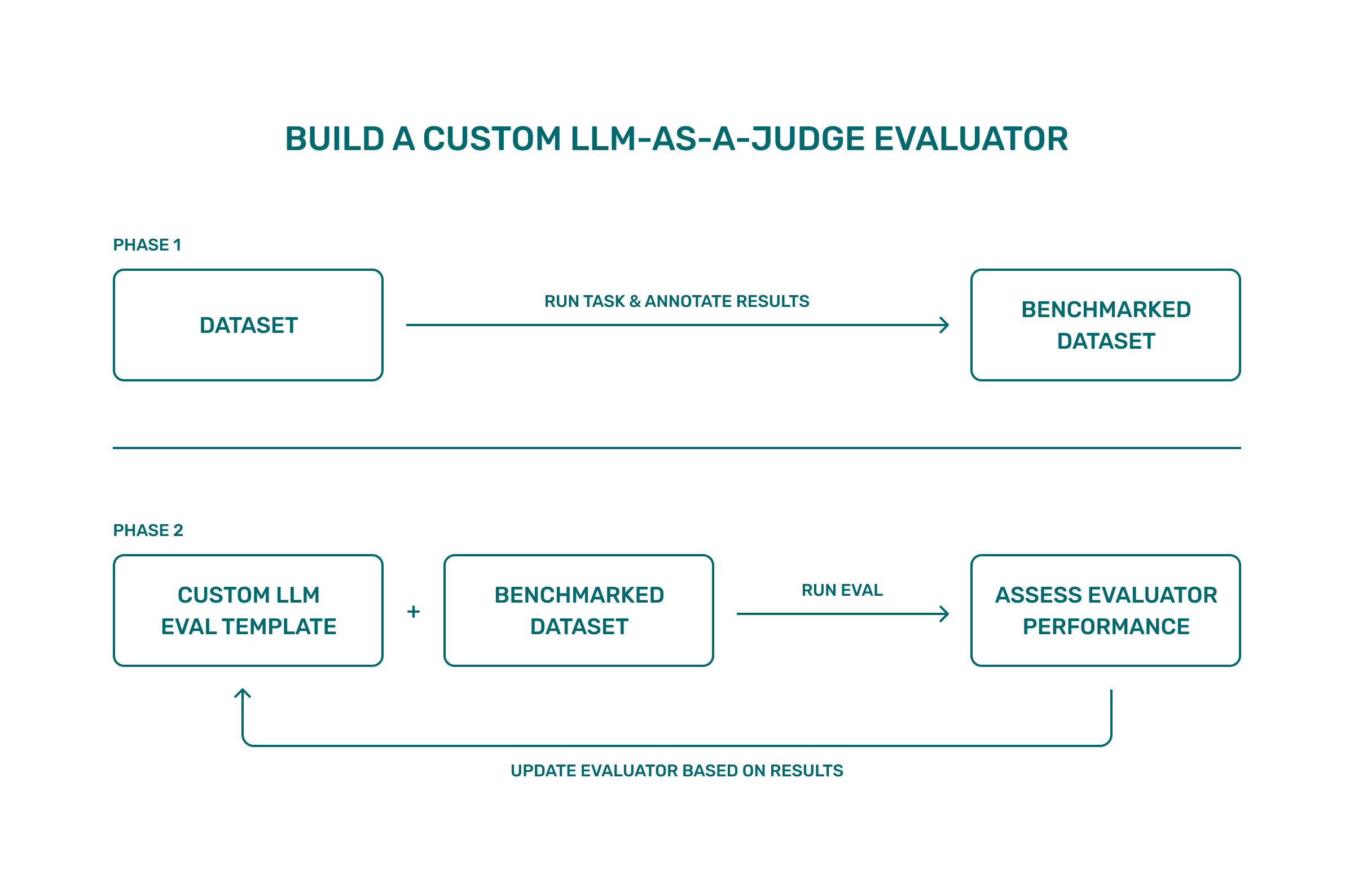
The approach is straightforward:
- Start with a small benchmark dataset built from realistic examples
- Add annotations with clear label definitions (for example: “accurate,” “almost accurate,” “inaccurate,” with a brief explanation of each)
- Use that as ground truth (more information on using human-annotated data can be found in the next section)
- Write an evaluation template that states the judging criteria plainly and constrains the judge to your label definitions. If the task mixes modalities, structure the prompt accordingly (e.g., text followed by an image)
- Run the judge on your dataset and compare its labels to your annotations to measure evaluator performance
- Then iterate:
- Examine cases where the judge disagrees
- Clarify the instructions or add a short, concrete example
- Re-run.
Many improvements come from making the label definitions explicit; the video below, for instance, walks you through the process of creating an image classification model that works on receipts. One way it could be improved would be to require that “total,” “itemized list,” and “category” all be correct to assign an ‘accurate’ label, which has the added benefit of keeping the task model and judge model separate.
| Phase | Inputs | What you do | Result |
|---|---|---|---|
| Build benchmark dataset | A small set of realistic outputs and references (e.g., receipt images with generated expense summaries) | Produce traces and annotate them using a categorical accuracy configuration with short explanations | A labeled benchmark dataset (inputs, outputs, labels, notes) |
| Create evaluation template | Fixed label definitions and the inputs the judge should see (e.g., text + image URL) | Write a structured evaluation template (prompt parts such as text → image → instructions) with unambiguous label definitions | A reusable template that restricts outputs to your labels |
| Run experiment | Benchmark dataset + template; a separate judge model | Apply the template to each example, then compare the judge’s label to the annotated label to compute evaluator performance | Baseline results with per-case outputs and rationales |
| Iterate on template | Disagreements between judge and annotations | Tighten instructions (e.g., require correct total, itemized list, and category for accurate), optionally add a brief example, then re-run | Better alignment between judge labels and annotations, reflected in updated scores |
For a deeper code walkthrough, see this Arize-Phoenix custom evals tutorial and companion Colab notebook.
LLM-as-a-Judge: Basis In Research
Several academic papers establish the legitimacy, efficacy and limitations of LLM as a judge.
| Paper | Authors & Affiliations | Year | Why It Matters |
| Judging LLM-as-a-Judge with MT-Bench | Lianmin Zheng et al. (UC Berkeley) | 2023 | Demonstrated GPT-4’s evaluations closely align with humans. |
| From Generation to Judgment: Survey | Dawei Li et al. (Arizona State University) | 2024 | Comprehensive overview identifying best practices and pitfalls. |
| G-Eval: GPT-4 for Better Human Alignment | Yang Liu et al. (Microsoft Research) | 2023 | Provided methods for structured evaluations that outperform traditional metrics. |
| GPTScore: Evaluate as You Desire | Jinlan Fu et al. (NUS & CMU) | 2024 | Allowed flexible, tailored evaluations through natural language prompts. |
| Training an LLM-as-a-Judge Model: Pipeline & Lessons | Renjun Hu et al. (Alibaba Cloud) | 2025 | Offered practical insights into effectively training custom LLM judges. |
| Critical Evaluation of AI Feedback | Archit Sharma et al. (Stanford & Toyota Research Institute) | 2024 | Explored replacing humans with LLMs in RLHF pipelines. |
| LLM-as-a-Judge in Extractive QA | Xanh Ho et al. (University of Nantes & NII Japan) | 2025 | Showed LLM judgments align better than EM/F1 with human evaluation. |
| A Survey on LLM-as-a-Judge | Jiawei Zhang et al. (University of Illinois Urbana-Champaign) | 2025 | Offers a comprehensive taxonomy of LLM-as-a-Judge frameworks, benchmarks, and use cases across NLP and multi-modal domains. Emphasizes challenges like bias, calibration, and evaluation reproducibility. |
Techniques for Structuring LLM-as-a-Judge Prompts
The quality of a prompt plays a large part in the quality of a language model’s eventual output, and the same is true for using LLM-as-a-Judge. The way you pose the evaluation task matters, and your best shot at success is to start with clear and well-structured prompts. Here are a few commonly used formats.
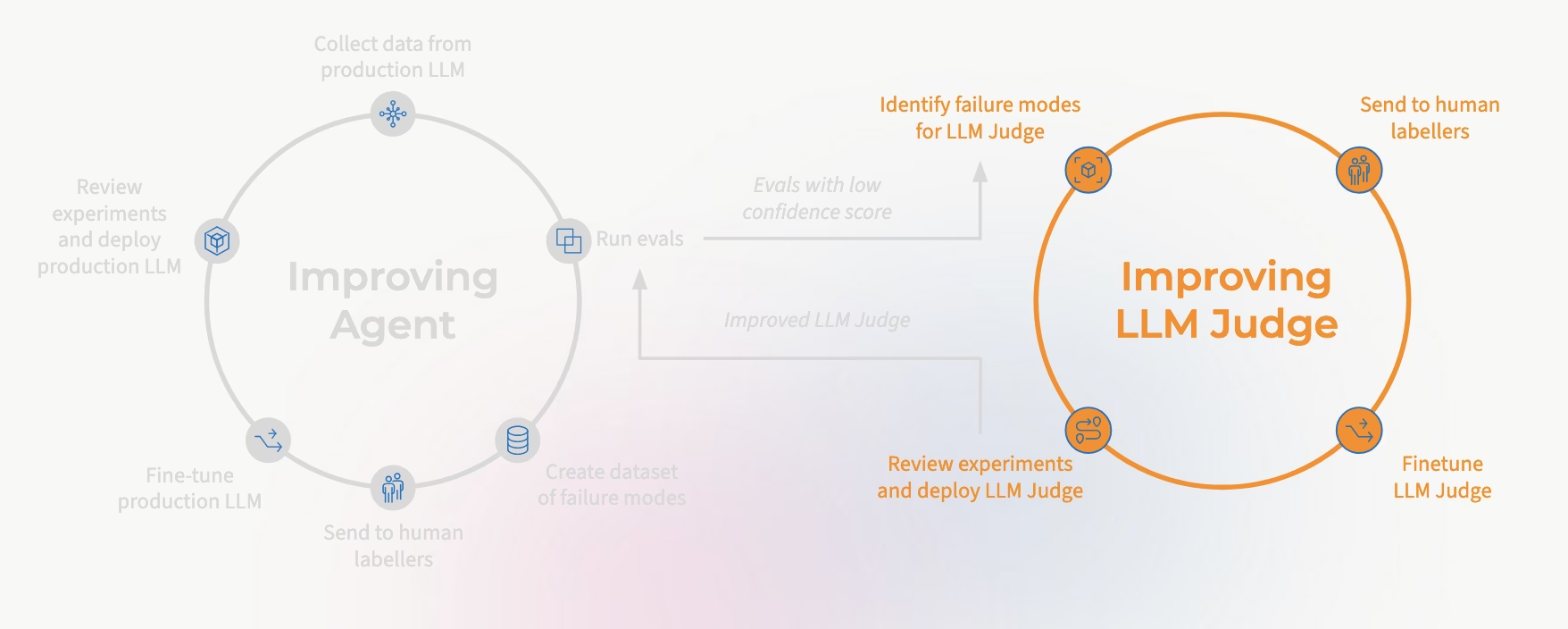
Common LLM-as-a-Judge Prompt Formats
- Single-answer evaluation: Present a user input and a single model response. Ask the LLM to rate it on specific criteria like correctness, helpfulness, or fluency.
- Pairwise evaluation: Provide two outputs for the same input and ask the LLM to select the better one, explaining its choice.
Prompting Best Practices
- Include explicit criteria (e.g., “Rate based on helpfulness, factual accuracy, and completeness.”)
- Ask for chain-of-thought reasoning before the final score or decision
- Request structured outputs (e.g., a JSON format or bullet points)
- Randomize candidate order and evaluate both permutations to reduce position bias.
Example prompt:

You are an expert AI evaluator. Given a user question and two model answers, select which response is better and explain why.

Question: ...
Answer A: ...
Answer B: ...
Evaluation Criteria: helpfulness, factuality, coherence.

Respond in this format:
Better Answer: A or B
Explanation: ...
Getting started with LLM judges
Before you write a single eval, look at your data.
Everything that follows depends on this: the failure modes you see in real traces determine the metrics, inputs, and prompts you should build.
Once you’ve written your eval, the next step is actually running them. That’s something we know a little bit about. Arize AX, for instance, can connect any frontier model as your judge, whether that’s GPT, Claude, Gemini, or an open-source alternative.
The evaluator you build here is what you should take into every stage that follows, ensuring that evaluation and improvement driven by those evaluations is in the same plane talking the same language through the same metrics or compounding metrics that tell a story about the aspect you wished to track.
The Arize AX platform and Phoenix OSS both support LLM judges out of the box, so you can run span-level evals on individual steps or trace-level evaluations across entire agent workflows.
From there, the process comes down to four steps.
Step 1: Look at your data first
This applies whether you’re looking at early dev traces or live production data.
Before you write a single eval, you need to know what problem you’re actually solving — whether you’re looking at synthetic dev traces or early integration runs.
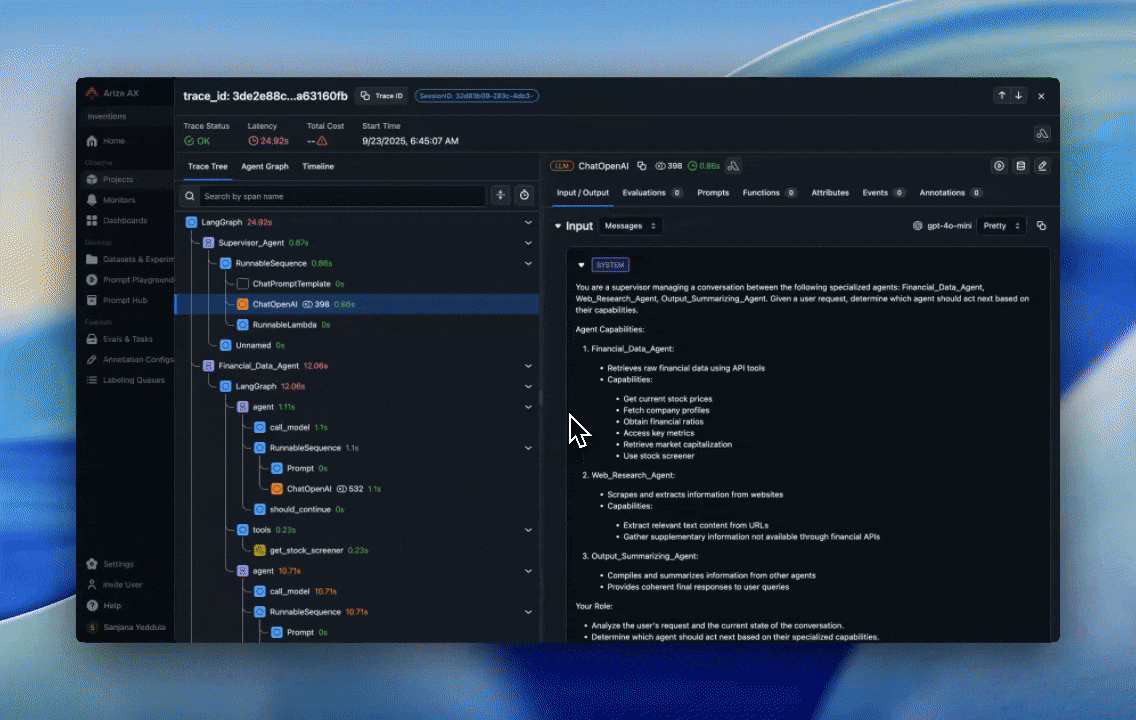
Open your traces in Arize AX and look at the Spans view to find where things are breaking. Are users rephrasing the same question repeatedly? Is the agent returning confident responses that contradict the source document? Is a tool call succeeding at the HTTP level but returning empty data?
Each failure pattern maps to a different eval setup. A hallucination problem needs the model response and the retrieved context as inputs. A tool calling failure needs the agent’s function call payload and the expected schema.
Defining your inputs upfront determines whether your judge is scoring the right thing. A judge evaluating the wrong data gives you precise measurements of nothing (and you’re still incurring costs).
Step 2: Define the metrics that matter
Once you know the problem and the inputs, decide what output you need from the evaluator. For most use cases, a binary label with an explanation is enough to act on. More granular numeric scoring makes sense when you’re comparing prompt versions or running experiments across model configurations.
But before you decide on the output format, you need to define what “good” actually means for your application. A RAG pipeline and a tool-calling agent have completely different failure surfaces. For RAG, good means the answer is grounded in the retrieved context. For an agent, good might mean the task was completed in the fewest steps with no hallucinated parameters. Trying to use the same metric for both is how teams end up with evals that pass while the system visibly degrades.
This is also where the LLM evaluation metrics Arize covers come in: matching the metric to the failure mode rather than picking whatever seems most intuitive.
Step 3: Write the prompt and pick your judge
You can structure LLM-as-a-judge in different ways depending on what you need.
The most common approach is to have the judge return a deterministic rating: pass/fail, yes/no, or a numeric score on a specific scale. This is where the eval metrics you identified, hallucination detection, agent function calling, RAG relevance, user frustration, become your rubric.
A minimal starting template looks like this:
You are evaluating a response for [task].
Inputs:
- User query: {query}
- Context: {context}
- Response: {response}
Criteria:
- Is the response grounded in the provided context?
- Does it fully answer the user’s question?
Output:
- Pass/Fail
- One sentence explanation
Start simple. You can add nuance once you see how the judge behaves.
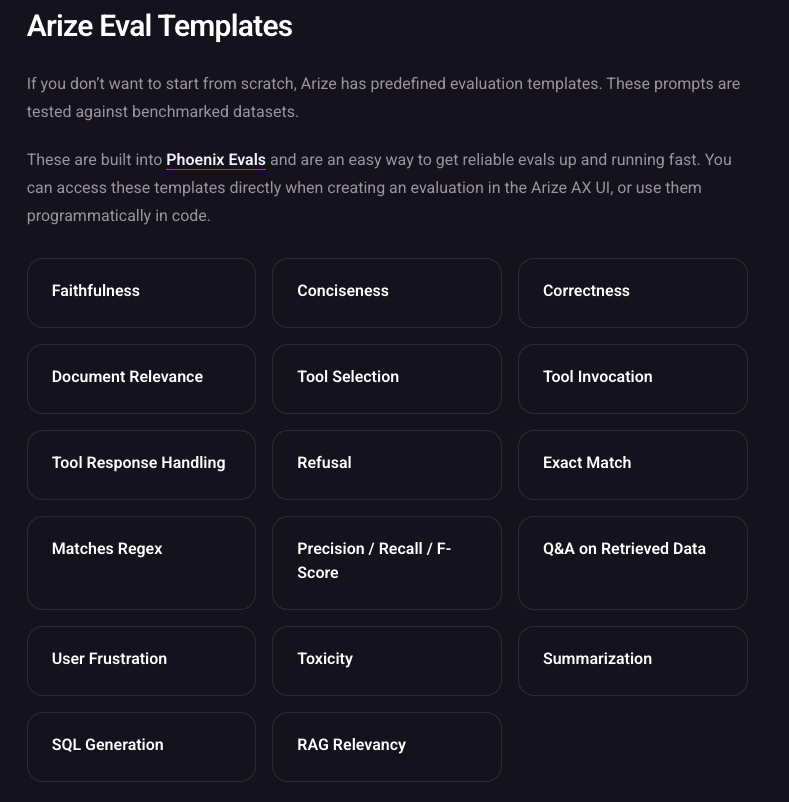
Explore pre-made LLM-as-a-Judge templates on Arize AX >
This process of getting some strict consistent values from the LLM gives you structured data you can aggregate, track over time, and use to spot outliers. If your judge rates 500 responses and 10 come back with low scores, you have clear signals about what’s breaking.
You can also use judges for categorization. Instead of a number, the judge labels each response as “hallucinated,” “grounded,” “partially grounded.” This lets you bucket failure modes and understand patterns. Are most failures from retrieval problems or model reasoning problems? The judge’s categorization tells you exactly where to fix.
The prompt itself is where you specify what you’re measuring and what output format you want. Keep it simple. Write it as if you’re instructing a human annotator. Give context about your application so the judge understands what success looks like. And keep your context under 4,000 tokens.
Now comes model selection. Larger, more capable models exhibit higher robustness as judges, and prompt design with unambiguous rubrics mitigates score shift. As per a report published in the Frontiers in Big Data journal, sophisticated judge models can align with human judgment up to 85%, which is actually higher than human-to-human agreement.
Pick a judge model that’s different from your application. If your app uses Claude Haiku, use Claude Sonnet or a competitive model as your judge. You don’t need reasoning models for evaluation. They’re overkill and add unnecessary latency and cost.
In Arize AX, you can plug in any frontier model as your judge. Claude, Gemini, open source alternatives? They all work. The platform handles prompt templating and structured output formatting, so you focus on defining what matters.
Step 4: Validate your evaluator
Once you’ve written your prompt, test it in Arize’s Evaluator Playground, where you can load your golden dataset and run your evaluator against specific spans from your project.The playground shows you both the evaluation label (like “factual” or “hallucinated”) and the judge’s explanation for each example.
Does it consistently label the examples the same way you did? Compare accuracy: if the judge and human labels match on 75-90% of examples, you’ve got alignment and you’re ready to scale. If not, iterate on your template or adjust the model to refine the results. You can repeat this process as many times as needed to fine-tune your evaluator.
Read the disagreements. Look at examples where the judge labeled it one way and you labeled it another. Read the judge’s explanation. What’s it missing? Is your rubric unclear? This signal tells you exactly what to fix. Refine your prompt based on those patterns, tighten your criteria, add negative examples. Run the eval again. Did accuracy improve? Keep iterating until alignment is strong.
The better your eval becomes, the better signal you have to improve your application.
Deploying your evaluator across the development lifecycle
While you’re still building
Slot the evaluator into your prompt iteration loop from this point forward. Every time you test a new variant, adjust retrieval, or modify a system prompt, run the eval and compare scores against your last run.
When a change causes hallucination rate to tick up or agent path convergence to drop, you catch it in the same session you introduced it. The earlier you run it, the more regressions you catch before they become load-bearing assumptions baked into your application.
This is also where the evaluator earns trust with your team. An engineer, for instance, might see their prompt tweak drop correctness by 8% in a five-minute eval run. That’s useful information.
The evaluator becomes part of how the team thinks about quality, which matters more than any single score it produces.
Before you ship
Run your evaluator across a representative sample of outputs and bring those scores into the release conversation. A hallucination rate above your established threshold or a sustained drop in Q&A correctness is a concrete, defensible reason to hold.
Stakeholders get something to weigh against risk tolerance. You also leave with an audit trail: this version shipped at this quality level, against this rubric, on this dataset. That baseline matters the moment something degrades later.
In production
In Arize AX, configure continuous online tasks to run your judge automatically against live traffic. Because it’s the same rubric you used during development, any degradation you catch is directly comparable to your pre-launch baseline.
Score drops become obvious. Say, if the hallucination rate was 6% at release and it’s 14% two weeks later, you know exactly when the drift started and you have a shared language with your team for describing the problem. You’re measuring with the same instrument you calibrated during development.
This also closes the loop on something teams rarely talk about: the cost of standing up a separate monitoring eval after launch. Every hour spent rebuilding a production eval from scratch is an hour where live traffic goes unscored. Starting from the evaluator you already validated eliminates that gap entirely.
Common pitfalls and how to avoid them
Getting your judge set up is one thing. But getting a reliable signal out of it is another. These habits matter whether you’re running evals on a staging environment or monitoring a live system.
Build your evaluators around your specific failure modes.
Pre-built metrics for helpfulness and coherence are a useful starting point, but high scores on them don’t mean your system is working. A customer support bot that confidently gives wrong answers can score well on coherence.
Validate your judge before you scale it.
The most expensive version of this mistake is running an unvalidated judge at scale, whether across dev experiment runs or production traces, and making decisions based on the scores.
Make sure your judge is receiving the right inputs.
A hallucination evaluator that doesn’t receive the retrieved context isn’t measuring hallucination. Define your inputs before you write your prompt, and sanity check that the data flowing into the judge at runtime actually matches what you designed it to evaluate.
Don’t treat a 100% pass rate as success.
If your judge is passing everything, your eval probably isn’t hard enough. A 70% pass rate on an evaluator that genuinely stress-tests your system tells you more than perfect scores on one that doesn’t.
What to do next
If you’re building today:
- Pull 50 real traces from your system
- Identify 2-3 common failure modes
- Write a simple pass/fail eval for one of them
- Run it across those traces
- Compare results with your own judgment and iterate
You don’t need a perfect dataset or production system to start. You need a clear failure mode and a way to measure it.
Get started with Arize
You’ve got the framework. You know how to diagnose failures, define metrics, write a judge prompt, and validate it before you scale. The part that used to take weeks of trial and error now has a much shorter path, and because you built the evaluator early, it carries forward into every stage that follows.
If you want to see it in practice, Alyx is the fastest way to get there. Start in the Prompt Playground with a use case you’re already working on, describe the failure mode you’re trying to catch, and watch it build from there. You don’t need a perfect golden dataset or a fully instrumented production system to get started. You just need a problem worth solving.
Try Alyx in Arize AX and see how far you can get in a single session.
Want to learn more about LLM-as-a-judge? Book a demo >
Frequently asked questions
What is LLM-as-a-Judge and why use it instead of human reviewers?
LLM-as-a-Judge uses a language model to evaluate another model’s outputs based on criteria you define in plain language. Human reviewers are the quality gold standard but can only evaluate a few hundred responses per day, a volume your application can generate in minutes. LLM judges bring human-level semantic understanding to evaluation without that bottleneck.
What’s the difference between semantic and operational evaluation metrics?
Semantic metrics measure whether response content is correct, grounded, and appropriate. Operational metrics measure whether the system is behaving efficiently and safely at the execution level. LLM judges excel specifically at semantic evaluations like hallucination detection, RAG relevance, and tone, where code-based checks fall short.
How do you know if your judge is actually reliable?
Validate it against a golden dataset and compare its labels to your own. A 75 to 90% match between judge and human labels indicates strong alignment and readiness to scale. Read the disagreements carefully. They reveal whether your rubric is unclear or your judge is missing context. Iterate on the prompt until alignment is strong.
Should you use the same model as your judge that you use in your application?
No. Pick a different, more capable model. If your app uses Claude Haiku, use Claude Sonnet or a competitive alternative as your judge. Reasoning models are overkill for evaluation and add unnecessary latency and cost without meaningful benefit.
What’s the biggest mistake teams make with LLM judges?
Treating a 100% pass rate as success. If your judge passes everything, the eval likely isn’t challenging enough. A 70% pass rate on a rigorous evaluator that genuinely stress-tests your system is more informative than perfect scores on one that doesn’t. Another critical mistake: running an unvalidated judge at scale and making real decisions based on those scores before confirming it actually works.

