If you’re shipping AI in production, your evaluation setup will outlast almost everything around it.
The model will change. Your framework may change. And your prompts, retrieval strategy, agent design, and product requirements will all definitely change. What shouldn’t change every time is the infrastructure you use to understand whether the system is getting better or worse.
That’s why the eval harness matters.
A production AI system rarely fails like traditional software. It does not always throw an exception or trip an error log. It gets quietly worse. A model upgrade changes behavior on a small slice of traffic. A prompt tweak fixes one workflow and breaks another. A retriever starts returning weaker context. An agent reaches the right final answer through the wrong sequence of tool calls.
An evaluation harness is the system that catches those failures consistently across the full lifecycle: local development, CI, production monitoring, and continuous improvement. The right harness lets you reuse instrumentation, evaluators, traces, and datasets as your application changes. The wrong one creates a second migration every time your AI stack evolves.
This post covers a practical decision framework: what an evaluation harness actually is, the criteria that defines a serious production harness, and how the leading harnesses stack up against those criteria.
Jump to a tool: LangSmith · Langfuse · Braintrust · Comet Opik · Phoenix and AX
Build better agents with Arize
Trace, evaluate, and learn. Build agents that work with Arize AX and start tracing your runs today.
Prefer open source? Try Arize Phoenix for self-hosted, open source agent observability.

What an eval harness is, and why you need one
The full definition lives here, but the short version: An evaluation harness is the infrastructure that lets you evaluate an AI system consistently as the system changes.
That consistency matters because production AI systems are moving targets. You may change the model, prompt, retrieval strategy, tool schema, routing logic, or agent framework. If every change requires a new eval setup, your evaluations become part of the migration problem instead of the safety net.
A production eval harness does three things:
- Define what gets evaluated. Which inputs, which traces, which production traffic — and at what granularity: individual spans, full traces, agent trajectories, or multi-turn sessions.
- Execute the scoring. Run evaluators (LLM-as-judge, code-based, embedding, or custom) against that data, offline on curated datasets or online on live traffic.
- Act on the results. Turn scores into something that changes what happens next.
A useful way to think about the loop is: (1) production trace, (2) evaluator, (3) monitor, (4) alert, (5) annotation queue, (6) regression dataset, and (7) CI gate.
The reason you need a harness and not just a folder of eval scripts is that scripts do not stay consistent on their own. Different engineers evaluate different slices of data. Offline and online evals drift apart. A passing score in CI stops meaning the same thing as a passing score in production.
The harness is what keeps evaluation portable, repeatable, and operational as your AI system evolves.
The action patterns: what happens after you have a score
Producing a score is the easy part. But using that score to change what happens next is where things get difficult.
That is where many eval workflows break down. A dashboard may tell you that retrieval relevance dropped or an agent failed a task, but unless that result triggers a review, alert, regression test, or fix, the score is just another metric to ignore.
A production eval harness needs to support four action patterns:
- Annotation queues route low-confidence cases to humans, whose labels feed back into evaluator calibration and regression datasets.
- Monitors and alerts threshold the eval metrics and route to the tools teams already use.
- CI/CD gates run regressions against candidate prompt and model changes and block bad ones from shipping.
- AI-assisted experiment workflows feed eval results into a loop where a copilot or coding agent proposes, tests, and iterates on fixes until a target metric threshold is met.
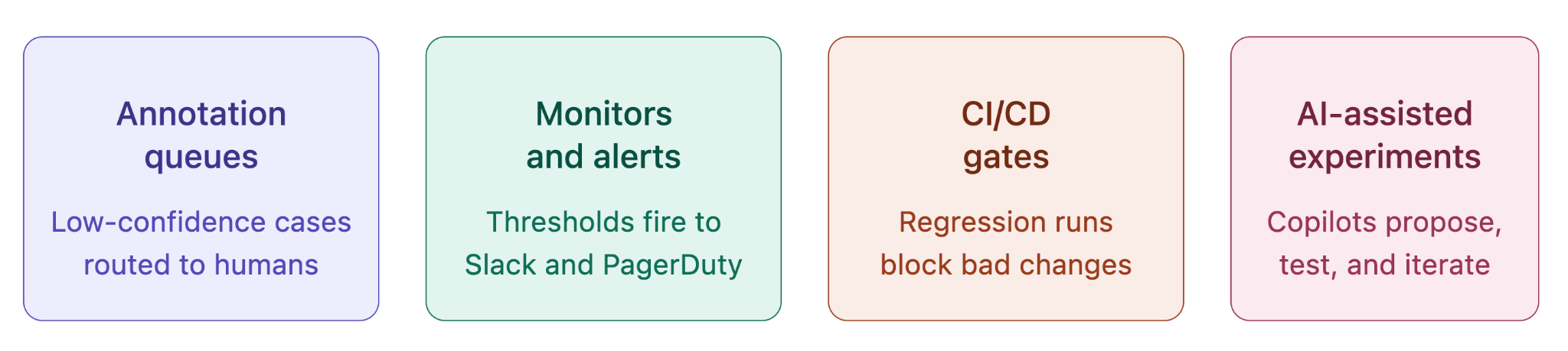
A production-grade harness should make these actions part of the same workflow, not four disconnected tools. Most tools in the category do one or two well. The question to ask of any tool is how completely the four are connected — because a score that doesn’t drive an action is just a number on a dashboard.
Five things to consider before choosing an eval harness
A good eval harness should survive changes to your model, framework, prompts, and production architecture. Before choosing one, pressure-test it against five criteria.
1. Open standards, because the instrumentation layer is the most expensive thing to replace later
Here’s something to ask yourself: If you change frameworks, models, or vendors later, do you need to re-instrument the application?
Instrumentation is the hardest part of an eval harness to replace later. If traces, spans, prompts, completions, tool calls, and token usage are captured in a proprietary format, switching tools means re-instrumenting the application.
OpenTelemetry matters because it gives teams a common observability foundation. OpenInference extends that model for LLM and agent applications, with semantic conventions for LLM calls, retrievers, tools, agents, prompts, completions, and token usage.
2. One evaluator definition everywhere, because two systems always drift
Here’s another thing to ask yourself: Can the same evaluator run against a notebook dataset, a CI job, and live production traces?
Many teams end up with separate eval systems: one for offline datasets and CI, another for production monitoring. Those systems drift. A passing score in CI stops meaning the same thing as a passing score in production.
A strong harness lets the same evaluator run against a notebook dataset, CI job, or live production trace.
3. Continuous evaluation, because production traffic is the real test set
Golden datasets are useful, but they never capture the full distribution of production traffic. The real test set is what users actually do.
Continuous evaluation means sampling live traces, scoring them, alerting on regressions, routing failures to review, and turning recurring failures into regression tests.
Ask yourself this: Can I evaluate sampled production traffic continuously, alert on quality regressions, and turn failures into future regression tests?
4. A maturity ladder, because your eval needs grow as your system does
Our post on the eval maturity model lays out four operational stages: GUI-first evaluation, AI-assisted eval ops, headless developer workflows, and monitor-triggered autonomous agents.
A harness that only serves one stage forces a migration when you reach the next. The harness worth picking should have primitives for all four, so growing up the ladder is a configuration change, not a re-platforming job.
When exploring tool choices, ask yourself this: Will this tool still work when my workflow moves from manual review to CI/CD to automated remediation?
5. Spans, traces, trajectories, and sessions, because agents fail at the trajectory level
Agents do not only fail at the prompt/response level. A correct final answer can come from a flawed sequence of tool calls; a wrong answer can trace back to a retrieval that failed four spans earlier. Evaluating these systems requires scoring at span, trace, trajectory, and session granularity — a tool that only scores prompt-and-completion can’t see where an agent actually went wrong.
To get this right, ask this question: Can I evaluate individual spans, full traces, multi-step trajectories, and sessions or only prompt/response pairs?
Related: Choosing an eval harness is one decision; instrumenting it so failures stay diagnosable is another. See our guide to agent harness tracing and evaluation.
How the tools compare
Each eval harness has a different center of gravity. The right question is not “which tool is best?” but which tool matches the workflow you need to support.
LangSmith
LangSmith is strongest when your application is already built on LangChain or LangGraph. The framework integration is tight, which makes it a natural choice for teams already committed to that ecosystem.
The tradeoff is portability. If your AI stack expands beyond LangChain/LangGraph, or if trace volume and retention needs grow quickly, teams should model the operational and pricing implications before standardizing on it.
Langfuse
Langfuse has been the default open-source pick for teams that want infrastructure control: MIT-licensed, self-hostable, strong prompt management.
ClickHouse acquired Langfuse in January 2026 as part of their $400M Series D, repositioning LLM observability as a feature of a database platform. The team has been clear that open source and self-hosting aren’t changing; the strategic question is what the roadmap looks like when the parent company’s primary business is selling a database.
Braintrust
Braintrust is strongest for eval-first workflows: versioned prompts, datasets, experiments, and regression gates in CI.
The tradeoff is production observability depth. It is a good fit when the main problem is testing prompt or model changes before release. It may be less ideal when the primary need is operating long-running agent workflows, debugging complex traces, or connecting production failures back into monitoring and remediation loops.
The Axium Industries case study is a worked example: a team building agents for industrial supply chains evaluated Braintrust, found it insufficient for production-grade tracing and operating complex agent workflows at scale, and moved to Phoenix and Arize AX.
Comet Opik
Comet Opik is a credible open-source option for teams that want eval workflows, PyTest integration, a prompt playground, and agent-assisted debugging.
The question is maturity at the upper operational layers: online evaluation, agent-specific evaluators, headless workflows, and monitor-triggered remediation.
Arize Phoenix and Arize AX
Phoenix and AX are built around the same trace and evaluator model from local development through production. Instrumentation, evaluator definitions, datasets, and trace schemas can move from notebook experimentation to CI to live monitoring without being rewritten.
Phoenix is the open-source starting point: run locally, inspect traces, define evaluators, and iterate on datasets. AX extends that workflow into production with online evaluation, monitors, alerts, annotation queues, an AI engineering agent Alyx, CLI workflows, RBAC, and enterprise controls.
The important architectural point is continuity: the same instrumentation and evaluator model can support local debugging, CI gates, production monitoring, and continuous improvement. That is the difference between adopting an eval tool and adopting eval infrastructure.
Across the maturity ladder, AX includes primitives for each stage:
- GUI evaluation for domain experts and product managers who shouldn’t have to write SDK code.
- Alyx, an AI copilot embedded in the platform, that analyzes traces, generates synthetic test data, drafts evaluators, runs experiments, and iterates on prompts conversationally.
- A fully documented AX CLI and a skills framework that AI coding agents (Claude Code, Cursor, Codex, Windsurf) consume directly, so an agent fetching open alerts, exporting spans, analyzing failures, drafting a fix, and running a targeted eval against the baseline is a real workflow.
- Webhook-routable monitors that trigger always-on agents with full CLI and skills context for autonomous triage.
How to start
There’s two ways you can go:
- Self-hosted Phoenix. pip install arize-phoenix, point your OTLP exporter at it, instrument with OpenInference. Local notebook, container, or Kubernetes. Full feature set, no gates.
- AX. When you want Alyx, online evals on production traffic, monitors and alerts, the CLI and skills for headless and autonomous workflows, and enterprise compliance — graduate without rewriting instrumentation.
The model, framework, and prompt strategy you use today will probably change. Your evaluation infrastructure should survive those changes. Pick the harness that lets you reuse instrumentation, evaluators, traces, and datasets across the full lifecycle: local development, CI, production monitoring, and continuous improvement.

