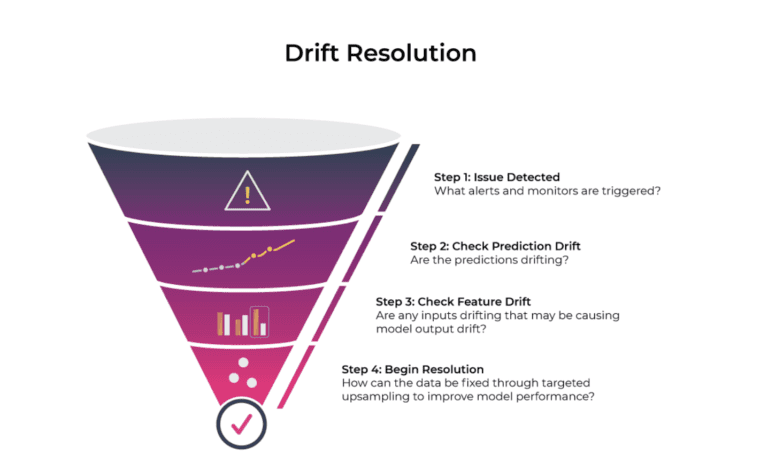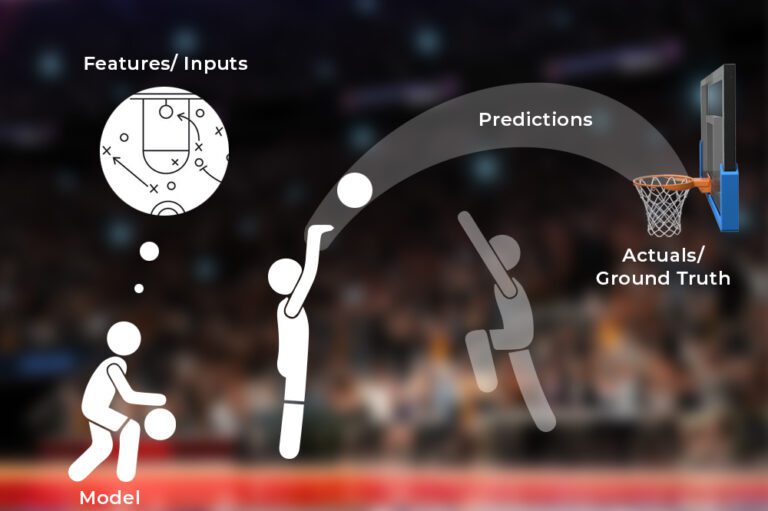

The product of feature importance and drift (population stability index, PSI) measures what impact a specific feature has on the prediction drift. Teams use prediction drift impact to rank which input shifts most likely explain movement in model scores or approval rates, instead of investigating every PSI alert equally.
Build better agents with Arize
Trace, evaluate, and learn. Build agents that work with Arize AX and start tracing your runs today.
Prefer open source? Try Arize Phoenix for self-hosted, open source agent observability.
Key takeaways
- Prediction drift impact weights feature drift scores by model importance to prioritize triage.
- High PSI on a low-importance feature may rank below moderate PSI on a top driver feature.
- Requires stable PSI bin definitions and consistent importance estimates (SHAP mean, gain, coefficients).
- Output is a ranking aid, not a causal proof that a feature caused score change.
- Pair impact scores with score distribution monitors and slice performance when labels exist.
Components
Feature drift. Often PSI comparing current feature distribution to reference bins.
Feature importance. Global or recent SHAP magnitude, tree gain, or linear coefficient magnitude depending on model type.
Impact score. Element-wise product (or similar combination) per feature, summed or ranked for dashboards.
Some platforms add prediction output PSI separately from input features when scores drift with stable inputs.
Why multiply importance and drift
Many features drift slightly in large systems. Analysts need ordering.
A large shift in a decorative field wastes time. A moderate shift in credit utilization may explain approval rate movement.
Impact scores focus incident response on features the model actually uses.
Workflow in incidents
- Detect prediction rate or score distribution shift versus reference.
- Compute PSI per feature on the same window.
- Multiply by importance weights from the champion model artifact.
- Inspect top features with bin-level diffs and slice performance.
- Decide among featurizer fix, retrain, threshold adjust, or external event explanation.
Articles on model, concept, and data drift connect input drift, output drift, and label eval steps.
Lifecycle framing in AI model lifecycle management places ranked impact lists in standard runbooks.
NLP monitoring examples in NLP sentiment classification monitoring show cohort views after you identify driving features.
Caveats
Importance from old data may misrank when concept drift changes which features matter.
Correlated features split impact arbitrarily; inspect groups together.
PSI noise on sparse bins inflates impact for rare levels.
Importance metrics differ by method; do not mix definitions week to week.
Scorecard integration
Some teams add prediction output PSI as its own row in weekly stability reports alongside top feature impact ranks.
When impact scores tie, break ties with business ownership of features and recent change logs from featurization teams.
Practitioner checklist
Before changing production settings, confirm labels, thresholds, and monitor windows match the definitions used in your last offline eval. Snapshot dashboards when incidents start so postmortems compare apples to apples.
Run slice-level reviews on high-traffic cohorts weekly even when global metrics look flat. Many failures appear first in one locale, product line, or prompt route.
Document model version, featurizer hash, and data window in every incident ticket. Future you needs that context to interpret drift charts.
When metrics disagree (offline vs online, precision vs recall), write down the business cost of each error type before picking a fix. Metrics are proxies; costs are the decision.
Share eval harness links in release notes so support and PM teams know which golden tasks must pass before they announce improvements.
Related concepts
Prediction drift impact complements population stability index tables on raw features and separate monitors on model scores. Use all three views in major drift incidents. Escalate when top-ranked features align with falling slice accuracy on recent labeled rows.
FAQ
Is prediction drift impact the same as SHAP?
No. SHAP explains predictions. Impact here combines drift magnitude with importance to prioritize features during drift incidents.
Should I use PSI or other drift scores?
PSI is common for scorecard-style monitoring; use whatever your platform standardizes, consistently binned.
Can impact be negative?
Products usually report magnitude for ranking. Direction comes from bin-level diffs (mass moved up or down).
Does this apply to LLM systems?
For structured features and reranker scores, yes. Free-form prompt drift needs different text statistics and eval suites.
When should impact trigger retrain?
When top impact features align with performance drops on recent labels and featurizer fixes are insufficient.