
Jason Lopatecki
Jason Lopatecki is co-founder and CEO of Arize AI, an AI & Agent observability and evaluation company. He is a garage-to-IPO executive with an extensive background in building marketing-leading products and businesses that heavily leverage analytics. Prior to Arize, Jason was co-founder and chief innovation officer at TubeMogul where he scaled the business into a public company and eventual acquisition by Adobe. Jason has hands-on knowledge of big data architectures, programmatic advertising systems, distributed systems, and machine learning and data processing architectures. In his free time, Jason tinkers with personal machine learning projects as a hobby, with a special interest in unsupervised learning and deep neural networks. He holds an electrical engineering and computer science degree from UC Berkeley - Go Bears!
-
 Company
Arize and Dynatrace: Making the World’s AI Work
Today we are announcing the signing of a definitive agreement for the acquisition of Arize by Dynatrace to accelerate our mission to make the world's AI work. Jason Lopatecki August 13, 2026 5 min read -
 Agent Observability
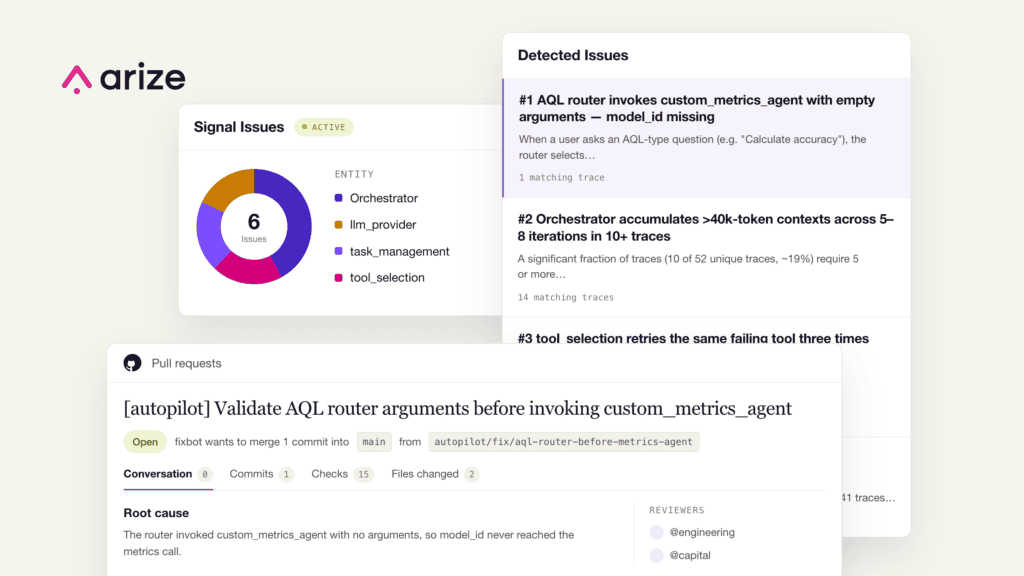
From Signal to PR: What if your agents got better every time they failed?
Signal, a managed agent built into Arize AX, continuously reviews production traces, surfaces ranked issues with evidence and proposed fixes, and — with Managed Agents — can carry… Chris Cooning Sally-Ann DeLucia Jason Lopatecki Aparna Dhinakaran July 29, 2026 5 min read -
 Agent Engineering
Building the AI factory for self-improving agents: What’s new in Arize AX
Arize AX is adding managed agents, full-agent experimentation, expanded multimodal support, and Harness-as-a-Judge to help teams observe, evaluate, and improve production agents. Jason Lopatecki Aparna Dhinakaran June 4, 2026 8 min read -
 Agent Engineering
Hierarchical Memory Management In Agent Harnesses
We’ve worked with thousands of customers building AI agents, and we’ve also spent the last two years building our own agent, Alyx, an in-product assistant for Arize AX.… Jason Lopatecki Aparna Dhinakaran Laurie Voss Aman Khan Chris Cooning January 29, 2026 10 min read -
 Agent Observability
How Context Graphs Turn Agent Traces Into Durable Business Assets
In their recent essay making the rounds, Foundation Capital’s Jaya Gupta and Ashu Garg argue that the next enterprise data advantage will come from capturing decision traces and… Jason Lopatecki January 8, 2026 4 min read -
 AI Evaluation
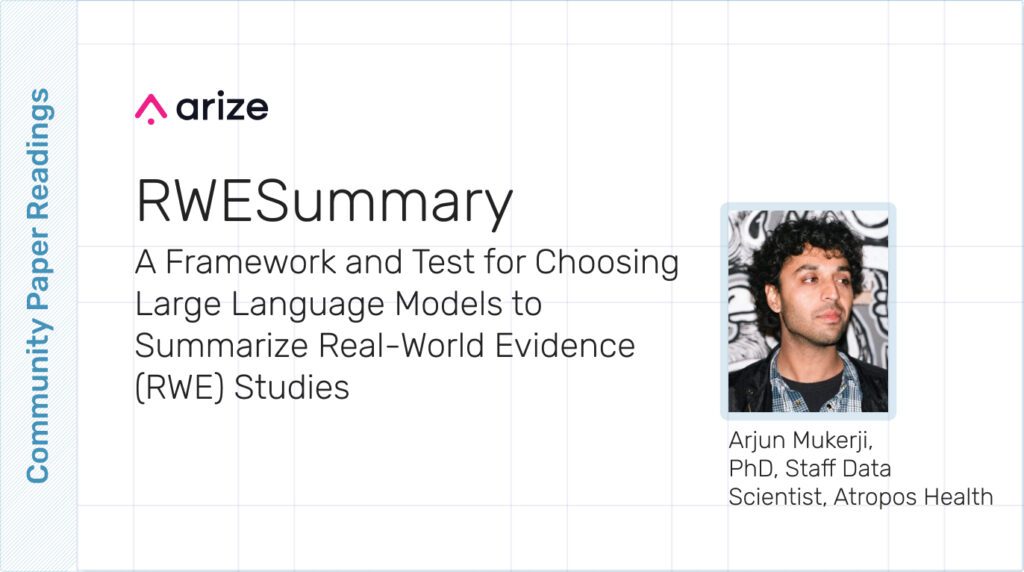
Atropos Health’s Arjun Mukerji, PhD, Explains RWESummary: A Framework and Test for Choosing LLMs to Summarize Real-World Evidence (RWE) Studies
Large language models are increasingly used to turn complex study output into plain-English summaries. But how do we know which models are safest and most reliable for healthcare? … Jason Lopatecki September 19, 2025 2 min read -
 AI Observability
adb Benchmarks
In launching adb (Arize database) we wanted to benchmark adb both internally as a database and at the system level in our application. Our goal is to show… Jason Lopatecki September 17, 2025 2 min read -
 Agents
Claude Code Observability and Tracing: Introducing Dev-Agent-Lens
Claude Code is excellent for code generation and analysis. Once it lands in a real workflow, though, you immediately need visibility: Which tools are being called, and how… Adam Mischke Alex Owen Jason Lopatecki August 22, 2025 5 min read -
 Security & Governance
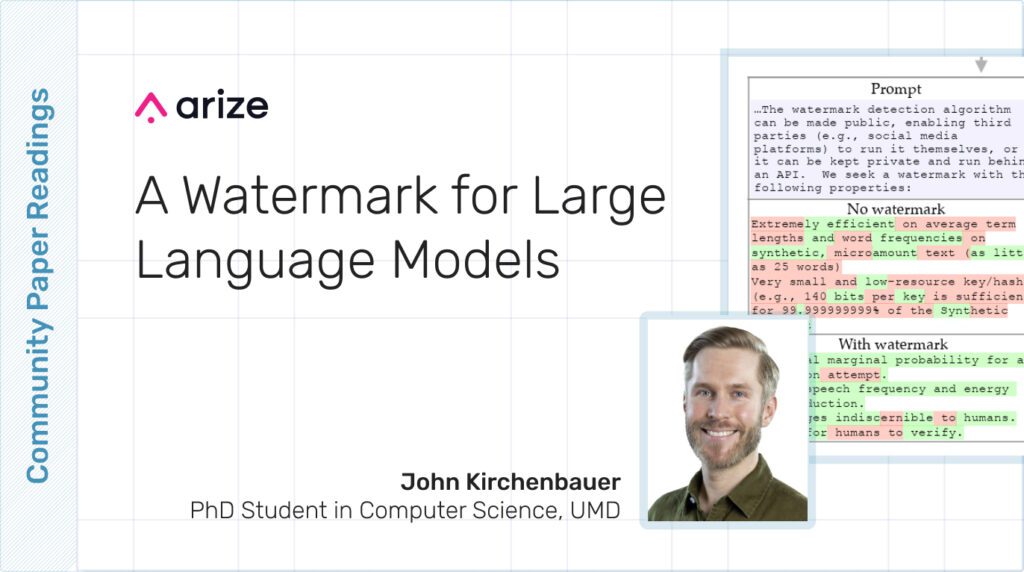
A Watermark for Large Language Models
In our latest live AI research papers community reading, the primary author of the popular paper A Watermark For Large Language Models (John Kirchenbauer of University of Maryland)… Jason Lopatecki July 30, 2025 5 min read -
 Agents
Prompt Learning: Using English Feedback to Optimize LLM Systems
Applications of reinforcement learning (RL) in AI model building has been a growing topic over the past few months. From Deepseek models incorporating RL mechanics into their training… Jason Lopatecki Aparna Dhinakaran Priyan Jindal Aman Khan July 18, 2025 15 min read
Don’t ship vibes.
Arize gives AI teams observability and evals to understand and improve agent performance.

