What if your agents got better every time they failed?
It’s 2 AM, and the pager goes off. User frustration rates are climbing, so someone opens a laptop, and the clock that matters (time to fix) has barely started.
The eventual patch may be two lines, but the expensive part comes first: finding the right traces, reconstructing the failure, forming a theory, and locating the responsible code.
We’re launching Signal, a managed agent built into Arize AX that takes on that investigative work continuously.
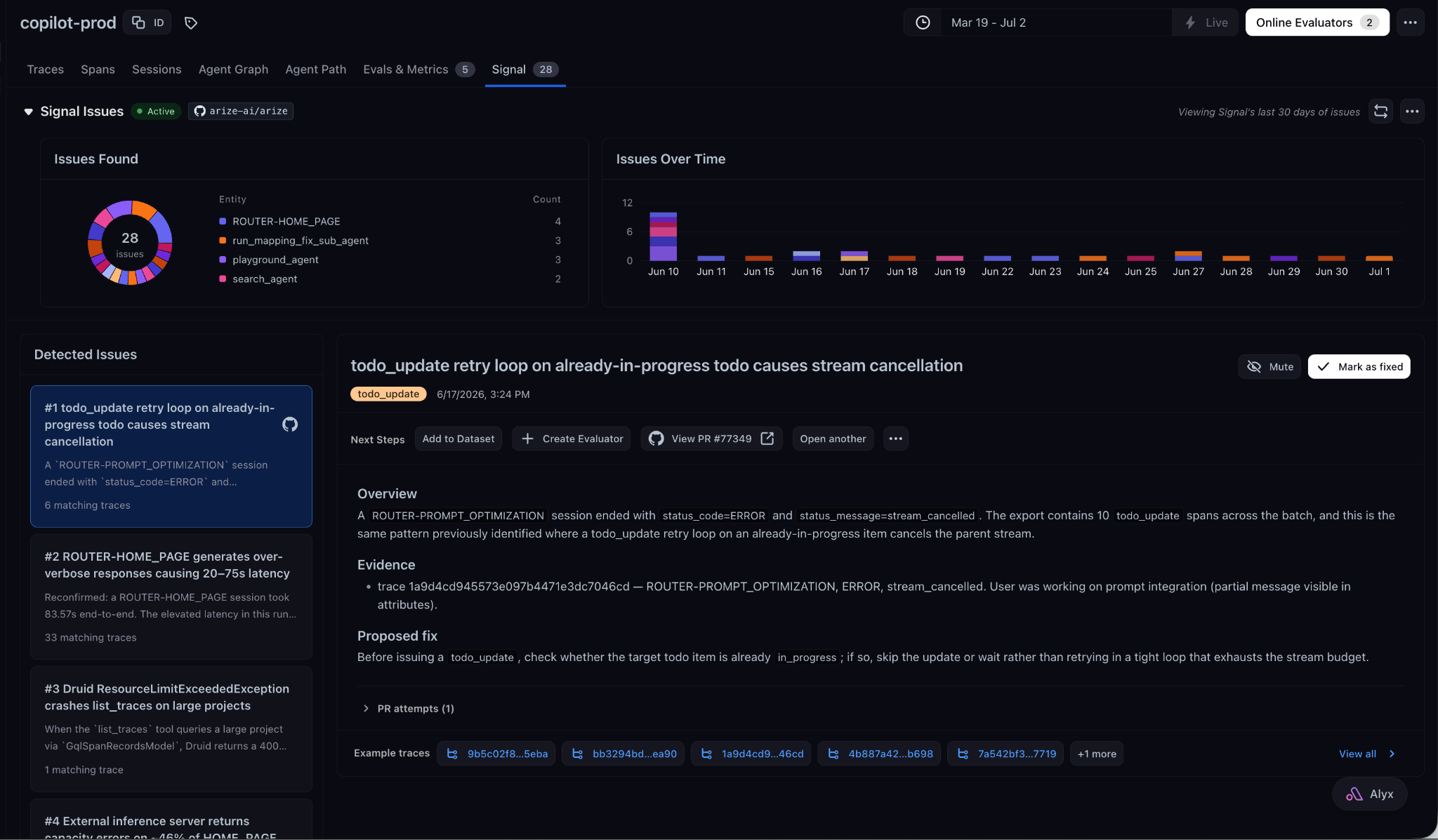
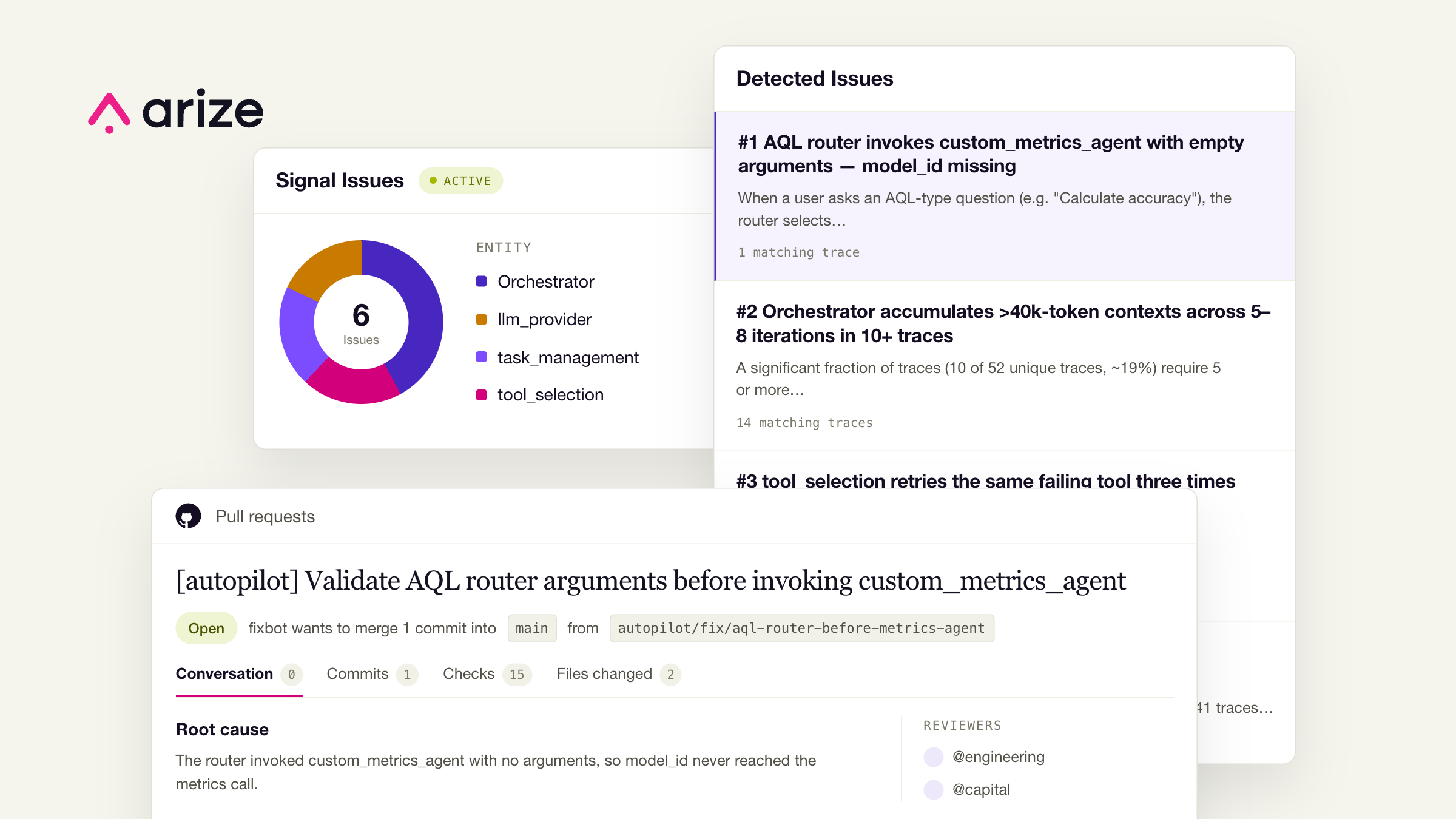
Signal reviews production traces, identifies recurring failure patterns, and groups them into ranked issues. Each issue includes supporting evidence, a root-cause analysis, and a proposed fix.
Signal doesn’t stop at surfacing issues. With a repository connected, a managed agent can carry the investigation into the codebase, propose a fix, and open a pull request, turning production telemetry into a reviewable change.
This launch points toward a more ambitious future. We believe agents will not only run in production, but also help improve the systems they run in. In fact, Signal is part of the agent improvement loop in Arize AX where production behavior becomes evidence, evidence becomes an investigation, and the investigation becomes a reviewable change.
The engineer still makes the call; they just begin with a diagnosis instead of a blank query box.
TL;DR
- Signal finds the issue. It continuously reviews production traces, groups related failures, and surfaces the evidence, likely cause, and proposed fix.
- Managed Agents help close the loop. With repository access, they can inspect the relevant code, propose a patch, and open a pull request.
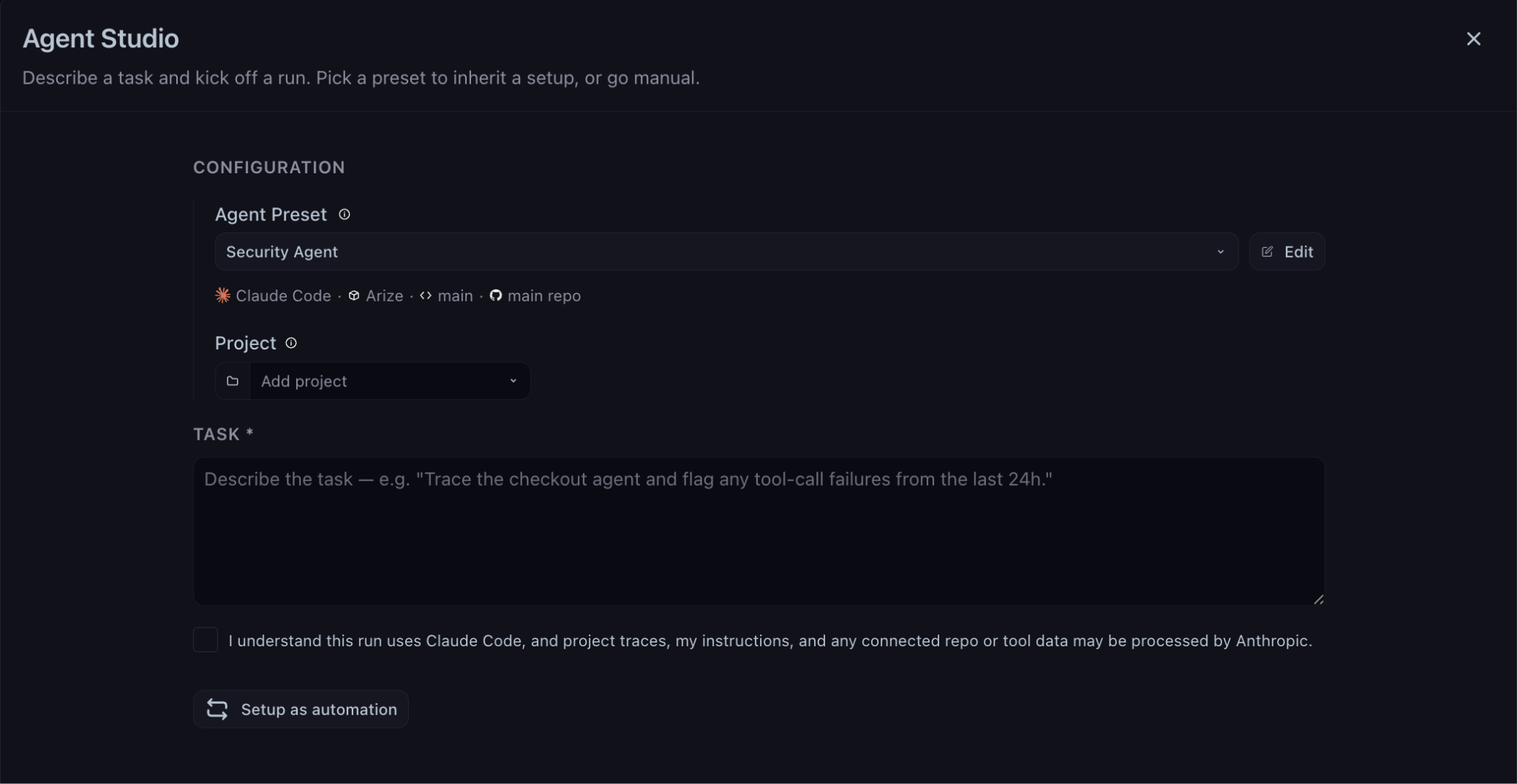
- Agent Studio makes the loop configurable. Teams can run guided or custom investigations once, on a schedule, or in response to an operational trigger.
- Humans remain in control. The agent investigates and proposes; the engineer reviews and ships.
Signal ships on Arize AX Free and Pro today. Full managed agents, including Agent Studio, presets, and repository access, are available to Enterprise customers in beta.
Observability has a new reader
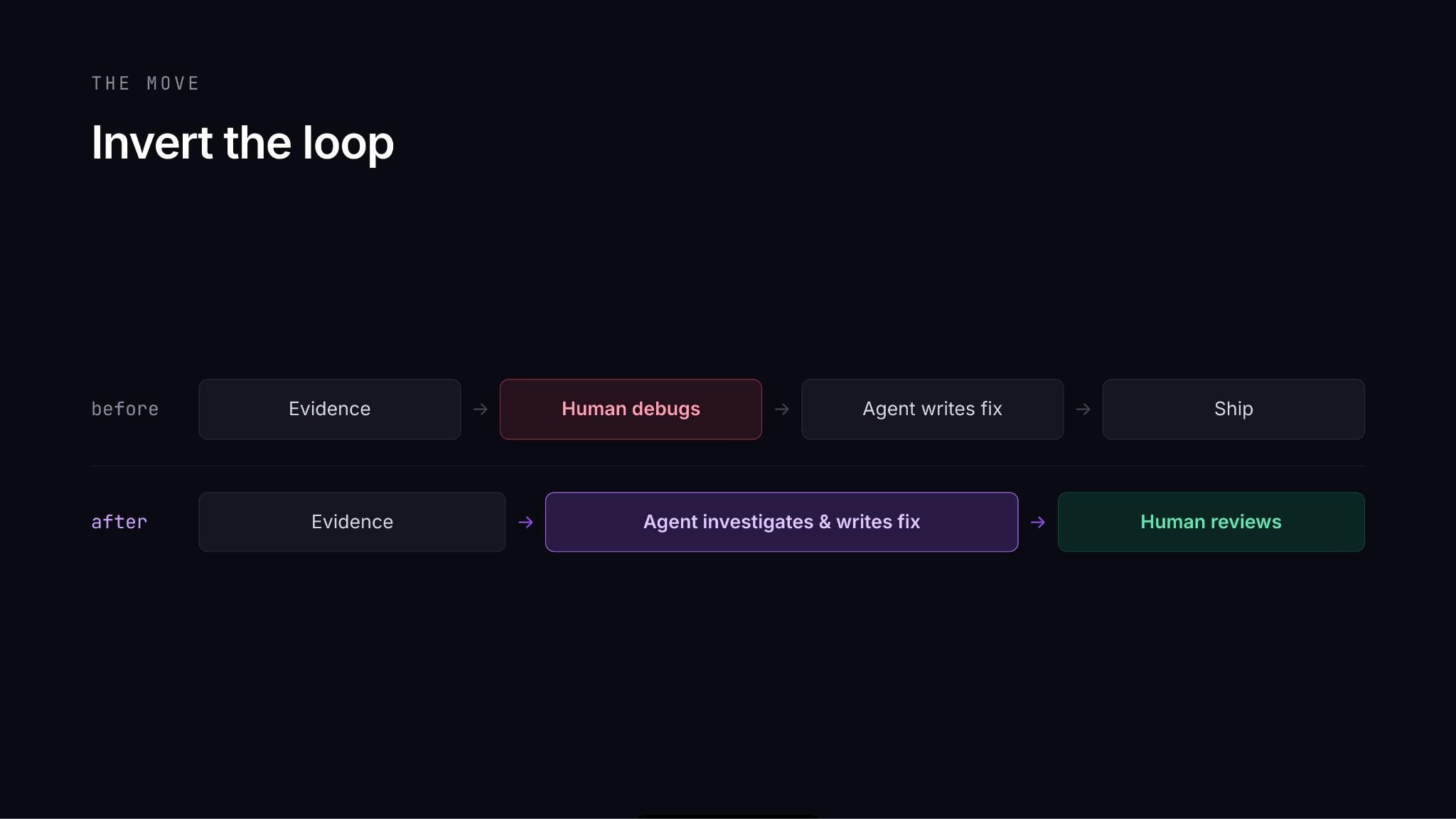
For decades, production telemetry had one real consumer: a human. Applications emitted logs, metrics, and traces, and dashboards organized them. Alerts woke someone up, and an engineer then translated that telemetry into an explanation.
Coding agents accelerated the final step. Once a developer understood the problem, an agent could write the patch for them. But the human still had to consume the telemetry, isolate the failure, and turn the investigation into a prompt.
Signal moves the agent upstream. This is the next step toward self-improving software: the telemetry you capture stops being something only a human reads and becomes an input an agent can immediately act on.
From traces to action
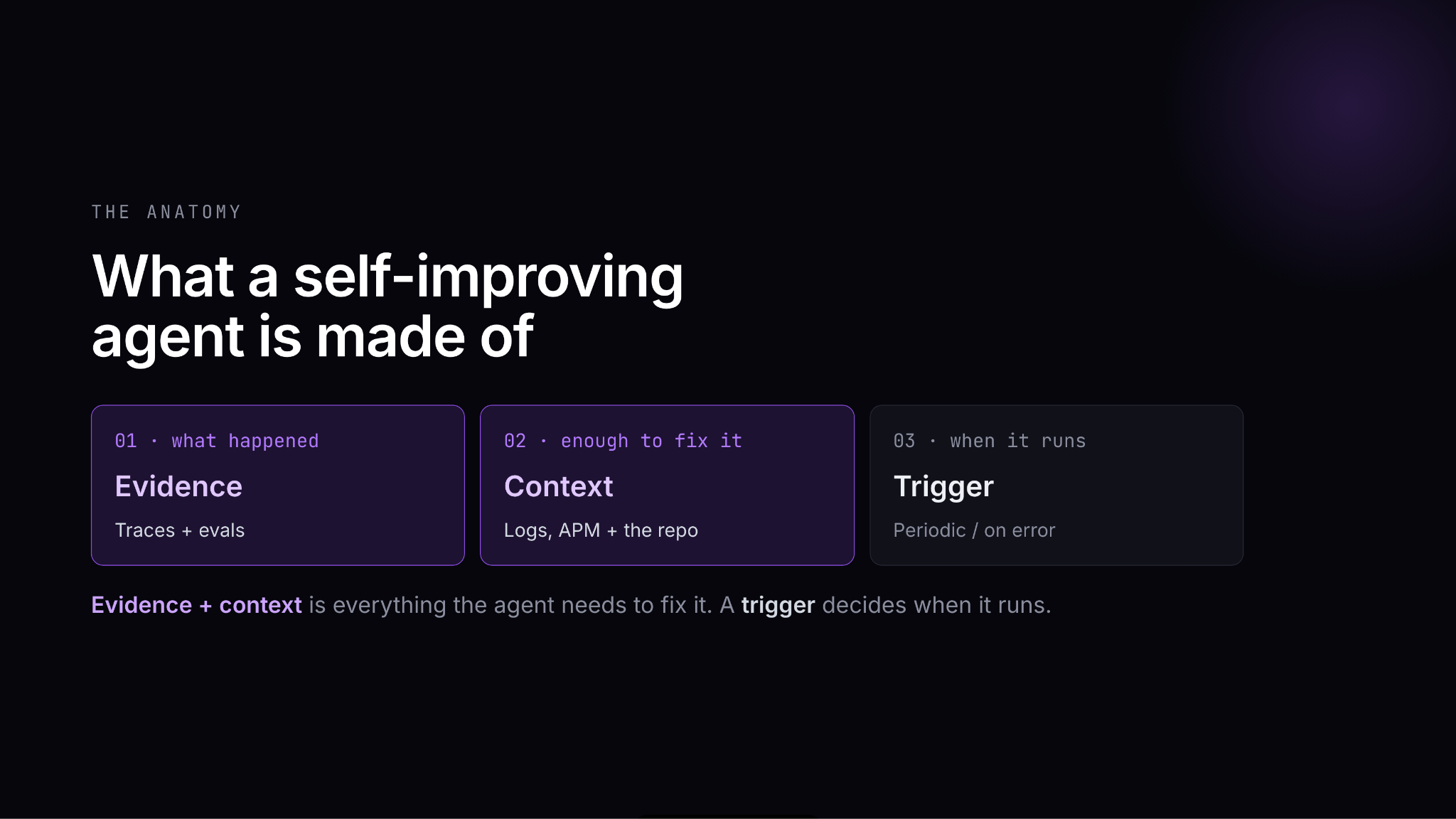
An agent improvement loop needs three things:
- Evidence comes from traces and evaluations. Traces capture what the agent did: model calls, retrievals, tool executions, inputs, outputs, timing, and errors. Evals help distinguish a technically successful run from a good result.
- Context connects runtime behavior to its cause. That can include logs, application spans, metadata, and, when connected, the repository where the change needs to land.
- A trigger determines when the investigation runs. Signal continuously sweeps new production traces, while broader managed-agent workflows can run on a schedule or in response to an operational event.
Together, those pieces create an improvement loop:
- Investigate
- Propose
- Review
- Ship
- Observe again
This makes observability, especially tracing, more important. Traces serve as the source of truth and the backbone of the feedback loop. The higher the quality of the traces, the better the agent can investigate failures and identify the right code to change. Paired with strong evaluations that distinguish error modes from silent quality issues, they help the agent turn “this behavior is broken” into “this is the code that should change.”
Start with Signal, extend with Managed Agents
Signal comes preconfigured for continuous production reliability. Turn it on for a tracing project, and it begins reviewing new runs, tracking issues it has already seen, and surfacing emerging failure patterns.
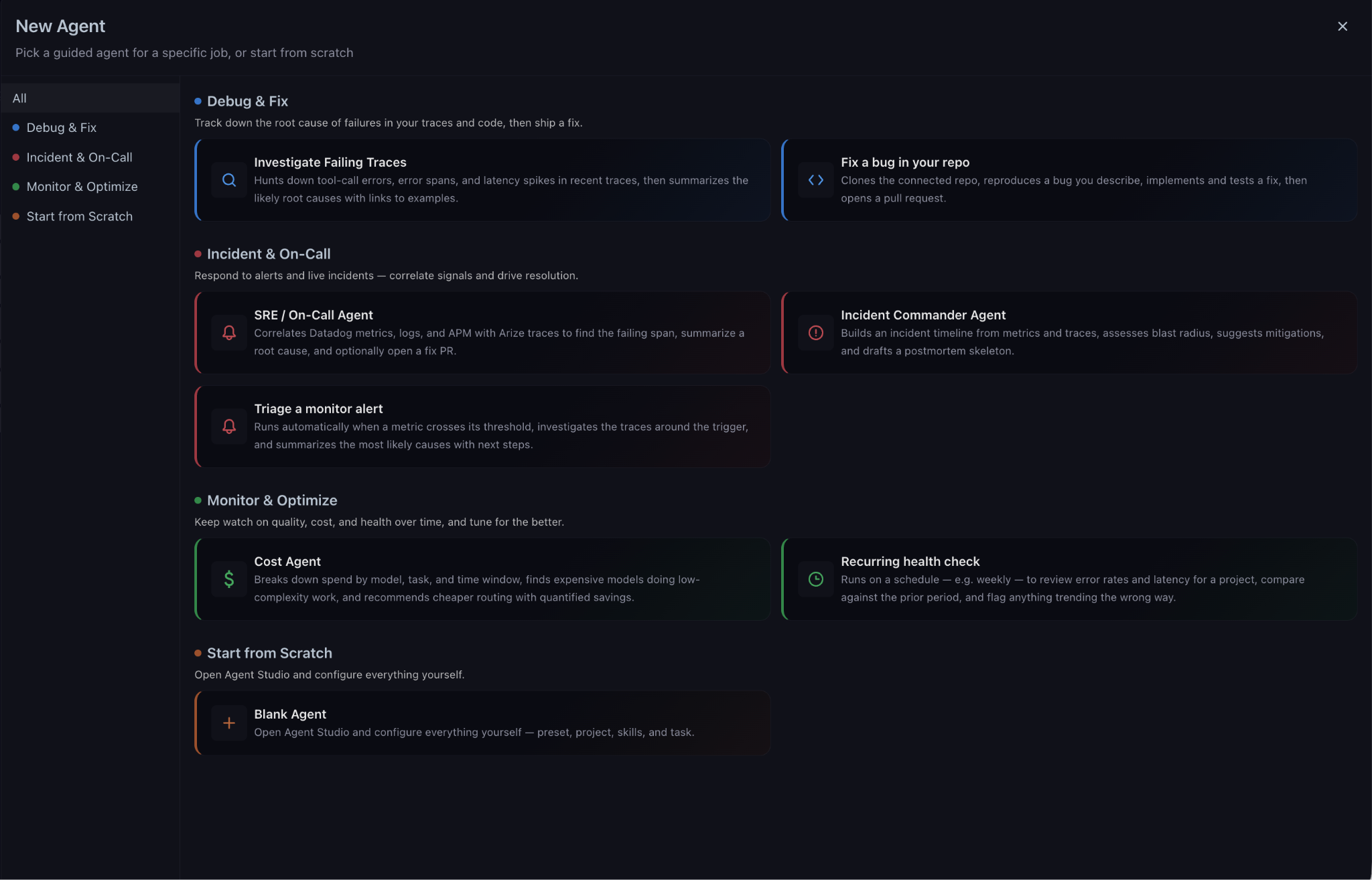
For teams that want to go beyond that workflow, Managed Agents and Agent Studio in Arize AX include templates for investigating failing traces, triaging monitor alerts, analyzing costs, running recurring health checks, inspecting repositories, and proposing pull requests. Teams can also start with a blank agent and build around virtually any engineering workflow they need.
Signal is not the endpoint, though. It is an early piece of a broader shift toward self-improving agent systems: software that can observe its own behavior, identify where it is failing, and propose the next improvement for a human to approve.
The future is not an agent rewriting itself in production. It is a controlled loop in which every trace can become evidence, every failure can become an investigation, and every investigation can become a reviewable change.
Signal is available in Arize AX today. Turn it on against the traces and evaluations you already capture.

