

Arize AX pushed out a lot of new updates in January 2026. From improved evaluator hub to custom prompt release labels, here are some highlights.
Evaluator Hub: Reusable Evaluators
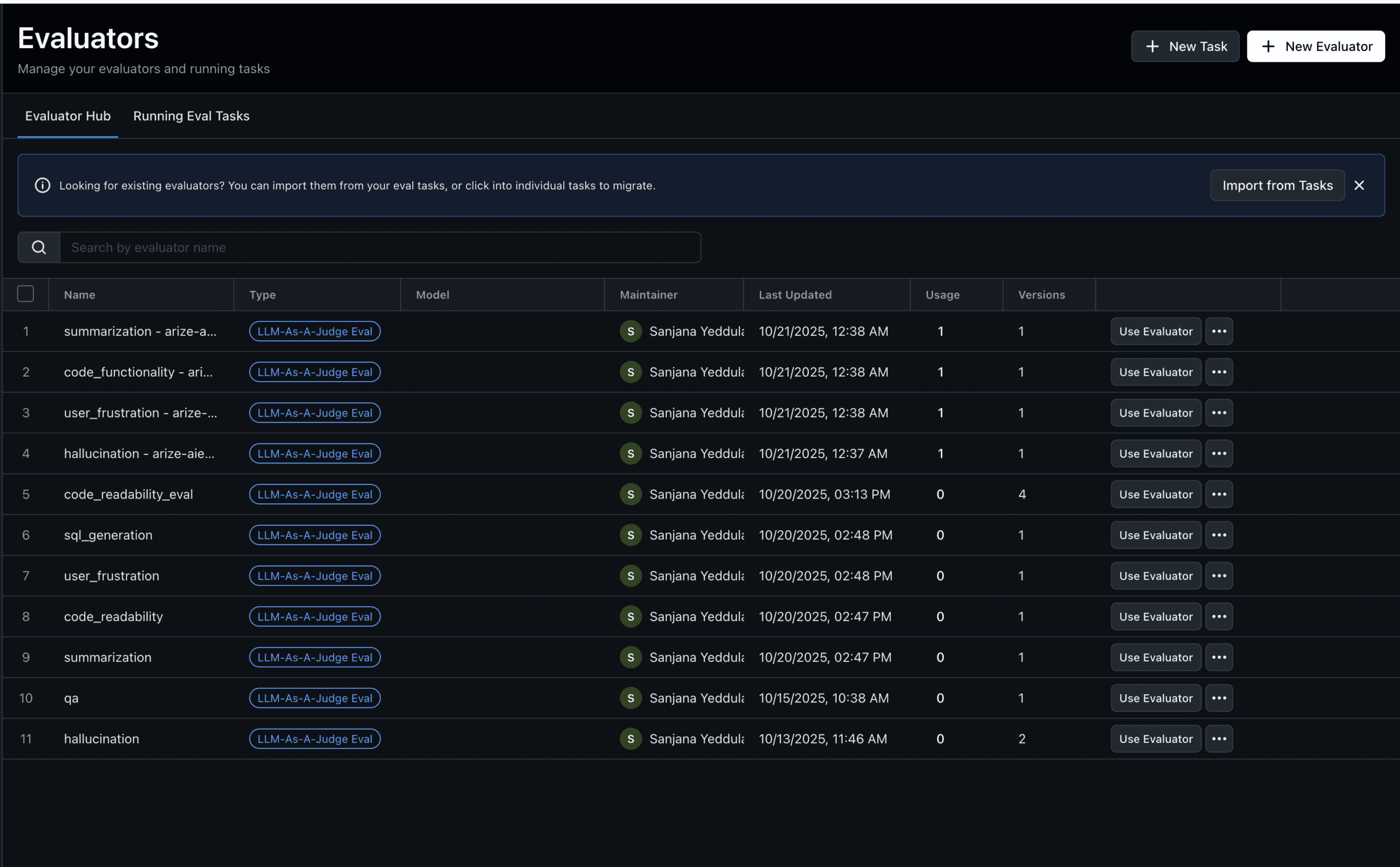
We’re excited to introduce the Evaluator Hub — a centralized place to create, version, and reuse evaluators across all your evaluation tasks.
Why reusable evaluators? Previously, evaluators were defined inline each time you created a task. This led to duplicated configurations, inconsistent evaluation criteria, and extra setup overhead. With the Evaluator Hub, you define an evaluator once and use it everywhere.
- Consistency: Reuse the same evaluator definition across tasks to eliminate drift.
- Reliability: Set LLM configuration (model/provider/params) at the evaluator level so it’s validated before production use.
- Version control: Track changes over time with commit messages for auditing and rollbacks.
- Flexibility: Reuse evaluators across datasets with different schemas via column mappings.
What’s new
- Evaluator Hub tab to browse, search, and manage all evaluators
- Running Tasks tab to view and manage active evaluation tasks
- “Use Evaluator” action to quickly create a task with an evaluator pre-selected
- Column Mappings to map evaluator template variables to datasource columns
- Evaluator Versioning with commit messages
Getting started
- Navigate to Evaluators in the left sidebar
- Click New Evaluator to create your first reusable evaluator
- Choose from pre-built templates or create a custom evaluation from scratch
- Use your evaluator via Use Evaluator or select it while creating a new task
Custom Prompt Release Labels
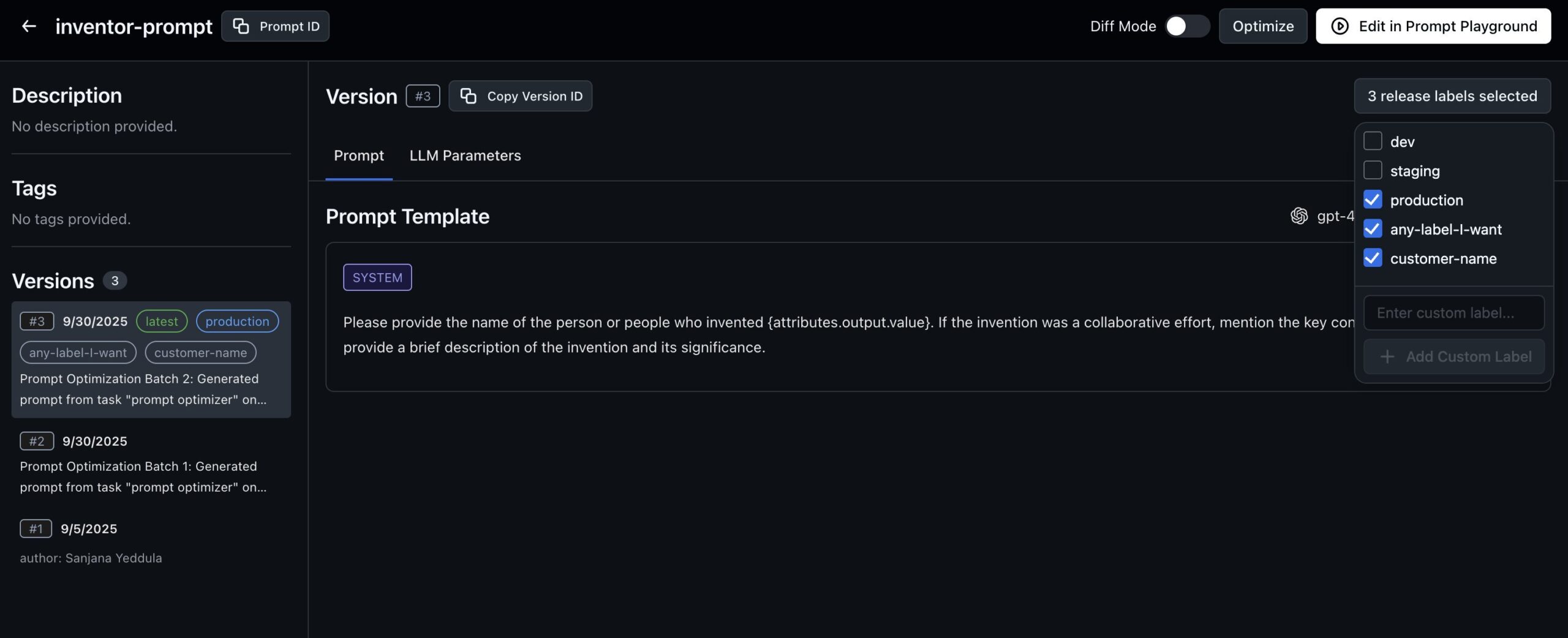
Organize and track prompt versions with custom labels like staging and production.
- Tag prompt versions with meaningful identifiers
- Use environment markers (e.g., “staging”, “production”)
- Get dynamic label suggestions from existing prompts
- Retrieve specific prompt releases quickly
Learn more about managing prompts in the Prompt Hub.
Labeling Queue Annotations
More flexible annotation management across spans, queues, and experiments.
- Clear annotations (reset to null) anywhere
- Support across spans, queues, and experiments for consistent workflows
- Improved annotation lifecycle management
Discover how to set up and use labeling queues for your annotation workflows.
AWS Bedrock Custom Endpoints
Enhanced AWS Bedrock integration for enterprise deployments.
- Custom base URL support for private endpoints
- Inference profile ARNs for multi-region routing
- Custom model configurations for specialized deployments
- Simplified regional management with unified tracking
Configure your AWS Bedrock integration to get started.
More January 2026 updates (roundup)
Enhanced Usage Monitoring
- Datasource-level breakdowns for granular usage visibility
- Account-based tracking with improved join keys for accurate reporting
- 10-minute update intervals for near real-time usage insights
- Automated cleanup of expired data for accurate retention calculations
Enhanced Platform Stability
- Configuration drift resolution in GCP Terraform
- Enhanced error handling across services
- Improved logging and monitoring for faster troubleshooting
- Database migration optimizations for schema updates
- Better resource management for high-volume workloads
Improved Onboarding Experience
- Redesigned onboarding cards with clearer visual hierarchy
- “My First Playground” experience for hands-on experimentation
- Role collection during signup for personalized setup
- Custom hover states matching each card’s accent color
Real-Time Evaluations
- Instant evaluation of production traces without delays
- Latent evaluation support for updating earlier spans
- Seamless cutover between batch and real-time processing
- Available across all Arize AX tiers by default
Set up online evaluations to monitor your production traces in real time.
Wildcard Array Path Variables
- Wildcard (*) patterns to reference all array elements
- Last-index (-1) access for the most recent item
- Automatic generation of wildcard variants for convenience
- Support in task variables and experiment columns
Improved Queue Management
- Duplicate detection with clear error messages
- Added and skipped record counts after bulk operations
- Actionable feedback when attempting to add existing records
Circuit Breaker for Evaluation Tasks
- Immediate abort on authentication errors (401/403)
- Automatic detection of systemic issues after 10 consecutive failures
- Failure rate monitoring to stop doomed batches early
- Resource optimization by preventing guaranteed-to-fail requests
Enhanced RBAC System
- Custom roles with specific permissions
- Space-level role bindings for granular access management
- Coexistence with legacy roles during migration
- UI support for role assignment across user management pages
- Automatic fallback to legacy roles when custom roles are deleted
Custom Metrics with LIKE Operator
- LIKE and ILIKE operators for pattern matching
- Wildcard support with % syntax
- Case-insensitive matching with ILIKE
- Direct Druid mapping for performance
Dashboard Template Filtering
- LLM-only space filtering shows only relevant templates
- Context-aware templates based on project types
- Reduced clutter in template selection
- Consistent experience across spaces and projects
Pivot Table Widget Schema
- Grouped categorical dimensions for organized views
- Configurable numeric columns with aggregations
- Flexible filtering and time range support
- Dashboard integration ready
Session Evaluations with Conversation Context
- {conversation} template variable for session-level evaluations
- Chronologically ordered input/output pairs
- Automatic aggregation of multi-turn dialogues
- Root span filtering for accurate session context
Tracing Configuration for Evaluation Tasks
- Toggle tracing on/off in Advanced Options
- Automatic trace generation for monitoring and debugging
- Persistent settings saved with your tasks
- Production-ready visibility into evaluation execution
Improved Error Handling for Exceptions
- Filter by exception.type and exception.message in the UI
- OpenInference semantic convention support for exceptions
- Consistent data structure across datasources
- Faster troubleshooting of error patterns
SAML Role Mapping Search
- Client-side search across attributes, spaces, roles, and organizations
- Visual highlighting of search matches
- Keyboard navigation through results
- Improved usability for enterprise customers
Enhanced Dashboard Time Persistence
- Auto-save time range, time zone, and granularity selections
- Instant restoration when returning to dashboards
- Per-dashboard settings for customized views
- Seamless experience across sessions
Resizable Trace Slideover
- Draggable slideover width for optimal layout
- Persistent sizing preferences across sessions
- Better content visibility for long traces
Trace Table Performance Improvements
- 30–50% faster initial load times
- String truncation for large content
- Lazy loading of full values in tooltips
- Minimal impact on user experience
Expandable Trace Hierarchy
- Expand traces to see child spans inline
- Hierarchical visualization without opening slideouts
- Faster navigation through complex traces
- Contextual understanding of request flow
Scatter Plot Widgets
- Correlation analysis for two numeric dimensions
- Interactive data points for detailed investigation
- Dashboard integration for visual analytics
- Customizable axes and filtering
Enhanced Monitor Configuration
- Configurable auto-threshold lookback windows via feature flag
- Extended lookback periods for sparse data projects
- Flexible threshold calculation based on historical patterns
- Account-specific customization for unique requirements
Enhanced Session Slideover
- Trace labels with links to detailed views
- Visual separators between traces
- Hover highlighting synchronized between list and conversation
- Improved readability for multi-turn interactions
Experiment Task Timeout Configuration
- Configurable timeout parameter beyond 120 seconds
- Function-level control in run_experiment and evaluate_experiment
- Backward compatibility with default values
- Support for complex evaluators requiring extended processing
Configurable Experiment Timeout
- Custom timeout values for long-running tasks
- Per-experiment configuration for flexibility
- Backward compatible defaults for existing code
Custom Prompt Release Labels
- Tag prompt versions with meaningful identifiers
- Environment markers like “staging” or “production”
- Dynamic label suggestions from existing prompts
- Easy retrieval of specific prompt releases
Eval Hub Enhancements
- Model information in evaluator listings with provider icons
- Evaluator counts in running tasks with hover details
- Automatic save when creating or editing evaluators
- Streamlined task flow for faster evaluation setup
Todo List Management Improvements
- Visual status indicators for all todo states
- Dynamic reminders with exact update calls needed
- Plan preservation across human-in-the-loop pauses
- Clearer instructions positioned near the plan
Span-to-Queue Workflow
- Multiple entry points from spans table, trace slideover, and queue records
- New or existing queue selection
- Batch operations for efficient queue population
- Dataclusters integration for reliable processing
Atlantis Terraform Automation
- Pull request integration for Terraform plans
- Automated plan posting as PR comments
- DevOps team permissions for webhook debugging
- Structured review process before applying changes
Java SDK Space ID Support
- Space ID authentication (space keys deprecated)
- Backward compatibility maintained with existing constructors
- Updated documentation and examples
- Test coverage for new authentication method
Enhanced Space Model Schema
- Space-level schema lookback overrides for custom retention
- Model-specific configurations for unique requirements
- Flexible data management across different use cases
Exact Match Code Evaluator
- String equality checks for exact matches
- Expected vs actual comparisons for testing
- Multi-field access with dataset row support
- Alphabetically sorted evaluator list in UI
Arrow Schema Reconciliation
- Parallel schema fetching from historicals
- Unified schema reconciliation across partitions
- Automatic conversion for schema consistency
- Support for both Druid and Arrow segments
Enhanced Annotation Configs
- Color-coded categories based on optimization direction
- Read-only view for reviewing existing configs
- Optimization direction control (maximize, minimize, or none)
- Clear label guidance for consistent evaluations
Batch Annotation Updates
- Optimization direction support in annotation configs
- Category-based labeling for issue detection
- Best practice guidance for naming and structure
- Streamlined categorization workflows
Stacked Bar Chart Widgets
- Stacked bar charts for comparing categories over time
- Druid-powered queries for fast rendering
- Customizable groupings and dimensions
- Dashboard integration for comprehensive monitoring
Enhanced Eval Hub Empty States
- Improved empty state design with clear next steps
- Documentation links for learning resources
- Actionable cards for common workflows
Google Analytics 4 BigQuery Sync
- Daily GA4 to BigQuery transfers via Terraform
- Raw event data access for advanced analysis
- Overcome GA4 limitations like sampling and retention
- Custom reporting capabilities with full data access
Vertex AI Migration
- Seamless Vertex AI connectivity for LLM applications
- Enhanced observability for Google Cloud deployments
- Modernized instrumentation for better tracing
Generative Service Monitoring
- Uptime and health alerts with paging
- CPU and memory monitoring with warnings
- Dedicated Grafana dashboard for visibility
- Runbook documentation for incident response
Custom Model Migrations
- Custom model endpoint support in evaluations
- Higher traffic model optimization for performance
- Flexible integration options for enterprise deployments
Prompt Optimization on Experiments
- Experiment selector in optimization task creation
- Dynamic column resolution for experiment data
- Enhanced iteration on proven prompts
- Seamless workflow from experiments to optimization
Labeling Queue Annotations
- Clear annotations (reset to null) anywhere
- Support across spans, queues, and experiments for consistent workflows
- Improved annotation lifecycle management