Automated evals are only as good as your understanding of what actually matters. Start by reviewing real interactions in your tracing project, identifying failure patterns, and grouping them into a taxonomy. The labels you collect become ground truth, and that process tells you which evals to build. When you are ready to automate, see create evaluators.
An annotation is a human label attached to a span, dataset example, or experiment result. It can be a category (e.g. Correct / Incorrect), a numeric score (e.g. 0-1), or freeform text feedback. Annotation configs define reusable schemas for these labels, keeping evaluations consistent and comparable over time.To add your first annotation config, navigate to Annotation Configs in the left navigation and click New Annotation Config. You’ll define:
Name: a clear label for the annotation (e.g. “Correctness”)
Type: categorical, numeric score, or freeform text
Optimization direction: Set to maximize if a higher score is better (e.g. accuracy), or minimize if a lower score is better (e.g. error rate). This determines how scores are color-coded in the UI.
Labels and score range: e.g. Correct (1) / Incorrect (0)
There are several ways to review and annotate your spans.
By Arize Skills
By Alyx
By UI
By Code
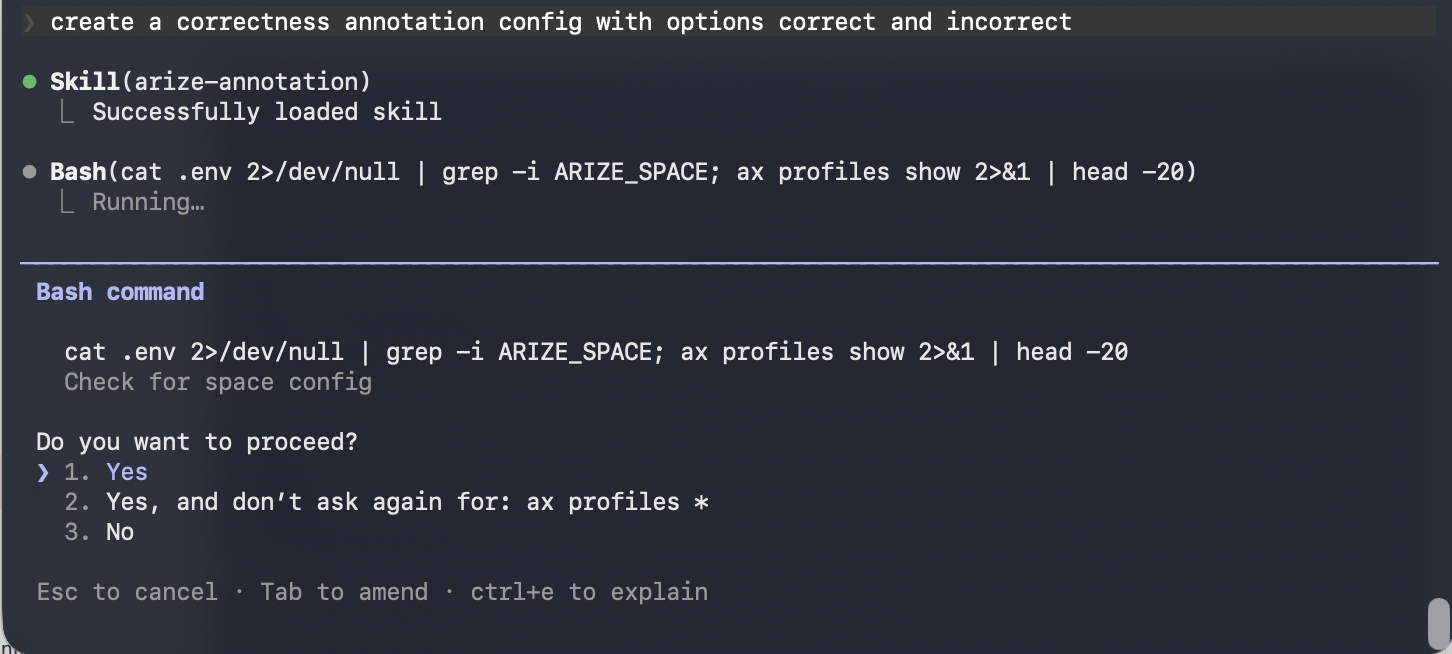
Use the Arize skills plugin in your coding agent to manage annotation configs and apply annotations without leaving your editor. See the full arize-annotation skill documentation for supported commands. Then ask your agent:
“Create a categorical annotation config called Correctness with correct/incorrect labels”
“List all annotation configs in my space”
“Bulk annotate these spans with their correctness labels”
Use Alyx to help you find common error patterns across your traces. From there you can ask Alyx to annotate spans directly:
“Show me the most common failure patterns in my traces”
“Create an annotation config capturing good and bad responses”
“Annotate spans where the output looks incorrect — a good response is factually accurate and directly answers the user’s question, a bad response is vague, hallucinated, or off-topic”
Open the Spans view and review real outputs. Optionally use filters to focus on a specific span kind, time range, or status. To annotate a span, click the annotate button, and select your config.
Apply annotations via the Python SDK to attach human feedback programmatically.
Note: Annotations can be applied on spans up to 31 days prior to the current day. To apply annotations beyond this lookback window, please reach out to support@arize.com
These are our sample annotations to be logged:
import pandas as pd# Sample annotation df with multiple annotationsannotations_dataframe = pd.DataFrame({ "context.span_id": [ "12345", "67890", ], # Categorical annotation: quality "annotation.quality.label": ["good", "excellent"], "annotation.quality.updated_by": ["annotator_1", "annotator_2"], # Optional notes for each span "annotation.notes": [ "User confirmed the summary was helpful.", "Response was clear and accurate.", ],})
The annotations_dataframe requires the following columns:
context.span_id: The unique identifier of the span to which the annotations should be attached.
Annotation columns use the pattern annotation.NAME.SUFFIX, where NAME is your annotation key (for example quality, correctness, or sentiment) using only letters, numbers, and underscores, and SUFFIX is one of the field types below:
SUFFIX defines the type and metadata of the annotation. Valid suffixes are:
label: For categorical annotations (for example, _good_, _bad_, _spam_). The value should be a string.
score: For numerical annotations (for example, a rating from 1–5). The value should be numeric (int or float).
You must provide at least one annotation.NAME.label or annotation.NAME.score column for each annotation you want to log.
updated_by (Optional): A string indicating who made the annotation (for example, user_id_123 or annotator_team_a). If not provided, the SDK automatically sets this to SDK Logger.
updated_at (Optional): A timestamp indicating when the annotation was made, represented as milliseconds since the Unix epoch (integer). If not provided, the SDK automatically sets this to the current UTC time.
annotation.notes (Optional): A column containing free-form text notes that apply to the entire span, not a specific annotation label or score. The value should be a string.
An example annotation data dictionary would look like:
# Assume TARGET_SPAN_ID holds the ID of the span you want to annotateTARGET_SPAN_ID = "3461a49d-e0c3-469a-837b-d83f4a606543"annotation_data = { "context.span_id": [TARGET_SPAN_ID], # Annotation 1: Categorical label, let SDK autogenerate updated_by/updated_at "annotation.quality.label": ["good"], # Annotation 2: Categorical label, manually set updated_by "annotation.relevance.label": ["relevant"], "annotation.relevance.updated_by": ["human_annotator_1"], # Annotation 3: Numerical score, let SDK autogenerate updated_by/updated_at "annotation.sentiment_score.score": [4.5], # Optional notes for the span "annotation.notes": ["User confirmed the summary was helpful."],}annotations_dataframe = pd.DataFrame(annotation_data)
For routed review workflows and curating labeled examples into a benchmark dataset, see Labeling Queues.