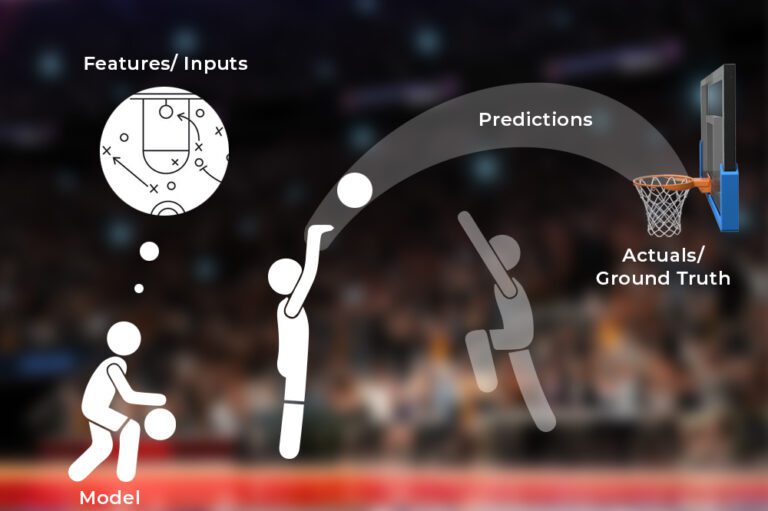

Concept drift is the shift in the statistical properties of the target or dependent variable(s), i.e. a drift in the actuals. Specifically, the drift of current ground truths from previous ground truths from a prior time window or training dataset. Unlike data drift, which changes input distributions, concept drift changes what the correct label means for a given input pattern. A spam filter sees new attack styles. A demand model breaks when a promotion changes buying behavior. The features may look familiar while labels no longer follow the old mapping.
Build better agents with Arize
Trace, evaluate, and learn. Build agents that work with Arize AX and start tracing your runs today.
Prefer open source? Try Arize Phoenix for self-hosted, open source agent observability.

Key takeaways
- Concept drift is a change in P(y|x), not merely a change in P(x).
- Detection needs labeled samples or reliable proxy outcomes; unsupervised input monitors alone miss concept drift.
- Sudden, gradual, and recurring drift patterns need different response playbooks.
- Retraining fixes some concept drift; policy or definition changes may require label schema updates instead.
- Separate concept drift alerts from data drift alerts so on-call knows which playbook to run.
Concept drift versus data drift
Data drift (covariate shift) shifts feature distributions while the labeling rule stays stable. Example: user age mix changes but fraud definition is unchanged.
Concept drift keeps inputs similar yet changes the label relationship. Example: fraudsters adapt tactics so the same transaction features mean different risk.
Production incidents often involve both. A marketing campaign shifts demographics (data drift) and also changes conversion meaning (concept drift).
Types of concept drift
Sudden drift follows a policy change, product launch, or external shock. Metrics step-change within days.
Gradual drift erodes performance slowly as behavior evolves. Easy to miss without trend lines on slice metrics.
Recurring drift follows seasons or cycles. Models may need periodic refreshes rather than one-time retrain.
Virtual drift happens when labels are redefined without feature change. Fix documentation and backfill labels, not only weights.
Detection signals
Track performance metrics with delayed labels: accuracy, precision, recall, calibration, or business KPIs tied to predictions.
Compare recent label rates to historical baselines conditional on score bins. If high-score bins suddenly produce more negatives, concept drift is likely.
Run periodic shadow models retrained on fresh data. If the challenger beats the champion on recent weeks while offline evals looked tied, drift is a prime suspect.
For LLM apps, rubric scores and human review samples play the role of labels. A drop on the same golden set after no code change suggests prompt or world-knowledge drift rather than concept drift in the classical sense, but the ops response is similar: investigate and refresh.
Response playbook
- Confirm label pipeline integrity (no bug in ground truth ingestion).
- Slice failures by cohort, geography, and product line.
- Decide between quick mitigations (threshold adjust, rules layer) and full retrain.
- Update training data window and document the incident for future baselines.
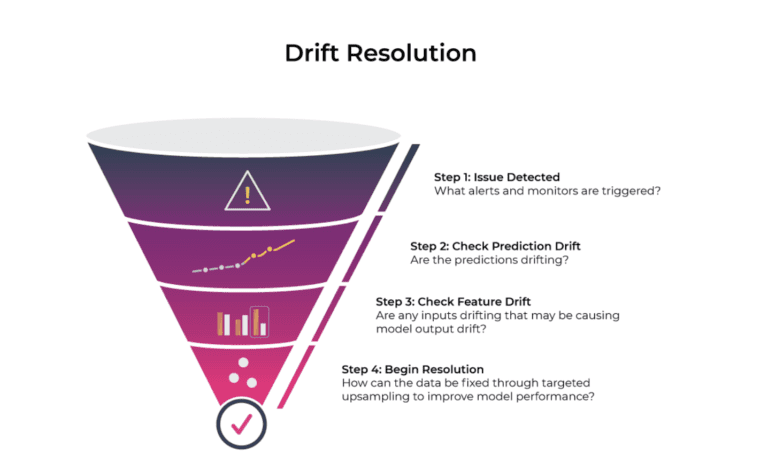
Articles on model, concept, and data drift walk through how teams triage which drift type fired an alert.
Lifecycle guides in AI model lifecycle management place concept drift review beside retraining cadence and validation gates.
For NLP classifiers, sentiment and topic shifts show up in production reviews; see monitoring patterns in NLP sentiment classification monitoring for slice-oriented workflows.
Failure modes in monitoring
Confusing latency for drift. Labels arriving late make recent windows look worse than they are.
Global averages. Concept drift often starts in one slice while global metrics barely move.
Over-retraining. Retraining on stale label definitions encodes the wrong concept.
Ignoring external events. Calendar knowledge (tax season, sports events) explains recurring drift better than model bugs.
FAQ
Can I detect concept drift without labels?
Purely unsupervised methods struggle. You can flag suspicion when input drift is low but business KPIs tied to predictions move. Eventually you need labeled or proxy evaluation.
Does concept drift always require a new model?
Sometimes policy or feature engineering fixes the issue. Often fresh labels and retrain help when the world changed but the feature set is still informative.
How is concept drift related to model staleness?
Staleness is informal aging. Concept drift is a specific statistical statement about P(y|x). A model can be stale from data drift alone.
What window size should I use to detect concept drift?
Long enough for stable label counts, short enough to catch incidents before business impact. Weekly for high-volume classifiers, monthly for low-volume, adjusted per slice.
How does concept drift affect LLM agents?
Tool success rates and task rubrics can drop when user intent shifts or external APIs change behavior. Trace evals on fixed scenarios help separate agent regressions from environmental change.