Arize vs. Braintrust at a glance
Quick answer: Braintrust is a strong fit for teams focused on prompt iteration and offline evaluation. Arize AX is designed for teams operating AI applications and agents in production, with deeper tracing, path and session evaluation, continuous monitoring, and VPC deployment. The right choice depends on the stage and scale of your AI systems.
Arize and Braintrust both sit in the AI evaluation and observability category, but they were built around different jobs.
Arize is an AI engineering platform for teams shipping agents. The improvement loop starts with the trace, which records every call from the first development run through production, evaluates behavior at the span, trace, and session level, surfaces failure patterns the team didn’t predefine, and feeds those real failures back into datasets, experiments, and regression coverage for the next release.
Braintrust is an evaluation-first platform. Its strongest loop lives in the playground and experiment workflow: tune a prompt, run it against a dataset, wire up a scorer next to it, and compare versions side by side. That makes it a fast way to dial in prompts and regression checks before release. Production logging, Topics, and Loop extend that same eval-centered loop rather than starting from an observability foundation.
Want a deeper dive into alternatives to Braintrust? Try our guide that explores everything you should consider when looking for options outside Braintrust.
In the meantime, here’s a side-by-side look at the core assets of each tool:
| Capability | Arize | Braintrust |
|---|---|---|
| Philosophy | Observability-first; evaluation across the full lifecycle | Evaluation-first; production logging as an extension of evals |
| Strongest phase | Production: live traces, sessions, online evals, monitoring, root cause | Pre-release: datasets, scorers, experiments, CI gates |
| Agent debugging | Trajectory, path, and session-level evaluation; graph views for multi-agent systems | Span and trace scoring; session grouping and multi-turn traces; span-tree trace review |
| Issue discovery | Alyx assistant plus Signal, which continuously reviews production traces and surfaces emerging failure clusters | Topics classification plus manual trace review and predefined scorers |
| Instrumentation | OpenTelemetry and OpenInference native; auto-instrumentation across 30+ frameworks and providers | SDK wrappers and decorators per framework; OTel supported as a fallback via a span converter into Braintrust's schema |
| Self-hosting | Arize AX deploys in your VPC or fully on-prem, control plane included; Phoenix also runs fully self-contained | Hybrid model: data plane in your VPC, control plane and auth managed by Braintrust; self-hosting requires Enterprise |
| Pricing model | Arize AX has free and self-serve tiers priced on spans and data volume, no per-seat charges; Phoenix is open source and free | Free Starter (1 GB, 10k scores), then $249/mo Pro; usage billed on processed data and score volume |
Teams whose main job is prompt experiments and regression checks before release will find Braintrust a reasonable tool for that loop. Teams shipping agents that need one record of every call from development through production, and a way to evaluate and fix behavior wherever it breaks, will find Arize AX the stronger platform.
See how Arize compares to other tools and platforms
Side-by-side breakdowns for teams evaluating tracing, evals, and agent observability tools.
Why teams choose Arize
One record from development to production Most agent evaluation tools split the AI lifecycle in half. Offline experiments…
See the competitionLangfuse
Compare Arize Phoenix vs. Langfuse on open source tracing, agent evals, self-hosting, and pricing, plus when teams add…
See the competitionLangSmith
Compare Arize vs. LangSmith for AI observability, agent evaluation, OpenTelemetry, failure discovery, self-hosting, and pricing to choose the…
See the competitionWhat Arize does well
- The observability foundation is complete. Traces, sessions, retrieval calls, tool calls, cost, and quality signals all land in one place, with dashboards, monitors, and alerting on top, so the platform answers “what happened” before the team starts asking “was it good.”
- Instrumentation lives on open standards. OpenTelemetry and OpenInference support means one instrumentation step covers 30+ frameworks and providers.
- Evaluation runs everywhere, not just in experiments. The same evaluators work in offline experiments, CI, and continuously against live traffic, and agent-native evals cover trajectories, path convergence, tool selection, and session-level task completion rather than only final outputs.
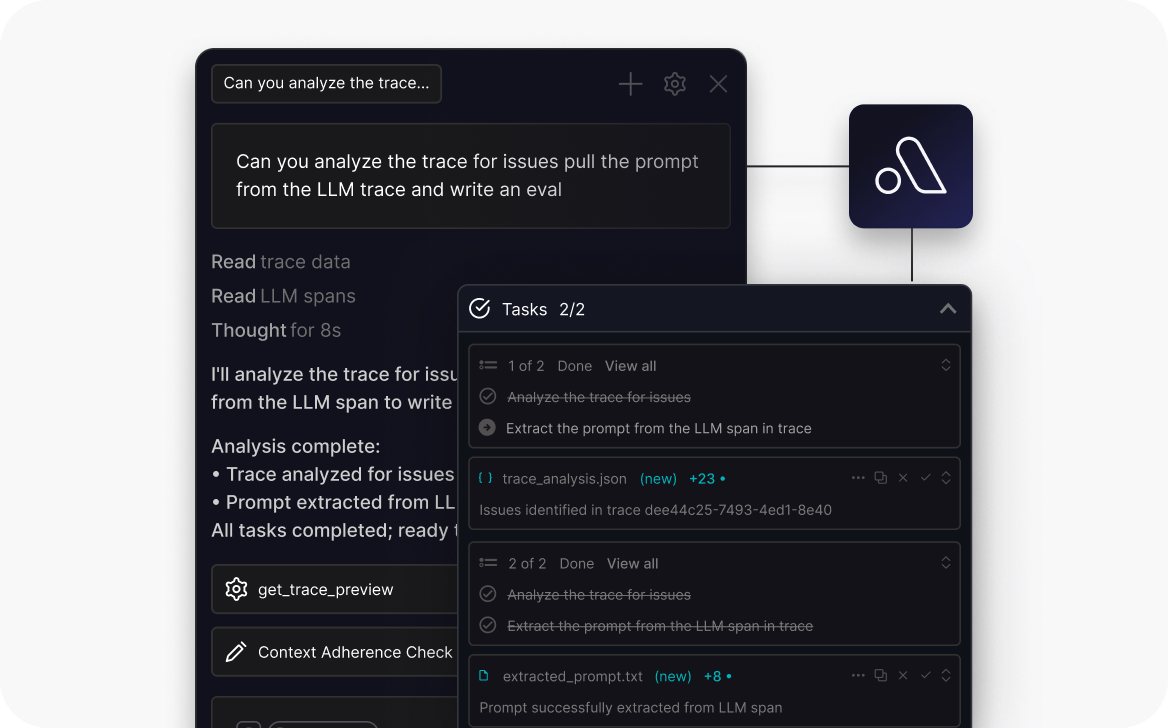
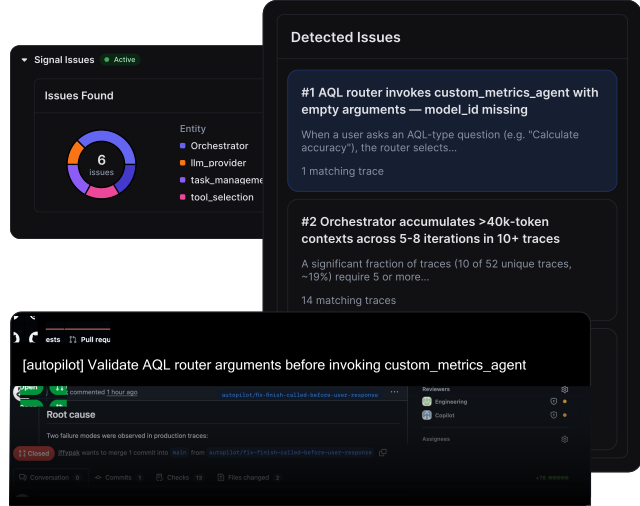
- Failure discovery is built in. Signal continuously reviews production traces and surfaces emerging failure patterns the team did not predefine. Alyx, the in-platform AI engineering agent, helps investigate those issues and propose next steps.
- There’s a free path with no ceiling on open source. Phoenix self-hosts in your own environment with no feature gates or usage caps. Teams move to Arize AX when they want managed infrastructure, governance, and production scale. AX Free and Pro include hosted tracing and evals with span, ingestion, retention, and Signal limits; Enterprise removes those ceilings and adds VPC / on-prem deployment.
Braintrust and Arize overlap most in the offline eval workflow and separate once the work moves into production.
What Braintrust does well
- The dataset, scorer, and experiment workflow is solid. Teams can build test cases, attach code-based or LLM-as-judge scorers, run experiments across prompt and model versions, and compare results side by side in the playground. User feedback highlights the experiment UI and the speed of prompt iteration.
- The trace-to-test workflow is a useful pattern. When a production trace looks wrong, one click turns it into a dataset row that becomes a permanent regression case, which closes a loop many teams otherwise handle with copy-paste.
- Release gating is native. Braintrust ships a GitHub Action that runs evals in CI and can block a deployment when scores regress, making evaluation part of the merge decision rather than a dashboard someone checks later.
- The platform continues to add to this loop. Topics classifies traces by intent and issue, Loop generates scorers and iterates on prompts, online scoring can run at span or trace scope, and the Brainstore backend, which is a proprietary database built for large nested trace payloads, handles queries over big traces quickly.
How Arize and Braintrust differ across the AI lifecycle
Braintrust is strong at prompt and experiment development: iterate on a prompt, run an experiment, compare versions, and ship with confidence. That loop assumes you already know what to test, and real usage breaks that assumption. Real users don’t behave like a curated dataset: they trigger runtime failures, orchestration failures, retrieval failures, and semantic failures that no one wrote a scorer for. When a bad answer reaches a user, the team’s first questions are operational rather than experimental:
- Which sessions failed, and how many users did this touch?
- Did the failure come from retrieval, the model, a tool call, routing, or stale context?
- Why did latency spike – retries, longer outputs, a slow external tool?
- Is this concentrated in one segment, one customer, one agent path?
- Is it recurring right now, and will we know whether it comes back after the fix?
This is where the two platforms diverge. Braintrust gives you an eval-centered surface: you measure against scorers and classifications you define, and production logging, Topics, and online scoring feed that surface.
Arize gives you a discovery surface built on a continuous record: every call is traced from development through production, Signal continuously reviews traffic, emerging failure patterns are clustered and surfaced, and the eval suite grows from what is actually breaking rather than only what the team predicted. This is the scenario Signal and Agent-as-a-Judge were built for. Signal is the always-on worker that reviews production traces and groups related failures into investigation reports. Agent-as-a-Judge (closed Enterprise beta) lets teams describe what good behavior looks like so an agentic harness can inspect live traces, identify the relevant spans, classify issues, and create labels that feed monitoring, evaluation, and experimentation going forward. The eval signal keeps pace with production instead of freezing at release time.
Head-to-head comparison
Observability: seeing what happened
Arize was built for observability first. Arize AX captures traces, sessions, spans, tool calls, retrieval calls, latency, token usage, and cost, with dashboards, alerting, and monitors on top: a full picture of agent observability rather than a searchable request log. (Classic ML monitoring for drift and embeddings remains part of Arize’s broader platform heritage, separate from the LLM and agent tracing surface.) Instrumentation is OpenTelemetry and OpenInference native, with auto-instrumentation across 30+ frameworks and providers including OpenAI, Anthropic, Bedrock, LangGraph, LangChain, LlamaIndex, CrewAI, the OpenAI Agents SDK, and DSPy. Because the data lives on open standards, it stays portable: you are not locked into one SDK or one vendor’s data format. Arize also supports voice agents natively, inspecting audio sessions alongside transcripts, analyzing interruptions and time-to-first-audio, and running evals directly against audio interactions.
Braintrust approaches observability from the eval side. Tracing is detailed and fast, but instrumentation runs through SDK wrappers, decorators, and callback integrations per framework, with OTel supported as a fallback path where spans get converted into Braintrust’s own trace format on the way in. It’s eval-forward and observability-second: strong at inspecting a trace you already found, weaker at proactively telling you which traces to look at. Topics moves toward active classification, but the platform’s monitoring, alerting, and cross-team dashboard depth still trails purpose-built observability platforms.
Evaluability: measuring whether it was good
Both platforms take evaluation seriously, and this is Braintrust’s home turf: datasets, code and LLM-as-judge scorers, human review, experiments, and CI gates are all first-class. Loop can generate scorers from natural language and iterate on prompts automatically. Scorers can run at span or trace scope, so teams can score individual operations or whole multi-turn workflows without rolling everything into a parent span first. Arize matches the offline workflow, including datasets, experiments, annotations, LLM-as-judge, human labeling queues, and extends it in three directions:
- Online evals at production scale. Evaluators run continuously against live traffic, not only against experiments, across customers like Uber and Booking.com.
- Agent-native evals. Beyond output and trace scoring, Arize evaluates trajectories: path convergence, tool-selection correctness, planning quality, and session-level task completion. For multi-agent systems, graph views show how agents hand off, loop, and backtrack.
- Versioned, reusable evaluators. The Evaluator Hub gives teams version history with commit messages over evaluators, so the same judge can run in offline experiments, CI, and production monitoring. (Custom code evaluators and Agent-as-a-Judge are available on Enterprise; Agent-as-a-Judge is currently closed beta.)
Actionability: getting from failure to fix
Arize is built for root cause. Signal surfaces recurring production failure patterns. Alyx, the in-platform AI engineering agent, investigates traces, proposes evaluators (with human confirmation before changes apply), and helps debug directly, while alerting routes to PagerDuty and Slack. The Arize CLI and Skills let teams run the same workflows from the terminal or from coding agents like Claude Code and Cursor, so debugging production issues lives in the same loop as writing the fix. Similar to Braintrust, the trace-to-dataset workflow exists here, too: a failed session becomes a labeled example, a dataset item, and a regression test.
Braintrust’s flow runs from trace to dataset to experiment to CI gate, and it works well when the failure is one you can already see and name. When the failure is buried in a long agent trace, the span-tree UI works against you: reading a 2,000-span agent run node by node is slow, because the UX was designed around prompt-response pairs and the eval loop rather than the debugging loop.
Operability: fitting how your company runs AI
This is where structural differences matter most for enterprise buyers.
Self-hosting
Arize offers a genuinely self-contained path. Phoenix runs entirely in your environment – locally, in Docker, or in your cloud – with no SaaS control plane. Arize AX adds enterprise deployment options including VPC and on-prem, with SOC 2 and GDPR support on the platform, plus HIPAA, RBAC, and audit controls on Enterprise. That same self-contained deployment model is used in regulated environments, including U.S. Navy / DIU MLOps programs where Arize contributed model-monitoring capabilities.
Braintrust’s model is hybrid: on Enterprise, the data plane can run in your VPC, but the control plane, including auth and the UI, remains managed by Braintrust’s cloud. Many teams will find that acceptable, but for regulated environments that need a fully self-contained control plane, or true air-gapped auth, it means outbound dependencies, a third party in the auth path, and version-skew risk when the local data plane falls behind the managed control plane’s update schedule. On Starter and Pro, all data runs through Braintrust’s hosted cloud, and there is no self-hosted option below Enterprise.
Data portability
Arize is built on OpenTelemetry and the OpenInference semantic conventions, so trace data remains in an open format you can move.
Braintrust’s Brainstore is proprietary, and even OTel spans get converted into its schema at ingestion. The performance benefits are real, though raw data portability is harder than with OTel-native platforms.
Cross-functional work
Production AI failures are rarely just a development problem, since support sees the tickets, product sees the abandonment, and finance sees the token spend. Arize AX gives each function a view over the same quality signal, including dashboards, labels, cost attribution, and recurring-failure reports, while teams work from raw traces and evaluator outputs. Braintrust’s surfaces are built primarily for the developer running experiments.
Compare pricing at your expected production volume
Both platforms have free tiers and usage-based paid tiers, but the units differ in ways that matter for agents.
Arize
- Phoenix: free and self-hosted with no feature gates or usage caps, covering tracing, evals, datasets, experiments, and prompt management.
- AX Free: hosted tier that includes Alyx and the evaluation suite at $0, with 25k spans/month, 1 GB ingestion, 15-day retention, Signal limited to 10 issues/month, and a choice of data region.
- AX Pro: self-serve tier from $50/month with 50k spans/month, 10 GB ingestion, 30-day retention, Signal limited to 25 issues/month, overage pricing so data keeps flowing past the cap, and no per-seat charges.
- AX Enterprise: custom pricing for production scale, governance, ADB Data Fabric, VPC / on-prem deployment, HIPAA, unlimited Signal, and support SLAs. The structural difference is that Arize does not meter your evaluation depth. Pricing scales with span and data volume rather than with how many evals you run per trace, so adding session-level and trajectory evals to an agent does not multiply the bill. For teams starting out, Phoenix removes the pricing question entirely.
Braintrust
- Starter: free, with 1 GB processed data/month (then $4/GB), 10,000 scores (then $2.50/1k), 14-day retention, and unlimited users and projects.
- Pro: $249/month, with 5 GB (then $3/GB), 50,000 scores (then $1.50/1k), and 30-day retention, with optional longer retention at $0.50/GB/month. Pro also includes basic RBAC, custom charts, and environments.
- Enterprise: custom pricing, required for self-hosting, SAML SSO, custom RBAC, BAAs, and custom retention/export. The pressure point is score-based billing in production. A single agent session can generate many scored units across the final answer, each retrieved chunk, each tool call, and trace-level evals, which means deep online evaluation coverage multiplies score volume with traffic. Included retention windows of 14 to 30 days are also short when you are debugging an issue a customer reported three weeks ago, unless you pay for longer retention on Pro or move to Enterprise. Teams consistently flag the jump from free to $249 with nothing in between, along with Enterprise gating for SAML SSO, BAAs, and custom retention policies.
When Braintrust is the right choice
Braintrust fits well when your workflow is centered on prompt development and you already know your failure modes. Teams whose day-to-day is prompt experiments, dataset curation, scorer development, and CI regression gates, with production logging mostly serving as an input to that loop, will get real value from Braintrust’s experiment UI and trace-to-test flow, and the free tier lets a whole team try it without procurement. It’s also a reasonable fit for teams that want a managed, all-in-one hosted product and do not have data-residency constraints that require self-hosting below Enterprise.
When Arize is the right choice
Choose Arize when:
- You want one record from development to production. Traces, sessions, online evals, monitoring, alerting, and root-cause workflows run on the same data before and after release, so nothing depends on what someone remembered to stage.
- You’re shipping agents. Trajectory evals, path and convergence analysis, multi-agent graph views, session-level task completion, and voice-agent observability are native capabilities rather than adaptations of a prompt-response model.
- You need failure discovery, not just failure measurement. Signal continuously reviews production traffic, surfaces issues you did not predefine, and turns them into labeled, monitorable patterns.
- You need real deployment control. Arize AX supports VPC and on-prem without a managed control plane in your auth path, and Phoenix gives you a fully contained open source option.
- You want data on open standards. OTel and OpenInference mean no framework lock-in and no proprietary data format between you and your traces.
- You operate at scale. Arize’s platform is built to handle trillion-span monthly volumes, with a heritage in ML monitoring, including drift and embeddings, that LLM-native tools do not match.