

TL;DR
- Agents fail in their work, not just their answers. A correct-looking output can hide a skipped policy step, the wrong tool, or wasteful retries — “corrupt success” that surfaces later as an escalation, an audit finding, or a lost deal.
- Output-only evaluation is expensive. Customers become the detection system, engineers become the search function, and releases either slow down for manual testing or ship blind.
- Agent-native evaluation scores the trajectory. It examines the path taken, tools selected, policies followed, and whether the full session accomplished the task — continuously, on live traffic.
- Measure it on risk, velocity, and ROI. Failures caught before customers report them, faster report-to-fix cycles, and incident and token costs made visible.
- Prove it with a pilot. Baseline four numbers on one production agent, run continuous evaluation for a bounded period, re-measure, and present the delta against platform cost.
Agents fail more like employees than software: they mishandle tasks, skip policies, or give customers answers that sound right but aren’t. And evaluating the output alone can miss where the work went wrong.
Agent-native evaluation examines an agent’s steps and tool calls across the full session to assess whether it follows policy and completes the task. The business case comes down to fewer costly customer-facing failures, less engineering time spent tracking down problems, and faster, more confident releases.
This guide explains why agent evaluation matters now, how to make the case for it internally, and what infrastructure you need to put it into practice.
Where agent failures hide once agents reach production
Two things have recently changed:
- AI applications became agents, meaning systems that take actions, call tools, and complete multi-step tasks rather than answering single questions.
- Those agents moved into production: they now run in front of customers, inside workflows the business depends on.
That combination changed where failure lives. A chatbot fails in its answer, and the answer is right there to check. An agent fails in its work, and the work is invisible unless something records it. For example:
- A support agent resolves a ticket while skipping the escalation rule that compliance requires.
- A finance assistant returns the right number after querying the wrong system, so the number is right today and wrong the day the systems diverge.
- An operations agent completes a task after retrying a broken tool path six times, burning latency and tokens on a route that will fail outright under load.
- A sales agent answers each message in a session well while losing the thread of the deal across them.
The first pattern is called corrupt success: the output passes while the process fails. Every one of those examples produces a response a spot check would approve, and every one carries a cost that surfaces later, as an escalation, an audit finding, a cloud bill, or a lost deal.
The question for a leader has now moved past whether the agent gives good answers, to whether anyone can see the work.
The cost of output-only agent evaluation
Teams that evaluate agents on outputs alone tend to pay in the same places, and the pattern is worth checking against your own operation:
Failures reach customers first. Without evaluation on the path and the session, the detection system is the customer. That pattern shows up even at the largest operators: a four-year study of GenAI production incidents at Microsoft found 38.3% were detected by humans rather than automated monitors, nearly three times the 13.7% rate for other cloud services. The cost arrives as support volume, escalations, churn risk on the affected accounts, and the discounting that follows a trust problem.
Engineers become the search function. When something goes wrong, someone pages through raw traces to find it, and that’s senior engineering time spent on archaeology. Manual review also stops scaling early, so coverage quietly shrinks as traffic grows.
Releases slow down or ship blind. Teams that can’t measure whether a change made the agent better face a bad menu: delay the release for manual testing, or ship and watch support queues. Both options show up in velocity metrics, and the second one shows up in incident reviews.
The same failures recur, and they take longer to fix. A fixed issue that isn’t monitored for recurrence gets rediscovered, rediagnosed, and refixed. The same study found GenAI incidents took roughly 1.7 times longer to mitigate than incidents in other services, partly because human-reported issues bounce between teams before landing with the right owner.
Run your numbers. As an illustration with round figures, swap in your own: three engineers spending five hours a week on manual trace review at a $100 loaded hourly rate is about $78,000 a year before a single incident. Add 30 agent-related escalations a month at a $50 handling cost and the line passes $95,000, without counting churn on affected accounts or the releases that slipped. Most platform tiers in this category price well under that line at comparable volume, which is the comparison that matters: tool cost against what the organization currently spends absorbing failures the tool would catch, rather than against zero.
Build better agents with Arize
Trace, evaluate, and learn. Build agents that work with Arize AX and start tracing your runs today.
Prefer open source? Try Arize Phoenix for self-hosted, open source agent observability.

What is agent-native evaluation
Traditional evaluation focuses on the final answer, while agent-native evaluation examines how the agent carried out the task. It assesses whether the agent took an efficient path, chose the right tools and inputs, followed product policies, and met the customer’s goal across the full session. Running these evaluations continuously on live traffic helps uncover failures that test cases didn’t anticipate.
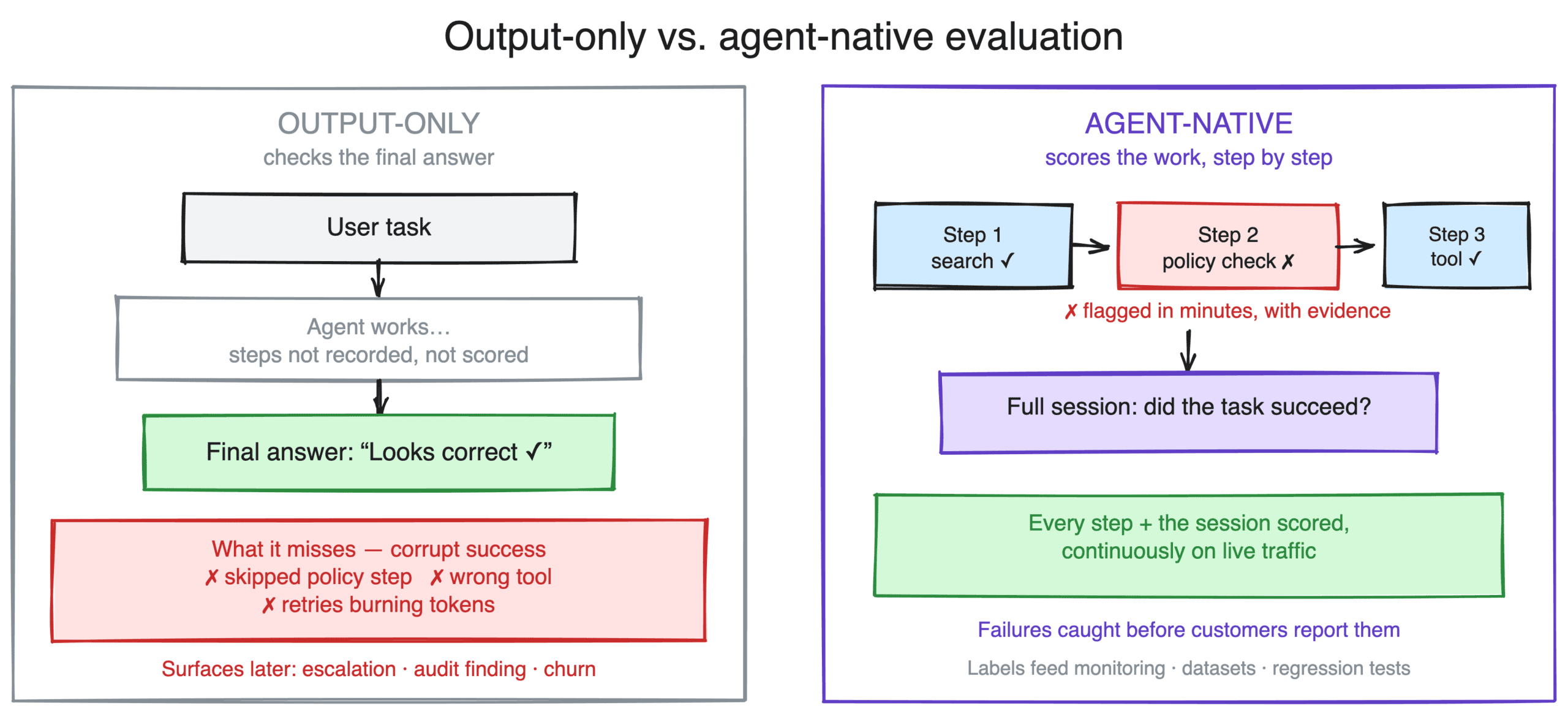
That last part matters most for the business case. Pre-release testing measures the failures your team already imagined. Production evaluation measures the ones it didn’t, and those are the ones that turn into escalations.
How to measure the ROI of agent evaluation
The same lenses that frame any infrastructure purchase apply here, and each one has a measurable line:
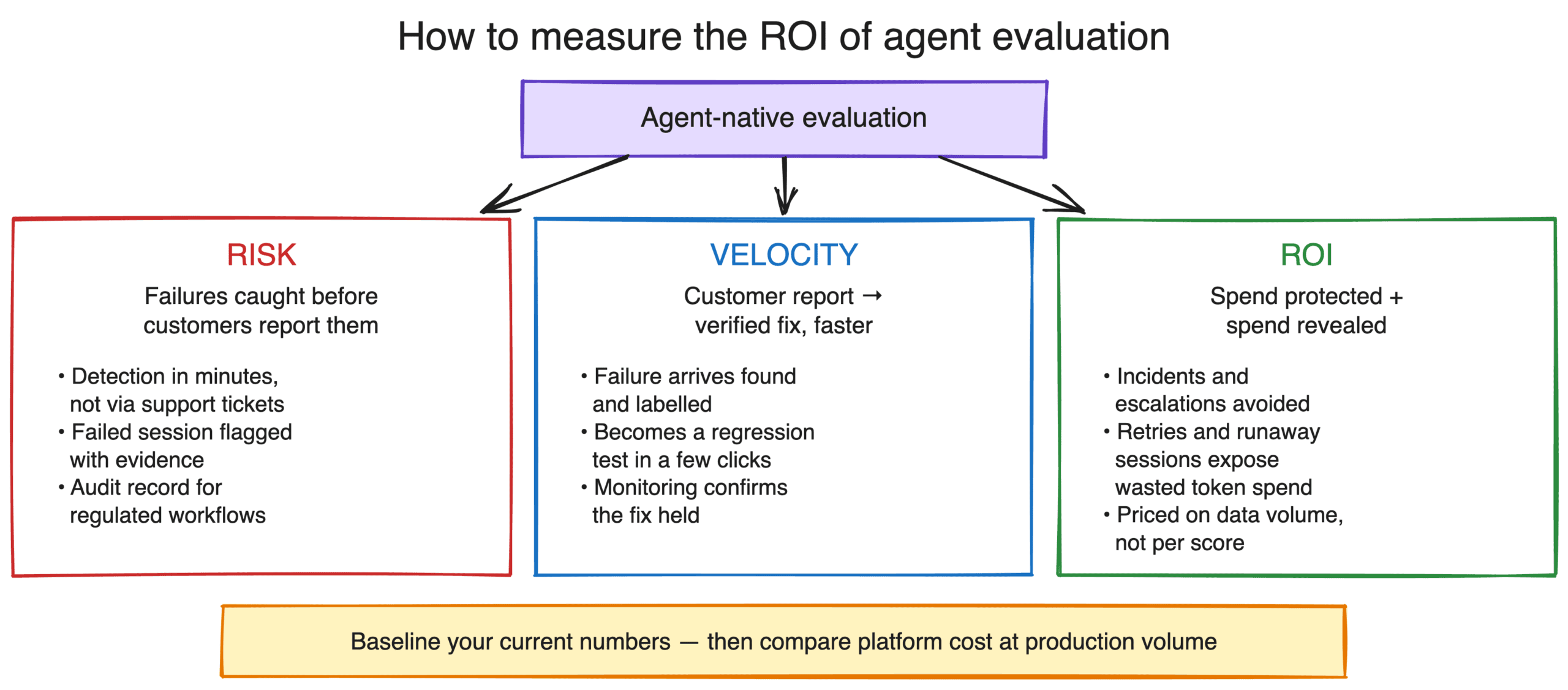
Risk: failures caught before customers report them
The baseline is your current detection story: how AI failures get found today, how long they run before someone notices, and what an incident costs by the time it surfaces through support. Agent-native evaluation moves detection upstream, since continuous scoring flags the failed session in minutes and discovery workflows surface the pattern across sessions before it trends. For regulated workflows, the same record doubles as evidence, so an audit question about how the agent behaved in March gets answered from the platform rather than reconstructed from memory.
Velocity: from customer report to verified fix
Measure the current cycle honestly: a customer reports a problem, an engineer hunts for the session, diagnoses it, tests a fix against whatever cases exist, ships, and hopes. Each step compresses when the failure arrives already found, labeled, and attached to the evidence, when it becomes a regression test in a few clicks, and when monitoring confirms the fix held. The compounding effect is release confidence, because teams that trust their evaluation coverage ship more changes, and shipping more changes is how the agent improves faster than competitors’ agents do.
ROI: the spend it protects and the spend it reveals
The protective side is the risk and velocity math above, priced in your own numbers. The revealing side is operational: trajectory-level visibility shows the retries, the redundant tool calls, and the runaway sessions that inflate token spend, which makes the cost of evaluation partially self-funding for high-volume agents. The structural detail to check is the pricing model itself, since platforms that bill per evaluation score tax exactly the deep coverage this business case depends on, while platforms priced on data volume let coverage deepen without the bill following.
How to build the business case for agent evaluation
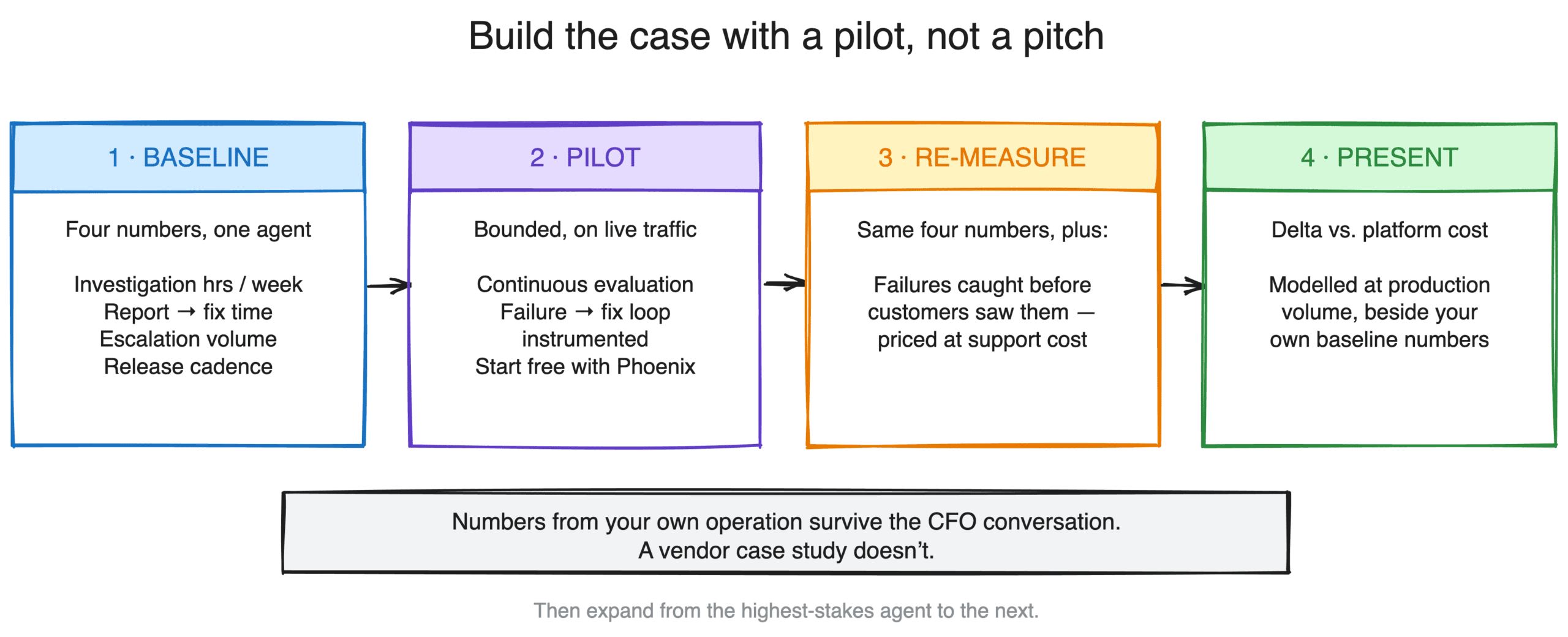
For the PM who has to sell this upward, the pitch writes itself from a baseline and a pilot:
- Baseline four numbers for one production agent: hours per week engineers spend investigating AI behavior by hand, median time from customer report to verified fix, escalation volume attributable to the agent, and the release cadence for agent changes.
- Run a bounded pilot on that agent, with continuous evaluation on live traffic and the failure-to-fix loop instrumented, which open-source tooling can cover before any procurement conversation.
- Re-measure the same four numbers, and add the failures the pilot caught that would otherwise have reached customers, priced at your support and escalation costs.
- Present the delta, with the platform cost modeled at production volume beside it.
The pilot design matters more than the vendor pitch, because the numbers come out of your operation rather than a case study, and a case built on your own baseline survives the CFO conversation.
What agent evaluation infrastructure requires
The other half of the bridge is what has to exist underneath for any of the above to work, and it’s a short list with sharp requirements:
- One record from development through production. Evaluation is only as good as the data under it, so every call the agent makes needs to be traced the same way before and after release, on open standards that keep the record portable as the stack evolves.
- Trajectories and sessions as first-class objects. Scoring the path requires a platform where paths, sessions, and multi-agent handoffs are native evaluation targets rather than something assembled from individual calls.
- Judges that investigate rather than grade. LLM-as-a-judge scores an output against a rubric, which works for single responses and stops at the surface of an agent run. Agent work needs a judge that does work of its own, the way Agent-as-a-Judge sends an agentic evaluator into the trace to find the relevant spans, classify the issue, and create the labels that feed monitoring, datasets, and experiments. The difference decides whether corrupt success gets caught, since a rubric can approve the output while an investigating judge flags the skipped step behind it.
- Discovery, since nobody predefines every failure. Continuous review of production traffic, the way Signal groups related failures into prioritized issues, is what finds the problems your test set never imagined.
- A view for every stakeholder. The failures land on support, product, and finance, so the platform has to give each function its view of the same quality signal without routing everyone through raw traces.
- Economics that reward coverage. The pricing model should let evaluation depth grow with the stakes rather than taxing it.
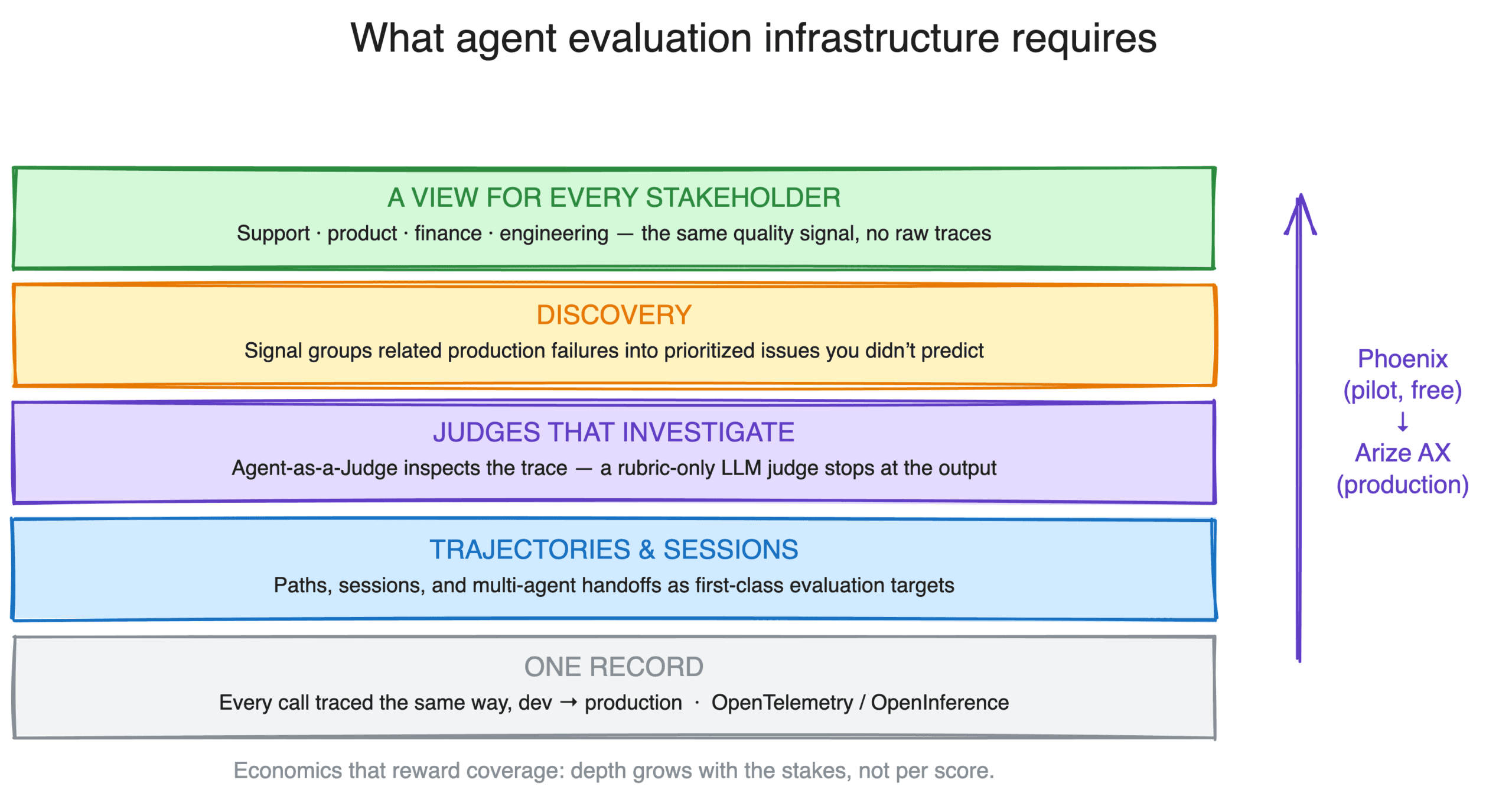
This is the lifecycle Arize was built around, with Phoenix as the open-source starting point that covers the pilot for free and Arize AX as the managed production layer on the same record, which is why the pilot-to-production path above requires no re-instrumentation.
Common objections to agent evaluation
“We already have monitoring.” APM tells you the agent responded quickly and threw no errors, and an agent can do both while completing the wrong task. The failures this case is about are semantic, and they need an evaluation layer, since infrastructure monitoring was never designed to judge whether work was done correctly.
“Our engineers built eval scripts.” In-house scripts usually cover offline testing of known cases, and the expensive failures are the unknown ones in live traffic. The build-it-yourself version of continuous production evaluation, discovery, and cross-functional reporting is a platform team, and that cost belongs in the comparison.
“We’ll add evaluation after launch.” Launch is when the unknown failures start, so evaluation added afterward begins with a backlog of incidents instead of a baseline. Teams that instrument before launch also avoid the migration tax, since the record that supported development carries into production unchanged.
“Isn’t this an engineering purchase?” Engineering runs it, and the outcomes land on the business: customer trust, incident cost, release velocity, and audit readiness. That’s why the strongest evaluations of this category involve both seats, with engineers testing the workflow and leaders holding it to the three numbers above.
Agent-native evaluation FAQs
What is agent-native evaluation?
Evaluation designed for AI agents rather than single responses. It scores the trajectory, including the path the agent took, the tools it selected, the policies it followed, and whether the full session accomplished the task, and it runs continuously against production traffic as well as in pre-release testing.
Why do output-only evals miss agent failures?
Because an agent’s final answer can look correct while the work behind it went wrong, a pattern researchers call corrupt success. The agent may have skipped a required step, used the wrong evidence, or burned cost on retries, and none of that appears in the output a spot check reviews.
What is the difference between LLM-as-a-judge and Agent-as-a-Judge?
LLM-as-a-judge asks a model to score an output against a rubric, and it remains useful for single responses. Agent-as-a-Judge sends an agentic evaluator into the trace itself, where it inspects the run, identifies the relevant spans, classifies the issue, and creates labels that feed monitoring, datasets, and experiments. For agents, the investigating judge is what catches the failures a rubric approves, like a correct answer produced through a skipped policy step.
How do we measure the ROI of agent evaluation?
Baseline the current costs for one production agent, including engineer hours spent investigating by hand, time from customer report to verified fix, escalation volume, and release cadence, then run a bounded pilot with continuous evaluation and re-measure. Add the failures caught before customers saw them, priced at your support and escalation costs, and put the platform cost at production volume beside the delta.
When should a team invest in this?
Before the agent carries real traffic, ideally, since the record that supports development carries into production and the team starts with a baseline instead of a backlog. Teams already in production should start with their highest-stakes agent, where the risk and velocity math is largest, and expand from the results.

