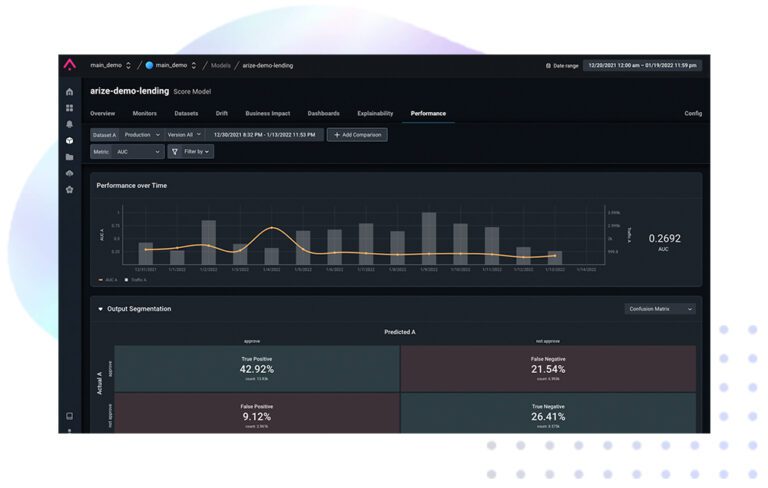

The Receiver Operating Characteristics (ROC) is a probability curve plotted between true positive rate (TPR) and false positive rate (FPR). Area Under the Curve (AUC) is an aggregate measure of performance across all possible classification thresholds. Together, ROC-AUC represents the degree of separability, or how much a model is capable of distinguishing between classes. The higher the AUC (i.e. closer to 1), the better the model ranks positives above negatives.
Build better agents with Arize
Trace, evaluate, and learn. Build agents that work with Arize AX and start tracing your runs today.
Prefer open source? Try Arize Phoenix for self-hosted, open source agent observability.

Key takeaways
- ROC-AUC measures ranking quality independent of a single threshold choice.
- Plots TPR versus FPR as threshold sweeps from high to low scores.
- AUC 0.5 means random ordering; 1.0 means perfect separation.
- Strong AUC can coexist with poor recall at the operating threshold under imbalance.
- Use ROC-AUC for model comparison; pair with precision-recall at chosen thresholds for deployment.
ROC curve mechanics
For each candidate threshold on predicted scores, compute TPR (recall) and FPR (FP among negatives). Plot TPR on y-axis, FPR on x-axis. Connect points to form the ROC curve.
AUC integrates the area under that curve. It equals the probability a random positive scores higher than a random negative for rank-based interpretations.
When ROC-AUC helps
Comparing models during development before business picks a threshold.
Problems where class balance in the eval set reflects scoring goals and both classes matter.
Ensemble feature selection when you need a threshold-free scalar.
When ROC-AUC misleads
Heavy class imbalance: ROC can look optimistic while precision at workable recall stays poor.
Cost-sensitive decisions: no single point on ROC reflects your FP versus FN economics.
Heavy score clustering: AUC may be high while small score changes massively move precision.
Always inspect precision-recall curves and confusion matrices at intended operating points.
Related metrics
PR-AUC focuses on precision versus recall, often more informative on rare positives.
Partial AUC emphasizes low FPR regions for fraud and safety use cases.
Calibration is separate; good ranking does not imply predicted probabilities match frequencies.
Guides on AI model lifecycle management place threshold metrics in production gates alongside AUC from offline eval.
Deployment confidence posts such as shipping image classification models with confidence stress slice metrics beyond aggregate AUC.
Probabilistic scorers in agent routes should log both AUC on eval sets and live precision-recall via LLM and agent evaluation platforms.
Monitoring notes
Track score distribution drift even when AUC on recent labels is stable.
Recompute AUC only on representative labeled samples; delayed labels skew windows.
Score calibration follow-up
After selecting models by AUC, run calibration plots before deploying probability thresholds to operations teams.
Partial AUC for fraud
Some fraud teams integrate ROC only up to FPR 0.05; document that slice when comparing models for those products.
Practitioner checklist
Before changing production settings, confirm labels, thresholds, and monitor windows match the definitions used in your last offline eval. Snapshot dashboards when incidents start so postmortems compare apples to apples.
Run slice-level reviews on high-traffic cohorts weekly even when global metrics look flat. Many failures appear first in one locale, product line, or prompt route.
Document model version, featurizer hash, and data window in every incident ticket. Future you needs that context to interpret drift charts.
When metrics disagree (offline vs online, precision vs recall), write down the business cost of each error type before picking a fix. Metrics are proxies; costs are the decision.
Share eval harness links in release notes so support and PM teams know which golden tasks must pass before they announce improvements.
Related concepts
ROC-AUC complements precision-recall analysis on imbalanced problems. Report both curves during model selection, then commit to threshold metrics for production dashboards.
FAQ
Is higher ROC-AUC always better?
Better ranking, yes. Deployment success still depends on threshold, calibration, and slice performance.
Can AUC be below 0.5?
Yes if the model ranks backwards; invert scores or fix labeling bugs.
Should I use ROC-AUC or PR-AUC?
ROC-AUC when both classes matter and negatives are plentiful. PR-AUC when positives are rare and misses dominate concerns.
Does ROC-AUC apply to multiclass models?
Extensions use one-vs-rest or macro-averaged curves; binary ROC remains the common teaching case.
Do LLM classifiers use ROC-AUC?
When you produce continuous scores or probabilities for a binary decision, yes on labeled eval sets.