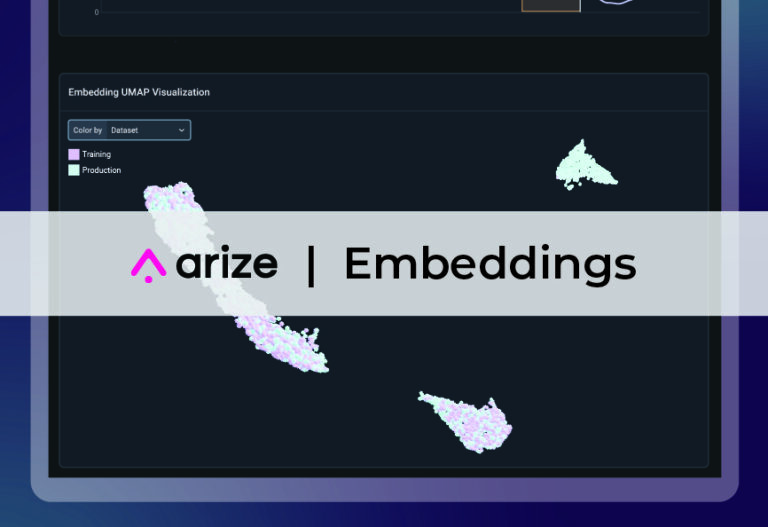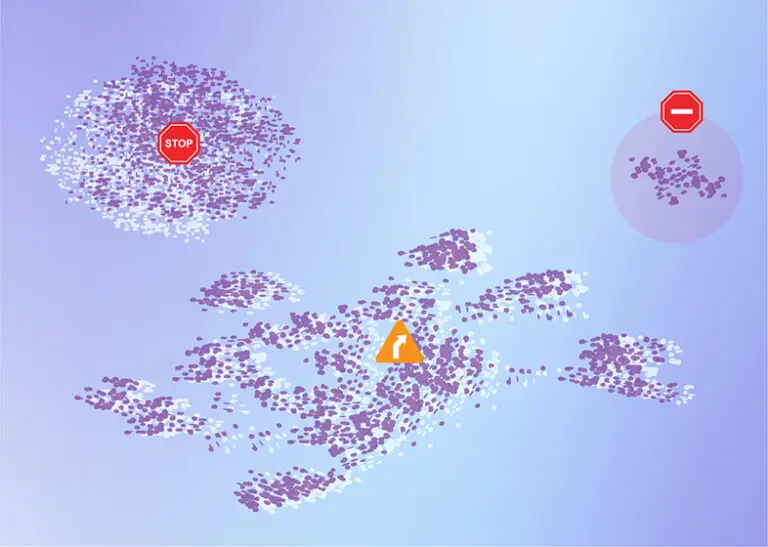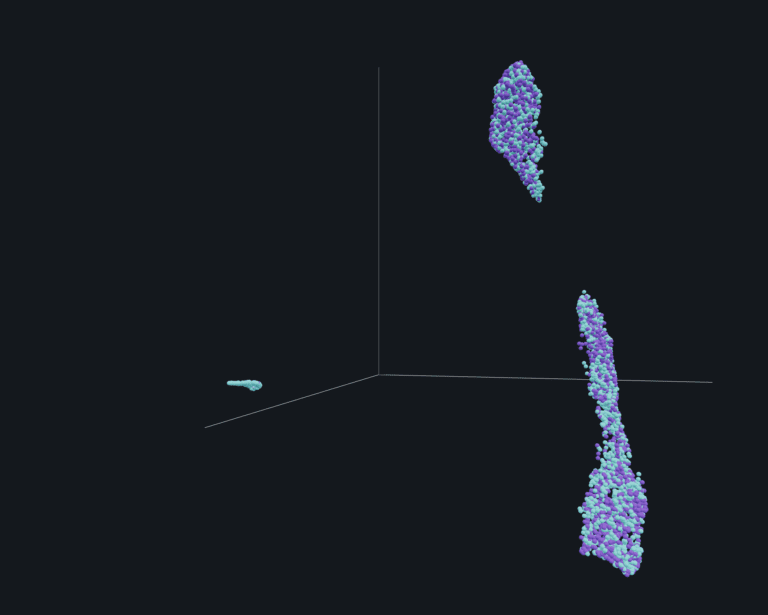

Embeddings are not static, as new concepts appear in the real world all the time. The practice of monitoring embeddings is key for picking up on upstream data quality issues or changes in the data. Retrieval quality, classifier margins, and cluster assignments all depend on vector spaces staying aligned with current language and catalog content.
Build better agents with Arize
Trace, evaluate, and learn. Build agents that work with Arize AX and start tracing your runs today.
Prefer open source? Try Arize Phoenix for self-hosted, open source agent observability.

Key takeaways
- Embedding monitors detect when production vectors diverge from reference clusters or corpus statistics.
- Track index freshness, encoder version, query-document score distributions, and cluster occupancy.
- Drift in embeddings often precedes retrieval misses before scalar tabular drift fires.
- Re-embed corpora when encoder or chunking policy changes; never mix versions in one index.
- Pair vector monitors with task metrics (recall@k, answer groundedness) on golden queries.
What to measure
Corpus-side. Document count, age histogram, language mix, duplicate near-neighbors, embedding norm distributions.
Query-side. Query length, language, nearest-neighbor score percentiles, empty-result rate.
Space-level. Sampled UMAP or PCA plots compared week over week; cluster size deltas; centroid drift for known themes.
Version metadata. Model name, tokenizer, chunk size, normalization flag logged on every vector write.
Reference baselines
Freeze a reference sample of embeddings from a stable period or training corpus. Compare current batches using distance to centroids, PSI on norm buckets, or novelty rate (fraction of points far from all reference clusters).
Set thresholds on business-critical clusters (product lines, policy topics) separately from long-tail noise.
Operational responses
Reindex when catalog updates shift terminology (new product names, rebrands).
Retrain or swap encoders when retrieval metrics fall on fixed query sets.
Fix chunking bugs when entity splits cause duplicate or fragmented vectors.
Pause auto-indexing when upstream OCR or HTML parsing quality collapses.
RAG introductions in introduction to retrieval augmented generation connect embedding quality to grounded answers.
Practical guidance in getting started with embeddings covers hybrid retrieval patterns that embedding monitors must respect.
Agent pipelines should trace retrieval steps per request as outlined in agent evaluation.
Failure modes
Monitoring only corpus size while scores silently degrade.
Running UMAP with different hyperparameters each week and chasing phantom shifts.
Query encoder updated without re-embedding documents.
Treating embedding drift as always requiring model retrain when the fix is corpus cleanup.
Hybrid retrieval monitors
When BM25 and dense scores blend, track both score streams and fusion weights. A drift in sparse hits alone can break answers before vector PSI moves.
Log chunk ids in retrieval traces so embedding drift investigations reopen the exact source text that moved in space.
Re-embed cadence
Publish a calendar for full corpus re-embeds tied to catalog releases, not only ad hoc fires after incidents.
Practitioner checklist
Before changing production settings, confirm labels, thresholds, and monitor windows match the definitions used in your last offline eval. Snapshot dashboards when incidents start so postmortems compare apples to apples.
Run slice-level reviews on high-traffic cohorts weekly even when global metrics look flat. Many failures appear first in one locale, product line, or prompt route.
Document model version, featurizer hash, and data window in every incident ticket. Future you needs that context to interpret drift charts.
When metrics disagree (offline vs online, precision vs recall), write down the business cost of each error type before picking a fix. Metrics are proxies; costs are the decision.
Share eval harness links in release notes so support and PM teams know which golden tasks must pass before they announce improvements.
Related concepts
Embedding drift often correlates with data drift on text length and language mix. Pair vector monitors with retrieval recall@k on fixed queries so you catch quality loss before users report wrong answers.
FAQ
How often should I sample embeddings for visualization?
Weekly for stable products, daily during major catalog or content migrations, always with fixed random seeds.
Is embedding drift the same as data drift?
Embedding drift is a compressed view of input and corpus change. Tabular drift on raw fields may still matter separately.
What score drop should trigger investigation?
Define on golden queries: e.g., recall@5 falls more than an agreed margin versus last week on the same index settings.
Do I monitor image embeddings the same way?
Same principles: reference clusters, score distributions, and task metrics on fixed eval sets, plus modality-specific quality checks.
Should monitors run online or offline?
Lightweight online stats (score percentiles, empty hits) plus heavier offline UMAP on samples.