The Evaluator
Your go-to blog for insights on AI observability and evaluation.
Showing 101–110 of 458 posts (page 11 of 46)

Hierarchical Memory Management In Agent Harnesses
We’ve worked with thousands of customers building AI agents, and we’ve also spent the last two years building our own agent, Alyx, an in-product assistant for Arize AX. These experiences have given us some insights about how to build agents and in particular how agent memory works. A lot of folks are writing about agent…
How Observability-Driven Sandboxing Secures AI Agents
AI agents become dangerous at the moment they gain the ability to execute actions. The moment an agent can touch the file system or invoke external tools, safety shifts from language to execution. What matters is not what the model says, but what the runtime allows it to do. Most existing isolation mechanisms, like VM…
AI Agent interfaces In 2026: Filesystem vs API vs Database (What Actually Works)
We Don’t Know How to Build Agent Interfaces Yet (And That’s Fine) Letta just published benchmark results showing a filesystem-based agent scored 74% on memory tasks by simply storing conversation histories in files, beating specialized memory tools. The result sparked an internal debate at Arize that surfaced two separate questions we’re still wrestling with. And…
Sign up for our newsletter, The Evaluator — and stay in the know with updates and new resources:
Google Antigravity and Arize AX’s MCP Tracing Assistant: How to Trace Your Agent Without Writing Any Code
TL;DR: Add the Arize AX MCP server to Antigravity to instrument your AI applications without leaving your IDE. Instrumenting AI applications with tracing and observability is critical for debugging, monitoring, and improving your agents in production. The Arize AX MCP server brings instrumentation guidance directly into your development workflow. When combined with Antigravity, you can…

How Context Graphs Turn Agent Traces Into Durable Business Assets
In their recent essay making the rounds, Foundation Capital’s Jaya Gupta and Ashu Garg argue that the next enterprise data advantage will come from capturing decision traces and stitching them into a queryable context graph. In their framing, retaining why your agents took action is as important as recording what they did. Our Take On…
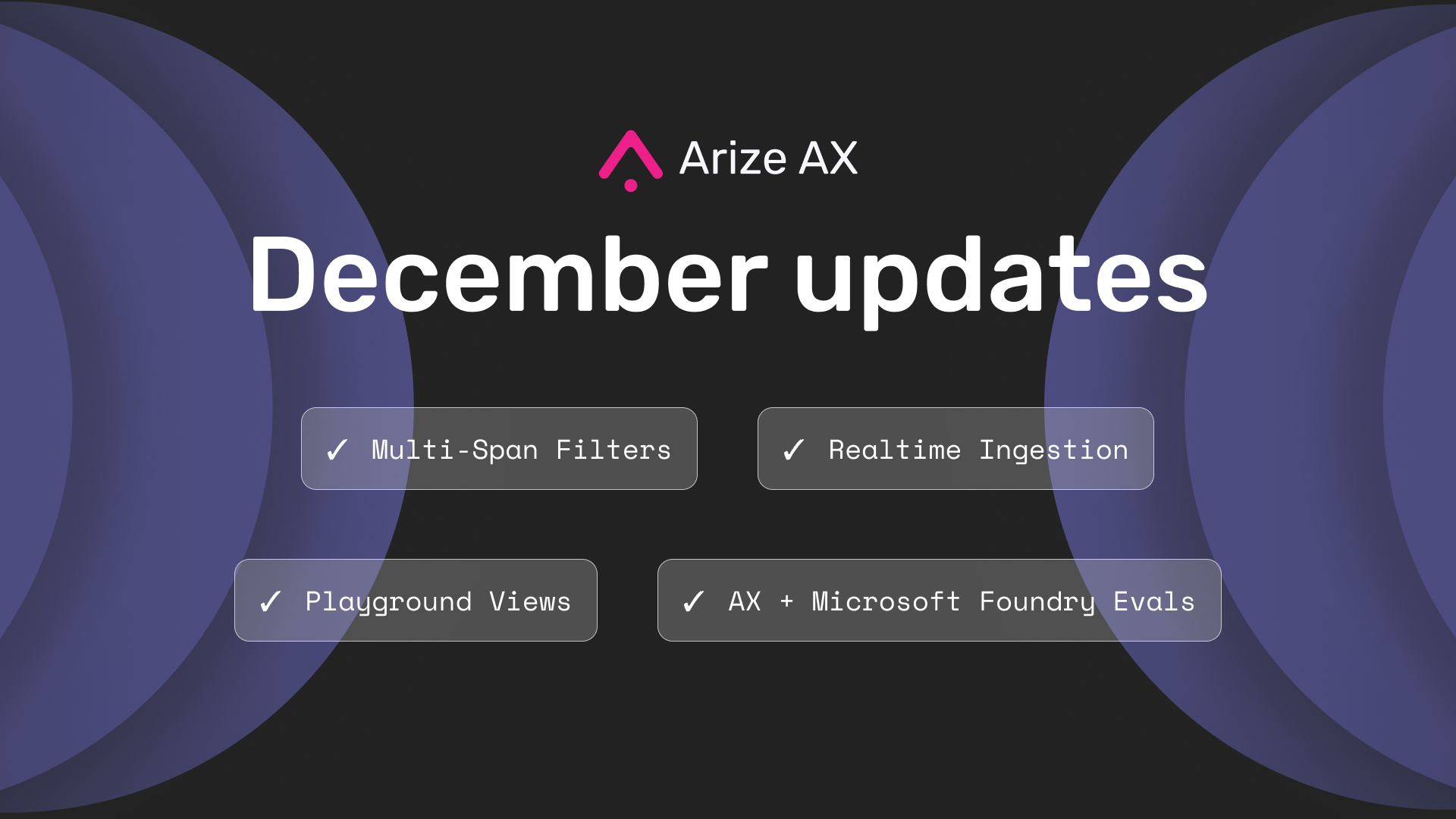
New In Arize AX: Multi-Span Filters and Improved Playground Views
Arize AX released a raft of new updates to close out December of 2025. From improved playground views to multi-span filters, here’s are some highlights. Multi-Span Filters Filter traces using multiple span conditions with: AND, OR, NOT operators for combining conditions Indirectly Calls (->) and Directly Calls (=>) relationship filters Up to 5 filters to…

Top 5 AI Prompt Management Tools for 2026
Every new AI release rises or falls on how people experience it, and prompts play a major role in shaping that experience. A short sentence can write code, trigger tools, and pull data from secure systems, all depending on how it’s written. Teams juggle hundreds of loose one-off prompts, each performing differently because of context,…

EU AI Act Compliance: What AI Engineering Teams Should Monitor
The EU AI Act is no longer a distant regulatory concept; it is in force and enterprises are road testing their real-world implementation. The core law is Regulation (EU) 2024/1689, and the full legal text is available on EUR-Lex. The Act went into effect in August 2024, with different obligations phasing in over the next…
How TheFork Leverages Online Evals To Boost Conversions with Arize AX on AWS
TheFork is one of Europe’s leading restaurant discovery and booking platforms, connecting millions of diners with tens of thousands of restaurants across major cities. The company’s marketplace spans everything from neighborhood bistros to destination dining, with real-time availability, offers, and a seamless reservation flow. How TheFork Uses AI AI is woven into customer journeys at…
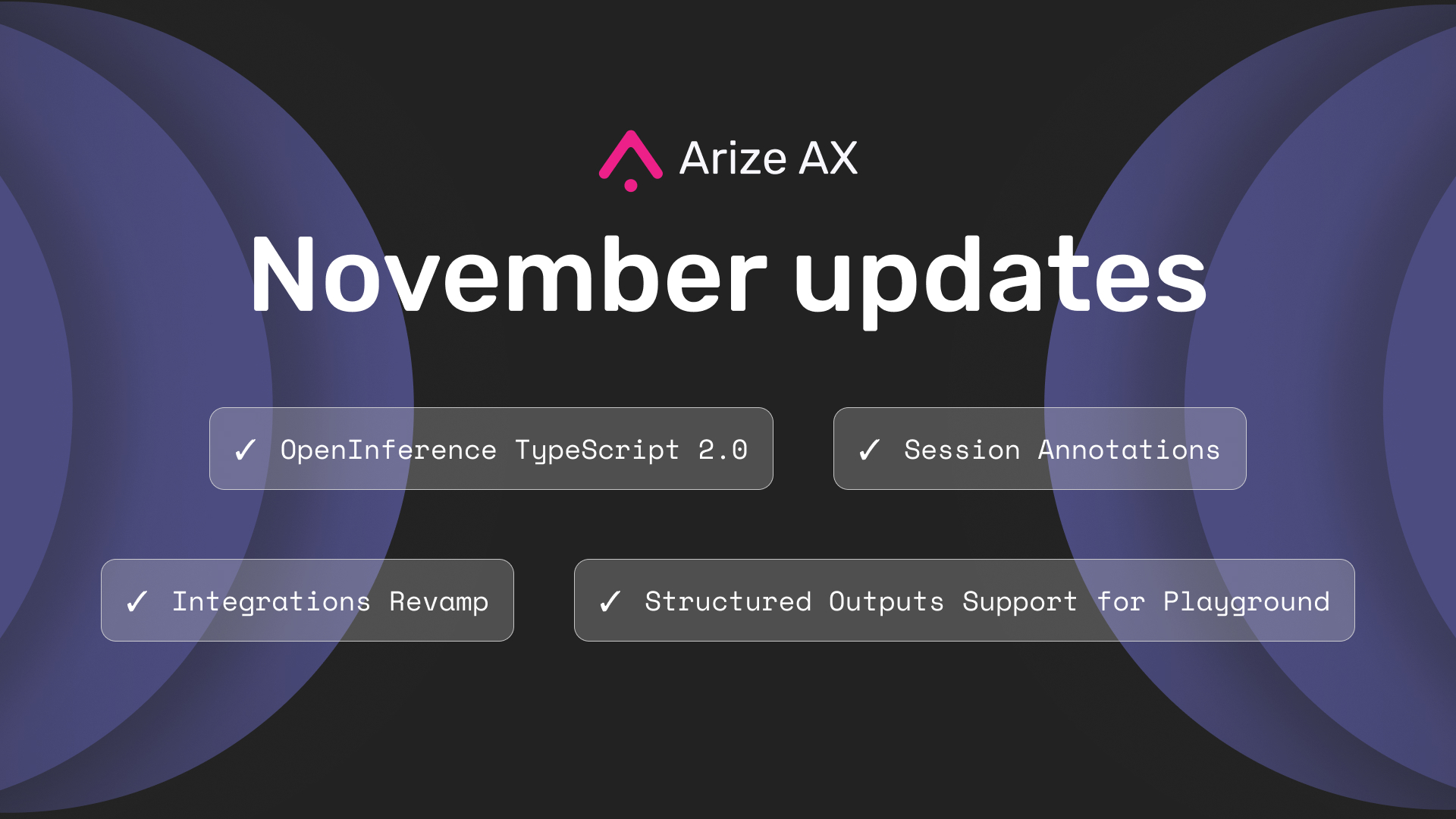
New In Arize AX: OpenInference TypeScript 2.0, Session Annotations, Integrations Revamp
Arize AX released a flurry of updates in November of 2025. From OpenInference TypeScript 2.0 to a revamp of integrations, there is a lot to catch up on. OpenInference TypeScript 2.0 The updates include: Easy manual instrumentation with the same decorators, wrappers, and attribute helpers found in the Python openinference-instrumentation package. Function tracing utilities that…