


Before you start
Keep your experiment comparison open. You’ll need the original and revised prompt, dataset version, and judge rubric used in those runs.Step 1: Set the requirements for the decision
Use the requirements you chose in Choose what to evaluate. For the budget instruction, check whether it:- Stops recommendations outside the shopper’s limit.
- Preserves useful recommendations when suitable products are available.
- Meets your application’s limits for response time and cost.
Step 2: Review the evidence against those requirements
In Phoenix, open both experiments together and select Metrics to review scores, latency, tokens, and estimated cost. Return to Grid to inspect the answers behind those numbers.
Open Metrics to compare the versions, then return to Grid to review individual answers.
- Answer quality: Which requests improved, which regressed, and which judge decisions need review?
- Execution and resources: Were runs missing or unscored? Did errors, response time, or estimated cost change?
- Coverage: Do the tested requests represent the situations where you intend to use the change?
What does the recorded comparison support?
What does the recorded comparison support?
The judge passed 3 of 6 original-agent attempts and all 6 revised-agent attempts. However, one revised answer praised an over-budget toy while asking the shopper to raise the limit. That pass needs review.The dataset also contains only 3 dinosaur-shopping requests with different budgets. It doesn’t cover other product categories or changing budgets during a conversation. Those gaps matter when deciding where to use the instruction.Your runs may differ. Base your decision on the answers and coverage you actually reviewed.
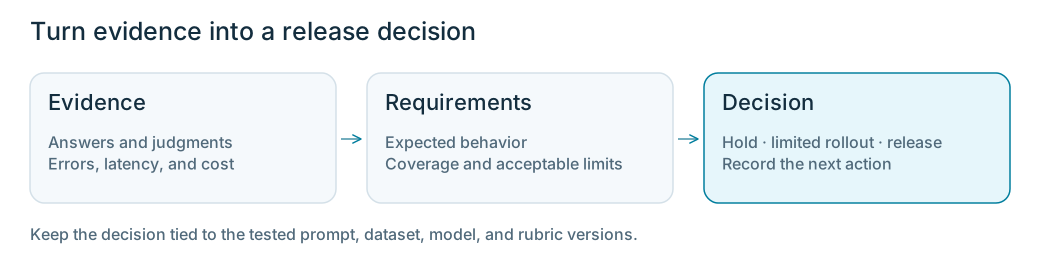
Step 3: Write the decision and its reasons
Now turn that review into a decision someone else can assess. From your Wonder Toys repository root, copy the supplied decision template:academy/release/budget-rule-decision.md. The copied template contains:
Decision note template
- Hold: An unresolved failure, disputed judgment, or important coverage gap needs attention first.
- Limited rollout: The evidence meets your requirements for a defined group of users, with a response plan if problems appear.
- Release: The evidence meets your requirements for the intended scope.
Step 4: Define the next action
A decision is useful when it tells the team what happens next. Finish the note with:- The evidence or change still needed, who will review it, and when.
- The signals to watch and who will respond if the change is released.
- The previous version you can restore if problems appear.