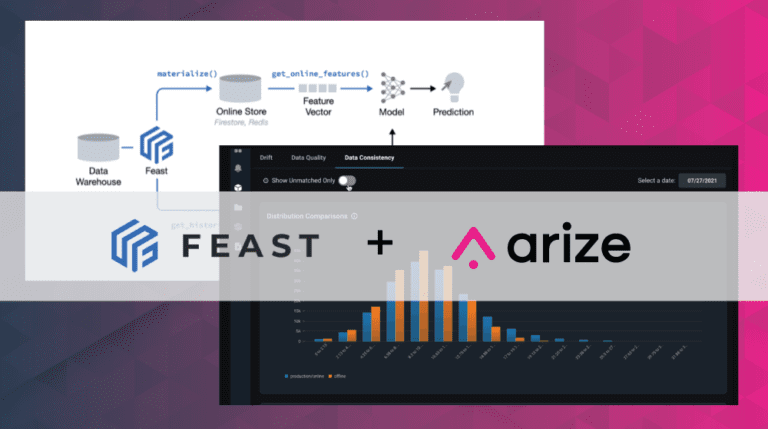

A machine learning infrastructure tool that handles offline and online feature transformations. Think of them as the interface between your models and data. Feature stores are used to: serve as the central source for feature transformations; allow for the same feature transformations to be used in both offline training and online serving; enable team members to share their transformations for experimentation; provide strong versioning for feature transformation code.
Build better agents with Arize
Trace, evaluate, and learn. Build agents that work with Arize AX and start tracing your runs today.
Prefer open source? Try Arize Phoenix for self-hosted, open source agent observability.

Key takeaways
- Feature stores unify offline batch features and low-latency online features under one API and catalog.
- Point-in-time correct joins prevent training-serving skew from future data leaking into labels.
- Versioned transformation code lets you reproduce training datasets months later.
- Shared features reduce duplicate ETL across teams but require ownership and SLAs.
- Feature stores do not replace model monitoring; they feed consistent inputs to models you still must observe.
Core responsibilities
Transformation library. Python or SQL definitions compute aggregates (7-day click counts), embeddings, and joins once, reused in notebooks and production.
Offline store. Historical tables keyed by entity id and event time for training backfills.
Online store. Low-latency key-value or column serving for inference paths.
Registry metadata. Owners, freshness SLAs, schemas, and lineage from raw tables to feature views.
Training-serving consistency
The classic failure mode is training on batch-computed features while serving uses a slightly different SQL window or timezone. Feature stores materialize the same logic in both paths.
Point-in-time lookups retrieve feature values as they existed at label time, not latest values, which prevents leakage in temporal problems.
Team workflow benefits
Data scientists publish features instead of re-deriving joins in every notebook. Engineers consume stable names (user_7d_purchase_sum) in models and monitors.
Experimentation tracks which feature view version trained each model artifact.
Operational concerns
Freshness monitors alert when online features lag batch pipelines.
Backfills after bug fixes must be coordinated with model retrain schedules.
High-cardinality keys need TTL and compaction policies to control cost.
Access control separates PII-heavy features from general model teams.
Lifecycle documentation in AI model lifecycle management places feature stores between data platforms and deployment gates.
When promoting classifiers built on store features, slice validation practices from shipping image classification models with confidence still apply.
Agent systems that log structured metadata benefit from the same catalog discipline described alongside eval platforms in LLM and agent evaluation platforms.
Failure modes
Silent schema changes breaking serving clients.
Training on latest features instead of point-in-time values.
Duplicate feature names with different definitions across teams.
Online store outages causing models to serve defaults without loud alerts.
Point-in-time joins in practice
Entity timestamps on labels must align with feature event times. Off-by-one-day joins create leakage that heat maps will not expose until production.
Backfill jobs after bug fixes should bump feature view versions and trigger dependent model retrains on a published schedule.
Cost management
Materializing wide feature views for every experiment inflates storage. TTL cold features and lazy backfill for rare research paths.
Online store sizing reviews should happen quarterly as QPS and feature cardinality grow.
Practitioner checklist
Before changing production settings, confirm labels, thresholds, and monitor windows match the definitions used in your last offline eval. Snapshot dashboards when incidents start so postmortems compare apples to apples.
Run slice-level reviews on high-traffic cohorts weekly even when global metrics look flat. Many failures appear first in one locale, product line, or prompt route.
Document model version, featurizer hash, and data window in every incident ticket. Future you needs that context to interpret drift charts.
When metrics disagree (offline vs online, precision vs recall), write down the business cost of each error type before picking a fix. Metrics are proxies; costs are the decision.
Share eval harness links in release notes so support and PM teams know which golden tasks must pass before they announce improvements.
FAQ
Do I need a feature store for LLM apps?
Structured features around users, billing, and retrieval metadata still benefit. Raw text prompts may bypass the store but tags and aggregates should not.
How is a feature store different from a data warehouse?
Warehouses hold raw and curated tables. Feature stores add serving APIs, point-in-time semantics, and feature-centric metadata.
Who owns feature definitions?
Usually platform plus domain owners with code review on transformation changes.
Can feature stores prevent data drift?
They enforce consistent computation but do not stop world change. Pair with drift monitors on feature values.
What is training-serving skew?
When live features differ systematically from training features, often from divergent code paths or timing bugs.