

Key takeaways
- AI memory is application-level infrastructure. It gives an AI system access to useful information from earlier interactions, tasks, or states.
- Memory has more than one dimension. Working, session, and long-term memory describe how long information remains useful. Episodic, semantic, and procedural memory describe what the information represents.
- A larger context window does not manage memory for you. The application still has to decide what information should persist and how it should reach future model calls.
- RAG, application state, and memory solve different problems. Authoritative information should usually remain in its source system, while memory is particularly useful for durable context learned through interaction.
- Simple memory architectures can cover many agents. Profiles, summaries, and checkpoints are often enough before searchable collections or knowledge graphs become necessary.
- Memory needs behavioral evaluation. A system can store and retrieve the correct information while the agent still ignores it, misuses it, or applies it when newer context should take priority.
AI memory is the system that lets an AI application preserve, retrieve, and update useful information over time.
Memory can keep an agent oriented during a long task, preserve a user preference across conversations, recall why an earlier decision was made, or carry a correction into future work. For developers, building memory requires decisions about what deserves to persist, where that information belongs, when the agent should retrieve it, how it should change, and when it should be forgotten.
This guide explains the major types of AI memory, how memory differs from context windows, RAG, and application state, the main architecture patterns developers use, and how to evaluate whether remembered information actually improves agent behavior.
Want to learn how to implement a long-term memory system in agents?
Read How we built long-term memory for Alyx: why we chose a file over a knowledge graph for the architecture, update pipeline, compaction logic, and evaluations behind that decision.
What is AI memory?
AI memory is application-level infrastructure that gives an AI system access to useful information from earlier interactions, tasks, or states.
In this guide, AI memory refers to memory used by LLM applications and AI agents. It does not refer to computer RAM, GPU memory, or parameters stored in model weights.
Consider an AI engineering agent that works with the same team over several weeks. Through its work, it might learn that:
- ground-truth labels live in a particular metadata field
- experiments should never run against production without confirmation
- the team uses task success as its primary quality metric
- a previous prompt was abandoned because latency increased
- the current project needs to reach a specific quality threshold before launch
Some of that information may remain useful long after the conversation where the agent learned it has ended.
A memory system therefore has to answer several questions:
- What information should survive the current interaction?
- Where should that information be stored?
- Which user, project, agent, or organization owns it?
- When should it become available again?
- How should the system respond when the information changes?
- How long should the memory remain valid?
- When should it be deleted or forgotten?
Storage supports this process, although useful memory also depends on selection, retrieval, updating, scope, security, and evaluation.
How does AI memory work?
Most AI memory systems perform four related jobs: select, store, retrieve, and maintain.
1. Select what should be remembered
After an interaction or event, the application determines whether anything should persist.
Candidates can come from a user message, tool result, correction, agent action, task outcome, or decision made during a workflow.
A production system should be selective because most information an agent encounters will have little value once the immediate task ends.
2. Store the memory with enough context
When information should persist, the application stores it in a form that can be used safely later.
Depending on the system, a memory may include:
- the remembered information
- the user, project, agent, or organization it belongs to
- its source
- when it was created
- when it was last updated
- its memory type
- its expiration or retention policy
- provenance or confidence information
These fields become especially important once several users, agents, or projects share the same memory infrastructure.
3. Retrieve useful memory when a later task needs it
A later request may require information learned previously.
A compact memory profile can be loaded directly into the model’s context. Larger stores may require semantic search, keyword search, metadata filtering, recency weighting, graph traversal, or reranking.
Retrieval only completes part of the job. Once the memory reaches the model, the agent still has to interpret and apply it correctly.
4. Update and forget as information changes
Useful memory cannot remain static forever.
A user may change a preference, a project may reach a milestone, or a previous assumption may turn out to be wrong. A memory system therefore needs mechanisms for replacement, consolidation, invalidation, expiration, compaction, and deletion.
These four jobs create a lifecycle:
Interaction → selection → storage → retrieval → use → update or forgetting
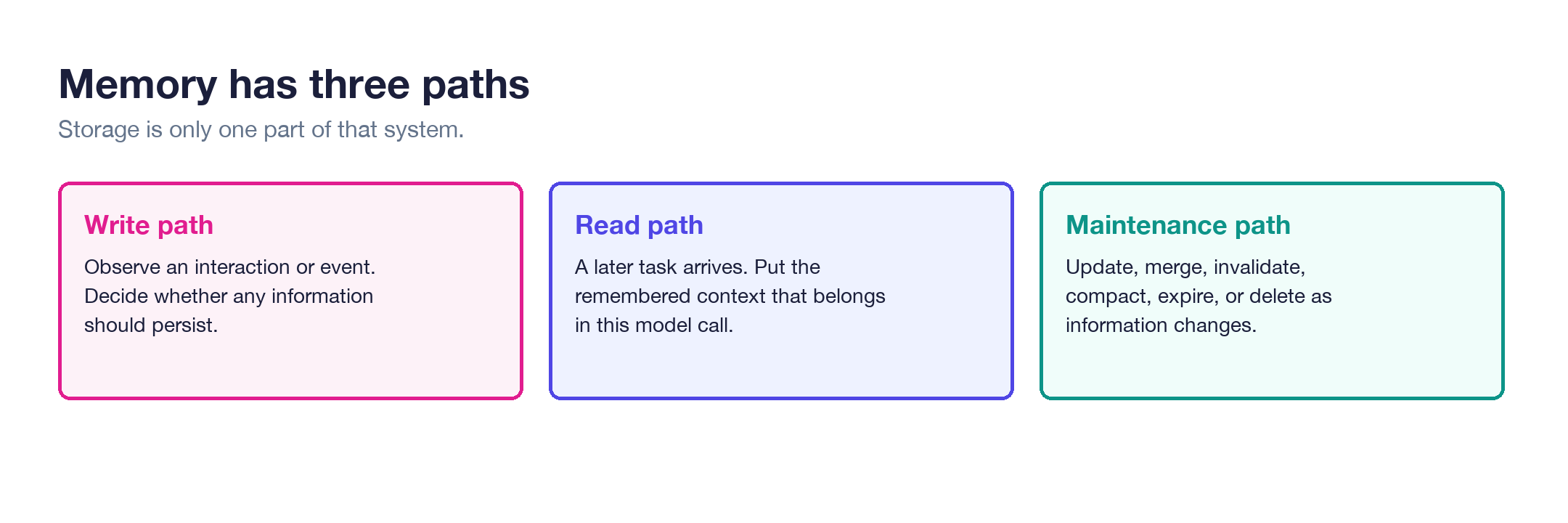
That lifecycle offers a more useful unit to observe and evaluate than the database alone.
Build better agents with Arize
Trace, evaluate, and learn. Build agents that work with Arize AX and start tracing your runs today.
Prefer open source? Try Arize Phoenix for self-hosted, open source agent observability.

What are the main types of memory in AI agents?
Memory terminology becomes confusing when several different classification systems get mixed together.
For engineering purposes, two questions help separate them:
- How long should the information remain available?
- What kind of information does it represent?
These are different dimensions of the same memory system.
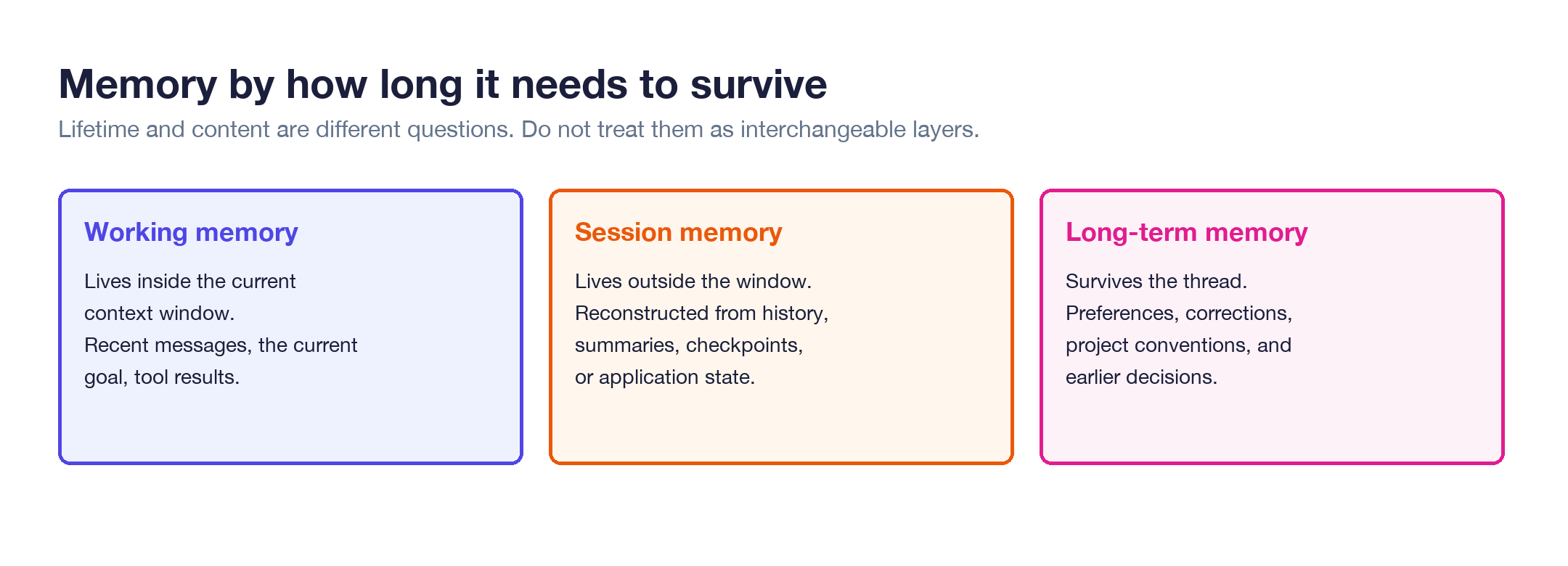
AI memory by lifetime
| Memory layer | What it does | Example |
|---|---|---|
| Working memory | Gives the model information needed for the current decision | Recent messages, current goal, tool output |
| Session memory | Preserves context across turns or resumptions of the same task | Workflow progress, recent actions, conversation summary |
| Long-term memory | Preserves selected information across independent sessions | Preferences, corrections, project conventions, previous decisions |
Working memory generally lives inside the model’s current context.
Session memory often relies on message history, summaries, checkpoints, or structured application state so a task can continue across multiple turns.
Long-term memory allows information learned in one session to influence work performed during a later session.
Need a primer on long-term memory in agents?
Long-term memory is context an agent keeps across sessions and uses to inform what it does later, including durable user preferences, goals, conventions, and decisions. Read our guide to how long-term memory works for AI agents for a deeper look at profiles, retrieval systems, knowledge graphs, forgetting, and multi-session evaluation.
AI memory by content
Long-lived information can also be classified according to what it represents.
| Memory type | What it represents | Example |
|---|---|---|
| Episodic memory | A specific past event or experience | “Prompt v3 scored 71% in last week’s experiment.” |
| Semantic memory | A fact, preference, concept, or relationship | “Ground truth is stored in metadata.label.” |
| Procedural memory | A reusable rule or way of doing something | “Confirm with the user before launching an experiment.” |
These categories can coexist inside the same storage system. A profile, document store, vector index, graph, or database may contain several kinds of memory.
The architecture needs to support the lifecycle of the information rather than mirror each conceptual category with a separate database.
Memory also needs a scope
Developers also need to decide who or what owns each memory.
Possible scopes include:
- user
- conversation
- project
- agent
- team
- tenant
- organization
Scope affects relevance, access control, and security.
A user’s preferred response style may belong to the user, while a rule requiring approval before production deployment may belong to a project or organization.
Poorly scoped memory can cause irrelevant information to influence another task. In multi-user systems, scope mistakes can also expose information across users, projects, or tenants.
AI memory vs. context windows, RAG, and agent state
Several mechanisms can put useful information in front of a model. Developers get more predictable systems when each kind of information has a clear home.
| Mechanism | Main job | Typical example |
|---|---|---|
| Context window | Holds information available during the current model call | System prompt, recent messages, tool results |
| Agent state | Tracks exact operational values required by a workflow | Current step, task ID, approval status |
| RAG | Retrieves external knowledge relevant to a request | Documentation, source code, policies |
| AI memory | Preserves useful context learned through previous interactions | Preferences, corrections, decisions, prior experience |
Context windows
The context window is the model’s immediate workspace.
A larger context window lets an application provide more information in one call. The application still needs to decide what should remain available after that interaction ends and what should be supplied during a future call.
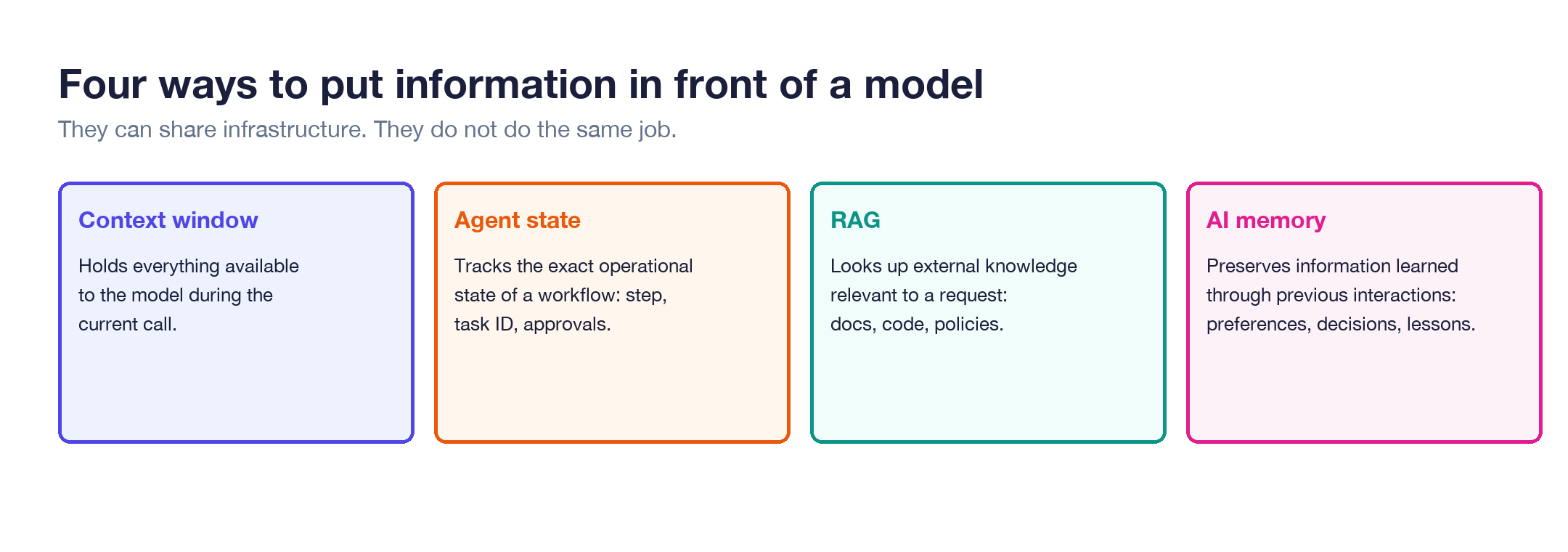
A context window, agent state, RAG, and AI memory solve different problems.
Agent state
Structured application state works well for exact operational values.
If an agent is waiting for approval, processing task ID 3829, or has completed six of eight workflow steps, those values should generally live in structured state that the application can read reliably.
RAG
RAG retrieves information from an external source of truth.
When an agent needs current API documentation, source code, a product catalog, or a policy document, it can retrieve the authoritative version when needed.
Memory becomes especially valuable when an interaction creates context that would otherwise be difficult to reconstruct, such as a correction from the user, a recurring preference, or the reason an earlier decision was made.
A practical way to decide where information belongs
Consider the same AI engineering agent:
- Recent tool output needed for the current decision: context
- Experiment ID and approval status: application state
- Current API documentation: RAG or a tool
- Current p95 latency: fetch from the authoritative system
- “Ask before running experiments against production”: memory
- “We abandoned prompt v3 because latency regressed”: potentially memory, particularly when that decision will matter later
This separation reduces stale copies of information and gives developers a clearer debugging surface.
When do AI agents need memory?
The agent’s requirements should determine how much memory infrastructure you build.
| Requirement | Start with |
|---|---|
| Keep a short conversation coherent | Current context and recent message history |
| Resume a long-running workflow | Checkpoints and structured session state |
| Compress a long conversation | Conversation summarization |
| Remember a small set of durable preferences or rules | Compact profile or memory file |
| Recall relevant information from a large history | Searchable memory collection |
| Represent relationships or facts that change over time | Temporal knowledge graph |
| Share durable memory across several agents | Explicit shared store with scopes and permissions |
Each additional mechanism introduces operational work.
Semantic retrieval requires indexing, ranking, filters, and thresholds. Graph-based systems add entity extraction, relationship management, graph queries, and temporal logic. Automatic memory formation introduces another decision layer because the system has to determine which information deserves to persist.
When a small profile can represent everything that materially affects future behavior, loading that profile may be easier to inspect and evaluate than searching thousands of individual memory records.
What should an AI agent remember?
A useful memory should generally satisfy four criteria.
- Durable. The information is likely to remain useful beyond the current interaction.
- Difficult to reconstruct. The agent cannot reliably retrieve the latest version from an authoritative system.
- Useful later. Remembering it could materially improve a future decision or prevent a repeated mistake.
- Appropriate to retain. The application can safely and reasonably persist the information.
For an AI engineering agent, that framework might produce the following decisions:
| Candidate memory | Remember it? | Why |
|---|---|---|
“Ground truth lives in metadata.label.” |
Usually | It affects future work and may be difficult to rediscover |
| “Ask before running experiments against production.” | Usually | It represents a durable workflow convention |
| “We want task success above 90% before launch.” | Usually | It establishes an ongoing goal |
| “Current p95 latency is 1.8 seconds.” | Usually fetch again | An authoritative system can provide the current value |
| “The current prompt text is…” | Usually fetch again | The application can retrieve the current version |
| Temporary authentication token | No | It is sensitive and short-lived |
| Every tool result from every session | No | Most results will never affect future work |
A useful rule for developers is to ask whether the system can reliably reconstruct the information.
Values that change frequently should usually remain in an authoritative system. Memory provides more value when it preserves information that would otherwise disappear, including intent, corrections, decisions, preferences, and lessons from previous work.
Common AI memory architecture patterns
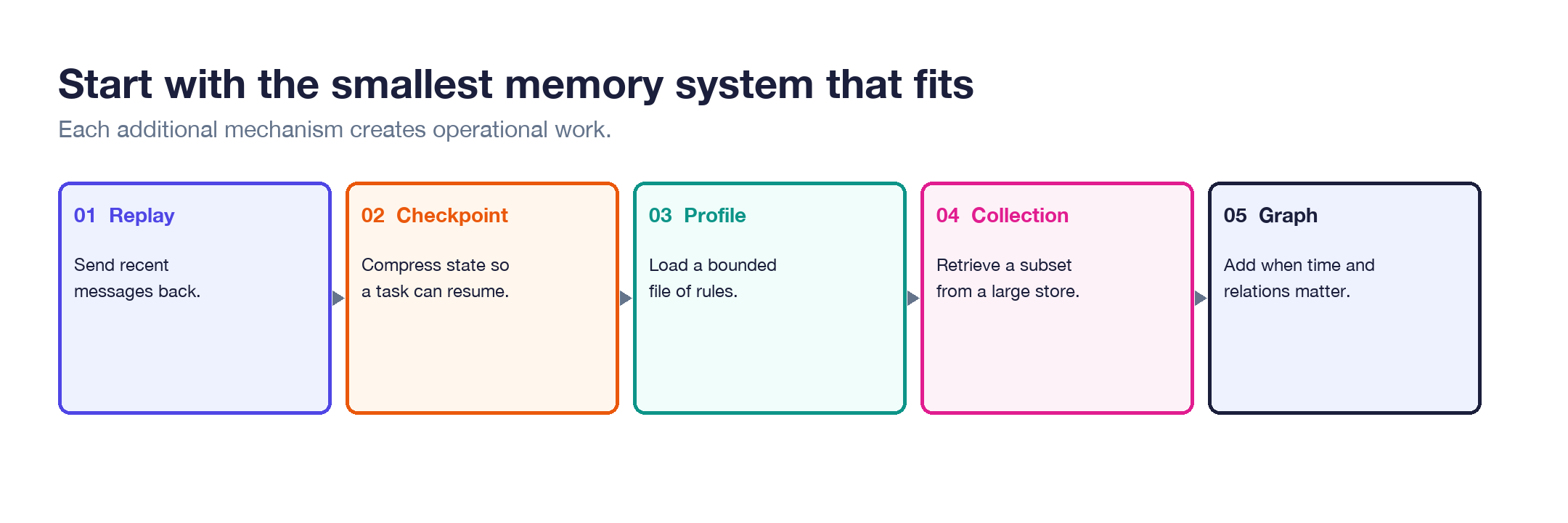
Several architecture patterns appear repeatedly because they serve different scales and access requirements.
| Pattern | How it works | Good fit | Main tradeoff |
|---|---|---|---|
| Conversation replay | Sends earlier messages back to the model | Short conversations | History grows quickly |
| Summary or checkpoint | Compresses earlier context | Long tasks and resumable workflows | Summarization can lose detail |
| Profile or memory file | Loads a bounded persistent representation into context | Preferences, goals, conventions | Capacity is intentionally limited |
| Searchable memory | Stores memories separately and retrieves relevant records | Large or open-ended histories | Retrieval can miss useful memory |
| Knowledge graph | Represents entities, relationships, provenance, and sometimes time | Connected or changing information | Extraction and maintenance add complexity |
| Hybrid memory | Keeps a small core available and retrieves additional information when required | Systems with high-priority and long-tail memory | More components need coordination |
These patterns can work together.
An agent might maintain recent turns during a session, keep exact workflow progress in a database, load a compact profile on every request, and retrieve older project history when a task requires it.
The architecture can remain small until the memory requirements justify additional components.
Profiles vs. searchable memory
One of the most important architecture decisions is whether the information an agent needs to remember can fit into a bounded profile.
Profile memory
A profile keeps a compact current representation of what the agent should know.
Because the entire profile can be loaded into context, the system does not need to make a retrieval decision for every fact.
This works particularly well for bounded information such as:
- preferences
- recurring corrections
- project conventions
- active goals
- durable instructions
The tradeoff is capacity.
Searchable memory
A searchable memory store can grow much larger because the agent retrieves only a subset of the stored information for each request.
The tradeoff is retrieval.
A relevant memory may exist in the store but still fail to reach the model because of the query, embedding similarity, ranking, filtering, recency logic, or top-k limit.
Profiles trade capacity for more predictable availability. Searchable collections trade guaranteed inclusion for scale.
How did we make this decision for Alyx?
For Alyx, the AI engineering agent in Arize AX, we chose one structured memory file per user and Arize space, capped at 8,000 characters and loaded on every request.
When should you use a knowledge graph for AI memory?
Knowledge graphs become useful when relationships among memories matter as much as the individual memories themselves.
Suppose an agent needs to understand:
Alice works on Project Mercury.
Project Mercury uses Dataset A.
Dataset A replaced Dataset B last month.
A flat memory collection can store each fact. A graph explicitly represents how they relate.
Temporal graphs can also represent how those relationships change.
That additional structure comes with additional work. Graph-based memory requires entity extraction, relationship management, invalidation, graph retrieval, and often temporal reasoning.
Use that complexity when the application needs it.
If the useful memory for an agent fits comfortably in a small profile, a graph may solve a problem the application does not yet have.
Updating and forgetting are part of AI memory
Persistent memory cannot be treated as an append-only archive.
A user changes a preference.
A project reaches its goal.
A debugging hypothesis turns out to be wrong.
A workflow convention is replaced.
When new information arrives, a memory system may need to:
- replace an older value
- append a new event while preserving history
- invalidate an earlier fact
- merge overlapping memories
- expire information
- compact a growing profile
- delete information that should no longer persist
Forgetting deserves the same design attention as remembering.
A store that accumulates every detail forever becomes harder to use. Retrieval gets noisier. More irrelevant information reaches the model. Old information remains available to influence future decisions.
Useful memory requires selection.
How do you evaluate AI memory?
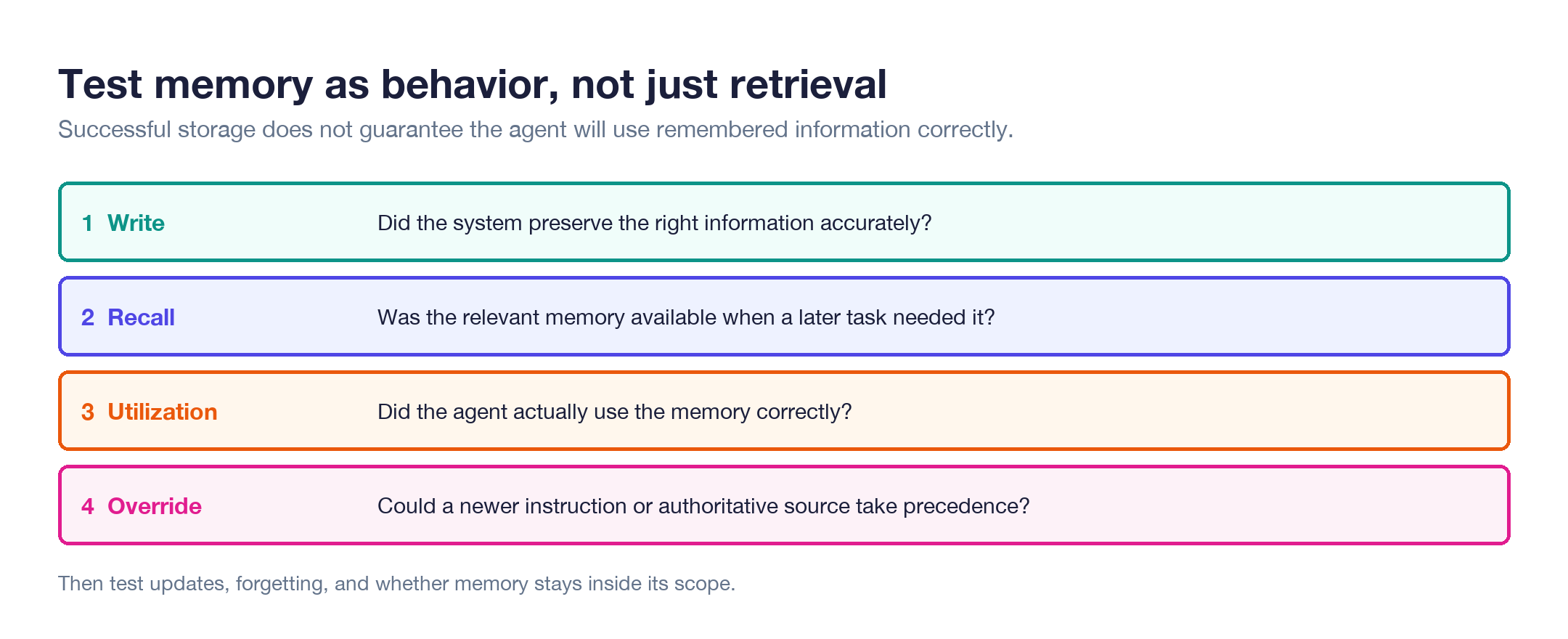
AI memory should be evaluated across its full lifecycle because successful storage does not guarantee useful agent behavior.
A system may preserve the correct fact and fail to retrieve it later. Retrieval may succeed while the agent ignores the memory. A remembered fact may also be accurate but inappropriate for the current task.
A useful evaluation suite should cover several stages:
| Evaluation | Question |
|---|---|
| Write correctness | Did the system preserve the right information accurately? |
| Recall | Was the relevant memory available when a later task needed it? |
| Utilization | Did the agent apply the memory correctly? |
| Override behavior | Did newer instructions or an authoritative source take precedence when appropriate? |
| Update behavior | Did a correction revise or replace the relevant memory? |
| Forgetting | Did expired or invalid information stop affecting behavior? |
| Scope isolation | Could memory cross a user, project, or tenant boundary? |
| Efficiency | What latency, token, storage, and model-call costs did memory introduce? |
Test memory across sessions
A strong memory test should exercise the actual write and read paths.
In the first session, give the agent information that should persist.
In a later session, assign a task where success depends on that information.
Then introduce a case where the remembered information is irrelevant or conflicts with a newer instruction. The agent should follow the information that is appropriate for the current task.
This sequence tells you whether memory changes agent behavior in the intended direction.
A retrieval benchmark alone cannot answer that question.
Common AI memory failure modes
The agent remembers too much
Automatic extraction can turn every conversation into a growing collection of facts.
Most of those facts will never matter again.
The result is more storage, noisier retrieval, and additional irrelevant context reaching the model.
A memory policy should be selective about what is durable enough and useful enough to survive.
The memory becomes stale
A remembered value can remain retrievable long after it stops being true.
Frequently changing values should usually come from an authoritative API, database, or tool.
If changing facts do belong in memory, the system needs a freshness policy such as timestamps, expiration, replacement, or invalidation.
The right memory exists but never reaches the model
Search introduces its own failure surface.
A memory may exist in the database and still fail to reach the model because of:
- retrieval query construction
- embedding similarity
- metadata filters
- top-k settings
- ranking
- recency weighting
Observability should distinguish among three different events:
- The memory existed.
- The memory was retrieved.
- The memory was used.
Those are not the same outcome.
Multiple memories contradict one another
Suppose the store contains:
- “Use prompt v2.”
- “Use prompt v4.”
Retrieval may surface either one unless the write path understands updates and supersession.
Memory systems need explicit rules for replacement, consolidation, validity, or chronology.
Memory changes while being rewritten
Repeatedly asking an LLM to rewrite an entire memory document can introduce drift.
A correct detail can disappear. Wording can shift. A previous fact can accidentally change.
Where possible, targeted inserts, replacements, invalidations, and deletes make changes easier to inspect and evaluate.
Untrusted content becomes persistent
Anything written into memory may eventually return to the model’s context.
That means an unsafe or malicious instruction can become more durable if the system saves it as memory.
Memory should be treated as persistent application data with appropriate validation, provenance, isolation, access control, and deletion.
Concurrent sessions overwrite each other
Two sessions may read the same initial memory and then attempt different updates.
Once memory becomes writable production state, systems may need version checks, transactions, locks, serialization, or conflict-resolution logic.
AI memory tools and platforms
The AI memory ecosystem includes standalone memory services, databases, agent frameworks, and stateful-agent runtimes.
The useful comparison is not which tool is universally “best.” It is which architecture matches the memory problem you need to solve.
| Tool or approach | Memory approach | When to consider it |
|---|---|---|
| Framework-native memory | Conversation history, checkpoints, stores, or framework-managed persistence | When memory is tightly coupled to one agent framework |
| Mem0 | Persistent memory APIs with retrieval and optional graph relationships | When you want a dedicated memory layer built around extraction and retrieval |
| Zep / Graphiti | Temporal graph-based memory with entities, relationships, and changing facts | When relationships, provenance, and time are central requirements |
| Amazon Bedrock AgentCore Memory | Managed short-term and long-term memory capabilities | When your agent stack is already built around AWS |
| Redis Agent Memory | Session and durable memory backed by Redis retrieval infrastructure | When Redis already plays a central role in your application architecture |
| Letta | Stateful agents with persistent memory available across conversations | When memory is a central part of the agent runtime itself |
| Custom profile or database | Application-specific schema, file, relational database, or document store | When your memory requirements are bounded and you want direct control |
It should go without saying, but you should start by choosing the architecture before the vendor.
Start by defining:
- what information must survive
- how much memory you expect to accumulate
- how often it changes
- how the agent should retrieve it
- which users and systems can access it
- how you will evaluate it
Those requirements make the infrastructure decision much easier.
Do you need a standalone AI memory layer?
Many agents do not.
A chatbot may only need conversation history.
A resumable workflow may only need database checkpoints.
An agent with a bounded set of preferences and project conventions may only need a small profile.
A dedicated memory layer becomes more useful when you need capabilities such as:
- persistent information across many sessions
- memory shared across agents or applications
- semantic retrieval across a large history
- structured memory extraction
- temporal or relational queries
- independent retention and deletion policies
- tenant or namespace isolation
- centralized memory governance
Start with the simplest system that satisfies the memory requirement you actually have.
A practical default for building agent memory
A useful starting point is to separate four types of context.
1. Current context
Put information here when the model needs it for the decision immediately in front of it.
2. Application state
Put exact operational values here when they determine the state of a workflow.
3. External knowledge
Keep authoritative information in the source system when the agent can retrieve the latest version through RAG or a tool.
4. Persistent memory
Use memory for durable context learned through interaction that should meaningfully affect future behavior.
From there, use the smallest memory representation that fits.
A compact profile can handle bounded preferences and conventions.
A searchable collection can handle larger histories.
A knowledge graph can help when relationships, provenance, and time become first-class requirements.
Then instrument the lifecycle.
You should be able to see:
- what the system considered remembering
- what it actually stored
- what it later retrieved
- what reached the model
- how the memory affected the final behavior
Without that visibility, memory failures can look like ordinary model failures.
Frequently asked questions about AI memory
Does AI have memory?
An individual LLM call only has access to the context supplied with that call. AI applications can create memory by storing information outside the model and making relevant information available again during later interactions.
What is agent memory?
Agent memory refers to the mechanisms an AI agent uses to preserve and reuse context across steps, tasks, or sessions.
Depending on the system, that can include conversation history, checkpoints, profiles, searchable long-term memory, or other persistent state.
What are the main types of AI memory?
Memory can be classified in several ways.
Working, session, and long-term memory describe how long information remains available.
Episodic, semantic, and procedural memory describe what stored information represents.
Those dimensions can overlap. A long-term memory system might contain episodic, semantic, and procedural information at the same time.
What is the difference between short-term and long-term AI memory?
Short-term memory helps the agent work with information relevant to the current conversation or task.
Long-term memory preserves selected information across independent sessions so that it can influence future behavior.
Is a context window the same as memory?
No.
A context window contains the information available to the model during the current call.
A memory system determines which information should survive beyond the current interaction and how that information becomes available to future context windows.
Is RAG the same as AI memory?
They overlap, but they usually serve different purposes.
RAG generally retrieves information from an external knowledge source such as documentation, code, or policies.
Memory usually preserves information learned through earlier interactions, including preferences, corrections, decisions, and previous experience.
Both systems may use similar retrieval infrastructure.
What is persistent memory in AI agents?
Persistent memory is information that remains available after the current conversation, execution, or session ends.
Long-term memory is a common form of persistent agent memory.
Do all AI agents need long-term memory?
No.
Agents that perform isolated, self-contained tasks may work well with current context and structured state.
Long-term memory becomes more useful when information learned during one session should affect work performed later.
Can memory make an AI agent worse?
Yes.
Incorrect, stale, irrelevant, or overly authoritative memories can degrade agent behavior. Memory can also introduce security risks if information crosses scopes or unsafe instructions become persistent.
That is why memory systems need evaluation for both positive cases, where remembering should help, and negative cases, where the agent should ignore or override remembered information.
How should you test AI memory?
Test the entire lifecycle across multiple sessions.
Verify that the system:
- remembers the right information
- retrieves it when relevant
- uses it correctly
- updates it when information changes
- ignores it when newer context should take priority
- forgets information that should no longer influence behavior
- keeps memory isolated between users, projects, and tenants
The goal is to determine whether memory improves the agent’s decisions, not simply whether information can be stored and retrieved.
Build agents you can understand and improve
Memory introduces another source of state into an already complex agent system.
Tracing the memory lifecycle alongside the agent’s tool calls, decisions, and outputs makes it easier to understand whether remembered context helped, hurt, or never reached the model at all.
Arize AX and Phoenix help AI teams trace and evaluate agent behavior so they can identify failures and systematically improve agent performance.

