


What Is Adaptive Knowledge Graph Memory?

Adaptive Knowledge Graph Memory
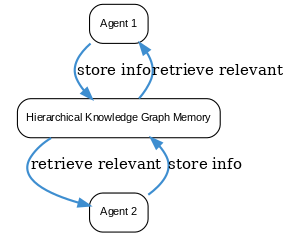
Adaptive knowledge graph memory is a shared, hierarchical knowledge graph that several LLM agents read from and write to instead of keeping separate, isolated transcripts. The idea comes from the DAMCS framework (Dynamic Adaptive Multi-agent Cooperative System): facts and relations live in a structured graph, agents query for what they need, and the memory layer decides what to store, what to surface, and what to leave local. It is collective memory for decentralized agents, not a bigger context window pasted into every prompt.

If you run multi-agent systems today, you have probably felt the alternative: isolated scratchpads, compressed handoffs, and duplicated retrieval. Adaptive knowledge graph memory treats the graph as the durable record, so agents coordinate through structured queries instead of broadcasting everything they know.

Try Arize AX

Build better agents with Arize

Trace, evaluate, and learn. Build agents that work with Arize AX and start tracing your runs today.

Prefer open source? Try Arize Phoenix for self-hosted, open source agent observability.

Key takeaways

  • Adaptive knowledge graph memory is a shared graph of facts and relations that multiple agents contribute to and retrieve from, not per-agent transcript storage.
  • The memory is hierarchical and adaptive: it organizes information by importance and filters what gets shared so agents see pertinent knowledge, not the full graph.
  • A structured communication protocol lets agents query the graph for relevant subgraphs rather than dumping entire histories into every handoff.
  • Research on the DAMCS framework reports more efficient teamwork, including tasks solved with up to 74% fewer steps when agents focus on pertinent shared information (AAAI 2025 workshop paper).
  • Production teams still need tracing and evals on what entered the graph, what was retrieved, and whether shared memory helped or hurt the final answer.

How it differs from ordinary agent memory

Most agent stacks treat memory as something attached to a session: message history, a vector store of retrieved chunks, or a key-value scratchpad one agent owns. That works for a single loop. It breaks down when several agents run in parallel, spawn children, or finish after the parent has moved on.

Adaptive knowledge graph memory moves the durable state outside any one agent’s context window. Nodes might represent entities, claims, tool outputs, or task milestones. Edges capture relations: supports, contradicts, derived_from, assigned_to. When agent A learns that a customer record was updated, that fact can become a node with provenance. Agent B does not need A’s full transcript. It queries the graph for facts about that customer and gets a bounded subgraph.

The adaptive part is what keeps the graph usable at scale. Not every observation belongs in shared memory. The framework ranks and filters by relevance, recency, and task context so agents receive subgraphs sized for the job, not the entire knowledge base. That is the mechanism behind the efficiency gains reported in the DAMCS work: fewer redundant steps because agents stop re-deriving facts a teammate already committed to the graph.

The DAMCS communication pattern

In the DAMCS design, agents do not free-form chat with each other for every fact transfer. They use a protocol to publish structured updates and request targeted reads. A write might add nodes and edges with metadata about source agent, confidence, and time. A read might specify a query pattern: entities of type X related to Y within depth two.

This resembles how engineers already think about databases and APIs more than how they think about prompt engineering. The graph is the contract. Agents remain decentralized in their reasoning, but they share a canonical representation of what the team collectively knows.

That distinction matters for debugging. When a multi-agent run fails, you want to inspect whether the failure came from a stale graph node, a missing write, or a correct graph that no agent queried. Shared graph memory makes those questions answerable in principle if you instrument writes and reads.

The pattern sits between flat conversation history and static RAG corpora. Conversation history is linear and agent-local. A document index is usually read-heavy. The graph is read-write and accumulates task-specific knowledge. Embeddings find similar text; graphs traverse relations such as which tool output supports which conclusion. Teams often need both. For a map of what teams actually ship for agent memory, see the AI memory resource hub.

Why AI engineers should care now

More teams hit coordination bugs in production because multi-agent prototypes are cheaper to build. Shared graph memory addresses handoff loss, duplicated retrieval, and inconsistent world models. It is not free: you need schema decisions, write policies, conflict handling, and cleanup for stale nodes.

Extra agents multiply model calls. Without shared structured memory, they also multiply redundant reasoning. Targeted sharing can claw back wasted steps, though results depend on task structure and graph quality. As cheap models change multi-agent economics, sloppy coordination costs more relative to adding another specialist agent.

Memory remains underspecified in many shipped systems. Treat it as infrastructure with explicit read, write, and retention semantics rather than an implicit side effect of logging prompts. That framing appears in memory as a missing primitive, and adaptive knowledge graph memory is one research direction that makes those semantics concrete for multi-agent teams.

Failure modes to plan for

Stale or orphaned nodes. A child agent writes a fact, then crashes. The graph retains it without a cleanup policy. Downstream agents treat it as ground truth.

Over-sharing. Adaptive filtering fails open and every agent receives huge subgraphs. You have recreated broadcast messaging with extra serialization cost.

Under-sharing. Filtering is too aggressive. Agents miss contradictions a teammate already recorded and spend steps reconciling incompatible plans.

Schema drift and missing provenance. Incompatible node labels make queries return incomplete subgraphs. Without traces of writes and reads, you cannot tell whether the graph, the query, or the agent caused a bad answer.

FAQ

Is adaptive knowledge graph memory the same as RAG?

No. RAG usually retrieves static or semi-static documents into a prompt. Adaptive knowledge graph memory is a mutable, structured store agents update during a task. You might combine both: RAG for corpus grounding, a graph for live multi-agent coordination.

Do I need a full knowledge graph database?

Not necessarily. The pattern is shared structured memory with queryable relations and adaptive filtering. Property graphs in SQL or disciplined JSON schemas can work.

Where does the 74% fewer steps claim come from?

It comes from experiments reported in DAMCS framework research presented at an AAAI 2025 workshop. It describes fewer agent steps when sharing pertinent graph-filtered information, not a guaranteed production savings for every workflow.

How does this relate to agent state management?

Agent state management tracks runs and lifecycle for a fleet. Graph memory tracks what the team knows about the task. Operational state and domain facts usually live in separate stores.

What should I measure in production?

Trace graph writes and reads per agent step, subgraph size returned to each agent, task completion steps, and final task quality. Compare runs with shared graph memory enabled versus isolated memory to see whether coordination improved or you added latency and stale state.

Don’t ship vibes.

Arize gives AI teams observability and evals to understand and improve agent performance.