

Chapter summary
Last reviewed: August 26, 2026. Arize publishes this comparison and includes its own products. We compare publicly documented capabilities and product behavior as of the date above. Several products discussed here are in beta and changing quickly, so teams should verify current capabilities against vendor documentation.
TL;DR
- Braintrust Topics is primarily a classification system for discovering recurring patterns in production conversations.
- LangSmith Engine is an opinionated agent workflow that detects failures, diagnoses root causes, proposes fixes, and creates regression coverage.
- Arize Signal is a prebuilt production investigation on top of a composable Managed Agents system with model choice, custom skills, harness control, and broader operational context.
All three start with production telemetry. They differ in how far they travel through detect → diagnose → fix → verify, and how much control teams keep over the system doing that work.
In 2026, three of the leading AI observability platforms each shipped features that read your production traces so your engineers don’t have to. Arize launched Signal, LangChain launched LangSmith Engine, and Braintrust launched Topics. All three answer the same question: when your agent generates 50,000 traces a week, how do you find the failure patterns no human will ever read their way to?
A useful way to compare them is by how far each travels through the agent improvement loop.
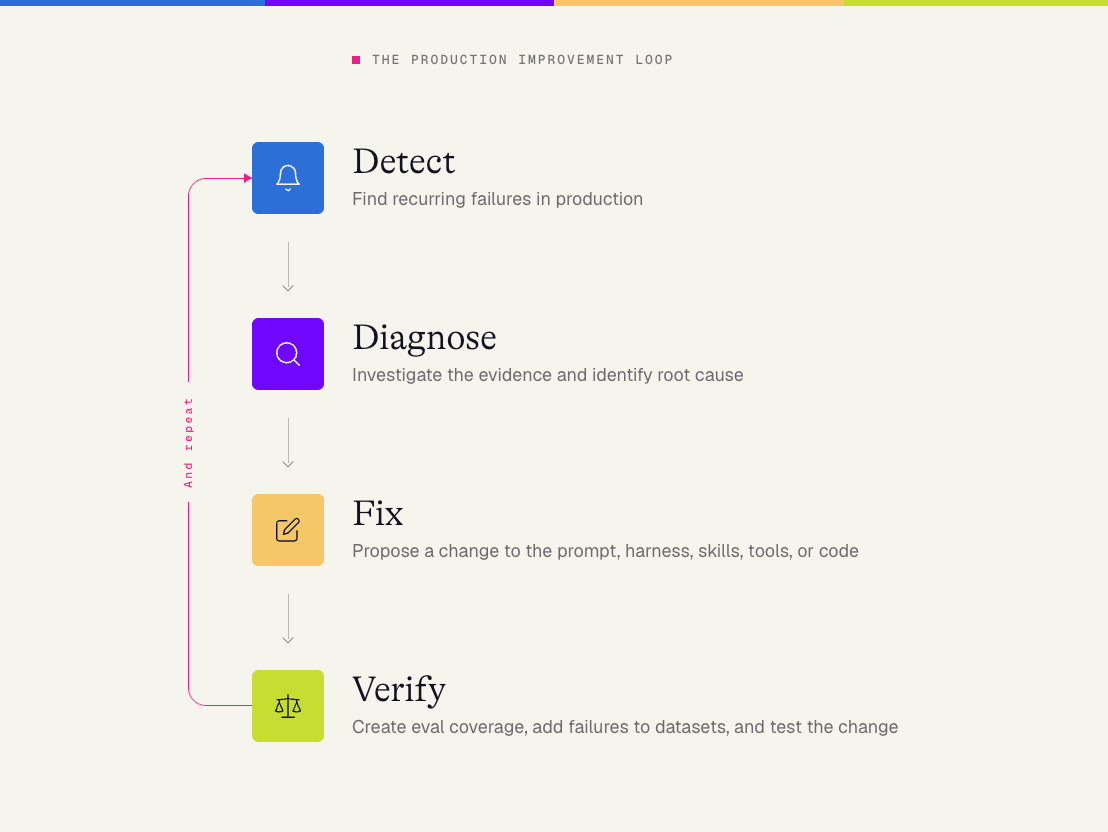
At a high level, all three tools are trying to compress some or all of the same production improvement loop:
- Detect a recurring failure or behavioral pattern in production
- Diagnose what’s causing the failure pattern using available trace, code, and operational evidence
- Fix the failure by proposing or making a change to the prompt, tools, routing, harness, or code
- Verify the fix and prevent regression by turning the failure into an eval, dataset example, or other durable test.
All three start with production telemetry, but they differ substantially in how far they extend from pattern discovery into diagnosis, remediation, and regression prevention. They also differ in something equally important: how much control teams have over the system doing that work.
The category: agents reading telemetry
For decades, production telemetry had one consumer: a human. Dashboards organized logs, metrics, and traces, alerts woke someone up, and an engineer translated the telemetry into an explanation. Coding agents accelerated the last step, writing the patch, but a human still had to consume the telemetry, isolate the failure, and turn the investigation into a prompt.
These products move AI upstream into that investigative work. Traces become the source of truth for an improvement loop instead of an archive a human occasionally greps.
But they approach the problem at different levels of abstraction. Braintrust Topics is primarily a classification system. LangSmith Engine is an opinionated agent workflow for moving from production failures toward fixes and regression coverage. Arize Signal is a prebuilt investigation running on top of Arize’s broader Managed Agents system, which can also be configured for other operational workflows.
Build better agents with Arize
Trace, evaluate, and learn. Build agents that work with Arize AX and start tracing your runs today.
Prefer open source? Try Arize Phoenix for self-hosted, open source agent observability.

Braintrust Topics: pattern discovery and classification
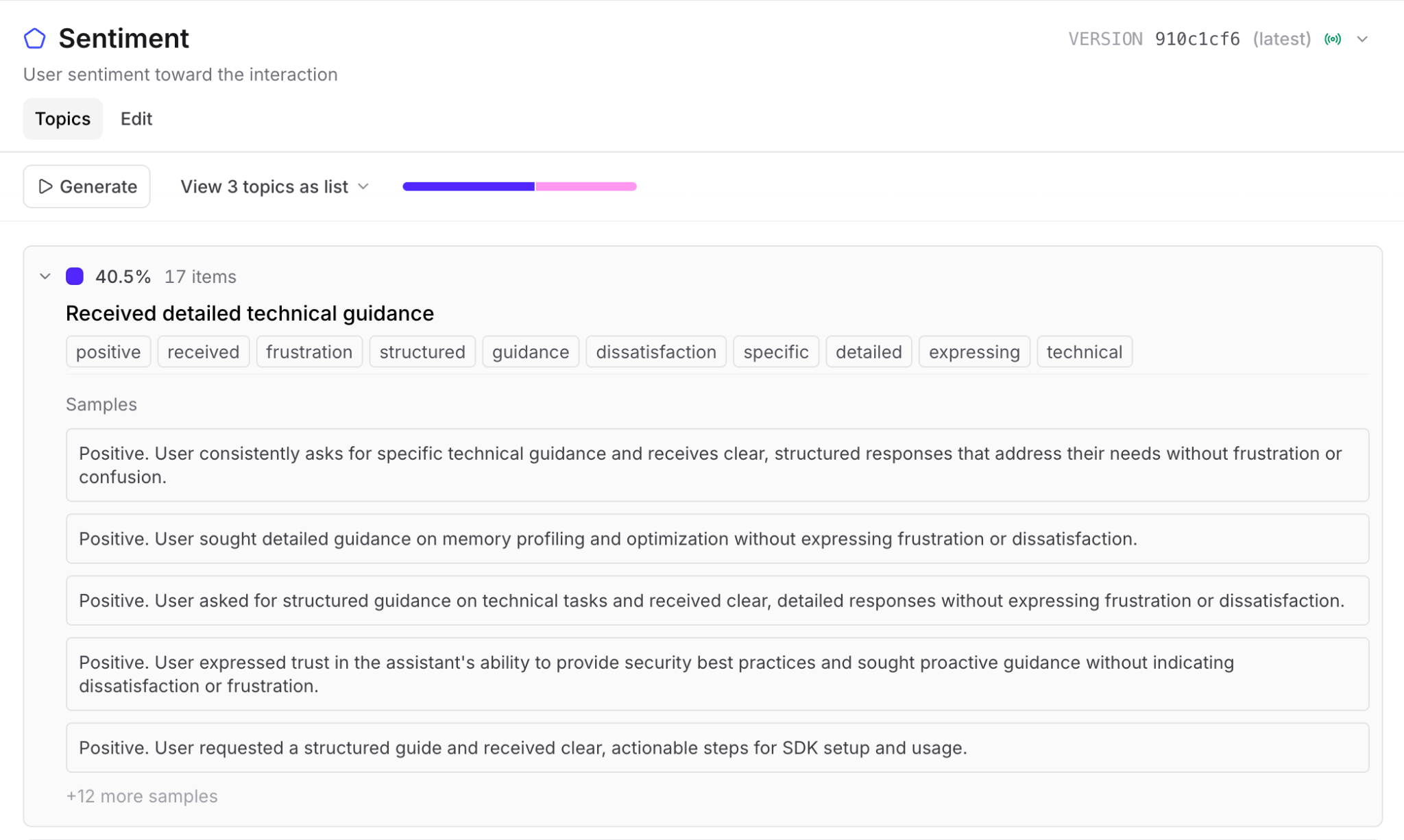
Topics is a conversation analytics layer. It runs a recurring pipeline over your logs: each trace is preprocessed into readable text, an LLM summarizes it through the lens of a facet such as Task, Sentiment, Issues, or a custom facet, an embedding model turns each summary into a vector, similar vectors are clustered, and an LLM names each cluster with a human-readable label like “Refund requests.” Classifications land as SQL-queryable, filterable fields next to your scores and tags.
Braintrust Topics is good at blind-spot detection. Topics surfaces user intents you didn’t know to tag, silent quality issues that don’t trip explicit checks, and roadmap signals from real traffic. Built-in facets make it relatively easy to start, while higher-tier capabilities such as custom facets and preprocessors give teams more control over how conversations are classified. The resulting classifications can feed Braintrust’s broader evaluation and review workflows.
For teams primarily trying to understand what users are doing, where sentiment is shifting, and which categories are emerging across large amounts of conversational data, Topics is a focused answer.
What it doesn’t do is investigate the issue it discovers. Topics can tell you that a cluster of failures exists, but it does not inspect your codebase, produce a root-cause analysis, or open a pull request. Braintrust describes closing that loop by exporting classifications and connecting the resulting failure modes to downstream workflows.
Within Topics itself, the emphasis is on detection. Braintrust’s broader platform provides datasets, scorers, and evaluation workflows for verification, while root-cause investigation and remediation remain downstream workflows that are not supported in the Braintrust product.
Topics’ summarize-and-cluster architecture is a proven approach to pattern discovery. Braintrust uses UMAP and HDBSCAN, techniques Arize has also used in production observability since 2022.
Braintrust has done significant work to make that architecture operate continuously at production scale, including applying Topics classifications across production traffic. That makes large-scale classification practical, but it also reflects what Topics is optimized to do: turn production behavior into a structured map of recurring patterns.
Arize has worked with embedding-based discovery for years. Signal takes a different approach. Instead of producing a classification layer and leaving investigation downstream, it investigates the underlying trace evidence, carries context forward, identifies likely root cause, and proposes what to do next.
The Topics pipeline runs on Braintrust-served models hosted on Baseten, including for self-hosted deployments that call Braintrust-hosted endpoints. Topics does not currently offer bring-your-own-model for this pipeline.
LangSmith Engine: an opinionated closed loop
LangSmith Engine goes much further into the improvement loop.
Engine watches production traces for explicit errors, online evaluator failures, anomalies, negative user feedback, and out-of-scope user requests. It clusters failures into named, prioritized issues, diagnoses root causes against a connected codebase, and drafts a GitHub pull request with a proposed fix.
Engine then proposes an online evaluator for the failure pattern and pulls failing traces into an offline evaluation dataset. If a closed issue resurfaces, Engine can reopen it.
Turning a resolved production failure into permanent evaluation coverage connects production observability directly to the development loop, and its integration with LangSmith’s tracing, datasets, and experiments means teams already using the platform don’t need to assemble those pieces themselves.
Still in public beta. Engine launched in May 2026.
Its analysis depends heavily on AI-generated config setup. During setup, Engine creates an AI-generated agent overview describing the application architecture and relevant metrics, then uses that document as context for subsequent investigations. LangChain recommends reviewing and correcting it carefully because inaccuracies can degrade issue quality downstream. In practice, that means Engine’s investigations are only as good as the project model you maintain for it.
Compute is metered. Engine is a standalone agent that consumes LangChain Compute Units (LCUs), a normalized unit covering compute, storage, memory, and LLM usage. Consumption varies with trace volume and analysis depth, making Engine’s cost usage-dependent rather than primarily tied to the underlying platform tier.
No model choice. Engine uses LLMs provided through LangChain. Teams can’t currently bring their own model or provider to power Engine.
The harness is opinionated. Engine gives you a predefined agent engineer designed around LangChain’s failure-to-fix workflow. That’s valuable if the workflow matches what you want.
The limitation is that the underlying agent isn’t a general-purpose system you can recompose around your own operational workflows. You can’t bring your own agent harness, give Engine your own library of skills, swap in your preferred model, or use the same underlying system to create an entirely different trace-driven agent.
Engine is customizable primarily within its workflow. It is not a framework for defining the workflow itself.
Arize Signal: a preset on top of a composable agent system
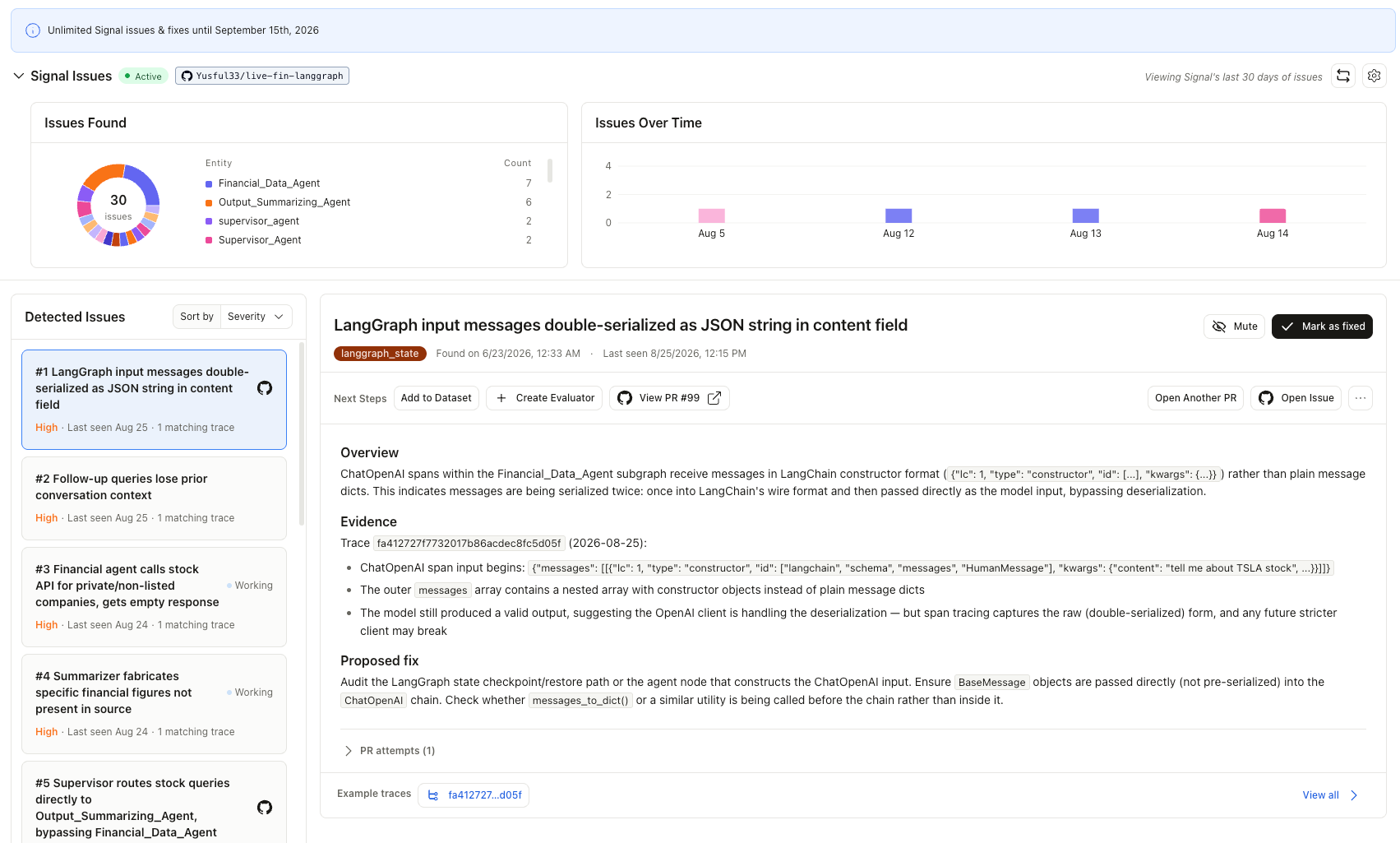
Signal is a managed agent built into Arize AX that continuously reviews production traces, remembers issues it has already identified, and groups recurring failures into ranked issues with evidence, root-cause analysis, and a proposed fix.
With a repository connected, a managed agent can inspect the codebase, propose a patch, and open a pull request. The same failure can become an eval through Agent-as-a-Judge or a dataset example for regression coverage. The engineer reviews and ships.
Signal is a prebuilt workflow built on top of Managed Agents in Arize AX
Teams can start with presets for failing traces, monitor alerts, cost analysis, health checks, and repository investigation, or create their own agents and investigations.
Agents can run once, on a schedule, or from an operational trigger.
Choose the model: Use an Arize-provided model out of the box, or bring your own API key and select the model used by your managed agent.
Add your own skills: Give managed agents organization-specific instructions and capabilities, including your debugging methods, investigation workflows, and remediation procedures.
Choose the harness: Teams aren’t limited to Signal’s default production investigation. They can define the agent architecture and workflow appropriate for their environment.
Bring your own sandbox: Agent execution can use the environment and controls appropriate for the work rather than requiring every investigation to run inside one vendor-defined execution path.
Bring in context beyond AI traces: An agent investigating an AI failure doesn’t necessarily need to stop at the agent trace. Teams can bring additional operational evidence into the investigation, including telemetry such as APM metrics and traces, so the agent can reason across the AI and software systems involved in the failure.
A bad response may originate in a prompt, tool call, model behavior, application dependency, or infrastructure problem. The investigation needs access to the evidence required to tell the difference.
Closing the loop
Signal sits inside a broader feedback loop in Arize AX. Production traces, eval results, feedback, and other telemetry provide the evidence. Managed agents investigate that evidence and propose changes; Agent-as-a-Judge can turn what they learn into new eval coverage, failing traces can become dataset examples, and experiments test whether changes improve the system before they ship.
New production behavior becomes evidence for the next cycle.
Signal works across agent frameworks using OpenTelemetry and OpenInference instrumentation and can incorporate operational evidence beyond the agent trace. That gives the investigation more context to determine what happened, why it happened, and what should change.
Signal is available on Arize AX Free and Pro. The broader Managed Agents system, including Agent Studio, presets, and repository access, is currently in beta for Enterprise customers.
Arize Signal vs. LangSmith Engine vs. Braintrust Topics: feature comparison
| Capability | Braintrust Topics | LangSmith Engine | Arize Signal + Managed Agents |
|---|---|---|---|
| Primary abstraction | Classification system | Preconfigured agent engineer | Prebuilt investigation on a managed-agent system |
| Core approach | Summarize, embed, cluster, and classify | Agentic issue detection and remediation | Continuous agentic investigation |
| Pattern detection | Yes, facet-based clustering | Yes, failure clustering into named issues | Yes, ranked issues with evidence |
| Root-cause analysis | No | Yes, against connected source code | Yes, with supporting evidence |
| Proposed fix | No | Yes | Yes |
| Opens pull requests | No native Topics-to-code PR workflow documented | Yes, GitHub | Yes, GitHub via repo-connected managed agents |
| Regression prevention | Classifications can feed evaluation workflows | Proposes evaluators, adds failing traces to datasets, reopens issues | Can create eval coverage, add examples to datasets, and validate changes through experiments |
| Workflow customization | Custom facets and preprocessors | Configuration within predefined workflow | Custom agents, presets, schedules, triggers, and investigations |
| Custom skills | Not an agent-skill system | No user-defined skill system for Engine | Yes, bring your own skills |
| Agent harness | N/A | Vendor-defined Engine workflow | Bring your own harness / customize agent architecture |
| Model choice | Braintrust-served models for Topics | LangChain-provided models | Arize-provided models or BYOK/model selection |
| Execution environment / sandbox | N/A for classification workflow | Engine-managed workflow | Supports bringing your own sandbox |
| External operational context | Logs and classification inputs | LangSmith traces plus connected repository context | AI traces plus repositories, skills, and external operational telemetry from popular APM providers |
| Custom investigations | Custom classification facets | Within Engine’s defined use case | Build new trace- and telemetry-driven agents in Agent Studio |
| Scheduling / triggers | Recurring Topics jobs | Engine continuously monitors configured projects | One-time, scheduled, or operationally triggered agents |
| Open instrumentation | Supports OpenTelemetry | Supports OpenTelemetry | OpenTelemetry + OpenInference |
| Availability | Topics available in Braintrust; plan capabilities vary | Public beta | Signal on AX Free/Pro; full Managed Agents in Enterprise beta |
| Pricing model | Included credits plus usage-based Topics charges | Metered LCUs | Signal included with AX tiers; Managed Agents packaging varies by tier |
Which one should you use?
Choose Braintrust Topics if the primary problem is aggregate analytics across production conversations: intent distribution, sentiment shifts, emerging categories, and other patterns that are difficult to define ahead of time. Its classification architecture is purpose-built for that job.
Choose LangSmith Engine if you want a turnkey failure-to-fix workflow and are comfortable adopting LangChain’s opinionated agent architecture. Its integration between production issues, pull requests, evaluators, and datasets makes regression prevention particularly strong.
Choose Arize Signal if you want continuous production investigation but don’t want the investigation architecture to stop at a vendor-defined workflow. Signal gives you the prebuilt experience; Managed Agents lets you extend it with your own models, skills, harness, sandbox, operational context, and entirely different investigations.
At a distance, all three products can look like variations on “AI reads your traces.” Architecturally, they’re making different bets:
- Topics is a classification system.
- Engine is an opinionated agent workflow.
- Signal is an opinionated workflow built on a composable managed-agent system.
All three reflect the same shift: production telemetry is becoming an input to agents that investigate problems and propose what to do next.
The difference is how far the automated workflow travels, what evidence it can use, and how much control teams retain over the system performing the work.
Related resources: For the broader Arize stack around this comparison, see agent reliability, building agent evals from traces, LLM as a judge, and how Arize compares to other AI observability tools. For production examples, read how Booking.com scales AI observability and how LG Uplus uses evaluation-driven development.
Frequently asked questions
What is Arize Signal?
Signal is a managed agent in Arize AX that continuously reviews production traces, groups recurring failures into ranked issues with evidence and root-cause analysis, and proposes fixes. Signal runs on Arize’s broader Managed Agents system, which supports custom agents, skills, harnesses, model choice, execution environments, and additional operational context.
Can Arize Signal open pull requests?
Yes. With a repository connected, Managed Agents can inspect code, propose a patch, and open a pull request for engineer review. The workflow can also create evaluation coverage, add production failures to datasets, and use experiments to validate subsequent changes.
Can I customize the agents behind Arize Signal?
Signal is a prebuilt investigation, while Agent Studio and Managed Agents provide the broader customization layer. Teams can build custom agents and investigations, bring their own skills and harness, select models or use BYOK, control the execution environment, and incorporate additional context and telemetry.
What is LangSmith Engine?
LangSmith Engine is a public-beta agent from LangChain that clusters production failures into named issues, diagnoses root causes against a codebase, drafts GitHub pull requests, and proposes evaluators to prevent regressions. It runs on LangChain-provided models and is priced in LangChain Compute Units.
Can I customize LangSmith Engine?
Engine provides configuration within LangChain’s predefined failure-to-fix workflow, but it is not currently a general managed-agent framework where teams can replace the underlying harness, supply their own model, or compose the agent from their own skills.
What is Braintrust Topics?
Topics is Braintrust’s trace classification feature. A recurring pipeline summarizes traces by facet, embeds and clusters those summaries, and assigns human-readable classifications. It is designed primarily for discovering patterns across production conversations rather than root-cause investigation or remediation.
Does Braintrust Topics open pull requests?
No. Topics classifies production data. Teams that want those classifications to drive code changes need to connect them to a custom built downstream remediation or code-generation workflow.
Could Managed Agents or Arize Alyx recreate a Topics-style workflow?
Yes. A team could ask Alyx or configure a managed agent to periodically analyze production conversations and classify or summarize recurring patterns. Topics provides that workflow as a purpose-built feature; the distinction is that Arize exposes a broader agent system that can also be configured for other investigation and remediation tasks.
What is the difference between Arize Signal, LangSmith Engine, and Braintrust Topics?
Braintrust Topics is primarily a production classification system for discovering recurring patterns. LangSmith Engine is a preconfigured agent workflow that detects production failures, investigates root causes, proposes fixes, and creates regression coverage. Arize Signal provides a prebuilt production investigation on top of a broader Managed Agents system that teams can customize with their own models, skills, harness, sandbox, and operational context.
Do these tools replace engineers?
No. They automate the repetitive work of digging through traces and assembling evidence, freeing engineers to focus on the work that requires human judgment: defining quality, aligning evals, annotating data, and deciding what should ship. The human moves up the stack, from doing the investigation to reviewing and directing it.

