
Recall is the fraction of values predicted to be of a positive class out of all the values that truly belong to the positive class (including false negatives). Recall = Predicted True Positives / (True Positives + False Negatives). High recall means the model catches most actual positives; misses (false negatives) are rare.
Build better agents with Arize
Trace, evaluate, and learn. Build agents that work with Arize AX and start tracing your runs today.
Prefer open source? Try Arize Phoenix for self-hosted, open source agent observability.

Key takeaways
- Recall = TP / (TP + FN): among actual positives, how many the model found.
- Low recall misses real cases: fraud, defects, diseases, or critical tickets.
- Raising recall usually lowers precision when threshold drops.
- Choose thresholds using validation data and explicit FN versus FP costs.
- Monitor recall on minority classes and slices where misses hurt most.
Formula and confusion matrix
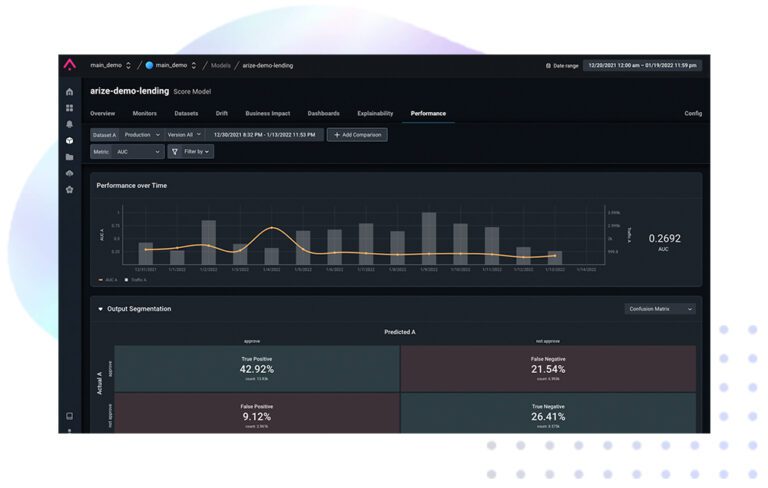
True positives (TP): predicted positive, label positive.
False negatives (FN): predicted negative, label positive.
Recall = TP / (TP + FN). Also called true positive rate or sensitivity in binary classification.
When there are zero actual positives in a window, recall is undefined; handle gracefully in dashboards.
When recall dominates
Fraud and abuse detection where missed fraud is expensive.
Safety and compliance screening where false negatives create liability.
Medical triage where missing a case is worse than extra review.
Search and retrieval where failing to return a relevant document loses the user.
Rare defect detection in manufacturing vision.
Teams accept more false positives (lower precision) to raise recall by lowering thresholds or improving features on hard positives.
Tradeoff with precision
Lowering the decision threshold usually increases recall and decreases precision.
Plot precision-recall curves and pick operating points with stakeholder agreement.
Report both metrics at the production threshold, not at defaults.
Monitoring
Track recall with delayed labels, especially on rare positives. Small sample noise swings recall wildly week to week; use confidence intervals.
Slice recall on segments where FN stories cluster (new attack patterns, locales).
Guides on AI model lifecycle management include recall floors in release criteria when misses are costly.
Slice deployment guidance in shipping image classification models with confidence helps catch recall collapse on tail cohorts.
Agent decision layers should log recall on audited positives via LLM and agent evaluation platforms.
Common mistakes
Celebrating high accuracy while recall on positives is near zero under imbalance.
Evaluating recall on a balanced test set that misrepresents production prevalence.
Changing label definitions without recomputing historical recall trends.
Cost of misses
Document expected cost per false negative in the same dashboard footnote as recall so stakeholders understand why thresholds sit low.
For multistage systems, recall on the final decision may differ from recall on the model alone; measure end-to-end.
Practitioner checklist
Before changing production settings, confirm labels, thresholds, and monitor windows match the definitions used in your last offline eval. Snapshot dashboards when incidents start so postmortems compare apples to apples.
Run slice-level reviews on high-traffic cohorts weekly even when global metrics look flat. Many failures appear first in one locale, product line, or prompt route.
Document model version, featurizer hash, and data window in every incident ticket. Future you needs that context to interpret drift charts.
When metrics disagree (offline vs online, precision vs recall), write down the business cost of each error type before picking a fix. Metrics are proxies; costs are the decision.
Share eval harness links in release notes so support and PM teams know which golden tasks must pass before they announce improvements.
Related concepts
Recall connects to true positive counts and false negatives in the confusion matrix. Incident reviews should quote all three cells when explaining missed cases to stakeholders. Plot recall trends by week on priority slices, not only on global aggregates. When recall rises but precision falls, confirm reviewer capacity can absorb the extra flagged volume.
FAQ
How is recall different from precision?
Recall measures missed positives among actual positives. Precision measures false alarms among predicted positives.
What is a good recall target?
Set from risk tolerance and review capacity. Often defined relative to baseline catch rates, not a universal percentage.
Is recall the same as sensitivity?
Yes in binary classification terminology.
How do LLM classifiers report recall?
Map outputs to discrete positives and compare to human labels on sampled traffic or golden sets.
Why did recall drop suddenly?
Investigate concept drift, threshold increases, feature bugs, or adversarial adaptation against your model.