

Chapter summary
Swarm management is the control-plane layer that operates multiple AI agent executions over time. It keeps agent work addressable, bounded, recoverable, and observable. This guide was last updated on August 21, 2026.
Swarm management is the control plane for operating many AI agent executions over time. It gives each execution durable identity and operational boundaries, tracks state and dependencies, enforces budgets and permissions, routes results, handles failures and recovery, and cleans up the resources agents leave behind. Orchestration determines how work should flow, and effective swarm management keeps that work controllable after it starts.
Tools like Cursor and Claude Code have made spawning subagents increasingly easy. The challenge starts when you have a lot of subagents running concurrently. You have to know what each agent is doing, what it can access, how much it can consume, how failures should be handled, and whether its result reaches the right place.
Let’s jump in.
Key takeaways
- Swarm management owns the lifecycle of many agent executions, including identity, state, concurrency, delivery, recovery, and cleanup.
- Task delegation and swarm management solve different scopes of the problem. Delegation creates work. Swarm management keeps control of that work after it exists.
- There is no single required swarm topology. Agent systems may use worker pools, trees, DAGs, graphs, or combinations of these patterns.
- Production systems need runtime-enforced limits, including concurrency, spawn depth, budgets, permissions, credentials, and tool access.
- Observability has to work at both the run and fleet level, so teams can understand individual failures as well as coordination problems across many agents.
Why spawning a child is not enough
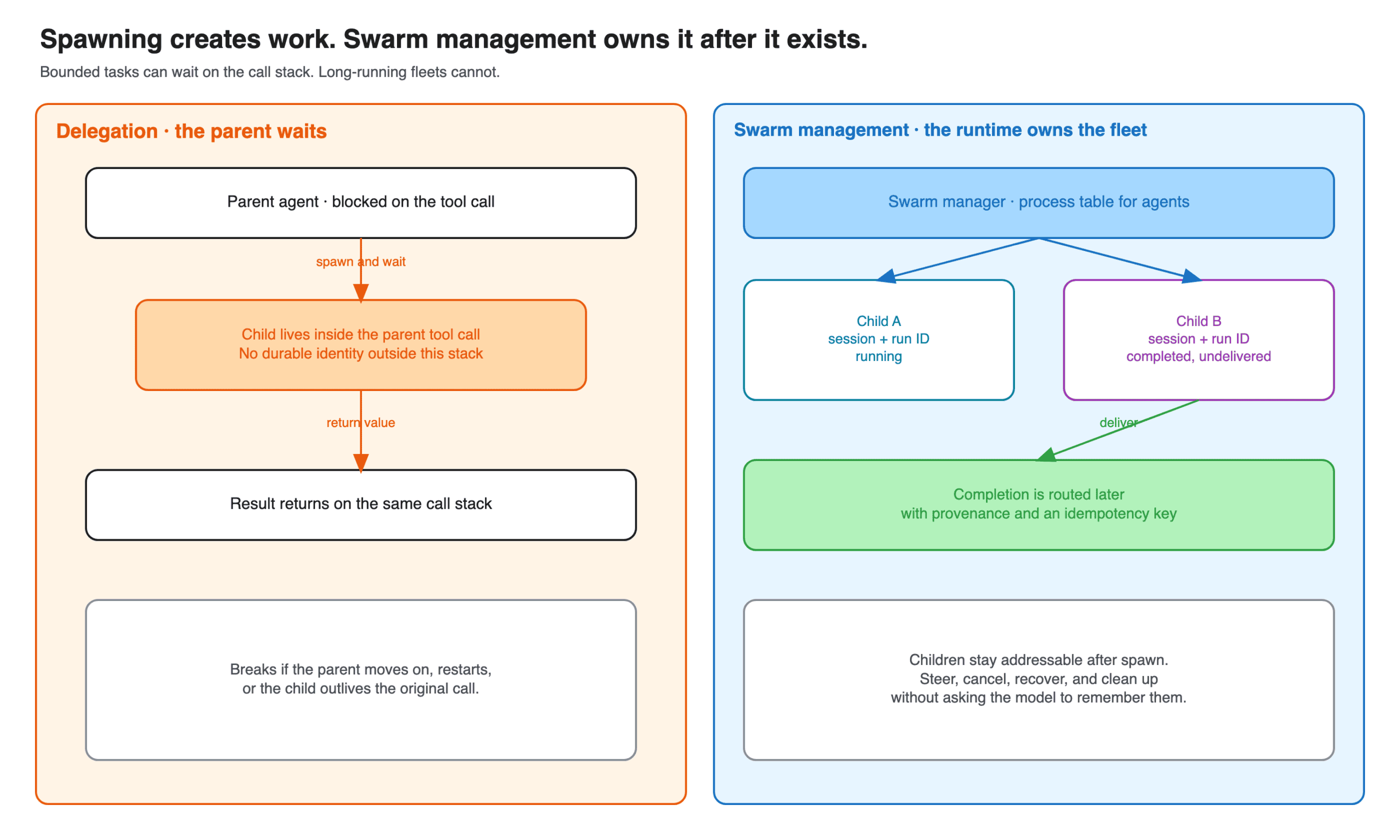
Most agent harnesses can delegate work to another agent.
And for bounded tasks, that may be all you need. A parent agent creates a child, waits for it, gets a result, and continues.
But longer-running systems introduce another set of questions:
- How do you identify the child after the original tool call ends?
- Who owns it?
- Can you inspect or steer it while it is running?
- What happens if the parent continues doing other work?
- What happens if the process restarts?
- Can a child create more children?
- Which credentials and tools can each child use?
- What happens if completion is delivered twice?
- Who cleans up the session, workspace, browser, files, or runtime after execution?
Those are control-plane problems.
Hermes is a useful example of how the boundary is evolving. Its delegate_task primitive supports both normal delegation and background execution. Background delegation can return control to the parent while the child continues, but Hermes’ own documentation still distinguishes that from durable work that must survive session closure or process restart.
OpenClaw pushes further into runtime management. A spawned subagent receives its own session and execution identity, runs asynchronously, can be inspected or controlled, and reports completion back through runtime-managed delivery. It also has limits for nesting and concurrency, cleanup policy, capability restrictions, and retry behavior around completion delivery.
- Delegation answers: How should one agent divide work?
- Swarm management answers: How does the system continue to own all of that work while it is running?
Build better agents with Arize
Trace, evaluate, and learn. Build agents that work with Arize AX and start tracing your runs today.
Prefer open source? Try Arize Phoenix for self-hosted, open source agent observability.

Where swarm management sits
Agent infrastructure increasingly blends several responsibilities together, so these are better understood as capabilities than as rigid layers.
| Capability | Primary job | Typical responsibilities |
|---|---|---|
| Agent harness | Run one agent effectively | Model loop, tools, context, memory, permissions, hooks |
| Orchestration / workflow | Decide how work should flow | Decomposition, routing, dependencies, handoffs, retries |
| Swarm / fleet management | Operate many executions over time | Identity, concurrency, lifecycle, control, delivery, recovery, cleanup |
| Observability and evaluation | Determine what happened and whether it was good | Traces, metrics, logs, evals, cost, quality, root-cause analysis |
A modern orchestration framework may provide persistence, retries, interrupts, and other features that overlap with swarm management. And a dedicated fleet manager isn’t a requirement if the surrounding runtime already provides those guarantees.
The important question is whether some part of the system owns the lifecycle of the work after it has been launched, and which component provides that control plane.
What a swarm manager has to track
Once agent executions can outlive the call that created them, the runtime needs durable state.
A useful control-plane record usually includes:
- Logical identity: which agent, task, or session this work belongs to
- Execution identity: the current run or attempt
- Ownership: who requested the work and which runtime controls it
- Topology: parents, children, dependencies, or other causal relationships
- Status: queued, running, blocked, completed, failed, cancelled, timed out
- Capability policy: tools, credentials, data, networks, repositories, and services the agent may access
- Resource policy: concurrency, runtime, token, cost, memory, or compute limits
- Routing state: where completion or intermediate results should go
- Retry and idempotency state: whether an operation or result has already been processed
- Artifacts: files, pull requests, reports, datasets, logs, or other outputs
- Timestamps and outcome: creation, start, completion, latency, quality, and cost
A system does not have to call these concepts a “session ID” and “run ID.” The underlying requirement is more general: durable logical identity needs to be distinguishable from individual execution attempts.
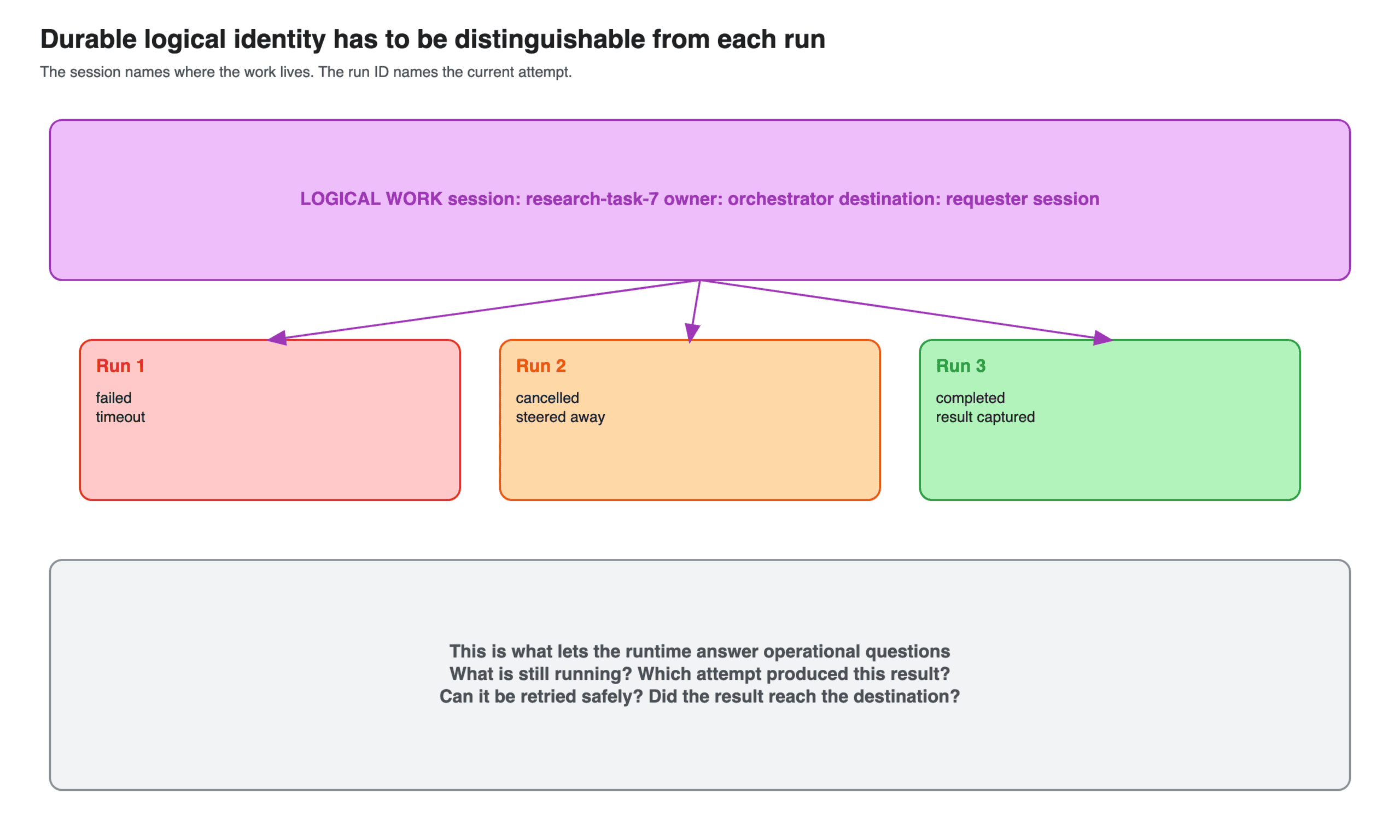
That distinction lets the runtime answer basic operational questions:
- What is still running?
- Which work belongs together?
- Which attempt produced this result?
- Can this execution be retried safely?
- Who is allowed to steer or cancel it?
- Did its result reach the intended destination?
- Which state should survive after execution ends?
Control-plane jobs
Completion may need to be routed
Synchronous delegation has a simple contract:
- Parent requests work.
- Child runs.
- Child returns a result.
- Parent continues.
That works well when the parent intentionally waits.
Long-running or asynchronous work breaks the assumption that the original call stack will still be there when the child finishes. The requester may be idle, processing another turn, restarted, or waiting on several children.
In those systems, completion becomes a delivery problem.
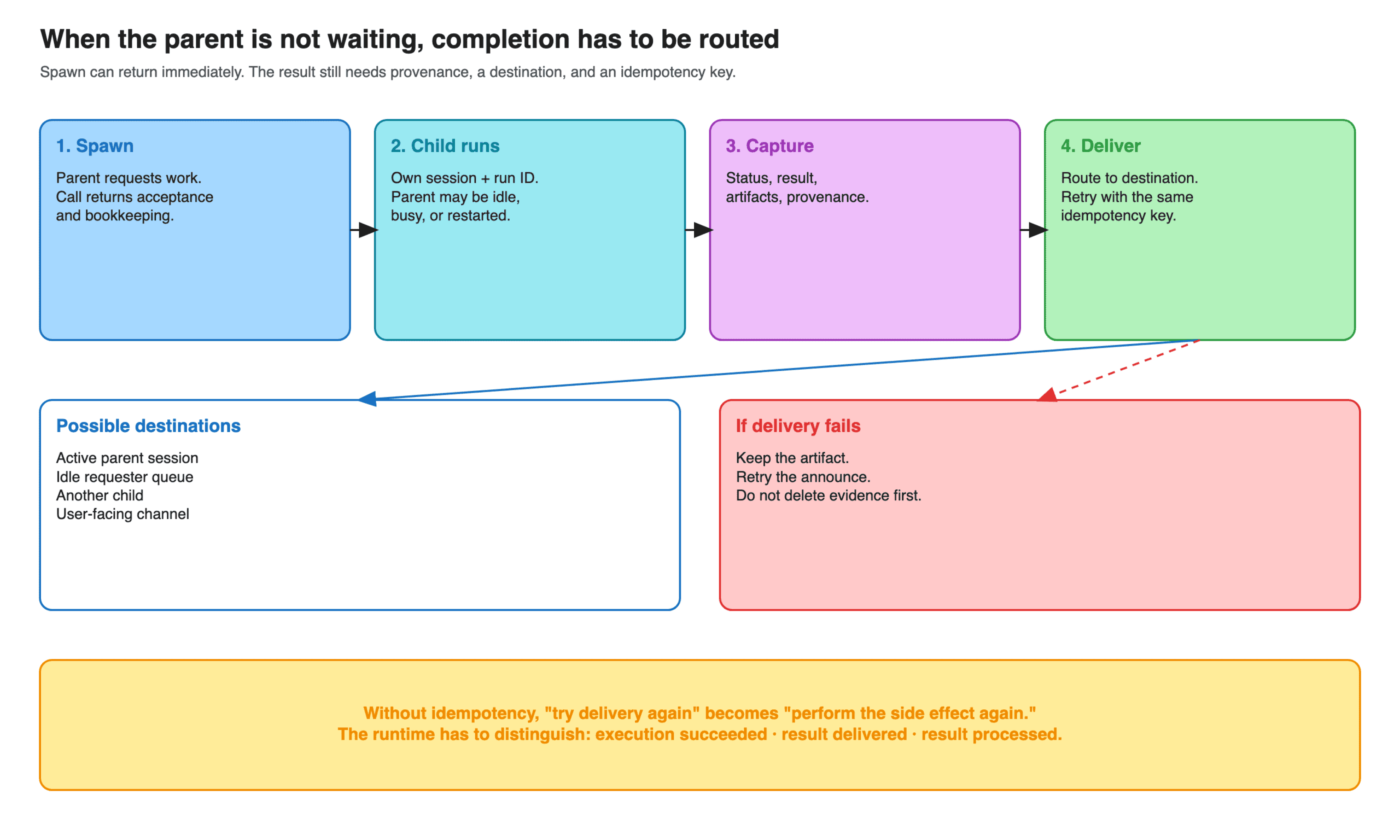
A durable completion record may need to carry:
- child identity
- execution identity
- status
- result or artifact references
- destination
- provenance
- delivery state
- an idempotency key
OpenClaw, for example, returns immediately from a spawn and later hands completion back to the requester session. Its current delivery path uses a stable idempotency key and retries failed completion delivery rather than silently dropping the result.
That last part matters because distributed systems retry things.
Without idempotency, “try delivery again” can become “perform the side effect again.” That means an effective production swarm manager needs to distinguish between execution succeeded, result was delivered, and result was processed exactly as intended.
Concurrency needs explicit semantics
Parallelism is one of the reasons to use multiple agents, but concurrency creates state-management problems quickly.
Within one logical session, two operations may try to:
- edit the same file
- change the same plan
- update the same memory
- respond to the same user
- consume the same queue item
That doesn’t mean you need strict serialization. Some systems deliberately fork work and merge it later.
What matters is that conflicting operations have defined concurrency semantics. Depending on the application, that might mean:
- serialize mutations within a session
- use locks or leases
- use optimistic concurrency
- isolate work in separate branches or worktrees
- make operations idempotent
- merge independent outputs at a synchronization point
At the same time, unrelated sessions should usually be able to execute in parallel.
This is where queueing and backpressure become important. A runtime needs to decide what happens when a new message, completion event, retry, scheduled job, or steering instruction arrives while other work is already active.
Better prompting cannot solve an overloaded queue.
Steering and cancellation are different operations
Stopping an agent is useful, but cancellation alone is a limited control surface.
Long-running agents may need several forms of intervention:
- Steer: change instructions while preserving the logical session
- Interrupt: stop the current execution so it can be replaced
- Cancel: terminate a particular task
- Kill: forcibly terminate an execution or runtime
- Cascade: terminate owned descendants when a parent is stopped
Cascade semantics depend on topology.
In a hierarchical delegation system, ownership often forms a tree, so terminating an orchestrator may reasonably terminate its descendants.
Other multi-agent architectures may use worker pools, DAGs, shared workers, or graph relationships. In those systems there may be no single parent whose cancellation should automatically destroy every causally related execution.
A swarm manager needs an explicit ownership model rather than assuming every swarm is a tree.
Roles, permissions, and capability boundaries
Agent fan-out becomes dangerous when every child inherits every capability of its parent.
Production runtimes should enforce what an agent can do at the control-plane level.
Useful constraints can include:
- maximum concurrent children
- maximum delegation depth
- allowed agent types
- tool allowlists and denylists
- credential scope
- repository scope
- filesystem boundaries
- network access
- sandbox requirements
- token and cost budgets
- runtime limits
Hierarchical systems often distinguish orchestrators from leaf workers. An orchestrator may be allowed to create or inspect children, while a leaf can perform its assigned task but cannot create another generation of agents.
OpenClaw and Hermes both expose controls around nesting and child capabilities.
The broader principle is more important than the specific role names: delegated work should receive the minimum authority it needs.
Flat worker pools can scale extremely well. The unsafe pattern is unbounded recursive fan-out with unrestricted capabilities.
Recovery keeps ownership intact
If the runtime claims to manage a fleet, process restart cannot erase its understanding of the fleet.
A swarm manager typically needs some durable equivalent of a process table with:
- known executions
- latest state
- ownership
- execution attempts
- deadlines
- delivery status
- cleanup status
After a restart, the manager may need to reconcile those records against reality.
For example:
- A run is marked active, but no worker exists.
- A worker completed, but its completion was never delivered.
- A retry started a second execution.
- A parent disappeared while children continued.
- A result was delivered, but the acknowledgement was lost.
- A cancelled run still owns resources.
That means recovery goes further than just “restarting the agent.”
The runtime has to determine which state is authoritative, which operations are safe to retry, and which orphaned resources need to be reclaimed.
Agent state can outlive the model run
When a model stops generating tokens, the system may still own:
- transcripts
- checkpoints
- workspaces
- worktrees
- browser sessions
- containers
- subprocesses
- MCP connections
- temporary files
- artifacts
- delivery records
- credentials or leases
Some of that state should disappear immediately. Some should remain available for inspection or follow-up.
A useful lifecycle should separate run completion from resource cleanup and session retention.
Cleanup itself may need retries. If artifact delivery fails, deleting everything first can destroy the evidence required to recover.
Long-running agent infrastructure eventually becomes lifecycle-management infrastructure.
Observability and evals for agent fleets
Debugging a single agent run requires knowing what the model saw, which tools it called, how long steps took, what they cost, and where behavior diverged from expectations.
A fleet adds another dimension: coordination itself can fail.
Useful fleet-level signals include:
- total active and queued agents
- queue wait time
- execution latency
- fan-out per task
- maximum and average depth
- retry rate
- timeout and cancellation rate
- straggler time
- redundant or duplicated work
- coordination overhead
- tokens and cost by agent or task
- cost per successful end-to-end outcome
- human intervention rate
- task success and evaluator scores
Tracing also needs to represent more than a simple parent-child tree.
OpenTelemetry spans have a single parent, but they can also contain links to other causally related spans. Links are specifically useful for asynchronous work, batches, and scatter/gather patterns where several executions contribute to one downstream operation.
That makes them useful for multi-agent systems with fan-out and fan-in.
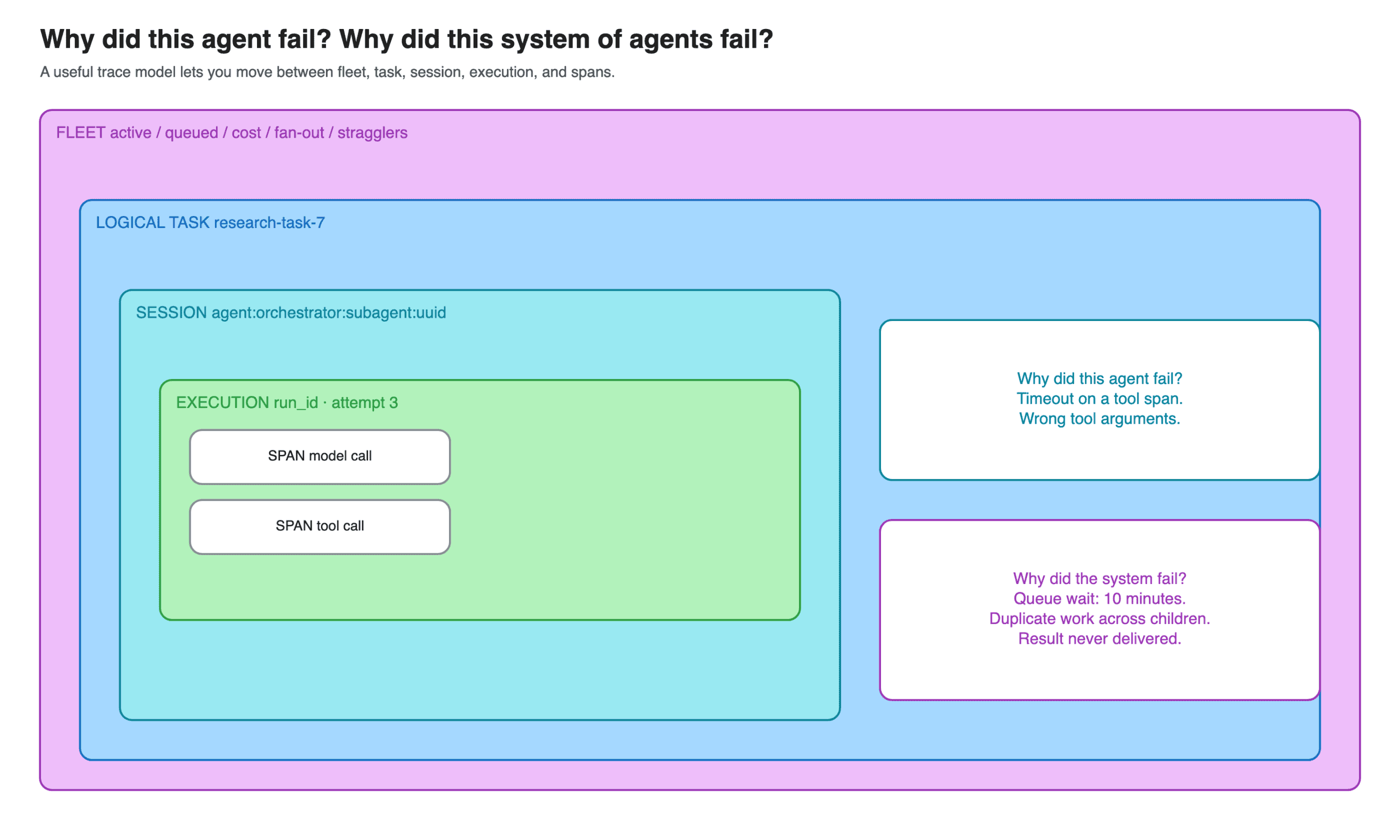
A useful trace model should let you move between:
Fleet → logical task → agent/session → execution attempt → model/tool spans → outcome/evals
The goal is to answer two questions:
- Why did this agent fail?
- Why did this system of agents fail?
Evals add another layer by scoring whether an individual execution, handoff, or end-to-end outcome was correct. When an evaluator runs asynchronously, it helps detect and categorize failures across the fleet. When a check runs synchronously in the execution path as a gate, it can also block, retry, or reroute work before a bad result propagates downstream. Evaluation and enforcement are separate capabilities, even when the same signal drives both.
Debugging an individual agent and debugging the coordination of an agent fleet are therefore related but increasingly distinct problems.
How this shows up in Arize AX
Arize AX can observe and evaluate production agents regardless of where those agents are orchestrated. Through OpenTelemetry and OpenInference tracing, teams can capture model calls, tool calls, retrieval, latency, token usage, cost, sessions, traces, and evaluation results, then investigate individual executions or patterns across production.
That is separate from Arize Managed Agents.
Managed Agents are engineering workers that operate on telemetry and connected systems to help teams investigate and improve the AI applications they already run. They can reason over traces, use skills and connected resources, work with code repositories when configured, and produce artifacts or proposed changes for human review.
Signal is one example. It runs on a schedule against project traces, finds recurring production issues, and surfaces durable findings with supporting evidence. The investigation can continue into connected engineering workflows without silently changing the customer’s production application.
Arize also uses swarms within the Managed Agents experience for on-demand parallel work. In the current product model, a swarm can launch one managed-agent definition as one or more parallel instances.
That is a product-specific implementation of a swarm.
The broader architectural definition on this page also applies to multi-agent systems built outside Arize, including systems with different agent roles, frameworks, topologies, and runtimes.
The common problem is the same: once many agent executions are active, somebody has to own their lifecycle.
FAQs about swarm management for AI agents
Is swarm management the same as a multi-agent system?
No. A multi-agent system describes an application in which multiple agents participate in a task or environment.
Swarm management describes the runtime capabilities used to operate those agents safely over time, including execution state, concurrency, permissions, delivery, recovery, and observability.
A multi-agent application may be simple enough that it does not need a dedicated swarm-management layer.
How is swarm management different from orchestration?
Orchestration primarily defines how work moves between agents or steps: which task runs next, which agent receives it, what dependencies exist, and how outputs are combined.
Swarm management primarily handles operational ownership: what is running, who owns it, how much it may consume, whether it can be steered, what happens after a restart, and how results are delivered and cleaned up.
In practice, the capabilities often overlap. A workflow engine or agent framework may implement much of the required control plane itself.
Is a swarm manager itself an AI agent?
It can contain agents, but the essential swarm-management responsibilities do not require an LLM.
Identity, queues, leases, permissions, retries, idempotency, timeouts, persistence, and cleanup are runtime concerns.
An AI agent may make higher-level decisions about delegation or coordination, while deterministic infrastructure enforces what is actually permitted.
How is task delegation different from swarm management?
Task delegation creates or assigns work to another agent.
Swarm management continues to own that work after it has been delegated.
That includes tracking execution, controlling resources, handling intermediate events, routing completion, recovering after failure, and cleaning up the state left behind.
For a short synchronous subtask, delegation may be sufficient. The distinction matters as agent work becomes asynchronous, parallel, nested, or long-running.
Does an agent swarm have to use a tree structure?
No.
Hierarchical delegation often forms a tree because each agent owns the children it creates. Other systems use flat worker pools, DAGs, shared services, graph-based handoffs, or hybrid architectures.
The swarm manager needs to understand the topology and ownership rules the application actually uses rather than imposing one universal structure.
When do teams need swarm management?
The need usually appears when agents start outliving simple request-response execution.
Common signals include:
- many agent jobs running concurrently
- background or long-running work
- nested delegation
- users steering agents while they work
- work that must survive restarts
- shared resource or budget constraints
- production requirements around permissions and auditability
- results that must be delivered asynchronously
- difficulty understanding which agents are running, blocked, duplicated, or failing
A small set of short-lived agents inside one synchronous workflow may not need a separate fleet-management layer.
But it quickly becomes exceptionally helpful as executions become more numerous, concurrent, asynchronous, nested, long-running, or operationally independent.
What should a swarm manager track?
At minimum, it should be able to correlate logical work with individual execution attempts and track:
- identity
- ownership
- status
- topology or dependencies
- capabilities and permissions
- resource limits
- routing and delivery
- retries and idempotency
- artifacts
- timing
- cost
- outcomes
The exact schema will vary by runtime.
How does swarm management help debugging?
It adds the operational context that individual agent traces cannot provide on their own.
A trace may show that one agent timed out. Fleet telemetry can reveal that the agent waited ten minutes in a queue because another branch created too many workers.
A trace may show a correct child result. Delivery state can reveal that the parent never received it.
A trace may show several individually reasonable runs. Topology and eval data can reveal that the system duplicated work, chose the wrong branch to synthesize, or spent five times the expected cost.
As agents become more parallel and autonomous, understanding the coordination layer becomes as important as understanding the model calls themselves.

