

Chapter summary
Compare platforms that turn production traces and feedback into tested updates to prompts, tool descriptions, agent programs, and model weights.
Last reviewed August 25, 2026
How to use this comparison
- Start with the layer that owns production evidence and the regression gate.
- Add prompt or program optimization when instructions are the smallest effective change.
- Use weight training only for persistent capability gaps after context and harness fixes.
A production agent calls the wrong tool and the trace makes the mistake obvious, so an engineer changes the system prompt. After that, the targeted failure disappears … but then a previously reliable workflow starts choosing the wrong route.
So the team fixed one issue while creating another because the change never passed a standing regression test. Sound familiar?
This is the operational problem behind continual learning for agents. A useful loop has to connect real production evidence to a versioned change, compare the candidate against the current system, and preserve a rollback path. The change may be a prompt, tool description, routing rule, compiled program, adapter, or model checkpoint.
The products in this comparison own different parts of that loop. Some collect traces and manage datasets, some optimize instructions or programs, and some train weights. We compare them by their primary layer, the artifact they produce, how that artifact is validated and promoted, and what remains for the team to build.
Disclosure and verification
Arize publishes this guide and appears in the comparison through Arize AX and Arize Phoenix. This is a documentation-reviewed editorial comparison, not a hands-on benchmark or a market-share ranking.
Capabilities, product maturity, and U.S. list prices were checked against official vendor documentation on August 25, 2026. Enterprise contracts, model-provider charges, storage, cloud telemetry, and deployment costs may change the totals.
Quick answer: most teams need a stack, not one continual learning platform
The documented products in this comparison cover different portions of production evidence, root-cause analysis, prompt and program optimization, weight training, release controls, and long-term monitoring. Start with the layer that owns your evidence and regression gate, then add an optimizer or training service only when the smallest effective change requires it.
- Evidence and improvement control planes: Arize AX and Arize Phoenix, LangSmith, and Amazon Bedrock AgentCore Optimization connect traces and evaluations to datasets, configuration changes, experiments, or release workflows.
- Prompt and program optimization: Arize Prompt Learning works inside the Arize AX workflow, AgentCore can recommend system-prompt and tool-description changes, and DSPy compiles a program against examples and a metric.
- Model-weight updates: W&B Serverless Training, Gemini Enterprise Agent Platform, Together AI, and Hugging Face provide different paths to adapters, tuned models, or checkpoints. They still need representative data and a regression gate.
The most defensible selection starts with a real failure and works backward from the artifact that can fix it. A prompt regression does not require a GPU cluster, while a persistent capability gap will not disappear because the team bought a better trace viewer.
What counts as continual learning for AI agents?
In machine learning research, continual learning has a narrow meaning: model parameters are updated across a sequence of tasks or data distributions while the system attempts to preserve earlier capabilities. This comparison uses production continual learning for the broader governed process that turns production evidence into measured changes to future agent behavior. Here, continual learning refers to the production improvement loop around an agent, rather than only the continual learning algorithms used to update model parameters.
That broader process can change prompts, retrieval, memory, tool descriptions, routing, orchestration, model selection, or model weights. The evidence can come from traces, evaluator results, user corrections, human review, or downstream task outcomes. The defining requirements are that the change is attributable, testable, versioned, and reversible.
Use precise failure language
Weight updates can cause catastrophic forgetting because gradient updates alter shared parameters. Prompt, retrieval, memory, tool, routing, and orchestration changes create system-level regressions instead. The test strategy should match the surface that changed.
A product qualifies for this comparison if it natively supports at least one shippable stage of the loop: turning observed behavior into a versioned dataset or configuration, producing a candidate change, validating the candidate, or deploying and rolling it back. An evaluation score alone does not close the loop, although evaluation is a required release gate.
People also search for continuous learning tools for AI agents. Product teams often use continual and continuous interchangeably, but this article uses continual to preserve the connection to the established machine learning field.
Build better agents with Arize
Trace, evaluate, and learn. Build agents that work with Arize AX and start tracing your runs today.
Prefer open source? Try Arize Phoenix for self-hosted, open source agent observability.

Choose the change surface before you choose the tool
Prefer the least invasive change that meets quality and operational requirements while testing end-to-end interactions. The table below maps common production failures to the artifact a team is likely to ship.
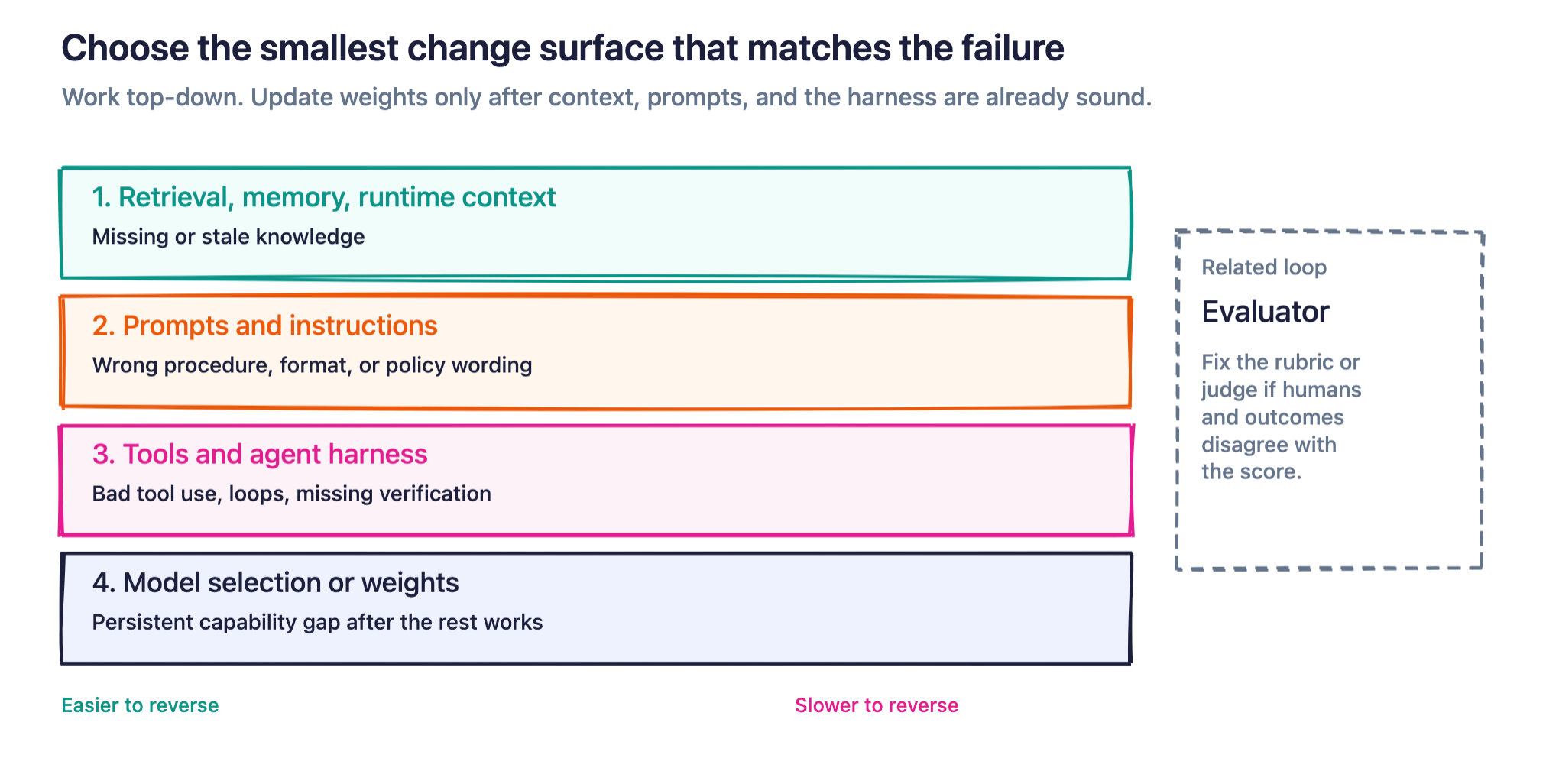
| Observed failure | First surface to investigate | Likely artifact | Primary tool layer |
|---|---|---|---|
| Missing, stale, or organization-specific knowledge | Retrieval, memory, or runtime context | Index or source revision, retrieval policy, memory record | Control plane plus application data stack |
| Correct knowledge, wrong procedure, format, or policy behavior | Prompt and instructions | Versioned prompt or instruction bundle | Control plane or prompt/program optimizer |
| Wrong tool, invalid arguments, loops, or missing verification | Tool definitions and agent harness | Tool-description revision, routing rule, code release | Control plane plus code and deployment workflow |
| Persistent capability gap after context and harness fixes | Model selection or weights | Adapter, tuned model, or checkpoint | Post-training infrastructure plus regression control plane |
| Humans or product outcomes disagree with the score | Evaluator | New evaluator version and calibration set | Separate evaluator-improvement loop |
Root-cause analysis comes before optimization. A weak final answer may have started with an empty retrieval result, a malformed tool argument, or a routing decision several steps earlier. Optimizing the final prompt against the wrong diagnosis can improve the score on one slice while leaving the causal failure untouched.
How the continual learning stack fits together
A complete loop connects production evidence to a controlled change and then returns to monitoring. Teams may use one platform across several stages or combine a control plane with a specialized optimizer or trainer.
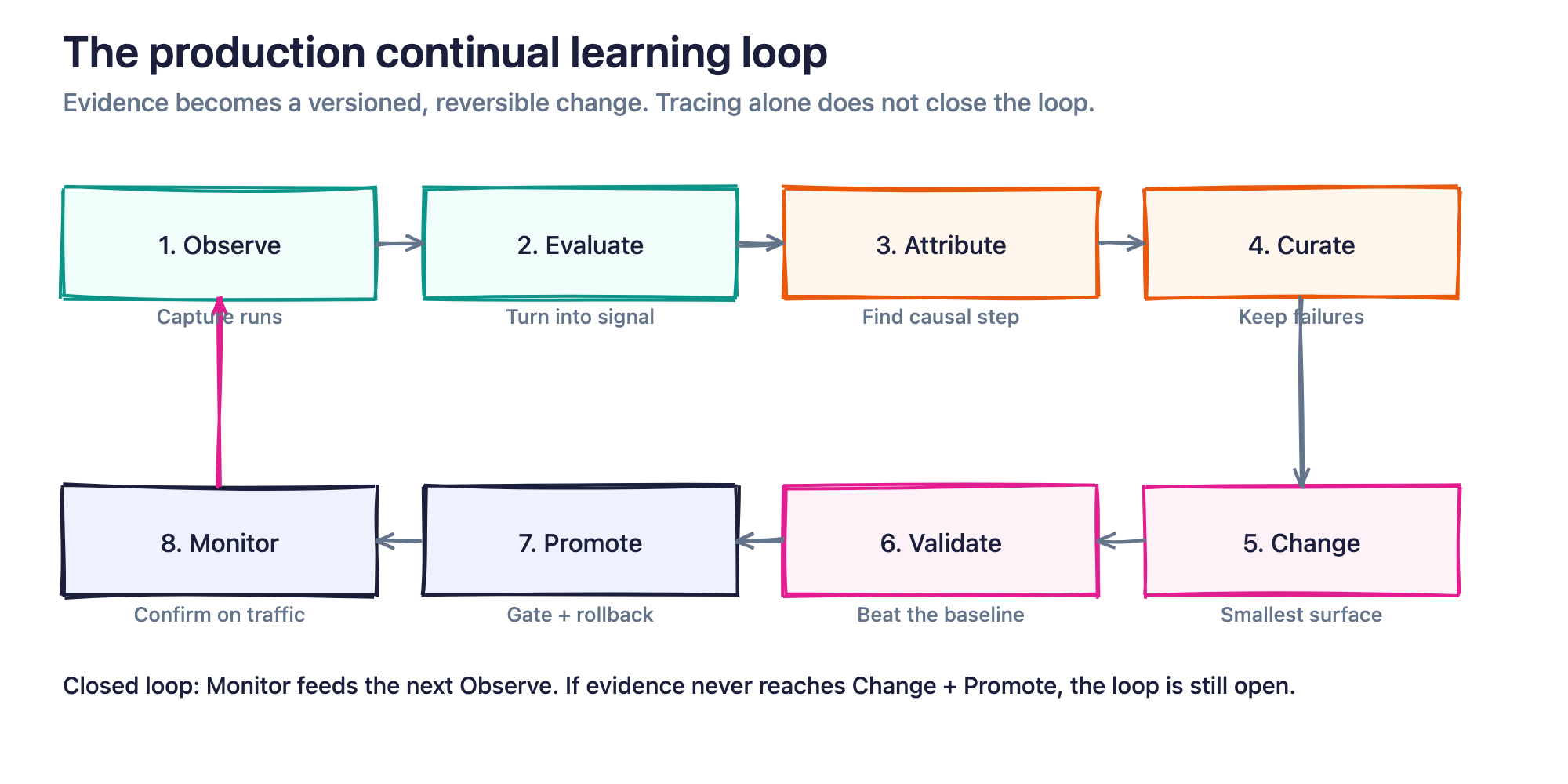
| Loop stage | What must happen | Representative products |
|---|---|---|
| 1. Observe and evaluate | Capture traces, outcomes, labels, and evaluator results. Attribute the earliest causal failure. | Arize AX, Arize Phoenix, LangSmith, AgentCore, W&B Weave |
| 2. Curate and version evidence | Promote representative failures, successful controls, boundaries, and canaries into a stable dataset. | Arize AX, Arize Phoenix, LangSmith, AgentCore batch evaluation, W&B Artifacts, Hugging Face Hub |
| 3. Produce one candidate change | Revise a prompt or tool description, compile a program, or train an adapter/checkpoint. | Arize Prompt Learning, AgentCore Recommendations, DSPy, W&B, Agent Platform, Together AI, Hugging Face |
| 4. Validate and promote | Compare baseline and candidate with fixed data and evaluator versions. Apply a release gate and retain rollback. | Arize experiments and Prompt Hub, LangSmith experiments, AgentCore A/B tests, model registries and endpoints |
| 5. Monitor the new baseline | Verify the gain on real traffic and watch for new failure categories, cost, latency, and evaluator drift. | The production control plane and product analytics stack |
How we evaluated the tools
We did not assign a numeric score because the products solve different engineering problems. Instead, we applied the same questions to each product and used “strong fit for” to describe documented fit rather than an objective overall ranking.
- Evidence path. Can production behavior become a reproducible dataset, evaluation run, or recommendation input without losing the context needed to diagnose the failure?
- Change surface. Does the product change a prompt, tool description, agent program, model selection, adapter, or full checkpoint? Is that choice explicit?
- Shippable artifact. What object leaves the workflow: a prompt version, configuration bundle, pull request, compiled program, adapter, tuned model, or endpoint?
- Validation and release. Can teams compare baseline and candidate with fixed evidence and evaluator versions? Does the product support offline experiments, live traffic splitting, promotion, and rollback?
- Interoperability. Can the team ingest OpenTelemetry or OpenInference traces, export data, and keep the control plane separate from the model or GPU provider?
- Deployment and ownership. Is the product a library, cloud service, local-first project, enterprise self-hosted platform, or managed training service? What work remains with the team?
- Cost model. Which units drive the bill: spans, ingested data, seats, compute units, evaluator calls, training tokens, inference tokens, storage, or GPU time?
- Maturity. Which capabilities are generally available, in preview, or dependent on a specific model, framework, region, or enterprise plan?
What this comparison does not claim
We did not run a shared hands-on benchmark, score output quality, or compare negotiated enterprise contracts. A documented capability can still be awkward in a real codebase, so the proof-of-concept protocol later in this guide is part of the recommendation.
Exact prices appear only where a vendor publishes a clear list price. Treat them as examples of the billing model rather than a complete monthly estimate.
Compare the meter, not only the sticker price
| Dominant meter | What makes the bill move |
|---|---|
| Spans and ingested data | Deeper traces, more tool calls, larger payloads, and longer retention |
| Seats, traces, and compute units | More collaborators plus evaluation, automation, and issue-analysis runs |
| Training tokens × epochs | Dataset size, repeated epochs, validation frequency, and model family |
| Inference, storage, and GPU time | Optimizer calls, repeated evaluations, checkpoints, endpoint uptime, and production traffic |
Continual learning tools for agents, compared
The first matrix compares workflow fit. The second focuses on operating model, pricing units, maturity, and the main limitation a team should test before purchase.
| Tool | Primary layer | Evidence in | Artifact out | Validation and promotion | Strong fit for |
|---|---|---|---|---|---|
| Arize AX + Arize Phoenix | Evidence and evaluation control plane; AX adds managed prompt optimization and production improvement workflows | OpenTelemetry/OpenInference traces, feedback, datasets, evals | Dataset, experiment record, and prompt version; on Enterprise, AX managed agents can propose fixes as pull requests in a connected GitHub repository | Offline experiments; Prompt Hub tags; external production rollout for code or weights | Teams that want open instrumentation plus local-first or managed paths |
| LangSmith | Evidence/control plane; agent engineering | LangSmith or OpenTelemetry traces, datasets, labels | Dataset example, prompt/graph/code change, PR for supported frameworks | Offline evaluation and deployment workflows | LangChain/LangGraph teams and OTel apps already using LangSmith |
| Amazon Bedrock AgentCore Optimization | Managed control plane and configuration optimization | CloudWatch traces or inline OpenTelemetry-compatible spans; one target evaluator for system-prompt recommendations | Prompt or tool-description recommendation, immutable config bundle, endpoint variant | Live A/B through AgentCore Gateway with online evaluation | AWS teams that want managed prompt/tool optimization and traffic splitting |
| DSPy | Prompt and program optimizer | Train/validation examples, metric, optional text feedback | Optimized DSPy module, optionally persisted as JSON state or as a full program artifact | Developer-run holdout evaluation and application deployment | Python teams with a trustworthy metric and explicit program structure |
| W&B Serverless Training | Managed post-training plus lineage | Training data, model runs, optional Weave traces | Versioned LoRA adapter artifact | Models tracks runs and metrics; Artifacts versions LoRA checkpoints; Registry collections and aliases can provide a promotion pointer; product regression approval remains external | Teams already using W&B that want preview-stage managed LoRA SFT or ART-based online RL on W&B’s current supported base-model catalog |
| Gemini Enterprise Agent Platform | Managed model tuning | Cloud Storage datasets and model-specific tuning inputs | Gemini tuned-model resource with shared-endpoint deployment; open-model full or PEFT/LoRA artifacts exported to Cloud Storage for separate deployment | Validation metrics, optional Gen AI Evaluation, managed deployment | GCP teams tuning Gemini or supported open models |
| Together AI | Managed open-model post-training | Task-schema JSONL, or pre-tokenized Parquet containing token IDs and attention masks | Private Together model-registry object plus downloadable merged weights, adapter, or full-weight artifacts, subject to model-specific constraints | Optional separately provisioned dedicated endpoint; external trace and regression control plane | Teams that want managed open-model tuning with published token pricing |
| Hugging Face | Modular open-weight stack | Hub datasets or custom data, TRL recipes, own metrics | Training output that the script explicitly pushes as an adapter or checkpoint revision to a Hub repository or external storage | Jobs or own compute, Hub versioning, Inference Endpoints or custom serving | Teams that want maximum control over open-weight training and deployment |
How to read this matrix
Read each row from evidence to artifact to release path. The artifact and validation columns usually matter more than the number of adjacent features because they show whether the product can complete the change your team actually needs.
| Tool | Deployment and interoperability | Pricing unit and published starting point | Maturity | Main limitation to validate |
|---|---|---|---|---|
| Arize AX + Arize Phoenix | Arize Phoenix local-first and source-available under ELv2; AX SaaS; AX Enterprise self-hosted | AX Free and Pro use monthly span-volume and storage limits; Free includes 25k spans, and Pro is $50/month with 50k spans | Production-available; maturity varies by capability | No managed weight-training cluster; offline experiments are not live traffic splitting |
| LangSmith | Cloud; Enterprise self-hosted and hybrid | Seats, base and extended-retention traces, and LangChain Compute Units; Plus $39/seat/month | GA | LangSmith’s core tracing and evaluation capabilities are production-available. LangSmith Engine launched in public beta and can propose fixes to connected GitHub.com repositories; other repository providers are not currently supported. |
| AgentCore Optimization | AWS managed; Gateway and CloudWatch-centered workflow | Underlying Evaluations, Gateway, Runtime, model, and CloudWatch charges | Recommendations, batch evals, and A/B tests GA; insights preview | Live A/B requires AgentCore Gateway and AWS operating components |
| DSPy | Python library inside the application or build pipeline | Library use is free; teams pay model and optimizer calls plus their own infrastructure | Active open-source framework | DSPy core is not a hosted governance, traffic-splitting, or managed-rollback service; its documented MLflow integration can add persistent tracing, experiment tracking, versioning, and deployment |
| W&B Serverless Training | Managed serverless training on CoreWeave with W&B lineage | Pro starts $60/month; Weave and storage beyond plan allowances are usage-based; inference is token-priced; adapter training is free during preview | Public preview | Training maturity and future pricing may change at GA |
| Gemini Enterprise Agent Platform | Google Cloud managed service | Model-specific price per million training tokens, generally dataset tokens × epochs; add distillation teacher calls, evaluation, storage, and serving charges | Maturity is capability-specific. Established supervised-tuning paths are GA, while some Gen AI Evaluation integrations remain in Preview. Gemini reinforcement-learning fine-tuning is Pre-GA and v1beta1-only; under Google’s current Pre-GA terms, it is intended for testing and evaluation rather than production use. | Requires GCP data and deployment workflow; supported models and tuning modes differ |
| Together AI | Managed training with optional, separately provisioned dedicated inference | Training tokens × epochs plus validation tokens × evaluation runs; up to 16B SFT LoRA starts at $0.48/1M processed tokens; most standard jobs have a $4 minimum, while some models are exempt or have higher minimums | GA | Production evidence, broad regression testing, and release governance usually live elsewhere |
| Hugging Face | Hub plus Jobs, Spaces, Endpoints, or self-managed compute | Pay-as-you-go compute, storage, and endpoints; hardware billed by time | Mature components | The team owns pipeline integration, evaluation design, promotion policy, and rollback |
Three conclusions from the comparison
- Keep the production evidence and regression history stable even when the optimizer, model provider, or GPU service changes.
- Treat offline experiments and live A/B tests as different release stages. Offline tests are more reproducible when inputs, model snapshots, decoding settings, retrieval corpus, tools, evaluator versions, and execution environment are pinned; live splits add real-user evidence and more operational risk.
- Preview status belongs in the architecture decision. A free preview can become a production dependency before pricing, model coverage, export paths, and service guarantees settle.
Evidence and improvement control planes
These products start closest to production behavior. They collect or consume traces, turn recurring failures into evidence, and help teams validate a change. Their strongest artifacts are usually datasets, prompt or configuration versions, experiment records, and code changes rather than new model weights.
1. Arize AX and Arize Phoenix
Strong fit for: Teams that want OpenTelemetry and OpenInference traces, datasets, experiments, and prompt iteration with a choice between a local-first, source-available project under ELv2 (Arize Phoenix) or a managed platform that’s built for enterprise demands (Arize AX).
What part of the loop it owns. Arize Phoenix covers tracing, datasets, experiments, evaluation, prompt tracking, and data curation. Arize AX adds a managed SaaS and enterprise operating layer, Prompt Hub, Prompt Learning, Signal, release-oriented prompt tags, and enterprise managed agents that can carry an investigation into a connected repository.
How the workflow works. Teams send traces through OpenTelemetry or OpenInference, attach evaluator results or human annotations, preserve representative failures in a dataset, and run the current and candidate systems against the same examples. Prompt Learning can use the current prompt, examples, and evaluation feedback to propose a revised prompt. The winning prompt is saved as a new immutable version in Prompt Hub and can be promoted through a tag that the application reads at runtime.
What developers should validate. Arize Phoenix gives developers direct control over tracing, datasets, evaluations, experiments, and the improvement workflow in a local or self-hosted environment. Teams still own the automation and release infrastructure around those primitives. AX is designed for teams that want to operationalize the same evidence-to-improvement loop across production systems, adding managed issue discovery, prompt optimization, release-oriented workflows, and enterprise controls. Offline experiments compare candidates on fixed evidence; they do not provide live traffic splitting by themselves. Code, retrieval, and weight changes still move through the deployment systems that own those artifacts.
What product managers should validate. Define the product outcome that becomes the release gate, then test whether issue prioritization and dataset coverage match real user impact. AX Free and Pro use monthly span-volume and storage limits rather than seat-based pricing or evaluator-score charges, so forecast both dimensions on representative traffic. External model calls for evaluations and optimization remain separate costs.
Pricing and maturity. Arize Phoenix is open source and available under ELv2 and free to run locally or self-host, subject to the terms of that license. AX Free includes 25,000 spans per month, 1 GB of ingestion, and 15-day retention. AX Pro is $50 per month with 50,000 spans, 10 GB, and 30-day retention. Enterprise is custom and can be SaaS or self-hosted. Signal is available on all plans with tiered issue limits; managed agents are an Enterprise capability.
Use it when. Your first problem is getting from production traces to a reproducible dataset, experiment, and versioned prompt or code change without binding the application to one agent framework.
Avoid it when. You already have a trusted evidence and release control plane and only need managed GPU training or a specific cloud model-tuning service.
2. LangSmith
Strong fit for: Teams whose production traces already live in LangSmith, especially LangChain or LangGraph users, and OpenTelemetry teams that want trace-to-dataset and issue-management workflows in the same platform.
What part of the loop it owns. LangSmith provides tracing, datasets, annotation, online and offline evaluation, experiment comparison, and deployment tooling. LangSmith Engine scans production traces for recurring issues, diagnoses likely root causes, attaches new matching traces, proposes fixes, and creates ground-truth dataset examples from production inputs.
How the workflow works. A team can promote trace inputs into a dataset, run a candidate against the same examples and evaluators, and track whether the issue returns after deployment. Engine can propose fixes to any connected GitHub.com repository, including repositories using Deep Agents, LangChain, or LangGraph. Other applications can use LangSmith through its SDKs or OpenTelemetry ingestion; GitLab, Bitbucket, and other repository providers are not currently supported for Engine fixes.
What developers should validate. Confirm how well the OpenTelemetry mapping preserves the span attributes, attachments, session structure, and tool semantics your investigation needs. Test the path from an Engine issue to the actual repository and deployment system. A proposed pull request still needs code review, regression evaluation, and a production rollout plan.
What product managers should validate. Model the total bill across seats, base and extended-retention traces, evaluator execution, and Engine compute. Also verify that issue prioritization reflects severity and prevalence for your product rather than the frequency of a visually obvious trace pattern.
Pricing and maturity. The Developer plan is free with one seat. Plus is $39 per seat per month and includes up to 10,000 base traces before pay-as-you-go usage. Enterprise adds custom pricing and self-hosted or hybrid deployment options. Engine is available on paid plans and consumes LangChain Compute Units.
Use it when. LangSmith is already the system of record for your traces and experiments, or the team wants first-party Engine and deployment workflows for LangChain and LangGraph applications.
Avoid it when. Your primary requirement is model-weight training, or your repository is hosted outside GitHub.com and you require Engine to propose code fixes.
3. Amazon Bedrock AgentCore Optimization
Strong fit for: AWS teams that want a managed path from traces and evaluator findings to prompt or tool-description recommendations, immutable configuration versions, and live A/B testing.
What part of the loop it owns. AgentCore Optimization connects CloudWatch traces or inline OpenTelemetry-compatible spans to recommendations. System-prompt recommendations use one target evaluator; tool-description recommendations analyze tool-selection patterns directly. Teams can package the result into an immutable configuration bundle containing prompts, model identifiers, and tool descriptions, or compare separate runtime endpoints when the change includes code or a different agent implementation.
How the workflow works. For system prompts, the Recommendations API analyzes traces using exactly one target evaluator as the optimization signal. For tool descriptions, it analyzes tool-selection patterns directly without requiring an evaluator. AgentCore Gateway can split live traffic between control and treatment. Online evaluation scores sessions and reports statistical significance. After review, teams can promote the treatment with the AgentCore CLI, which updates agentcore.json; a separate agentcore deploy is required to roll it out. SDK users must update the relevant bundle or Gateway target themselves.
What developers should validate. Live A/B testing depends on AgentCore Gateway and its operational model. Confirm that traces contain the context the recommendation job needs and that configuration bundles cover the behavior you want to change. Bundles can reference an earlier immutable version; for endpoint variants, test the application or infrastructure procedure that restores the prior endpoint. Code-level changes remain endpoint variants rather than automatic configuration edits.
What product managers should validate. AgentCore provides one of the clearest managed paths to production traffic splitting in this comparison. The test still needs a meaningful online evaluator, enough traffic for a decision, and guardrails for high-risk actions. A statistically significant evaluator gain can still miss user correction, escalation, latency, or cost changes.
Pricing and maturity. Recommendations, batch evaluations, and A/B tests became generally available in June 2026, while failure, intent, and trajectory insights remained in preview at the time of review. AgentCore has no single Optimization subscription price. Recommendation generation is free, with charges for newly consumed Evaluations; batch evaluations receive a 25% discount; A/B tests bill Evaluations, Gateway, and Runtime when used. CloudWatch telemetry, model calls, and external hosting are separate, while Insights are free during preview.
Use it when. The application already operates in AWS and the desired change is a system prompt, tool description, model identifier, configuration bundle, or endpoint variant that can be tested through AgentCore Gateway.
Avoid it when. You need a cloud-neutral control plane, local-first development, or a weight-training service. Also test whether the required AWS components fit your security, audit, and cost model.
Prompt and program optimization
Program optimizers are useful when the team can define a training set and a trustworthy metric, but they do not replace production observability or release governance. The optimizer should consume evidence from the control plane and return a versioned artifact that can be evaluated independently.
4. DSPy
Strong fit for: Python teams that can express an agent or LM workflow as a DSPy program and own a metric that captures the behavior they want to improve.
What part of the loop it owns. DSPy structures language-model calls as modules and signatures, then uses optimizers to compile the program against examples and a metric. GEPA can use numeric scores and text feedback to propose new instructions, evaluate candidates, and retain the variants that perform best within a configured budget.
How the workflow works. Developers provide a program, trainset, metric, and normally a reflection model. A separate validation set is strongly recommended but optional, and a custom instruction proposer can replace the reflection model. The optimizer repeatedly runs the program, scores the output, proposes instruction changes, and returns an optimized program that can be saved as a configuration artifact. Production traces do not become a trainset automatically; the team must export, clean, label, and map them into the DSPy workflow.
What developers should validate. Keep a final test set outside the optimization loop so the optimizer cannot overfit the metric or the examples used during compilation. Inspect the generated instruction changes, track the optimizer model and budget, and preserve the original program for rollback. A higher compile metric does not prove that the production agent improved on unrelated workflows.
What product managers should validate. The metric becomes a product specification. Before optimizing, confirm that human reviewers and downstream outcomes agree with the score. Budget both the optimizer calls and the repeated student-model executions, especially when the program has several LM or tool steps.
Pricing and maturity. DSPy is a Python framework rather than a hosted control plane. The software does not impose a platform fee, while model calls, evaluation runs, storage, and deployment remain the team’s responsibility.
Use it when. The workflow is already expressed in DSPy, the team can build a representative train and validation set, and the desired artifact is a compiled program rather than a managed prompt record or model checkpoint.
Avoid it when. You lack a trustworthy metric, need live issue discovery, or want a managed release and rollback system. Pair DSPy with a trace and evaluation platform for production use.
Model-weight and post-training infrastructure
Weight updates often belong later in the decision tree, but they may be appropriate earlier when capability, latency, cost, privacy, or portability benefits justify the broader validation burden. Use them when the model still fails across representative examples after the system supplies correct context, clear instructions, reliable tools, and sound orchestration. Every training path below needs a training-data version, a broad retention set, a deployment artifact, and a previous model version that can be restored.
5. W&B Training
Strong fit for: Teams already using Weights & Biases for model and artifact lineage that want managed Serverless SFT or Serverless RL without provisioning a training cluster.
What part of the loop it owns. W&B Training provides managed post-training through Serverless SFT and Serverless RL, producing LoRA adapter artifacts while integrating training runs with W&B’s model and artifact lineage. W&B Models and Artifacts track training metrics, versions, and lineage. Weave can add tracing and evaluation around model behavior, although it remains optional to the training service.
How the workflow works. Teams configure an SFT or RL job, run inference to generate or evaluate trajectories where applicable, update LoRA weights on managed infrastructure, and store checkpoints as W&B artifacts. The adapter can then be evaluated, served through W&B Serverless Inference, or used in a later training run.
What developers should validate. Serverless Training was in public preview when reviewed. Confirm supported models, environment requirements, checkpoint formats, export options, failure handling, and the exact serving path before making it a production dependency. Keep the product-level regression dataset outside the training loop so adapter quality is not judged only by training metrics.
What product managers should validate. W&B provides unusually tight lineage between runs and model artifacts, but the production improvement loop still needs a way to select representative failures and measure downstream outcomes. Forecast Weave ingestion, artifact storage, inference, and future training charges rather than treating the preview price as the long-term unit economics.
Pricing and maturity. W&B Pro starts at $60 per month. Additional Weave ingestion and storage are usage-based. During the public preview, W&B does not charge for adapter training. Inference is token-priced, and checkpoint or artifact storage is charged only beyond the storage included with the account plan. Training pricing is expected to change at general availability.
Use it when. The team already relies on W&B for experiment and artifact lineage and wants a managed LoRA path with minimal infrastructure work.
Avoid it when. Preview maturity, supported-model constraints, or future pricing uncertainty are unacceptable, or the team only needs prompt and harness changes.
6. Gemini Enterprise Agent Platform
Strong fit for: Teams whose data, security controls, and model deployments already live in Google Cloud and that need managed tuning for Gemini or supported open models.
What part of the loop it owns. Gemini Enterprise Agent Platform AI provides model-dependent supervised and preference tuning for Gemini, along with tuning paths for supported open models. Google also exposes Pre-GA, v1beta1 reinforcement-learning fine-tuning for supported Gemini models. Because that capability is currently intended for testing and evaluation rather than production use, teams should treat it separately from the Enterprise Agent Platform’s production tuning paths. Supported open-model options include supervised full fine-tuning, LoRA or other PEFT methods, and distillation for listed models.
How the workflow works. A team prepares model-specific JSONL data in Cloud Storage, launches a tuning job, and reviews training and validation metrics. Supported Gemini jobs return a tuned-model resource with shared-endpoint deployment; open-model jobs export artifacts to Cloud Storage and require separate deployment to a GPU-backed Vertex endpoint or another serving stack. Google also supports evaluation integrations for selected tuning workflows, but the production trace-to-dataset and release policy still need to be designed around the application.
What developers should validate. Model, tuning method, region, modality, dataset format, quotas, and endpoint behavior vary. Confirm the exact supported path before building the pipeline. Preserve the source dataset, base model identifier, hyperparameters, validation set, tuned model resource, endpoint, and previous model version so the release is reproducible.
What product managers should validate. Google prices tuning by model and training-token volume, where training tokens are the dataset tokens multiplied by epochs. Tuned inference rates also vary by model generation. Include storage, evaluation, endpoint, and data-engineering costs when comparing the service with an open-weight path.
Pricing and maturity. The service publishes per-million-training-token rates by model. Managed tuning is generally available for supported paths, while specific evaluation integrations or methods may be preview features. Supported models and regions change more often than the surrounding workflow.
Use it when. The team wants a managed GCP path, the target model is supported, and Cloud Storage, IAM, Model Registry, and endpoint deployment already fit the organization’s operating model.
Avoid it when. You need cloud-neutral model portability, the desired model or tuning mode is unsupported, or production evidence lives elsewhere and would require a brittle export pipeline.
7. Together AI
Strong fit for: Teams that have a curated training set and want managed SFT, DPO, LoRA, or full fine-tuning for supported open models with a public token-based rate card.
What part of the loop it owns. Together AI provides the managed post-training and inference layer. Teams upload JSONL or Parquet data, launch a tuning job, and receive a fine-tuned model that can be served through Together. LoRA is the lower-cost default for many supported models, while full fine-tuning and DPO are available at higher rates.
How the workflow works. The team prepares training and optional validation data, chooses the base model and tuning method, configures epochs and other job parameters, estimates the training-token cost, and launches the job. Optional dedicated inference is provisioned separately and billed per running replica per minute, including idle time; deployability depends on the base model.
What developers should validate. A well-formed JSONL file is not a regression dataset. Keep target examples, older passing tasks, safety cases, and unrelated canaries separate from the examples used to update the model. Confirm supported models, data limits, endpoint requirements, and whether the resulting artifact has the portability your deployment needs.
What product managers should validate. The public rate card makes job cost easier to estimate than many managed services, but training is only one part of the loop. Include data curation, labeling, evaluation inference, repeated experiments, model hosting, and production verification in the business case.
Pricing and maturity. Together prices fine-tuning by processed tokens: training tokens × epochs plus validation tokens × evaluation runs. When packing is disabled, training-token accounting uses dataset rows × maximum sequence length. SFT LoRA for models up to 16B started at $0.48 per million processed tokens; most standard jobs have a $4 minimum, while some models are exempt or carry higher minimums. DPO, full fine-tuning, larger models, and inference cost more.
Use it when. The team wants a managed open-model training path, the target model is supported, and published token pricing matters for planning.
Avoid it when. You still need to discover failures, build the dataset, or manage a cross-application release gate. Together is the training layer, not the entire production learning loop.
8. Hugging Face
Strong fit for: Teams that want a modular open-weight stack and are willing to own more of the training, evaluation, registry, deployment, and rollback workflow.
What part of the loop it owns. Hugging Face supplies interoperable building blocks rather than one closed-loop platform. The Hub versions model and dataset repositories, TRL provides SFT, DPO, GRPO, and related trainers, Jobs runs scripts on managed compute, and Inference Endpoints or custom infrastructure serve the result.
How the workflow works. Teams prepare or version a dataset, run a TRL recipe through Jobs or their own compute, explicitly push an adapter or checkpoint to a Hub repository or external storage, evaluate the revision, and deploy it to an endpoint or another serving stack. Jobs storage is ephemeral, so unpushed output is lost at termination or timeout. Each piece can be replaced, which increases flexibility and integration work at the same time.
What developers should validate. Define repository permissions, dataset and model cards, immutable revision references, evaluation automation, artifact signing, endpoint rollout, and rollback. Pin endpoints to commit hashes; rollback requires updating a running endpoint to the prior commit, or creating a new endpoint if the existing endpoint has failed, followed by deployment validation. A pinned Hub commit identifies an immutable repository snapshot, but end-to-end reproducibility also requires pinned data, base model, code and environment, configuration, seeds, and evaluation inputs. The team still needs a release record tying the revision to evidence, evaluator versions, approver, and production outcome.
What product managers should validate. Open-weight flexibility can reduce provider dependence and support specialized deployment requirements. It can also shift cost into platform engineering, GPU utilization, security review, and operational ownership. Compare the complete team and infrastructure cost with a managed tuning service.
Pricing and maturity. Hub collaboration plans, Jobs, upgraded Spaces, storage, and Inference Endpoints have separate meters. According to the detailed billing pages, Jobs and Inference Endpoints are metered by the minute at hardware-specific rates; Jobs bill while Starting or Running. Self-managed compute adds the underlying cloud or hardware cost.
Use it when. The team wants open model and dataset artifacts, broad trainer choice, and control over where the model is trained and served.
Avoid it when. The team expects one vendor to provide production issue discovery, dataset curation, evaluation, promotion policy, and rollback without substantial integration work.
Reference stacks for common continual learning workflows
Most production architectures combine a system of record for evidence with a specialized change engine. The following stacks are starting points rather than required pairings.
| Reference stack | Typical components | When it makes sense |
|---|---|---|
| Source-available and local-first | Phoenix for traces, datasets, and experiments; DSPy or the Prompt Learning SDK for program or prompt optimization; Hugging Face or your own infrastructure for weights. | Teams that need local development, inspectable components, and provider flexibility. Expect to build CI, promotion, and governance. |
| Managed trace-to-prompt loop | Arize AX, LangSmith, or AgentCore as the control plane, with the application reading a versioned prompt or configuration and reporting the new production baseline. | Choose based on instrumentation, framework, cloud, deployment, live A/B needs, and release ownership. |
| Managed weight-update loop | A trace and evaluation control plane plus W&B, Agent Platform, or Together AI for training, then a registry and tested deployment procedure that can restore the previous artifact. | Use when a stable model capability gap remains after prompt, retrieval, and harness work. |
| Modular open-weight workshop | A control plane plus Hugging Face Hub, TRL, Jobs or your own GPUs, and the serving stack of your choice. | Use when model portability and infrastructure control justify the extra integration and operational load. |
Keep the evidence plane separate from the training vendor when possible
A team should be able to change model providers or GPU services without losing production traces, labels, evaluator history, and regression datasets. Standard telemetry and exportable evidence reduce the cost of changing either side of the stack.
How developers and product managers should choose
Developers and product managers need the same release evidence, but they ask different questions about it. A useful evaluation process makes both sets of concerns explicit before a proof of concept begins.
| Developers should ask | Product managers should ask |
|---|---|
| Can I ingest and export standard telemetry without rewriting the agent? | Which user or business outcome becomes the release gate? |
| Can I reproduce the failure with the same prompt, model, tools, data, and evaluator versions? | Does issue prioritization reflect prevalence, severity, and affected user segments? |
| Are datasets, evaluators, prompts, configurations, and model artifacts versioned? | Who can approve changes to behavior, permissions, safety policy, and spend? |
| Can the workflow run in CI or an automated experiment pipeline? | Can we measure cost per successful task, correction effort, escalation, and latency? |
| Does the product support offline comparison, live traffic splitting, or both? | How much evidence is required before a rollout expands? |
| Can I roll back the exact artifact without redeploying unrelated components? | Can results be segmented by workflow, risk tier, customer type, and failure category? |
| What remains DIY, and which dependencies are preview or framework-specific? | What is the expected loop latency from production failure to verified deployment? |
Run the same proof of concept with every finalist
A credible proof of concept should end with a reversible production artifact, not a dashboard tour or one impressive demo. Use the same recurring failure, evidence set, and product outcome across finalists so the comparison measures workflow rather than vendor-specific presentation.
- Define one failure operationally. For example: “The support agent claims an order status after the lookup returns no record.” Avoid broad labels such as “bad answer.”
- Collect representative evidence. Start with roughly 50 real failed traces when volume allows, then add successful controls, boundary cases, high-risk cases, and unrelated canaries. A severe incident may justify a smaller immediate set.
- Identify the earliest observed contributing failure. Attach the failure to the retrieval, tool, routing, model, or final-response step where the trace first shows a material contribution, then confirm causality where practical through replay, ablation, controlled intervention, or counterfactual testing.
- Freeze the comparison contract. Record the baseline application, dataset snapshot, evaluator versions, judge model, thresholds, and number of repeated runs.
- Change one surface. Produce one prompt version, tool-description bundle, code release, compiled program, adapter, or checkpoint. Changing one surface simplifies attribution. If multiple surfaces change together, use an experimental design that isolates their effects where practical, such as staged ablations, controlled interventions, or factorial tests.
- Run baseline and candidate on the validation and regression set, then use an untouched final test set for the final estimate. Use the same inputs and evaluator versions. Predefine independent trial counts or a statistically valid stopping rule, then report task-level success rates with confidence intervals; use pass@k or pass^k only when they match product semantics.
- Inspect aggregates and individual regressions. Require the target failure to improve without a critical safety, policy, or unrelated-task regression.
- Price the complete loop at 10 times current volume. Include trace storage, curation, human labels, evaluator calls, optimization or training, model hosting, and production monitoring.
- Promote through the real release path. Record the artifact version, evidence, scores, approver, known tradeoffs, and prior version.
- Roll back in one controlled action and verify production. Restore the prior prompt, configuration, deployment, adapter, or checkpoint, then confirm the improvement and cost profile on live traffic.
Take this with you
Choose the toolchain from the shippable artifact backward. When the failure is procedural or lives in the harness, begin with a control plane that can preserve production evidence, create a standing regression set, and compare a versioned prompt, configuration, or code change. Add DSPy when the workflow is programmatic and the team owns a trustworthy metric. Add managed training only when a stable model capability gap remains after context, instructions, tools, and orchestration are sound.
The proof of concept should end with the same evidence regardless of vendor: a real failed session becomes a reproducible case, one candidate artifact beats the current system on a validation and regression set that includes older passing tasks, then passes an untouched final test set, the complete loop has a forecastable cost, and the previous behavior can be restored immediately.
For the full architecture and implementation sequence, read Continual learning for AI agents and LLM systems: A developer guide. Teams evaluating the Arize path can start with Arize Phoenix or explore Arize AX.
Frequently asked questions
Do I need one continual learning platform or several tools?
Most teams need a stack. The control plane should own production evidence, evaluation history, and the regression gate. A prompt optimizer, program compiler, or weight-training service can produce a candidate artifact, while the application deployment system owns promotion and rollback. One vendor may cover several stages, but the architecture should make those boundaries explicit.
Which tools can optimize prompts from production traces?
Arize AX Prompt Learning can use prompts, examples, and evaluation feedback inside a trace-to-experiment workflow. AgentCore Recommendations can generate system-prompt variants from traces and one target evaluator; tool-description recommendations instead analyze tool-selection patterns directly without requiring an evaluator. LangSmith Engine can propose fixes and create dataset examples from production traces. DSPy can optimize instructions from examples and metrics after the team maps trace evidence into a trainset.
Which tools support model-weight updates?
W&B Training supports Serverless SFT and Serverless RL and produces LoRA checkpoints. Supported models and reinforcement-learning implementation details remain dependent on the current preview offering. Agent Platform tunes supported Gemini and open models. Together AI offers managed SFT, DPO, LoRA, and full fine-tuning for supported models. Hugging Face provides the modular open-weight path through TRL, Jobs or custom compute, Hub repositories, and serving options.
Are Phoenix and DSPy substitutes?
No. Phoenix is a trace, dataset, evaluation, and experiment platform. DSPy is a program-optimization framework. A common architecture uses Phoenix to collect and curate production evidence, DSPy to compile a candidate program, and Phoenix again to compare that candidate with the baseline.
What is the difference between an offline experiment and a live A/B test?
An offline experiment runs control and candidate against a fixed dataset and evaluator contract. It is more reproducible when model snapshots, decoding settings, retrieval data, tools, evaluator versions, and the execution environment are pinned, but it cannot capture every production interaction. A trustworthy randomized A/B test splits real traffic and can add direct evidence about production outcomes and external validity, subject to valid assignment, adequate power, exposure accounting, instrumentation, and risk controls. High-quality loops usually use offline gates before any live split.
Can production traces become training data?
Yes, after governance and curation. Production traces can contain private data, secrets, noisy outcomes, selection bias, weak labels, repeated incidents, poisoned or adversarial content, and model outputs that should not be treated as verified labels. Require provenance and lawful-purpose or consent checks, de-identification, access controls, deduplication, policy and version lineage, poisoning screening, representative sampling, and separation of model output from verified labels. Apply retention and deletion rules before reuse.
How should I compare pricing across these tools?
Price the full path from failure to verified release. That includes telemetry, storage, seats, compute units, human review, evaluator model calls, optimizer calls, training tokens or GPU time, model hosting, and production monitoring. Cost per successful task and loop latency are more useful than the price of one training job.
How often should a continual learning loop run?
Run it when the evidence and risk justify a decision, not simply because a schedule fired. Low-risk prompt or ranking changes with stable evaluators may support frequent automation. Permissions, safety policy, spend controls, and model weights usually require more evidence and explicit human approval.

