

Chapter summary
Continual learning for AI agents is a governed process that turns production behavior into verified changes to future runs. Teams collect traces, user feedback, evaluator results, and task outcomes; identify a recurring failure; test a change to prompts, retrieval, memory, tools, routing, or model weights; and promote it only when the evidence shows improvement without unacceptable regression.
Most production learning loops improve the system around the model before they update the model itself. Prompts, retrieval policies, tool definitions, and orchestration rules are easier to inspect, test, and roll back than a fine-tune.
In machine learning research, continual learning has a narrower meaning: updating model parameters across a sequence of tasks or data distributions while preserving prior capability. This guide explains that distinction, then focuses on the operating architecture production teams need to improve agents safely.
Key takeaways
- Production continual learning is a system loop. It converts observed behavior into tested, versioned, and reversible changes.
- Start with the smallest change surface that matches the failure. Knowledge failures usually point to retrieval or memory; procedural failures to prompts; action failures to the harness; persistent capability gaps may justify a model or weight change.
- Evaluation is the release gate, not the whole loop. A complete loop starts with production traces that reflect real user behavior, attributes failures to the causal step, preserves representative failures and successful controls in a regression dataset, and defines ownership, promotion, and rollback. Synthetic cases can extend coverage, but they should supplement, not replace, production-grounded evidence.
- Measure product outcomes and loop health. Task completion, correction effort, cost per successful task, regression rate, and time from failure to verified deployment tell different parts of the story.
- Autonomy should follow reversibility and risk. Narrow changes with clear metrics can be automated more aggressively than permissions, safety policy, spend controls, or model weights.
Last reviewed August 16, 2026. Arize publishes this guide and references Arize Phoenix and Arize AX where relevant.
What is continual learning for AI agents?
Continual learning for AI agents is the process of using production evidence to improve future behavior through controlled, measurable updates. Those updates can target any layer that shapes behavior, from runtime context and memory through retrieval, prompts, tools, routing, orchestration, and model choice, all the way to model weights. The evidence can come from traces, user feedback, evaluator scores, human review, or downstream task outcomes.
The defining feature? Teams can show why the change was made, what evidence supported it, how it performed against a baseline, who or what approved it, and how to reverse it.
People also use the phrase continuous learning for AI agents. In product discussions, the terms are often interchangeable. This guide uses continual learning because it connects the production practice to the established machine learning field while keeping the two meanings distinct.
What this guide covers, and where Arize goes deeper
| If your question is… | Start here |
|---|---|
| How should production evidence change future agent behavior? | This guide |
| How do I choose, design, and validate evaluators? | The definitive guide to LLM evaluation |
| How do I instrument an agent and inspect its execution path? | agent evaluation |
| How does research continual learning handle catastrophic forgetting? | Continual learning glossary |
| How do I optimize prompts from evaluator feedback? | Prompt Learning Playbook |
Research continual learning vs. production continual learning
The same phrase describes two related but different engineering problems.
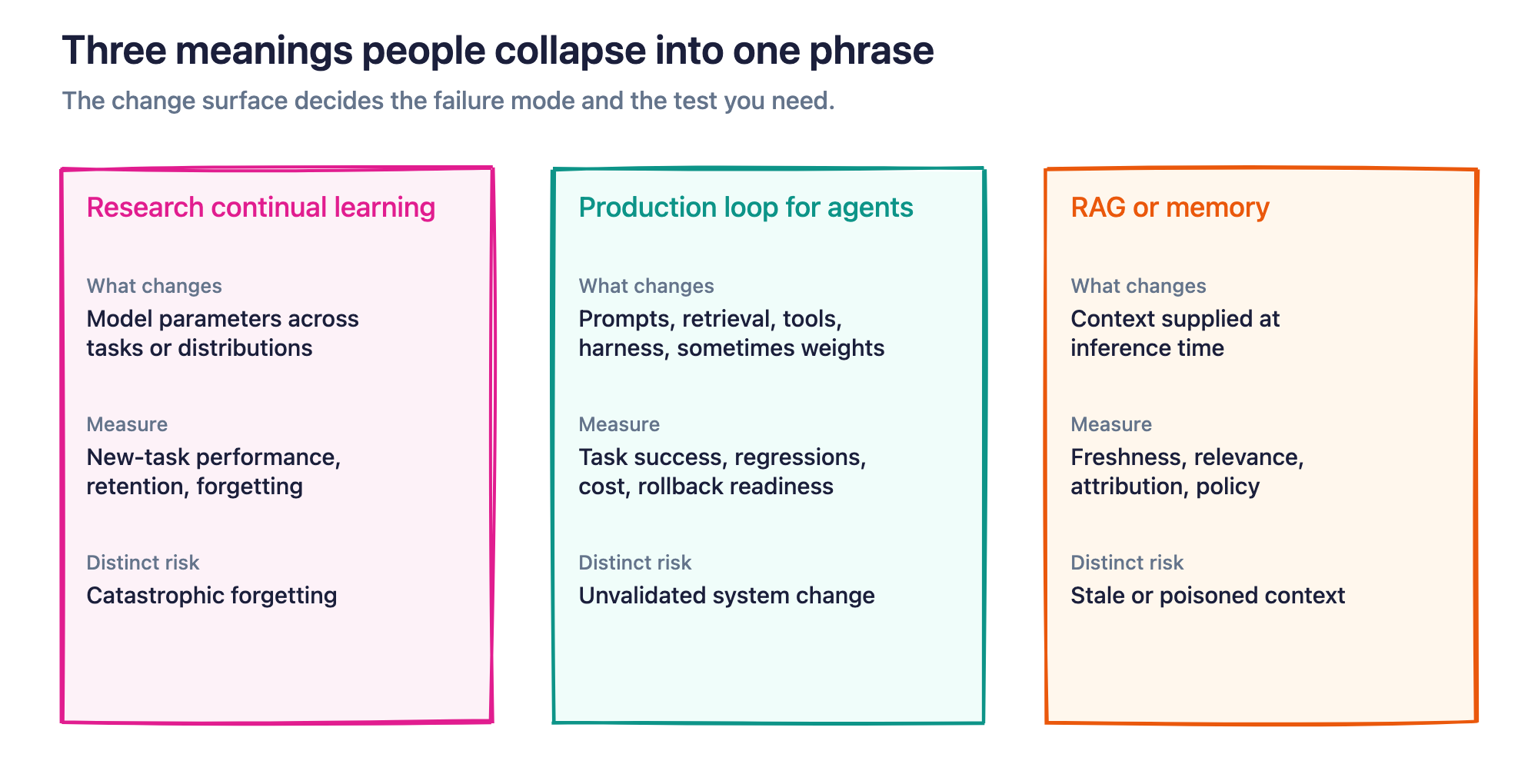
| Concept | What changes | Typical trigger | What must be measured |
|---|---|---|---|
| Research continual learning | Model parameters across a sequence of tasks or distributions | New training data or a new task | New-task performance, retention, forgetting, and transfer |
| Online learning | Model parameters incrementally from streaming examples | Each example or small batch | Predictive performance, stability, delayed labels, contamination, and drift |
| Production continual learning for agents | Prompts, retrieval, memory, tools, routing, orchestration, model choice, and sometimes weights | Observed failure, feedback, or changing environment | Task success, regressions, reliability, cost, latency, safety, and rollback readiness |
| RAG or memory | Context supplied at inference time | Each request, session, or memory update | Freshness, relevance, sufficiency, attribution, and policy compliance |
The change surface determines both the failure mode and the test strategy. Weight updates can cause catastrophic forgetting because gradient updates alter shared parameters. Prompt changes can regress unrelated behavior; memory can become stale or poisoned; routing changes can send a previously correct workflow to the wrong tool. Test the risks created by the surface you changed.
Research continual learning becomes directly relevant when the loop updates model parameters. For changes to prompts, retrieval, memory, tools, or orchestration, the corresponding system-level regression is the thing to measure.
Build better agents with Arize
Trace, evaluate, and learn. Build agents that work with Arize AX and start tracing your runs today.
Prefer open source? Try Arize Phoenix for self-hosted, open source agent observability.

The architecture of a production continual learning loop
A complete production continual learning loop can connect eight stages. Teams do not need to operationalize every stage with the same level of ceremony on day one. For a narrow change, curation may mean preserving a handful of representative cases, while promotion may be automated. The path from production evidence to a validated change needs to be explicit, measurable, and reversible.
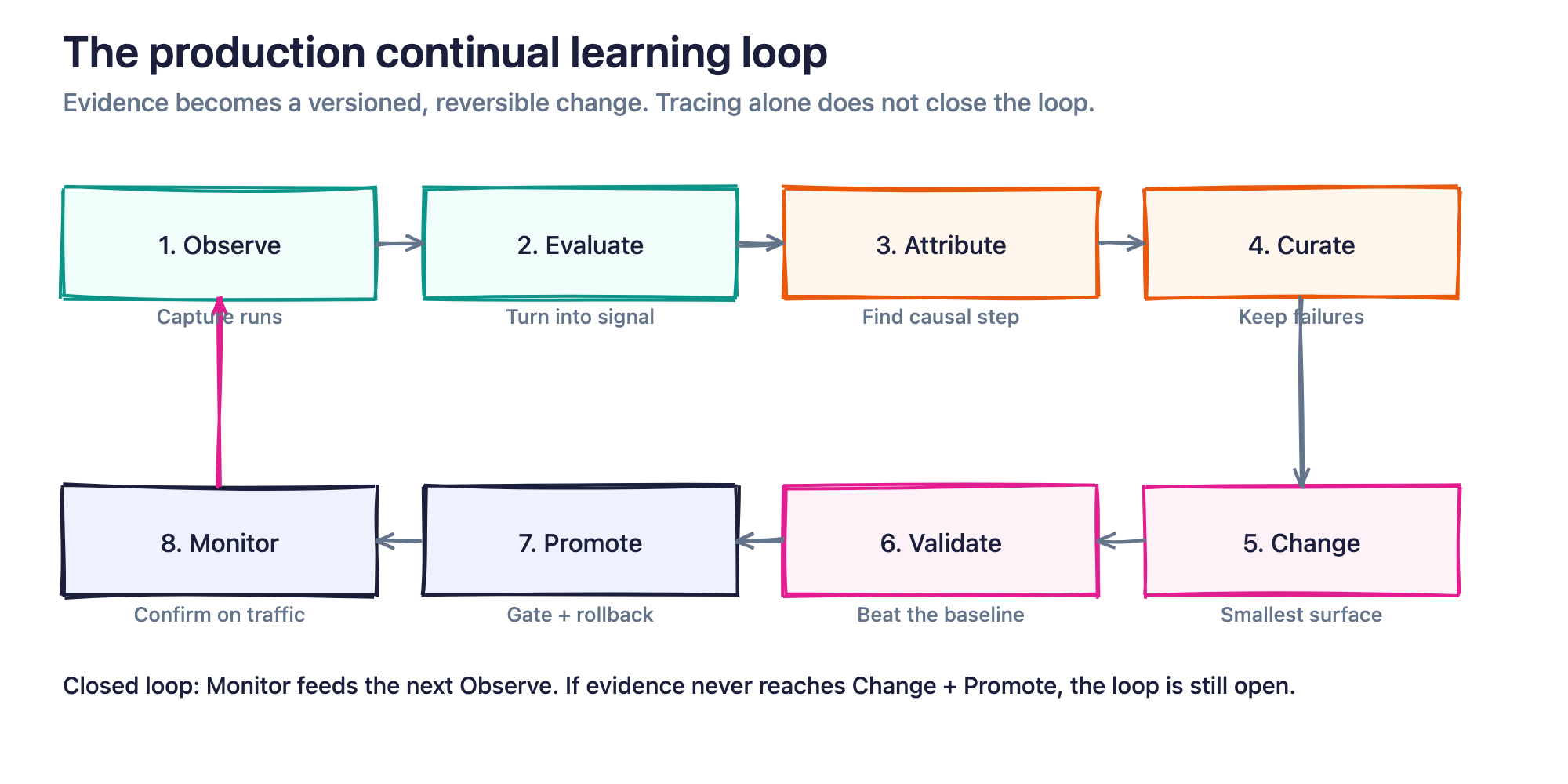
- Observe. Capture the execution evidence needed to explain a run, including model calls, retrieval, tool inputs and outputs, state transitions, errors, latency, cost, and final task outcome.
- Evaluate. Turn part of that evidence into a deterministic check, model-based judgment, human label, or business outcome.
- Attribute. Locate the earliest causal failure. A bad final response may have started with an empty retrieval result, a malformed tool argument, or a routing decision several steps earlier.
- Curate. Preserve representative failures and important edge cases in a versioned dataset. Add enough context to reproduce the behavior.
- Change. Modify the smallest surface that matches the root cause: context, prompt, retrieval, tool schema, routing, orchestration, model selection, or weights.
- Validate. Compare the current and candidate systems on the same dataset and evaluator versions. Include unrelated canary cases so a targeted fix cannot hide a broader regression.
- Promote. Apply a release gate matched to risk, with an owner, approval rule, version identifier, and rollback artifact.
- Monitor. Verify that the gain holds on real traffic and watch for new failure categories, distribution shifts, cost changes, and evaluator drift.
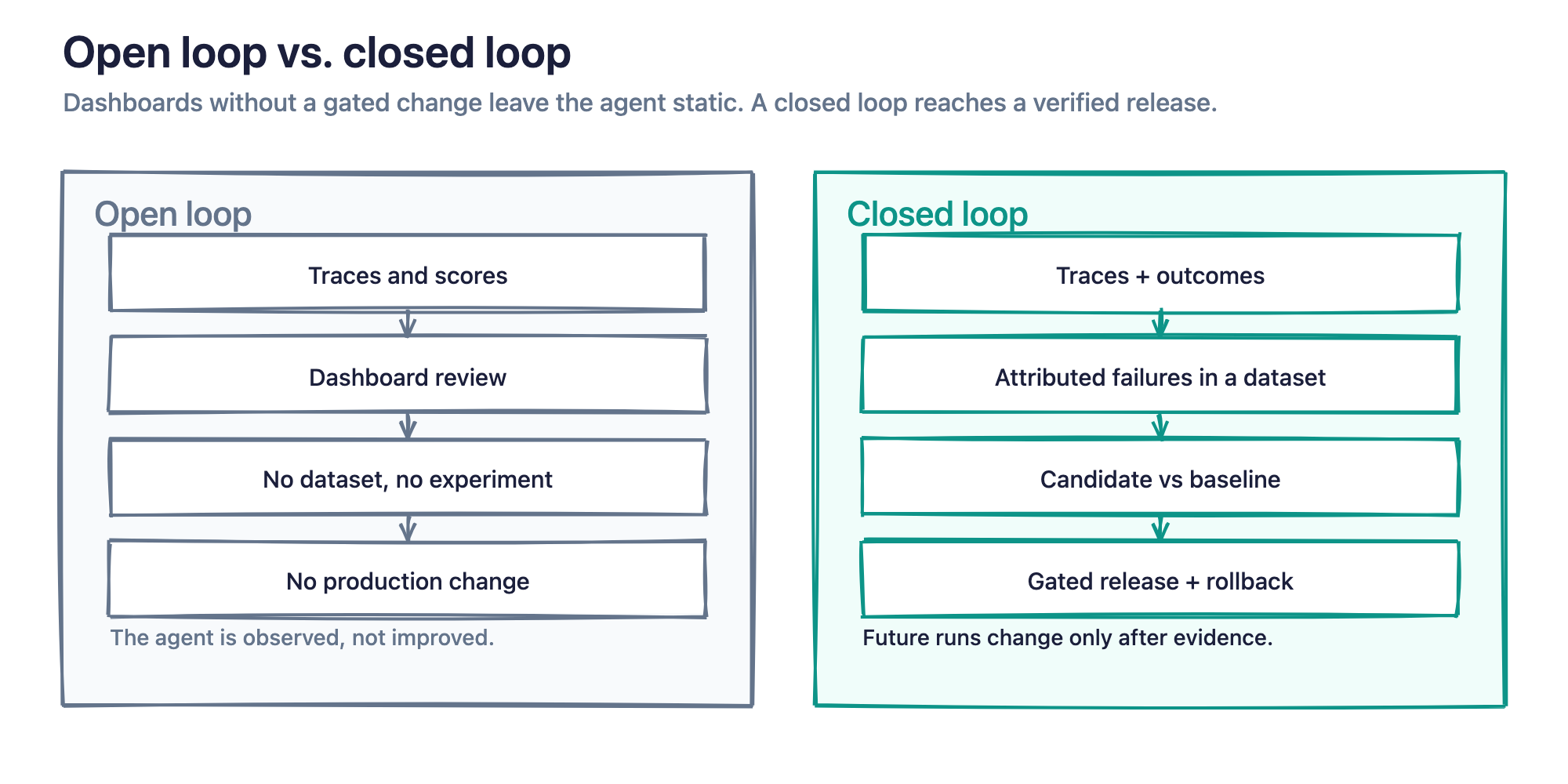
The agent feedback loop describes the operating cycle. A closed-loop agent is one where the cycle actually results in a controlled change to future behavior. Tracing and dashboards alone leave the loop open.
Define the loop contract before automating it
A production continual learning loop needs explicit rules for each stage that admits evidence, changes behavior, or makes a release decision. Define what can enter the loop, how failures are evaluated and attributed, what may change, what proves the change is better, and what happens after deployment. Without those boundaries, “learn from feedback” can become an unsafe or unauditable data pipeline.
| Loop stage | Contract question | Example |
|---|---|---|
| Observe | What evidence can enter the loop, at what granularity, and how is it linked? | Session, trace, and span IDs joined to user feedback and task outcomes at collection time |
| Evaluate | What turns the evidence into a signal, and which evaluator version applies? | Tool-argument check, judge rubric v3, human label, or task completion |
| Attribute | How will the team identify and audit the causal step? | Inspect the session path, attach the failure to the earliest causal span, and review attribution samples |
| Curate | Which cases enter the regression dataset, and how is coverage maintained? | Representative production failures, successful controls, edge cases, plus synthetic cases that extend coverage |
| Change | Which surfaces may change, and which are off limits or require stronger approval? | Prompts, retrieval, and tool descriptions may change; permissions require separate approval |
| Validate | What proves the candidate is better? | Higher task success with no critical-policy regression on a fixed dataset and unrelated canaries |
| Promote | Who or what can approve the change, what is versioned, and what enables rollback? | Automatic for bounded ranking changes; human review for broad prompt edits; prior config retained |
| Monitor | What production evidence confirms the gain or triggers another investigation? | Target failure rate, task success, latency, cost, new failure categories, and evaluator drift |
Ownership is cross-cutting: assign a named engineer or product owner to review loop health, exceptions, and rollback readiness on a defined cadence.
Choose the right change surface
The fastest safe fix usually comes from changing the smallest layer that caused the failure.
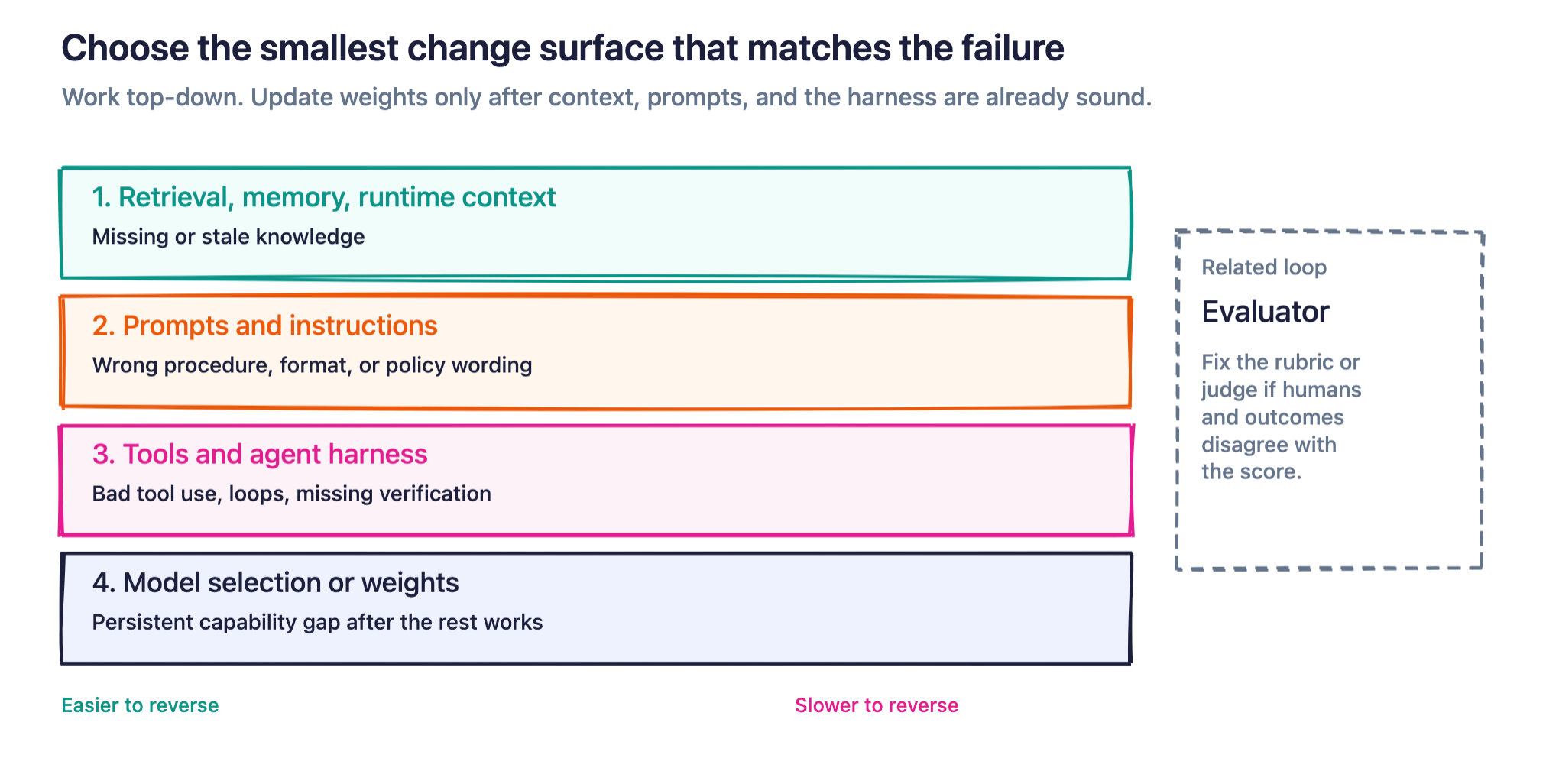
| Observed failure | First surface to investigate | Typical change | Main regression risk |
|---|---|---|---|
| Missing, stale, or organization-specific knowledge | Retrieval, memory, or runtime context | Update a source, metadata filter, freshness rule, memory record, or retrieved example | Wrong or outdated context becomes persistent |
| Correct knowledge, wrong procedure, format, tone, or policy wording | Prompt and instructions | Clarify a rule, add a counterexample, restructure instruction priority | Instruction conflicts and prompt bloat |
| Wrong tool, invalid arguments, loops, missing verification, or unsafe side effects | Tools and agent harness | Change schemas, routing, retries, stopping rules, guardrails, or state handling | New paths affect permissions, latency, or downstream systems |
| Persistent capability gap after good context, instructions, and tooling | Model selection or weights | Change model, fine-tune, add an adapter, or train a specialist component | Cross-task regressions, retention loss, cost, and slower rollback |
| Humans and task outcomes disagree with the score | Evaluator | Fix rubric, examples, input mapping, judge model, or calibration set | Optimizing the application against a faulty judge |
Evaluator improvement is a related loop, but it should remain conceptually separate from agent improvement. The self-improving LLM evaluation chapter covers how evaluators themselves change. This guide focuses on how verified evidence changes the application.
Memory, retrieval, and runtime context
Use this surface when the model could perform correctly if it had the right information. Examples include changing facts, company policy, customer context, prior corrections, and reusable successful trajectories.
Version the source, retrieval policy, and memory record. You should also add freshness and deletion rules. In our experience, building a memory system without that never forgets anything can compound old mistakes far more often than it compounds useful knowledge (which isn’t exactly useful).
Prompts and instructions
Use prompt changes for procedural behavior the model can follow when stated clearly: when to ask a clarifying question, which evidence to verify, what format to return, or how to handle an empty tool result.
Rich evaluator explanations can help here because they describe the failure in language that can be translated into an instruction or example. The Prompt Learning Playbook covers this optimization path in depth. Every candidate prompt should be versioned and compared against the same baseline dataset before release.
Tools and the agent harness
Use the harness when the failure lives in execution structure rather than prose. The harness includes context assembly, tool definitions, routing, state, retries, stopping conditions, verification, permissions, and fallback behavior.
Common fixes include making a tool description unambiguous, validating arguments before execution, requiring a read-after-write check, imposing a step ceiling, or routing high-risk actions to human approval. These changes deserve software-style testing because they can lead to real side effects.
Model selection and weight updates
Use a model change or fine-tune when the target behavior remains poor across representative examples after the system supplies good context, clear instructions, and a sound execution path. The behavior should be stable enough to label consistently, and the team should have retention, safety, latency, and cost tests that cover more than the target slice.
Weight updates are slower to attribute and reverse. Treat them as model releases, with a training-data version, evaluation report, deployment artifact, and previous checkpoint available for rollback.
How to build a minimal continual learning loop
Start with one recurring, consequential failure. A completed loop around one category is more useful than trying to do too much too quickly without proper measurement.
- Define the failure operationally. “Bad answer” is too broad. “The support agent claims an order status after the lookup returns no record” is observable and testable.
- Capture the causal evidence. Instrument the tool call, result, model response, user correction, and final state. The agent tracing guide covers the instrumentation details.
- Create one focused evaluator. Prefer deterministic checks when the expected behavior is machine-verifiable. Use an LLM judge or human review when judgment is semantic or policy-heavy.
- Build a regression dataset. Include representative production failures, successful controls, boundary cases, and unrelated canaries. One severe incident may justify immediate action; routine prompt changes need enough examples to establish a pattern.
- Record a baseline. Run the current system with fixed evaluator versions. For stochastic workflows, use repeated runs or confidence intervals when variance could change the decision.
- Change one surface. Keep attribution clear. A prompt, retriever, tool schema, model, and evaluator changed together cannot tell you what caused the result.
- Compare candidate and baseline. Inspect aggregate deltas and individual failures. Require no regression on critical policy or safety cases.
- Deploy with a rollback plan. Record the application version, dataset version, evaluator versions, scores, approver, and prior artifact.
- Verify on production traffic. Confirm the targeted failure declines without creating new costs, latency, escalations, or user corrections.
The release record should be reproducible
| Artifact | What to store |
|---|---|
| Application version | Prompt commit, harness release, model identifier, retrieval configuration |
| Evidence set | Dataset ID and immutable version or snapshot |
| Evaluation contract | Evaluator versions, judge model, rubric, thresholds, repetitions |
| Decision | Baseline and candidate results, known tradeoffs, approver, timestamp |
| Rollback | Previous prompt, config, index snapshot, deployment, or checkpoint |
How to measure whether the agent is improving
Component scores explain where behavior changed, and your product metrics show whether the change mattered.
| Level | Examples | Question answered |
|---|---|---|
| Step or component | Retrieval relevance, tool selection, argument validity, groundedness, latency per span | Which part of the system improved or regressed? |
| Run or session | Task completion, path efficiency, recovery, session resolution, policy compliance | Did the agent complete the workflow correctly? |
| Product | Retry rate, correction effort, escalation, conversion, resolution, cost per successful task | Did the user or business outcome improve? |
| Learning loop | Loop latency, regression rate, promotion rate, dataset coverage, rollback rate | Can the organization turn evidence into safe improvement? |
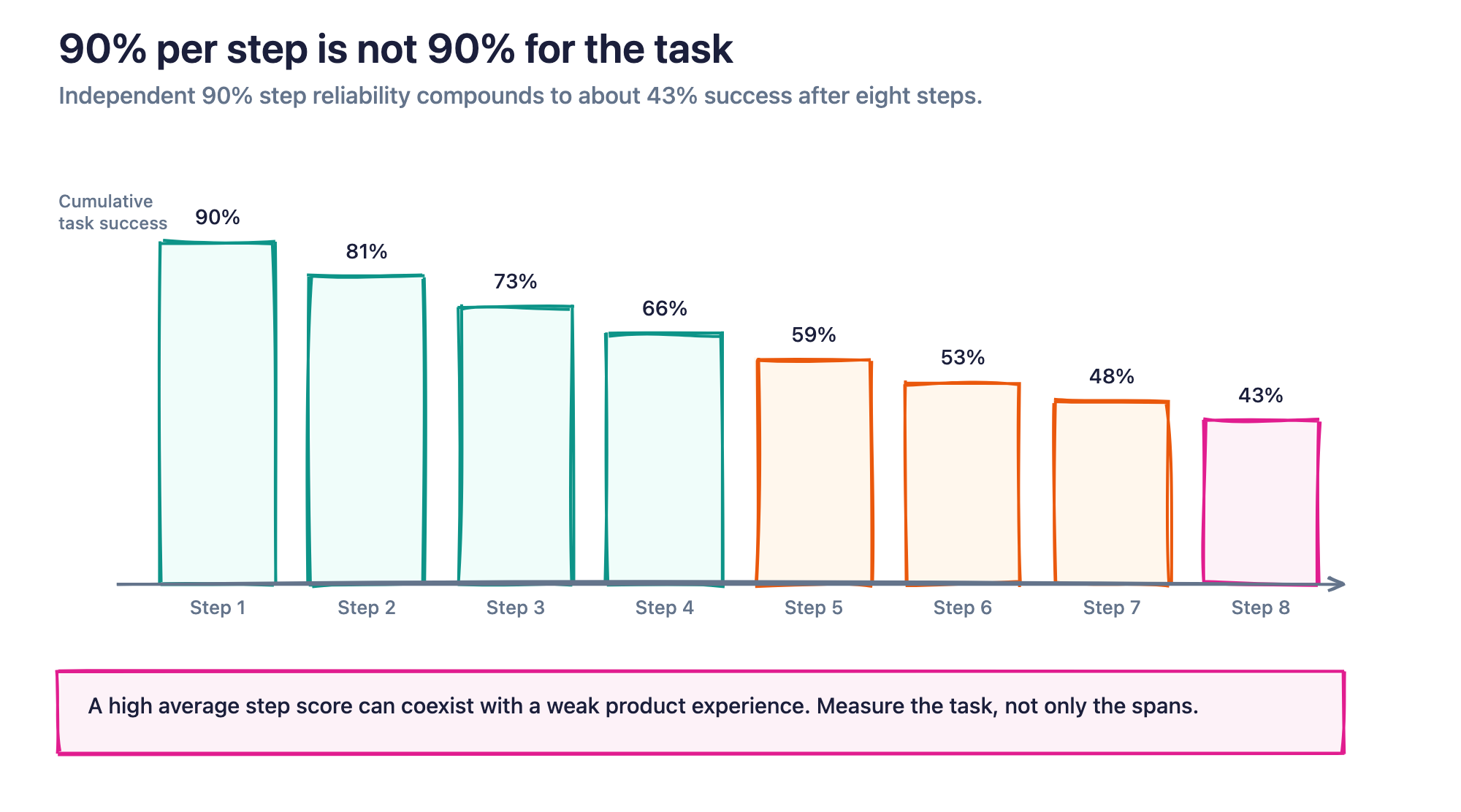
And remember: multi-step reliability compounds. Under a simplified independence assumption, an eight-step workflow with 90% reliability at each step succeeds end to end only about 43% of the time. That’s why a high average step score can coexist with a weak product experience.
Loop latency is the elapsed time from a meaningful production failure to a verified change in production. Break it into detection, triage, fix, validation, approval, and deployment time. The decomposition shows whether the bottleneck is missing instrumentation, weak attribution, no standing dataset, slow review, or release friction.
Loop latency should not reward reckless speed. To that effect, you should track it alongside regression rate, critical-case failures, and rollback frequency.
When should continual learning update model weights?
Fine-tune when the failure represents a stable capability gap that persists after the system supplies good context, clear instructions, and reliable tools. The team should have consistent labels, broad evaluation coverage, and a model artifact it can roll back.
Before changing weights, answer five questions:
- Does the model still fail when retrieval and context are correct?
- Can domain experts label the target behavior consistently?
- Will the behavior remain useful long enough to justify training and validation?
- Does the evaluation set cover prior capabilities, safety boundaries, and unrelated tasks?
- Can the deployment restore the prior checkpoint quickly?
If any answer is no, continue improving the harness and collecting evidence. The labels and regression cases created during that work make a later fine-tune safer.
When weights do change sequentially, the research concerns become directly relevant: retention, forgetting, transfer, replay, regularization, and parameter isolation. See the continual learning glossary for those methods and evaluation settings.
Failure modes and governance
Open loops. The team captures traces and scores but no evidence reaches a dataset, experiment, or release decision. Assign a named owner and start with one complete cycle.
Bad attribution. A session-level complaint gets treated as a final-answer problem even though the causal failure occurred earlier in retrieval or tool execution. Join feedback and outcome signals to session, trace, and span identifiers at collection time. During triage, inspect the full session and its contained traces and spans, then audit a sample of attribution decisions over time to catch systematic mislabeling.
Prompt whack-a-mole. A new instruction fixes the target category and hurts unrelated behavior. Run every candidate on a standing regression set and critical canaries.
Stale or poisoned memory. Incorrect, adversarial, private, or expired information enters future context. Require provenance, filtering, retention rules, review thresholds, and deletion paths.
Evaluator drift. The score remains stable while the product, judge model, or user expectations change. Calibrate important evaluators against human review and observable task outcomes on a schedule.
Recent-failure overfitting. The dataset becomes dominated by the latest incident and stops representing the supported workload. Track dataset coverage by task, user segment, path, risk tier, and failure category.
Autonomous overreach. The system changes permissions, spend, safety policy, or broad behavior based on noisy feedback. Keep these surfaces behind explicit human approval and security review.
Irreversible releases. The team can identify a regression but cannot restore the prior behavior. Version prompts, harness configuration, datasets, retrieval indexes, and model artifacts before promotion.
Implementation example: compare a prompt change with Phoenix
This example demonstrates a small production learning loop. It creates a regression dataset, instruments model calls, runs the same evaluator against two prompt versions, and records both experiments in Arize Phoenix. Notably, it does not update model weights.
Install:
pip install arize-phoenix-client arize-phoenix-otel openinference-instrumentation-openai openai pandas
Configure the Phoenix connection for your deployment, then set OPENAI_API_KEY and OPENAI_MODEL.
import os
import pandas as pd
from openai import OpenAI
from openinference.instrumentation.openai import OpenAIInstrumentor
from phoenix.client import Client
from phoenix.otel import register
# Send OpenTelemetry traces to Phoenix.
tracer_provider = register(project_name="continual-learning-guide")
OpenAIInstrumentor().instrument(tracer_provider=tracer_provider)
phoenix = Client()
openai_client = OpenAI()
model = os.environ["OPENAI_MODEL"]
SYSTEM_PROMPT_V1 = (
    "You are an order-support agent. Be concise and helpful."
)
SYSTEM_PROMPT_V2 = (
    "You are an order-support agent. Be concise and helpful. "
    "Never infer order status. If the user has not supplied an order ID, "
    "ask for it before stating any status."
)
# Real systems usually build this set from production traces.
frame = pd.DataFrame(
    {
        "user_message": [
            "Where is my order?",
            "My package never arrived.",
            "Can you check the status of my purchase?",
        ]
    }
)
dataset = phoenix.datasets.create_dataset(
    name="order-support-missing-id",
    dataframe=frame,
    input_keys=["user_message"],
    output_keys=[],
)
def run_agent(system_prompt: str, user_message: str) -> str:
    response = openai_client.chat.completions.create(
        model=model,
        messages=[
            {"role": "system", "content": system_prompt},
            {"role": "user", "content": user_message},
        ],
    )
    return response.choices[0].message.content or ""
def task_v1(input: dict) -> str:
    return run_agent(SYSTEM_PROMPT_V1, input["user_message"])
def task_v2(input: dict) -> str:
    return run_agent(SYSTEM_PROMPT_V2, input["user_message"])
def follows_missing_id_policy(output: str) -> bool:
    text = output.lower()
    asks_for_id = "order id" in text or "order number" in text
    claims_status = any(
        phrase in text
        for phrase in ("has shipped", "was delivered", "is in transit")
    )
    return asks_for_id and not claims_status
baseline = phoenix.experiments.run_experiment(
    dataset=dataset,
    task=task_v1,
    evaluators=[follows_missing_id_policy],
)
candidate = phoenix.experiments.run_experiment(
    dataset=dataset,
    task=task_v2,
    evaluators=[follows_missing_id_policy],
)
print("Baseline:", baseline)
print("Candidate:", candidate)
The two experiments use the same inputs and evaluator, so the comparison isolates the prompt change. Before promotion, add successful controls and unrelated cases, inspect the traces behind failures, and verify the candidate on production traffic. See the Phoenix experiments documentation for current setup and API details.
Why static agents need a learning strategy
Let’s get this out of the way: agents change. Model providers ship updates, retrieval indexes change, user behavior shifts, and tool APIs return different schemas. An agent tuned at launch degrades even when nobody’s touching the code.
Most failures are semantic, not structural. The agent returns 200, looks plausible, but it’s wrong. Without agent-native evaluation, wrong tool calls, silent retrieval failures, and path inefficiency never surface until someone reads sessions manually.
The gap between knowing something is wrong and shipping a verified fix is what loop latency measures. Teams that treat agents as ship-once products hit the same wall traditional ML teams hit before eval-driven development: production is where the hardest learning begins.
Agent-native evaluation as a prerequisite
Final-answer scores miss most of what breaks in production. Agent-native evaluation scores trajectories: tool calls, step-level decisions, and tool results as runtime ground truth. Improvement loops need scores attached to the span that caused the failure, not a number on a dashboard with no path back to the session.
For instrumentation patterns, see agent evaluation and harness engineering.
Related concepts and case studies
- Self-improving agents
- Self-improving harness
- AI product quality
- Evaluation-driven development
- Closing the loop on coding agents
- Automating the LLMOps feedback loop
- Prompt learning using English feedback
- How to build agent evals from traces
- AI model lifecycle management
- Own the loop: field guide to agent harnesses
Frequently asked questions
What is continual learning for AI agents?
Continual learning for AI agents is a controlled loop that uses production evidence to improve future behavior. Teams observe runs, evaluate outcomes, preserve failures in datasets, test changes, and deploy only when the candidate beats a baseline within defined safety, reliability, cost, and latency constraints.
Is continuous learning the same as continual learning?
The terms are often used interchangeably in agent product discussions. In machine learning research, continual learning is the more established term for learning from sequential tasks or distributions while retaining prior capability. This guide uses continual learning for the broader production loop and states explicitly when model weights change.
Does an agent need retraining to keep learning?
No. Most production improvement can come from changing retrieval, memory, prompts, examples, tools, routing, or orchestration. Retraining becomes appropriate when a stable capability gap persists after those surfaces are working well and the team has sufficient labels and regression coverage.
How is continual learning different from RAG or memory?
RAG and memory change the context available during a run. Continual learning is the operating process that decides when those stores or retrieval policies should change, validates the change against a baseline, and monitors the result. RAG or memory can be one change surface inside the loop.
How is continual learning different from online learning?
Online learning usually updates model parameters incrementally as new examples arrive. A production continual learning loop may never update weights. It can improve an agent through versioned changes to context, prompts, tools, and policies, with offline experiments and promotion gates between observation and deployment.
How do you prevent an improving agent from forgetting prior behavior?
For prompt, retrieval, and harness changes, preserve prior successes and critical boundaries in a regression dataset, then compare every candidate against them. For weight updates, add retention and transfer evaluations across prior tasks and keep the previous checkpoint available for rollback.
Can the continual learning loop be fully automated?
Narrow, reversible updates with unambiguous metrics can be automated more aggressively, such as reranking examples or tuning a bounded threshold. Broad prompt changes, permissions, spend controls, safety policy, and model weights should use stronger review because feedback and evaluators can both be wrong.
How often should an agent learning loop run?
Use event-driven escalation for severe failures and a regular cadence for recurring categories. The right frequency depends on traffic, risk, label availability, and deployment cost. The operational goal is to reduce time from evidence to verified improvement without weakening validation.
Choose the next guide for your implementation
| Next task | Resource |
|---|---|
| Define the research term and catastrophic forgetting | Continual learning glossary |
| Instrument spans, traces, and sessions | agent evaluation |
| Choose and validate evaluation methods | LLM evaluation guide |
| Evaluate agent trajectories and tool use | Agent-native evaluation |
| Optimize prompts from natural-language feedback | Prompt Learning Playbook |
| Run an open-source trace, dataset, and experiment workflow | Phoenix documentation |
Start with one known failure, one evaluator, one regression dataset, and one reversible change. A continual learning system becomes credible when that first loop reaches a verified production result.
Ready to close the loop? Start tracing with the open source Arize Phoenix or the managed platform Arize AX, or download the Prompt Learning Playbook.

