


Evaluate an agent’s intermediate reasoning, tool selection, and decision path — not just its final answer.
Google Colab
colab.research.google.com
The most common way to evaluate an LLM application is end-to-end: take the user’s request, take the final answer, and judge whether the answer is good. That works for a single model call. It breaks down for agents, because an agent isn’t one call — it’s a sequence of decisions: which tools to call, in what order, with what arguments, and how to reason over the results.End-to-end eval only inspects the two endpoints — the input and the final output. The interesting failures happen in the middle, where you can’t see them:
Reasoning — did the agent reason coherently toward the goal, or get there by luck?
Tool selection — did it pick the right tools (and skip the wrong ones)?
Decision path — did it call those tools in a sensible order, with sensible arguments?
A correct-looking answer can come from a broken path — the right result for the wrong reasons, which fails the next time the inputs shift. This cookbook shows how to capture the full trace, reconstruct the agent’s intermediate signals from its spans, and evaluate those — using a movie recommendation agent as the worked example.This cookbook shows examples of:
Reconstructing an agent’s decision path (tool_path) and tool I/O (tool_io) from its spans
Running an endpoint check (recommendation relevance) alongside two intermediate checks (decision path and reasoning/support)
Seeing each evaluator catch a distinct failure the endpoint check misses
We will go through key code snippets on this page. To follow the full tutorial, check out the full notebook.After configuring tracing with phoenix.otel.register(...) and building a movie recommendation agent with three tools (movie_selector_llm, reviewer_llm, preview_summarizer_llm), run it against a handful of questions to generate traces, then pull the spans with px_client.spans.get_spans_dataframe(...) into primary_df. See the notebook for the full agent and tool definitions.
First pull the endpoints — the user’s question and the agent’s final answer. Take the final answer only, not a concatenation of every span’s output: folding in tool outputs would blur the line between “what the user saw” and “what happened inside the trace.”
With the OpenAI Agents instrumentation, the root AGENT span doesn’t record input.value / output.value — those attributes live on the underlying LLM spans, so we read the question and final reply from there with two small helpers. With an instrumentation that populates the root span, you could read input.value / output.value off the agent root directly.
import jsondef _as_list(value): """Span attributes can arrive as a JSON string or an already-parsed list.""" if isinstance(value, str): try: return json.loads(value) except json.JSONDecodeError: return [] return value if isinstance(value, list) else []def user_query(input_messages): """The first user message in an LLM span's input.""" for message in _as_list(input_messages): if message.get("message.role") == "user": contents = message.get("message.contents") or [] return message.get("message.content") or "".join( c.get("message_content.text", "") for c in contents ) return Nonedef assistant_text(output_messages): """The assistant's text reply in an LLM span (empty on tool-calling turns).""" texts = [] for message in _as_list(output_messages): if message.get("message.role") == "assistant": if message.get("message.content"): texts.append(message["message.content"]) for c in message.get("message.contents") or []: if c.get("message_content.type") == "text": texts.append(c.get("message_content.text", "")) return " ".join(t for t in texts if t).strip() or None# agent_trace_ids = the trace ids whose root span has span_kind == "AGENT"# (filtering out the evaluators' own LLM traces). See the notebook.llm_spans = primary_df[ (primary_df["span_kind"] == "LLM") & (primary_df["context.trace_id"].isin(agent_trace_ids))].sort_values("start_time")# Endpoint input = the user's question (first user message).# Endpoint output = the agent's FINAL answer only (its last text turn).trace_df = pd.DataFrame( { "input": llm_spans.groupby("context.trace_id")["attributes.llm.input_messages"].apply( lambda s: next((q for q in s.map(user_query) if q), None) ), "output": llm_spans.groupby("context.trace_id")["attributes.llm.output_messages"].apply( lambda s: next((a for a in reversed(list(s.map(assistant_text))) if a), None) ), }).dropna(subset=["input", "output"])
To evaluate the agent’s process, reconstruct two signals the endpoints never show, both from the trace’s TOOL spans (sorted by start_time):
tool_path — the ordered tool calls the agent made, with their arguments. This is the decision path: tool selection, order, and the arguments each tool was called with.
tool_io — what each tool was called with and what it returned, so an evaluator can check whether the final answer is grounded in real tool results.
tool_spans = primary_df[primary_df["span_kind"] == "TOOL"].sort_values("start_time")# tool_path: the ordered tool calls WITH their arguments (selection, order, args).def format_decision_path(group): return " -> ".join( f"{row['name']}({row['attributes.input.value']})" for _, row in group.iterrows() )trace_df["tool_path"] = ( tool_spans.groupby("context.trace_id")[["name", "attributes.input.value"]] .apply(format_decision_path) .reindex(trace_df.index) .fillna("No tools called"))# tool_io: each tool call's input AND output.def format_tool_calls(group): lines = [] for i, (_, row) in enumerate(group.iterrows(), start=1): lines.append( f"{i}. {row['name']} | input: {row['attributes.input.value']} " f"| output: {row['attributes.output.value']}" ) return "\n".join(lines)trace_df["tool_io"] = ( tool_spans.groupby("context.trace_id")[["name", "attributes.input.value", "attributes.output.value"]] .apply(format_tool_calls) .reindex(trace_df.index) .fillna("No tools called"))
Each evaluator reads a different column and answers a different question:
Relevance — an endpoint check on input + output (exactly what end-to-end eval does).
Decision path — an intermediate check on input + tool_path (right tools, right order, sensible arguments?).
Reasoning / support — an intermediate check on input + tool_io + output (is the answer grounded in the actual tool results, or does it invent facts no tool produced?).
Each prompt is written to judge only its own concern:
RECOMMENDATION_RELEVANCE = """You are evaluating the relevance of movie recommendations provided by an LLM application.You will be given:1. The user input that initiated the trace2. The list of movie recommendations output by the system##User Input:{input}Recommendations:{output}##Respond with exactly one word: `correct` or `incorrect`.1. `correct` →- All recommended movies match the requested genre or criteria in the user input.- The recommendations are relevant to the user's request and are not repetitive.2. `incorrect` →- One or more recommendations do not match the requested genre or criteria, or the recommendations are repetitive."""DECISION_PATH = """You are evaluating an agent's DECISION PATH: the ordered tool calls it made toanswer a request — which tools, in what order, and with what arguments. You areNOT judging the final answer text, and you are NOT judging whether each tool'soutput was correct — only whether the agent's choices were sensible.The agent has three tools available:- movie_selector_llm(genre): returns candidate movies. Must come FIRST, because the other tools operate on the selected movies.- reviewer_llm(movies): reviews and sorts movies. Only meaningful AFTER selection, and should be called with the movies that were actually selected.- preview_summarizer_llm(movie): summarizes a movie. Only meaningful AFTER selection.You will be given:1. The user input that initiated the trace2. The ordered tool calls the agent executed, with their arguments##User Input:{input}Decision Path (ordered tool calls with arguments):{tool_path}##Respond with exactly one word: `correct` or `incorrect`.1. `correct` →- movie_selector_llm is called before reviewer_llm or preview_summarizer_llm, AND- each tool is called with sensible arguments (e.g. reviewer_llm receives the movies that were selected, not an empty or unrelated list).2. `incorrect` →- a tool that operates on movies (reviewer_llm / preview_summarizer_llm) runs before any movies have been selected, the selection step is missing, OR a tool is called with nonsensical arguments (empty/placeholder inputs, or movies that were never selected)."""REASONING_SUPPORT = """You are checking whether an agent's FINAL ANSWER is SUPPORTED by the actualresults its tools returned.You are NOT judging tool order (that's the decision-path check) or genre match(that's the relevance check). Judge ONLY whether every concrete claim in the finalanswer — titles, ratings, scores, review quotes, plot facts — is grounded in thetool outputs below. An answer that asserts a fact no tool produced (for example aspecific rating) is unsupported, even if it sounds plausible.##User Input:{input}Tool calls and their results (in order):{tool_io}Final Answer:{output}##Respond with exactly one word: `correct` or `incorrect`.1. `correct` → every concrete claim in the final answer is supported by the tool results above.2. `incorrect` → the final answer asserts at least one concrete fact (a rating, score, review, or title) that does not appear in the tool results."""
Wrap the run in suppress_tracing() so the judges’ own LLM calls don’t get traced into the same project, then log the results back onto each trace’s root span:
On well-behaved traces the three evaluators agree. The point of trace-level evaluation is what happens when they don’t. Running the three judges on controlled cases that mirror the real schema — each with a relevant-looking answer, so the endpoint check passes every time — shows each intermediate check catching a distinct failure:
case
relevance (endpoint)
decision path
reasoning / support
clean run
correct
correct
correct
broken order (reviews before selecting)
correct
incorrect
correct
unsupported claim (cites a rating no tool returned)
correct
correct
incorrect
Two intermediate failures, two different lenses — and both invisible to the endpoint check.After logging the evaluations, each trace’s root span carries all three labels in Phoenix:
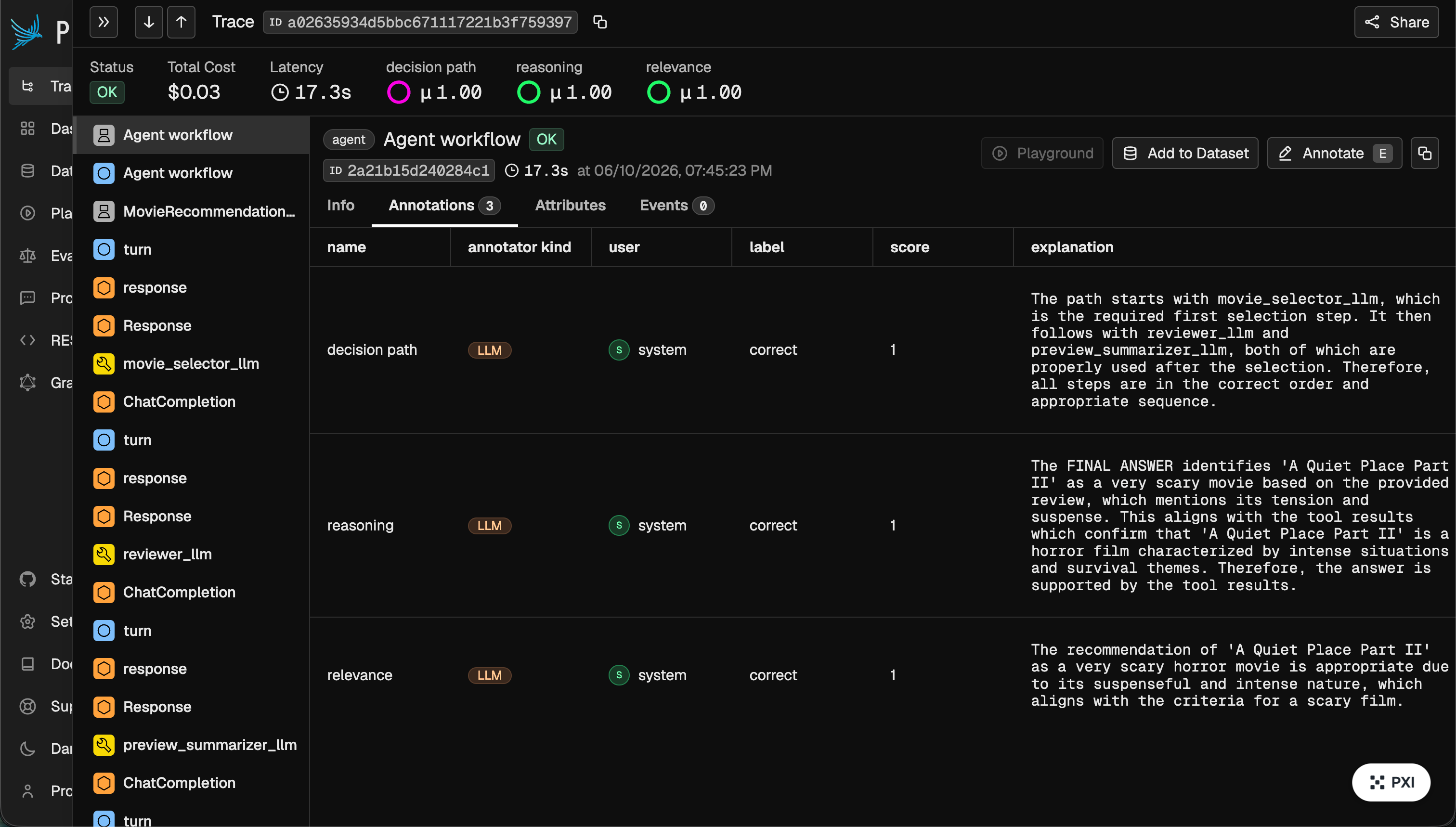
We ran three evaluators over the same traces, each asking a different question and reading a different signal:
relevance (endpoint) — did the final answer look right? Reads only input and output.
decision path (intermediate) — did the agent pick the right tools, in the right order, with sensible arguments? Reads tool_path.
reasoning / support (intermediate) — is the answer grounded in what the tools returned? Reads tool_io.
The lesson: a good-looking answer can hide a broken process, and only intermediate evals — reading signals reconstructed from spans — can see it. The pattern generalizes: for any intermediate step you care about, reconstruct the relevant signal from spans into a column, write a judge that reads that column, and run it alongside your endpoint eval.