
Chapter summary
Prices and product details verified August 24, 2026.
An agent can finish a locally correct step and still lose the job. Case in point: a worker can error out 47 minutes into a three-hour run, a handoff might drop state, or a retry may send the same refund twice. The final model response can even look fine while the underlying workflow itself is anything but ok.
Agent orchestration is the layer that decides what runs next, carries state across steps, coordinates tools and agents, pauses for external input, and recovers when a process or dependency fails.
Orchestration determines how work should flow. The swarm management control plane keeps ownership, concurrency, delivery, recovery, and cleanup under control after many executions are running.
The category is confusing because different products solve different parts of the problem. LangGraph and Mastra help developers express agent control flow, while tools such as Temporal and Restate provide durable execution. Inngest and Cloudflare Workflows wrap application code in managed, replayable steps, while Azure Durable Task and AWS Step Functions offer cloud-native orchestration systems. An agent observability and evaluation platform records the trajectory and helps determine whether the run was acceptable.
Arize publishes this guide. Arize AX and Arize Phoenix are not orchestration runtimes, so they are not ranked alongside the tools that execute workflows. They are covered separately as the tracing, evaluation, and improvement layer that can sit behind any of them.
TL;DR
- Choose LangGraph when the agent itself is a stateful, cyclic graph and model-driven branching is central to the application.
- Choose Mastra when a TypeScript team wants agents, tools, memory, and explicit workflows in one developer framework.
- Choose Temporal when a long-running workflow must survive worker failure across services, languages, and days of execution.
- Choose Restate when you want durable agents and functions with a smaller operational footprint and built-in stateful services.
- Choose Inngest when an event-driven JavaScript or TypeScript application needs durable steps, waits, retries, and managed infrastructure.
- Choose Cloudflare Workflows when the application already runs on Workers and edge-native deployment matters more than portability.
- Choose Azure Durable Task Scheduler when the estate is centered on Azure Functions, .NET, or the Durable Task SDKs.
- Choose AWS Step Functions when explicit AWS state machines, service integrations, and predictable branching matter more than agent-native loops.
- Pair any orchestrator with Arize AX or Phoenix when you need portable nested traces, trajectory evaluation, recurring-failure discovery, and experiments that show whether an orchestration change helped.
Best agent orchestration tools compared
| Tool | Best for | Execution model | Published starting point | Main tradeoff |
|---|---|---|---|---|
| LangGraph + LangSmith Deployment | Stateful and cyclic agent graphs | Graph checkpoints, threads, interrupts, managed Agent Server | LangGraph open source; LangSmith Developer $0; Plus $39/seat/month | Strongest around the LangChain graph abstraction; cross-service durability may need another layer |
| Mastra | TypeScript-first agents and explicit workflows | Sequential, parallel, branching, looping, suspend/resume; optional Inngest or Temporal backing | Open source; Mastra Platform Starter $0; Teams $250/month | TypeScript-first; durability and billing depend on the execution backend you choose |
| Temporal | Multi-day, cross-service recoverable workflows | Deterministic workflows, activities, event history, signals, timers | Open source; Temporal Cloud has a $100 monthly plan fee plus usage | Powerful but operationally heavier; workflow determinism changes how code is structured |
| Restate | Durable agents and functions without operating a large cluster | Journaled invocations, durable steps, virtual objects, workflows | Open source; Cloud Free includes 50k actions/month; paid production pricing varies by deployment model | Smaller ecosystem than Temporal; action-based billing needs workload modeling |
| Inngest | Event-driven application functions with durable steps | Function runs, step.run, events, waits, retries, queues | Hobby $0 with 50k executions; Pro $99/month with 1M | A run and its steps consume executions, so step-heavy agents can multiply cost |
| Cloudflare Workflows | Workers-native long-running workflows | Persisted named steps, sleeps, waits, retries on Workers | Workers Free; Workers Paid starts at $5/month | Cloudflare lock-in and platform limits; best for JavaScript/TypeScript workloads |
| Azure Durable Task Scheduler | Azure-native orchestrations and .NET/Python workloads | Orchestrator, activity, and entity functions with managed state | Consumption per action or Dedicated per capacity unit; compute billed separately | Regional pricing and Azure coupling; replay semantics require discipline |
| AWS Step Functions | Explicit AWS state machines and service coordination | Standard or Express state machines with retries, Map, Parallel, and service integrations | 4,000 Standard transitions/month free; usage after that | Cyclic, model-driven graphs are awkward; retries and branches increase transition count |
Prices and product details were checked against official documentation and pricing pages on August 24, 2026. Cloud bills may also include model calls, compute, storage, workers, network services, or observability.
What agent orchestration actually includes
A useful evaluation starts by separating three layers.
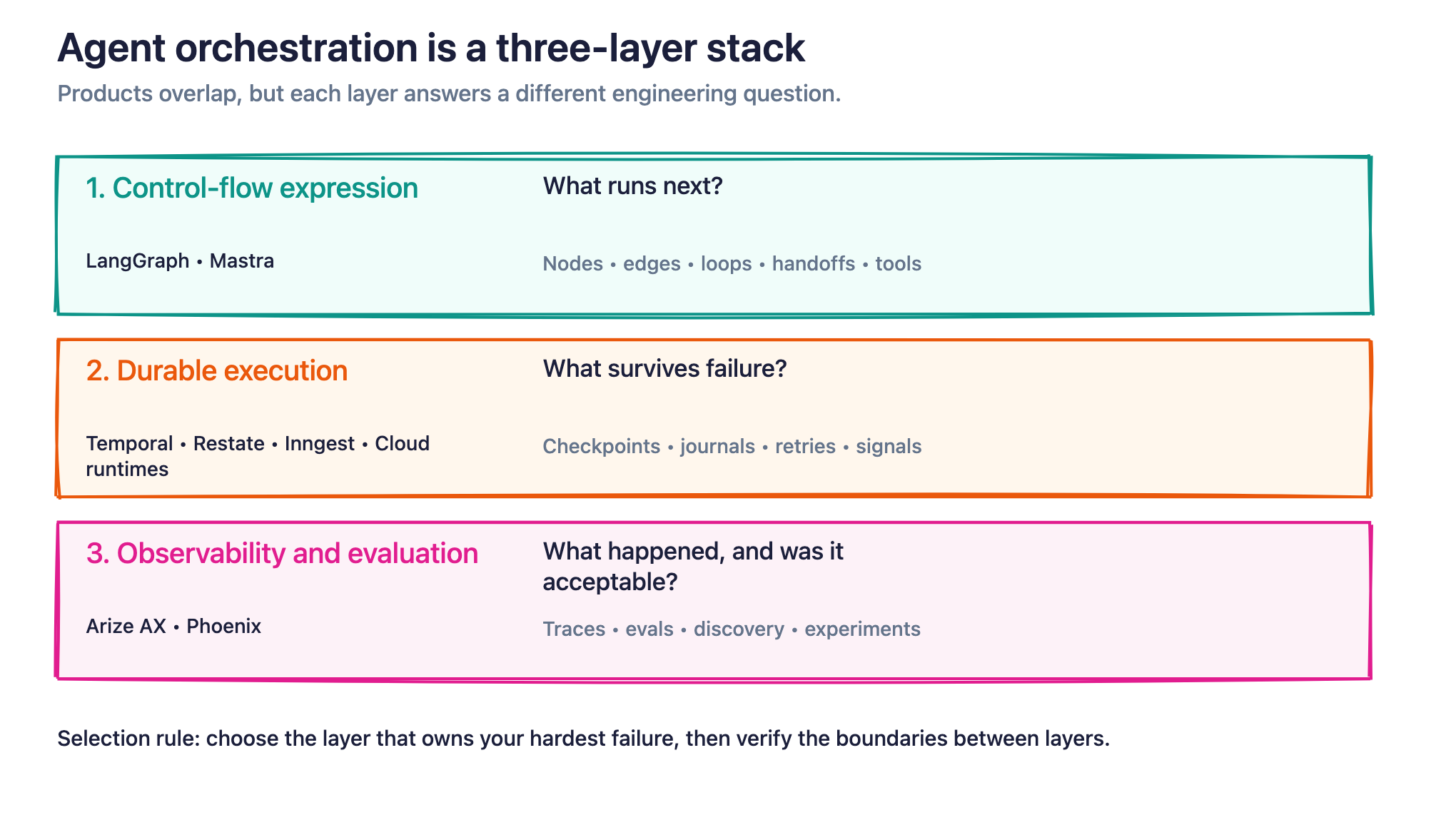
1. Control-flow expression
This is how the team represents the agent: nodes, edges, loops, handoffs, tools, branches, and stopping conditions. LangGraph and Mastra are strongest here.
2. Durable execution
This is how the work survives failure: checkpoints or journals, retries, timers, signals, pause and resume, worker replacement, and state recovery. Temporal, Restate, Inngest, Cloudflare Workflows, Azure Durable Task, and AWS Step Functions sit primarily here.
3. Observability, evaluation, and improvement
This is how the team reconstructs what happened, judges whether the trajectory and outcome were acceptable, discovers recurring failure patterns, and tests a candidate change. Arize AX and Phoenix sit here.
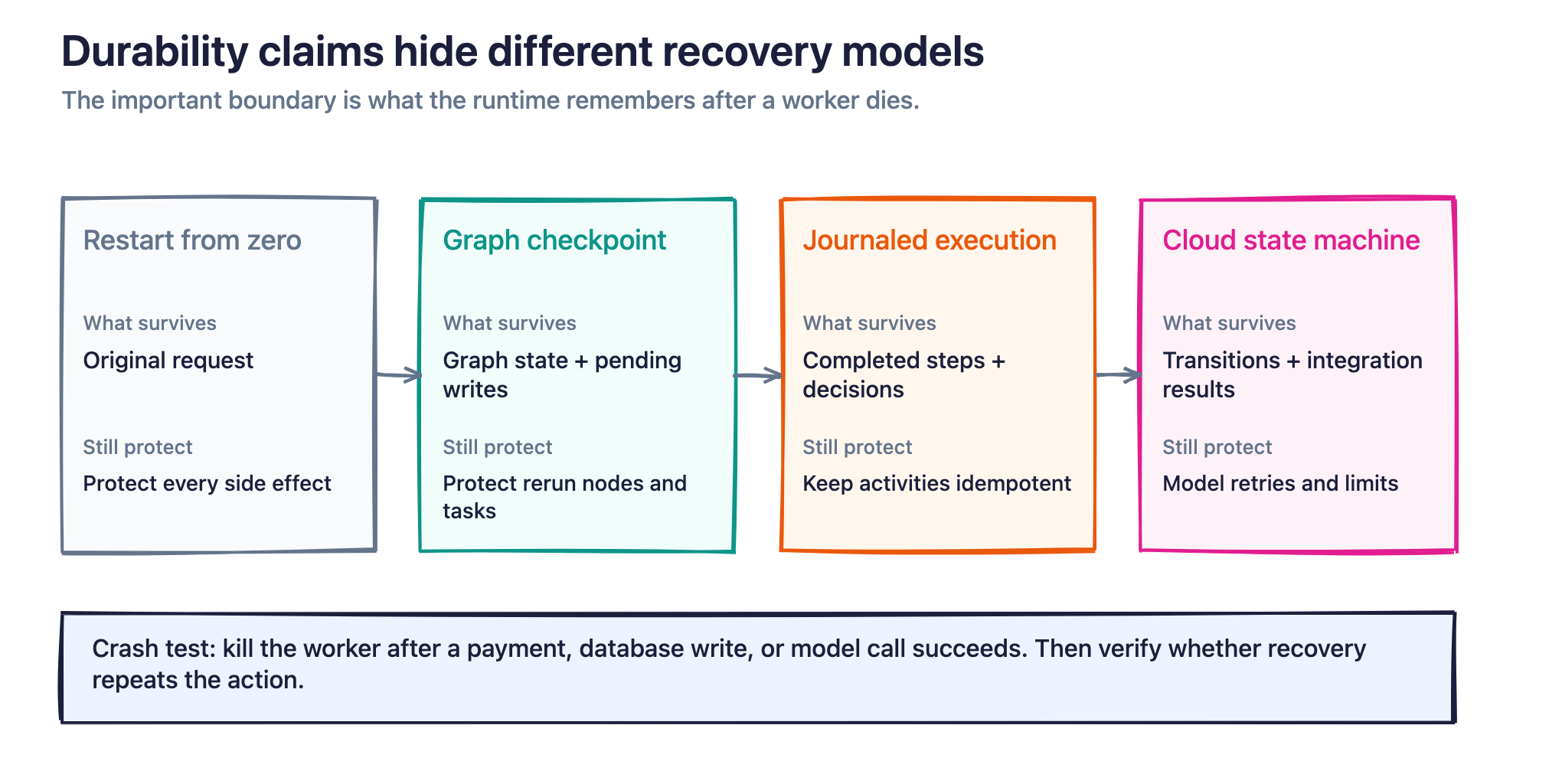
A single product may cover more than one layer, but no label should substitute for checking the failure semantics. “Durable” can mean that graph state is checkpointed, that every side effect is journaled, or simply that a platform retries failed steps. Those are materially different guarantees.
Checkpointing, journaling, and replay are not the same thing
| Recovery model | What survives | What the developer must still protect |
|---|---|---|
| Restart from zero | Usually only the original request | Duplicate side effects, repeated model calls, lost progress, and inconsistent external state |
| Graph checkpoint | Graph state at super-step boundaries plus pending node and task writes | Side effects in rerun nodes or unfinished tasks, idempotency, checkpoint storage, and version compatibility |
| Journaled durable execution | Completed activities or durable steps and the decisions that led to them | Deterministic workflow code, idempotent activities, safe workflow versioning, and compensation |
| Cloud state machine | State transitions and service-integration results | Transition count, payload limits, service-specific retry behavior, and vendor coupling |
The practical question is what happens after the worker has charged a card, written a record, or paid for an LLM call and then crashes before the next state occurs.
How we evaluated the tools
We did not assign a universal numeric score. A chat agent that runs for three seconds and a coding agent that works for six hours need different orchestration.
Instead, we used nine questions:
- Can the team express the real control flow in versioned code? The tool should represent loops, branches, handoffs, parallel work, and completion conditions without hiding the logic inside one prompt.
- What exactly is persisted? Look for graph state, completed steps, activity results, timers, external signals, and workflow history.
- What happens when a worker dies? Does another worker resume from durable state, replay deterministic workflow code, or restart the run?
- Are side effects replay-safe? Model calls, payments, writes, and tool actions should not silently execute twice after recovery.
- Can the workflow pause for humans or external systems? Approvals, webhooks, and long waits should survive restarts without keeping a request thread open.
- How does workflow versioning work? Long-running instances may outlive the code version that created them.
- Can the team export portable nested traces? The trace should connect orchestration nodes, model calls, retrieval, tools, handoffs, errors, and retries.
- What is billed? Compare actions, steps, state transitions, executions, deployment uptime, storage, workers, and seats.
- What breaks at the next order of magnitude? Check history size, payload size, step count, concurrency, fan-out, retention, and rate limits.
What to look for in an agent orchestration tool
| Capability | What good support looks like | Why it matters |
|---|---|---|
| Versioned control flow | Graphs, steps, or state machines live in code or checked-in definitions | Prompt-only routing is difficult to test, review, and migrate |
| Explicit durability boundary | The product documents when state is checkpointed or journaled | “Retry” is not enough when a run has already caused a side effect |
| Replay-safe I/O | External calls are isolated in activities or durable steps | Recovery should not rebill a model call or repeat a transaction |
| Human-in-the-loop | Approval and external signals are durable and timeout-aware | High-impact actions may wait minutes or days for a decision |
| Workflow versioning | Running workflows can finish safely across code changes | Long-lived agents often outlive a deployment |
| Idempotency and compensation | The design supports idempotency keys, rollback, or compensating actions | Exactly-once business outcomes require more than retry settings |
| Portable traces | Stable run, node, task, and version identifiers flow into OpenTelemetry | A recovered workflow is still a black box without a coherent trajectory |
| Predictable billing | The team can model retries, waits, steps, transitions, and retained history | Base-plan prices hide the cost of complex failure paths |
The 8 best agent orchestration tools in 2026
1. LangGraph and LangSmith Deployment: Best for agent-native graphs
Best for: Teams whose primary abstraction is a stateful graph with loops, conditional edges, subagents, memory, and human interrupts.
LangGraph is a low-level orchestration framework for stateful agents. It makes nodes, edges, thread state, interrupts, subgraphs, and checkpoints first-class. With a durable checkpointer, a graph can pause, resume, inspect prior state, and fork from a checkpoint. LangSmith Deployment provides the managed Agent Server, persistence, task queues, scaling, and deployment surface around those graphs.
The main advantage is that the orchestration structure looks like the agent: a graph can loop after a tool error, route to a specialist, pause for approval, or revisit a prior state. That is easier to reason about than burying the full loop in one agent prompt.
Use LangGraph when:
- Model-driven routing and cyclic behavior are core to the application.
- You want explicit graph state and thread-level memory.
- Human interrupts and state inspection are part of the product.
- The team already uses LangChain or wants LangSmith Deployment.
Tradeoffs: LangGraph provides durable graph execution through checkpoints, but its abstraction is not identical to a cross-service workflow engine. If a job spans many services, languages, or days, evaluate whether LangGraph should run inside a Temporal or Restate activity rather than owning the outer durability boundary. The managed stack also combines seat, trace, compute, and storage billing; legacy per-run and uptime pricing remains temporarily for existing customers through October 1, 2026.
Pricing: LangGraph is open source. LangSmith pricing lists Developer at $0 per seat with 5,000 base traces per month and Plus at $39 per seat with 10,000 base traces and access to Deployment. Plus includes one small serverless deployment. New deployment billing is based on compute and storage consumed; existing customers may remain on legacy per-run and uptime pricing through October 1, 2026.
2. Mastra: Best for TypeScript-first agent workflows
Best for: TypeScript teams that want agents, tools, memory, Model Context Protocol integrations, and explicit workflows in one framework.
Mastra workflows support sequential steps, parallel branches, conditional paths, loops, shared state, nested workflows, and suspend and resume. Steps can call agents and tools directly, which makes it useful when some work should be deterministic and other work should remain model-driven.
Mastra persists workflow snapshots for suspension and resumption. For production durability, teams can use the built-in engine or connect workflows to Inngest or Temporal. The official Temporal integration maps Mastra workflows to Temporal workflows and Mastra steps to Temporal activities with minimal application-level changes. The integration is experimental, and its API may change between releases.
Use Mastra when:
- The application is TypeScript-first.
- You want one developer framework for agents and explicit workflows.
- The workflow needs a mix of deterministic steps and open-ended agent calls.
- You value a local Studio experience and a managed deployment option.
Tradeoffs: Mastra is broader than a durable engine, so the exact recovery and billing model depends on the backend you choose. Snapshot-based pause and resume, Inngest execution, and Temporal replay do not provide identical semantics. Make that choice explicitly before relying on it for irreversible work.
Pricing: The framework is open source. Mastra Platform pricing lists Starter at $0 and Teams at $250 per month, with additional usage for observability events, CPU time, storage, and persistent servers.
3. Temporal: Best for multi-day, cross-service recoverable work
Best for: Business-critical workflows that must survive worker crashes, dependency outages, deployments, long waits, and handoffs across services or languages.
Temporal separates deterministic workflow code from activities that perform side effects. The Temporal Service persists event history, timers, signals, retries, and workflow state. Workers can disappear and another worker can replay the history to reconstruct the workflow before continuing unfinished activities.
For agents, the safest pattern is usually to put model calls, tools, and external I/O in activities. The workflow remains the durable shell that decides what happens next, waits for human or system signals, and records progress. This is especially useful for coding agents, operations agents, and back-office agents whose work lasts hours or days.
Use Temporal when:
- Losing completed work after a crash is unacceptable.
- The workflow coordinates several services or programming languages.
- Timers, signals, retries, and long human waits are normal.
- The team can invest in workflow determinism, activity design, and worker operations.
Tradeoffs: Temporal is not an agent framework. Developers still need to choose how the agent plans, uses tools, and manages context. Deterministic workflow rules also require architectural discipline: direct network I/O, clocks, and randomness belong outside workflow code. Activities can retry, so external side effects still need idempotency keys or compensation.
Pricing: Temporal is open source and can be self-hosted. Temporal Cloud has a $100 monthly plan fee with action-based usage; its current AWS Marketplace listing publishes $50 per million actions. Compute for the workers you operate remains separate. See Temporal Cloud.
4. Restate: Best for durable agents without operating a large workflow cluster
Best for: Teams that want durable functions, stateful services, and agent sessions with a smaller operational footprint than a traditional workflow platform.
Restate places a durable runtime in front of ordinary service handlers. It journals function invocations, durable steps, timers, messages, and state so work can resume after a failure. Virtual Objects provide keyed state and concurrency control, which fits persistent agent sessions. Workflows and durable promises support long-running jobs and human approvals.
Restate has unusually direct agent support. Its documentation includes durable agents, sessions, multi-agent routing, orchestrator-worker patterns, pause and resume approvals, rollbacks, and OpenTelemetry export. A model routing decision can be persisted so recovery does not ask the model to make the same choice again.
Use Restate when:
- You want to write the agent as ordinary service functions.
- Persistent sessions and per-key concurrency matter.
- You need durable routing, tool calls, and approvals.
- You want self-hosting, managed cloud, or BYOC without adopting Temporal’s full model.
Tradeoffs: Restate’s ecosystem is smaller than Temporal’s, and its action unit can expand with intermediate steps, messages, state, and data payloads. Model a representative run before comparing its sticker price with per-workflow or per-execution products.
Pricing: Restate is open source to self-host. Restate Cloud currently offers a free environment with 50,000 actions per month. Paid production pricing varies by deployment model and should be confirmed on Restate’s current pricing page.
5. Inngest: Best for step-based workflows in existing web applications
Best for: JavaScript and TypeScript teams that want to wrap existing functions in durable steps without adopting a graph DSL or operating workers directly.
Inngest functions are triggered by events, schedules, or application calls. Developers wrap side effects in step.run, then use durable sleep, wait-for-event, retries, queues, concurrency controls, and fan-out. The platform manages execution and exposes traces, metrics, logs, and alerts.
The developer experience is deliberately incremental: application code stays recognizable, while the durable boundary is created around named steps. This is a strong fit for background agents, content pipelines, asynchronous user workflows, and agents that wait for external events.
Use Inngest when:
- The application is event-driven and primarily JavaScript or TypeScript.
- You want managed retries, queues, waits, and concurrency with minimal infrastructure.
- The workflow can be expressed as functions and steps instead of a cyclic graph.
- Built-in development tooling and observability matter.
Tradeoffs: Inngest bills executions, and the pricing calculator counts the function run plus each step. A 10-step workflow therefore consumes more than one execution. Step-heavy agents, high concurrency, and longer trace retention can change the economics quickly.
Pricing: Inngest pricing lists Hobby at $0 with 50,000 executions and Pro at $99 per month with 1 million executions, 100 included concurrent steps, and seven-day trace retention. The core engine can also be self-hosted.
6. Cloudflare Workflows: Best for Workers-native orchestration
Best for: Teams already building on Cloudflare Workers that want durable steps, retries, sleeps, waits, and high concurrency at the edge.
Cloudflare Workflows persists named steps inside a Worker. A workflow can pause without consuming active CPU, retry failed steps, wait for events, and run for long wall-clock durations. It inherits the Workers deployment model and integrates naturally with Cloudflare services.
The platform has become significantly more capable for large runs. Workers Paid supports 10,000 steps per workflow by default and can be configured up to 25,000. Account-level concurrency and creation-rate limits are also high enough for substantial event-driven workloads.
Use Cloudflare Workflows when:
- The application and data path already live on Cloudflare.
- JavaScript or TypeScript is acceptable.
- Edge deployment, global routing, and Workers integrations are priorities.
- You want managed orchestration without a separate workflow cluster.
Tradeoffs: This is the most platform-specific option in the list. The workflow, compute, storage, and surrounding services remain coupled to Cloudflare. Step limits, state limits, and Workers CPU rules should be tested against the longest expected agent run.
Pricing: Workflows is included with Workers Free and Paid. Cloudflare Workers pricing lists Workers Paid at $5 per month with 10 million requests, 30 million CPU milliseconds, 1 GB-month of workflow storage, and 500,000 workflow steps. Additional steps are $0.80 per 100,000.
7. Azure Durable Task Scheduler and Durable Functions: Best for Azure
Best for: Azure-centered teams that want orchestrator, activity, and entity functions with a managed state backend and strong .NET or Python support.
Durable Functions and the Durable Task SDKs use event-sourced replay to rebuild orchestration state. The Durable Task Scheduler is the managed backend that stores orchestration history and dispatches actions to the application. Teams can run functions on Azure Functions or use Durable Task SDKs from containers and virtual machines.
The platform supports timers, external events, fan-out and fan-in, entities, and long-running orchestrations. It is a natural fit when the rest of the system already uses Azure Functions, Azure identity, and Azure operations tooling.
Use Azure Durable Task when:
- Azure Functions or .NET is already the default application platform.
- The workflow needs managed state, timers, external events, or durable entities.
- Regional Azure deployment and identity are requirements.
- The team is comfortable with replay-safe orchestrator code.
Tradeoffs: Scheduler and compute are billed separately. Replay can also cause application code to execute multiple times logically, so orchestrators must remain deterministic and side effects belong in activities. Payload, scheduler, task-hub, and retention limits should be included in the design.
Pricing: Durable Task Scheduler billing offers Consumption pricing per dispatched action and Dedicated pricing per capacity unit. Consumption supports up to 500 actions per second with 30-day retention; each Dedicated capacity unit supports up to 2,000 actions per second and 50 GB of orchestration storage with up to 90-day retention. Azure Functions or other compute is billed separately.
8. AWS Step Functions: Best for explicit AWS state machines
Best for: AWS-native applications that coordinate Lambda functions and AWS services through explicit, reviewable state machines.
Step Functions supports Standard and Express Workflows, retries, catches, waits, parallel states, Map states, callbacks, and direct integrations with AWS services. Standard Workflows are durable and auditable, can run for up to one year, and use an exactly-once workflow-execution model unless Retry is configured. Express Workflows are limited to five minutes; asynchronous Express is at-least-once and synchronous Express is at-most-once, so tasks should be idempotent.
Step Functions works well when the workflow is mostly known in advance: call a service, branch on a result, wait, fan out, and compensate on failure. Model calls can live in Lambda or another compute service while Step Functions owns the outer recovery path.
Use Step Functions when:
- The application is firmly AWS-native.
- The workflow benefits from explicit JSON or visual state machines.
- Direct AWS service integrations reduce application glue code.
- The agentic loop can remain inside a task while Step Functions coordinates the outer workflow.
Tradeoffs: Cyclic, model-driven graphs are awkward to express in Amazon States Language. Each Standard transition, including retry paths, contributes to billing. Distributed Map, payload size, execution history, and nested workflow behavior need careful cost modeling.
Pricing: The AWS Step Functions pricing page includes 4,000 Standard state transitions per month at no charge. In US East (N. Virginia), Standard transitions are $0.000025 each after the free tier. Express Workflows are billed by requests and duration; the published example rate is $1 per million requests plus duration.
Where Arize AX and Phoenix fit in an orchestration stack
Arize AX and Phoenix do not schedule workers, persist workflow journals, or execute state machines. Instead, they help teams understand and improve whatever runtime they choose.
Both use OpenTelemetry and OpenInference, so a trace can connect the outer workflow, agent graph, model calls, retrieval, tools, handoffs, errors, and retries. Phoenix provides an open-source workflow for tracing, evaluation, datasets, and experiments. AX adds managed production workflows around the same evidence.
For orchestrated agents, the most relevant AX capabilities are:
- Signal: Continuously reviews production traces and groups recurring or emerging failures into prioritized investigations.
- Agent-as-a-Judge: Evaluates complex trajectories when evidence is distributed across nodes, tools, state, and retries. It is currently a closed Enterprise beta, with Claude Code supported as the harness today.
- Managed Agents: Available on Enterprise, they carry approved investigations into repositories or connected systems and return reviewable artifacts or proposed changes. They are not a runtime for customer-facing agents and do not deploy changes to production.
- Full-agent experiments: Compare baseline and candidate orchestration behavior, including tool use, retrieval, latency, trajectories, cost, and evaluation results.
A useful stack might use LangGraph to express the agent, Temporal to own multi-day durability, and Arize AX to trace and evaluate the complete trajectory. Another team may use Restate for both routing and durable state, then send OpenTelemetry traces to Phoenix for local debugging and experiments.
See Arize Phoenix, Arize AX pricing, and the agent improvement loop in Arize AX.
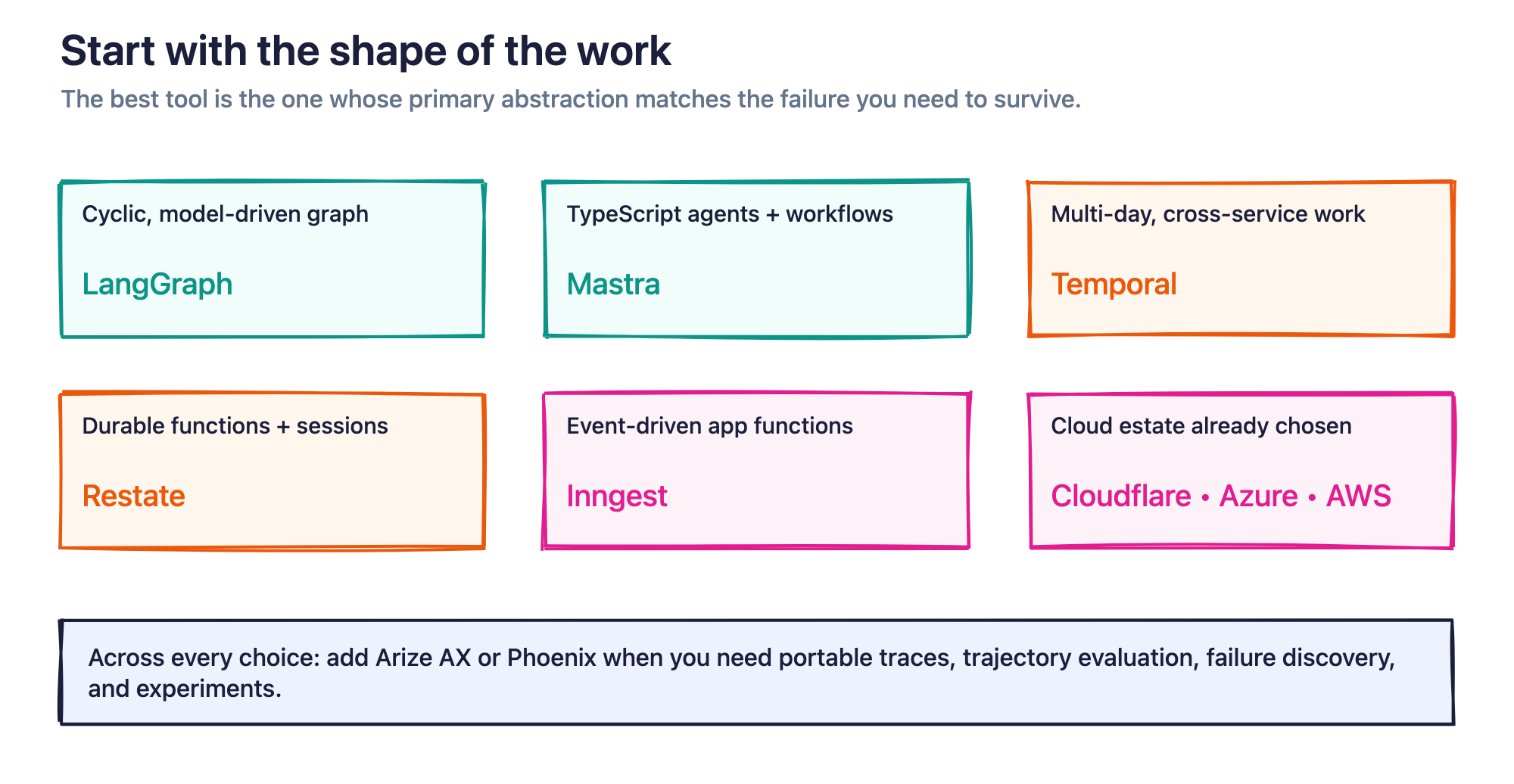
Which agent orchestration tool should you choose?
| Your primary requirement | Start with | Validate before committing |
|---|---|---|
| Cyclic graph with model-driven branches | LangGraph | Durable checkpointer, thread and state model, deployment billing, and outer runtime needs |
| TypeScript agents plus explicit workflows | Mastra | Snapshot semantics, chosen durable backend, and CPU and observability billing |
| Multi-day, polyglot, cross-service reliability | Temporal | Determinism, worker operations, activity idempotency, and action usage |
| Durable functions, sessions, and lower operational overhead | Restate | Action count, throughput tier, retention, and ecosystem fit |
| Event-driven application functions | Inngest | Execution multiplier per step, concurrency, retention, and self-host tradeoffs |
| Cloudflare-native edge application | Cloudflare Workflows | Step and state limits, CPU model, and platform lock-in |
| Azure Functions and .NET estate | Azure Durable Task | Scheduler plus compute bill, replay behavior, and payload and quota limits |
| Explicit AWS state machines | AWS Step Functions | Transition count, retries, Express vs. Standard, and cyclic-loop placement |
| Trace and evaluate any of the above | Arize AX or Phoenix | Instrumentation depth, trajectory evals, production issue discovery, and experiment workflow |
Common architecture patterns
LangGraph inside a durable outer workflow
Use LangGraph for model-driven loops and handoffs. Use Temporal or Restate as the outer process when the job spans services, waits for external events, or must survive for days. Keep nondeterministic agent work inside activities or durable steps rather than deterministic replay code.
Mastra for one TypeScript surface, Temporal for critical durability
Mastra gives the product team one agent and workflow framework. Its Temporal adapter can provide the stronger durable boundary for workflows that must survive worker replacement and long waits.
Restate as both agent runtime and durable coordination layer
Use Restate handlers, Virtual Objects, and workflows when durable sessions, routing, and service calls fit naturally into function-shaped code. Export OpenTelemetry traces to the evaluation backend of your choice.
Cloud-native state machine outside the agent loop
Use Step Functions or Azure Durable Task for the outer business process while the agentic loop runs inside Lambda, an activity function, or another service. This prevents a model-driven cycle from fighting a declarative state-machine language.
Run the same failure-oriented proof of concept in every finalist
A useful proof of concept should test recovery, not the happy-path demo.
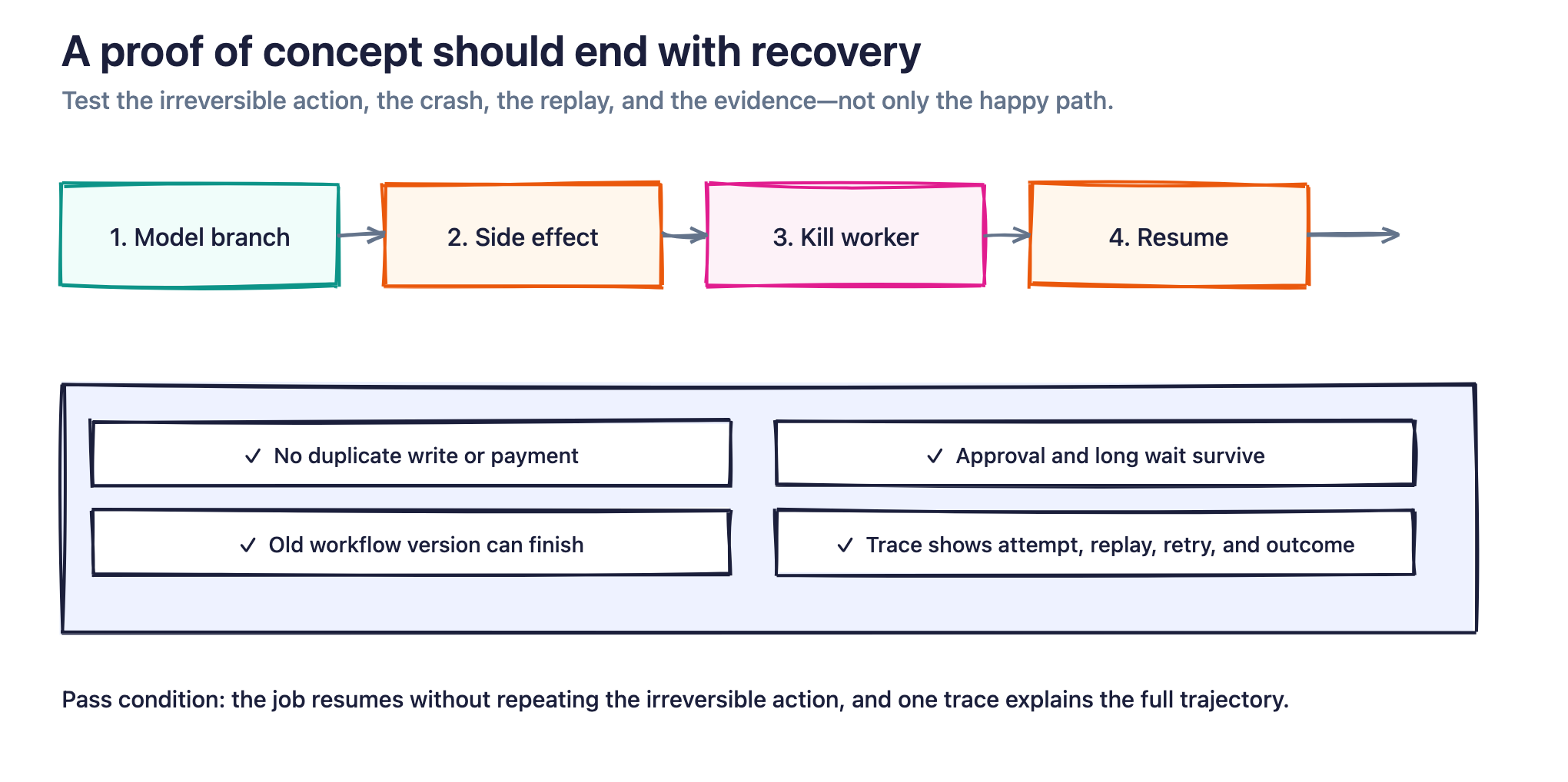
Build one workflow with:
- A model-decided branch.
- Two tool calls, including one non-idempotent side effect.
- A retry after a simulated rate limit.
- A human approval that waits at least several minutes.
- A 30-minute durable sleep or external-event wait.
- Parallel fan-out to three workers.
- A deliberate worker kill after the first side effect succeeds.
- A deployment of a new workflow version while one instance remains in flight.
Then verify:
- Does the replacement worker resume or restart?
- Are completed model and tool calls replayed, memoized, or executed again?
- Can the side effect be protected with an idempotency key?
- Does the approval survive the restart?
- Can the old workflow instance finish after the code deployment?
- Does the trace show the original attempt, replay, retry, and final outcome coherently?
- What are the billable actions, steps, transitions, and retained-history costs for 10,000 runs?
The proof of concept should end with a worker dying mid-run, the workflow recovering without duplicating the external action, and an engineer being able to explain the complete trajectory from one trace.
Agent orchestration implementation checklist
- Write the control flow in versioned code or a checked-in state-machine definition.
- Separate model and tool I/O from deterministic replay code.
- Give every workflow, task, node, and side effect a stable identifier.
- Make external writes idempotent and define compensation for partially completed work.
- Set retry policies by error class instead of retrying everything identically.
- Put human approvals and webhooks on durable signals, not open request threads.
- Define timeouts for the workflow, each step, each tool, and each approval.
- Plan workflow-version migration before long-lived runs reach production.
- Store references to large artifacts instead of placing large payloads in workflow state.
- Emit nested OpenTelemetry traces with model, tool, retrieval, handoff, and version metadata.
- Evaluate the complete trajectory and the state left behind, not only the final answer.
- Rehearse worker death, dependency failure, and duplicate delivery in staging.
- Price the failure path, including retries, replay, retained history, and observability.
- Keep the runtime and evaluation systems independently operable so one outage does not blind or freeze both.
Frequently asked questions
What is agent orchestration?
Agent orchestration is how an AI agent system decides what runs next, coordinates models, tools, subagents, and humans, carries state across steps, and recovers when a step, worker, or dependency fails. It can include a graph framework, a durable runtime, a cloud state machine, or a combination of those layers.
What is the difference between an agent framework and an orchestration runtime?
An agent framework provides primitives for agents, tools, memory, handoffs, and model-driven control flow. An orchestration runtime keeps work alive across crashes, retries, timers, deployments, and external events. LangGraph and Mastra emphasize the first job. Temporal and Restate emphasize the second. Some products cover parts of both.
What is durable execution for AI agents?
Durable execution persists enough information about a run that work can continue after a process or worker fails. Depending on the platform, that may mean graph checkpoints, an event history, journaled step results, or state-machine transitions. The key test is whether completed side effects and expensive model calls can be recovered without being repeated incorrectly.
LangGraph or Temporal: which should I use?
Use LangGraph when the main problem is expressing a stateful, cyclic agent graph. Use Temporal when the main problem is reliable execution across services, workers, languages, and long periods of time. For long-running agents, many teams use both: LangGraph owns the agent graph inside an activity or service, while Temporal owns the durable outer workflow.
What is the best agent orchestration tool for TypeScript?
Mastra is the most agent-specific TypeScript framework in this comparison. Inngest is strong for event-driven application functions and managed durable steps. Cloudflare Workflows is the natural fit when the application already runs on Workers. Temporal also has a mature TypeScript SDK when cross-service durability is the primary requirement.
Can AWS Step Functions orchestrate an AI agent?
Yes, especially when Step Functions owns the outer business process and an agent loop runs inside Lambda or another task. It is a weaker fit when the state machine itself must express frequent model-driven cycles, because Amazon States Language is optimized for explicit states and transitions rather than open-ended agent graphs.
Is OpenTelemetry an orchestration tool?
No. OpenTelemetry records and exports telemetry. It does not schedule workers, persist workflow journals, or resume failed execution. It is the common evidence layer that lets teams inspect and evaluate an orchestrated run across different frameworks and runtimes.
How should I evaluate an orchestrated agent?
Evaluate both the final outcome and the trajectory. Check whether the workflow selected the right tools, preserved state across handoffs, recovered safely, avoided duplicate side effects, stopped at the right time, and left the external system in the intended state.
Code evaluators work for exact conditions, LLM judges for stable semantic criteria, and Agent-as-a-Judge for complex multi-step trajectories that require trace exploration.
How much do agent orchestration tools cost?
The billing unit matters more than the base plan.
LangSmith combines seats and traces with deployment compute and storage; some existing customers remain on legacy per-run and uptime billing through October 1, 2026. Temporal and Restate bill actions. Inngest bills executions that include the run and its steps. Cloudflare bills requests, CPU, storage, and steps. Azure bills scheduler actions or capacity units plus compute. Step Functions bills transitions or Express requests and duration.
Model the success path and at least one retry-heavy failure path before comparing totals.
Final recommendation
Choose the smallest stack that can express the real control flow and survive the failure that would end the job.
- Start with LangGraph when the agent is fundamentally a cyclic graph.
- Start with Mastra when a TypeScript team wants agents and workflows in one framework.
- Add Temporal when the outer process must remain durable across services and days.
- Use Restate when durable functions and sessions fit better than a large workflow platform.
- Use Inngest or Cloudflare Workflows when the application is serverless and JavaScript-first.
- Use Azure Durable Task or AWS Step Functions when the cloud estate is already decided.
- Add Arize AX or Phoenix when you need to see the complete trajectory, evaluate whether recovery was correct, discover recurring production failures, and prove that the next orchestration change actually helped.
The right proof of concept does not end when the agent returns a good answer. It ends when you can kill a worker, resume the job without repeating an irreversible action, inspect the replayed trajectory, and turn the failure into a regression test.

