

Chapter summary
Last reviewed August 21, 2026. Compare platforms on how they connect tracing, evaluation, and production debugging, not on feature labels alone.
Arize alternatives at a glance
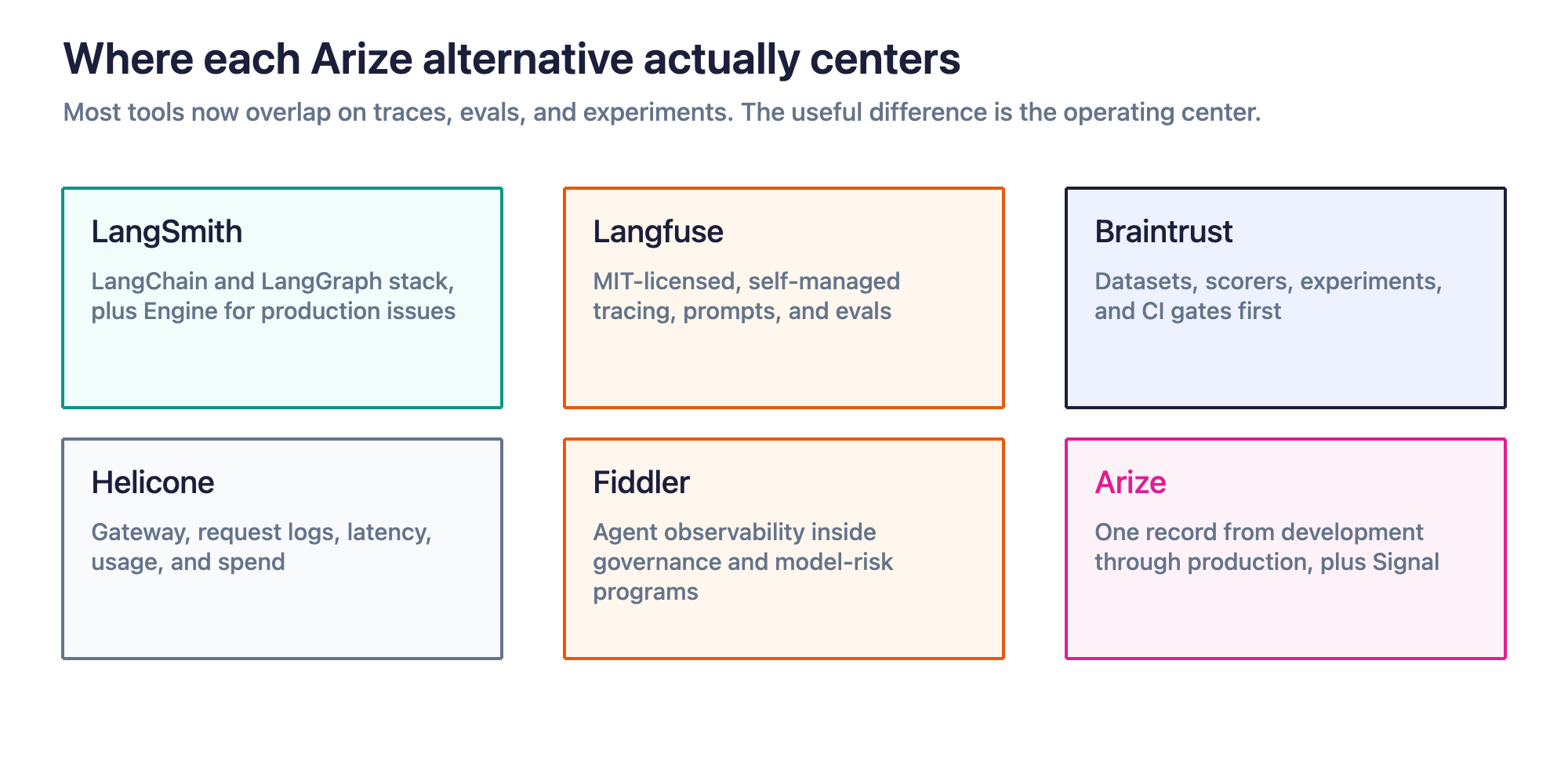
Quick answer: The most common Arize alternatives are:
- LangSmith for teams that want especially tight integration with LangChain and LangGraph
- Langfuse for teams that want an MIT-licensed, self-managed observability and evaluation platform
- Braintrust for teams centered on evaluation-driven development and production feedback
- Helicone for lightweight request, session, usage, and cost visibility
- Fiddler for enterprises combining agent observability with governance, model risk, and guardrails
These platforms increasingly overlap across tracing, evaluation, and production monitoring, but their centers of gravity differ. For teams whose alternative search starts with cost, open source, or self-management, Arize Phoenix, the open source project from Arize, is also worth evaluating before moving to an external platform.
Arize AX is an AI engineering platform for teams shipping agents. It provides a continuous trace record across development and production, then connects that evidence to evaluation at the span, trace, and session level, production monitoring, failure discovery, datasets, experiments, and regression coverage. Teams evaluating alternatives are usually comparing how deeply each platform connects those workflows, how it handles production agent failures, and how it fits their deployment and operating model.
| Platform | Best fit | Use when |
|---|---|---|
| LangSmith | Teams that want tight LangChain and LangGraph integration | Use when tight integration with LangChain and LangGraph is a priority and you want tracing, evals, production issue discovery, and deployment in the same ecosystem. |
| Langfuse | Self-managed open source observability | Use when you want an MIT-licensed tool for tracing, prompt management, and evals, and your team can own the infrastructure. |
| Braintrust | Evaluation-driven AI development | Use when datasets, scorers, experiments, CI gates, and production-derived evaluation workflows are the center of your AI engineering process. |
| Helicone | Lightweight logging and cost tracking | Use when you need quick visibility into requests, latency, usage, provider behavior, and spend. |
| Fiddler AI | Enterprise agent observability, governance, and risk | Use when you need agent observability alongside model monitoring, explainability, guardrails, and governance across predictive and generative AI systems. |
| Arize | Full-lifecycle observability and evaluation | Use when you need one record from development through production, agent-native evals, built-in failure discovery, and enterprise deployment control. |
Why teams look for Arize alternatives
The reasons cluster into a few patterns:
- The team is all in on one framework. When every service runs on LangChain or LangGraph, a framework-native tool offers real convenience, and the neutrality Arize provides matters less until the stack diversifies.
- The team wants open source with a specific license. Some organizations have policies that favor MIT licensing or require the team to run every tool on its own infrastructure.
- The workflow is narrower than the platform. A team living entirely inside prompt iteration, or one that only needs request logs and a cost dashboard, may see a full-lifecycle platform as more surface than the job requires.
- The buyer is a risk function rather than an engineering team. Governance programs sometimes start from explainability and audit requirements rather than from traces and evals.
Each of these is a real reason, and each maps to a specific alternative below.
If the reason is cost or open source, start with Arize Phoenix
Before comparing external tools, it’s worth knowing that Arize already has a free, open source option. Arize Phoenix is the self-managed AI observability and evaluation platform from Arize, with tracing on OpenTelemetry and OpenInference, evaluations, datasets, experiments, and prompt management without usage-based software fees. Teams run it on infrastructure they control, and the same OpenTelemetry/OpenInference instrumentation pattern can carry forward if they later move workloads to Arize AX. For a team whose alternative search starts with “free,” “open source,” or “self-managed,” Phoenix is worth evaluating alongside external alternatives.
How to compare Arize alternatives
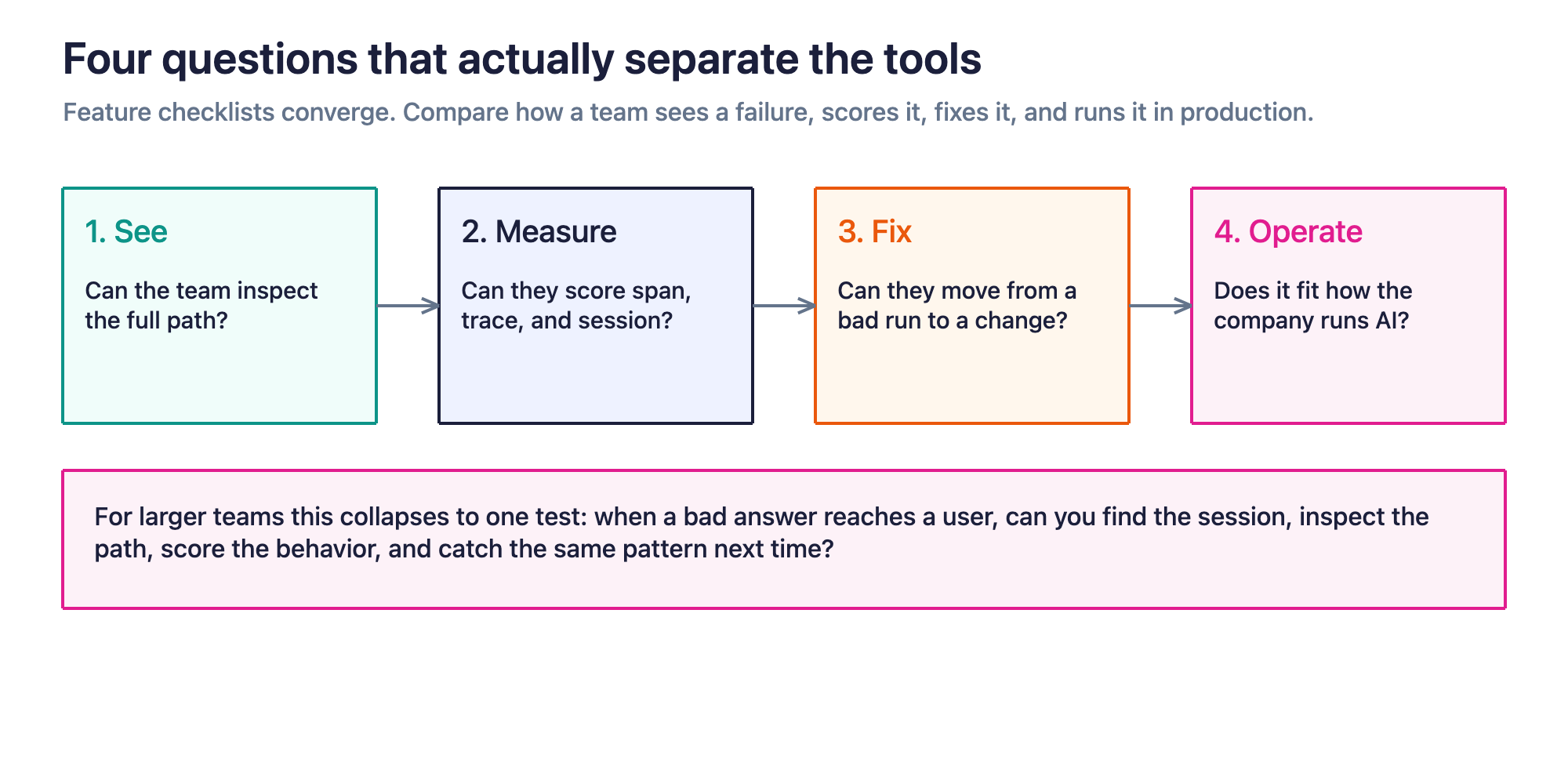
Most tools in this category offer support for evals, traces, prompts, datasets, and experiments, and the labels alone won’t separate them. We compare across four practical dimensions:
- See: can the team see what happened?
- Measure: can the team measure behavior at the output, span, trace, and session level?
- Fix: how quickly can the team move from a failed run to a fix?
- Operate: can the platform fit the way the company runs production AI systems?
For larger teams, these usually collapse into one question: when a bad answer reaches a user, can the team find the session, inspect the path, score the behavior, assign the failure, and make sure the same pattern is caught next time?
The top Arize alternatives
1. LangSmith: best for teams that want tight LangChain and LangGraph integration
Best for: Teams that want especially tight integration with LangChain and LangGraph while keeping tracing, evals, production issue discovery, and deployment in the same platform.
LangSmith remains especially convenient for teams building with LangChain and LangGraph. Tracing, LangGraph execution views, development tools, and deployment fit naturally together, while the platform also supports applications built with other frameworks and OpenTelemetry instrumentation.
LangSmith has also expanded significantly beyond trace inspection and predefined evaluation. LangSmith Engine monitors production traces, clusters recurring failures into issues, diagnoses root causes, proposes prompt or code fixes, recommends examples for offline evaluation datasets, and suggests online evaluators to detect recurrence. That makes production failure discovery and the trace-to-fix loop a meaningful part of the platform rather than a manual workflow around it.
The tradeoff is therefore less about whether LangSmith can support production debugging and more about operating model and ecosystem fit. Teams deeply invested in LangChain and LangGraph get especially tight integration, while teams prioritizing an open-source self-managed platform, a different enterprise deployment model, or pricing without per-seat licenses may prefer another approach. Self-hosted and hybrid LangSmith deployment options are available on Enterprise.
| Dimension | Assessment |
|---|---|
| See | Strong tracing across supported stacks, with especially tight integration for LangChain and LangGraph |
| Measure | Strong online and offline evaluation, datasets, experiments, and production monitoring |
| Fix | Engine adds recurring-failure discovery, root-cause analysis, proposed fixes, datasets, and evaluator generation |
| Operate | Strong integrated agent-engineering stack; self-hosted and hybrid deployment require Enterprise, with seat and usage-based pricing |
Pricing: Developer is free for one seat with up to 5,000 base traces per month. Plus is $39 per seat per month with 10,000 base traces included. Additional platform usage is metered through LangChain Compute Units and Storage Units, including usage by capabilities such as Engine and deployments. Enterprise pricing is custom and adds self-hosted and hybrid deployment options.
Full comparison: Arize vs. LangSmith
2. Langfuse: best self-managed open-source alternative
Best for: Teams that want an MIT-licensed tool for tracing, prompt management, and evals, with the capacity to run the infrastructure.
Langfuse gives developers a practical open source path for tracing live calls, managing prompts, collecting datasets, running experiments, reviewing annotations, and scoring outputs with custom or LLM-as-a-judge evaluators. Prompt management sits close to the traces, mixed stacks fit well through OpenTelemetry and SDK instrumentation, and it runs on ClickHouse for high-throughput ingestion.
The tradeoff shows up primarily in operating burden and how much automation the team wants around production debugging. At scale, a self-hosted Langfuse deployment includes multiple infrastructure components that the team is responsible for operating, upgrading, backing up, and scaling. Langfuse does support sessions, annotation queues, human review, online and offline evaluation, RBAC, SSO, and enterprise audit controls, so those capabilities should not be treated as out of scope. The sharper distinction is around automated recurring-failure discovery and agent-native trajectory analysis, which are less central to the Langfuse workflow than they are in Arize. Teams comparing on open source alone should weigh Langfuse and Phoenix directly.
| Dimension | Assessment |
|---|---|
| See | Strong for traces, sessions, users, cost, latency, and agent graphs |
| Measure | Strong building blocks for datasets, experiments, LLM-as-a-judge, human review, and online evaluation |
| Fix | Strong trace-to-prompt and human-review workflows; less emphasis on automated recurring-failure discovery |
| Operate | Best for teams that want open-source control and are prepared to own the platform infrastructure |
Pricing: Hobby is free with 50k units per month and 30-day data access. Core runs $29/month with 100k units and graduated overage. Pro runs $199/month with 3-year data access and retention management. Enterprise starts at $2,499/month. The unit is the detail to model, since traces, observations, and scores each count and a single agent run burns several.
Full comparison: Arize Phoenix vs. Langfuse
3. Braintrust: best for evaluation-driven AI development
Best for: Teams whose AI engineering workflow centers on datasets, scorers, experiments, CI regression gates, and turning production behavior into new evaluation coverage.
Braintrust’s evaluation workflow is a major strength: teams can tune prompts, run them against datasets, attach code-based or model-based scorers, compare versions, and use evaluation results in release decisions. Production traces can become regression cases, and Braintrust also provides tracing and online scoring for live applications.
Braintrust has expanded its production workflow substantially with Topics. Topics continuously analyzes production traces, classifies them across dimensions such as user intent, sentiment, and issues, and clusters related behavior so teams can discover recurring patterns they did not define ahead of time. Confirmed patterns can then become datasets, scorers, and review workflows. That means it is no longer accurate to describe Braintrust as a static evaluation surface limited to known failure modes.
The distinction is better understood as one of center of gravity. Braintrust remains evaluation-first: production evidence feeds a dataset-and-scorer workflow. Arize puts more emphasis on the broader production operating loop, including monitoring, session and trajectory evaluation, recurring issue investigations through Signal, and enterprise deployment and operations. Which model is better depends on whether evaluation itself or the larger production observability and debugging workflow is the team’s primary organizing system.
| Dimension | Assessment |
|---|---|
| See | Strong production tracing with Topics adding horizontal pattern discovery across traces |
| Measure | First-class datasets, scorers, experiments, online evaluation, and CI gates |
| Fix | Strong production-to-dataset and regression loop; Topics helps surface recurring patterns that were not predefined |
| Operate | Managed platform with Enterprise deployment and governance options; pricing scales with processed data and score volume |
Pricing: Starter is free with 1 GB of processed data, 10,000 scores, and 14-day retention. Additional Starter usage is $4 per GB and $2.50 per 1,000 scores. Pro is $249 per month with 5 GB of processed data, 50,000 scores, and 30-day retention; additional usage is $3 per GB and $1.50 per 1,000 scores. Enterprise pricing is custom and adds additional deployment, retention, governance, and support options.
Full comparison: Arize vs. Braintrust
4. Helicone: best for lightweight logging and cost tracking
Best for: Teams that want fast request visibility, provider usage analytics, latency tracking, and cost monitoring without a full evaluation platform.
Helicone starts with the request stream rather than with datasets and scorers. Teams route traffic through the proxy or use integrations, then get quick answers to operational basics: which models are in use, which requests are expensive, which endpoints drive traffic, and where latency comes from. For early production systems, that visibility can be enough, and the adoption path is simple.
Helicone has grown beyond basic request logging. It supports sessions for grouping multi-step agent workflows, scores, datasets, prompt management, a playground, user analytics, alerts, and reports. The distinction is therefore depth rather than presence: Helicone remains especially strong as a gateway-centered observability, usage, and cost layer, while teams that need a more extensive evaluation lifecycle, automated semantic failure discovery, and deeper production root-cause workflows may still prefer a dedicated AI engineering platform.
| Dimension | Assessment |
|---|---|
| See | Strong for requests, sessions, latency, token usage, cost, and provider behavior |
| Measure | Supports scores, datasets, feedback, and evaluation-oriented workflows; lighter than a dedicated evaluation platform |
| Fix | Good for investigating slow, expensive, failed, or poorly performing requests and sessions |
| Operate | Best for teams that prioritize lightweight gateway, usage, and cost visibility |
Pricing: Hobby is free with 10k requests. Pro runs $79/month with unlimited seats and usage-based pricing. Team runs $799/month with SOC 2 and HIPAA support. Enterprise is custom with on-prem deployment options.
5. Fiddler AI: best for enterprise agent observability, governance, and risk
Best for: Enterprises that want agent observability and evaluation alongside model monitoring, explainability, guardrails, and formal AI risk management.
Fiddler has historically been associated with model monitoring, explainability, fairness, and governance, but its current platform goes substantially further into agent engineering. Fiddler Agentic Observability provides hierarchical visibility across applications, sessions, agents, traces, and spans, with continuous evaluator rules, monitoring, experiments, and hierarchical root-cause analysis. Production findings can also feed back into evaluation datasets.
Its center of gravity still differs from Arize. Fiddler spans predictive AI, generative AI, agent observability, guardrails, model risk, and governance, making it especially relevant to enterprises trying to standardize oversight across a broad AI portfolio. Arize is more specifically centered on the AI engineering improvement loop for LLM applications and agents, including production failure discovery through Signal, agent-native evaluation workflows, and the Phoenix-to-AX path from open source to enterprise operation.
| Dimension | Assessment |
|---|---|
| See | Strong visibility across the application → session → agent → trace → span hierarchy |
| Measure | Strong production evaluation, custom evaluators, experiments, model monitoring, and safety metrics |
| Fix | Supports hierarchical root-cause analysis and production-to-development feedback loops |
| Operate | Strong for enterprises combining agent operations with governance, guardrails, predictive-model monitoring, and formal risk requirements |
Pricing: Fiddler offers a free guardrails tier. The Developer plan is usage-based at $0.002 per trace and includes unified observability for agentic and predictive systems, custom evaluators, and SaaS deployment. Enterprise pricing is custom and adds enterprise guardrails, infrastructure scalability, and SaaS, VPC, or on-prem deployment.
Other tools worth considering
A few more tools show up in a quick web search. They don’t replace Arize so much as cover one slice of the workflow near it:
| Tool | Best fit | Why consider it |
|---|---|---|
| Ragas | RAG evaluation | Useful for retrieval and generation metrics during experimentation. |
| TruLens | RAG and app-level evaluation | Useful for groundedness, context relevance, and answer quality checks. |
| Promptfoo | Prompt regression testing | Useful for lightweight prompt tests, CI checks, and model comparison before release. |
| OpenAI Evals | Custom eval harnesses | Useful when teams want code-first eval logic around OpenAI models. |
How to choose
The right call depends on what the alternative search is actually about:
- Tight LangChain and LangGraph integration is the priority: LangSmith is a strong option, especially if your team also wants its deployment and Engine workflows in the same ecosystem. Compare the operating model, deployment requirements, and total seat-plus-usage cost against Arize.
- Open source and self-management are hard requirements: Weigh Langfuse and Phoenix directly. Both cover substantial tracing and evaluation workflows, while their infrastructure architecture, agent-debugging experience, and paths to enterprise operation differ.
- Evaluation is the organizing system for the team: Braintrust is a strong option for datasets, scorers, experiments, CI gates, and production-derived eval coverage. Compare how each platform handles the step from finding an emerging production problem to diagnosing, fixing, and monitoring it.
- Gateway, request, session, and cost visibility are the primary need: Helicone offers a lightweight path with useful testing and dataset capabilities alongside its gateway and observability workflow.
- Agent observability must sit inside a broader governance and model-risk program: Fiddler is a serious option, particularly for enterprises operating both predictive and generative AI systems.
The market has converged quickly: serious AI engineering platforms now combine some mix of tracing, evaluation, production monitoring, datasets, and experiments. The useful question is no longer whether a platform has those primitives, but how well it connects them when something fails in production.
Arize’s differentiation is the way that loop fits together: open instrumentation, production traces and sessions, agent-native evaluation, recurring-failure discovery through Signal, datasets and experiments for validating fixes, and deployment options for teams operating AI across an organization.
Why teams choose Arize
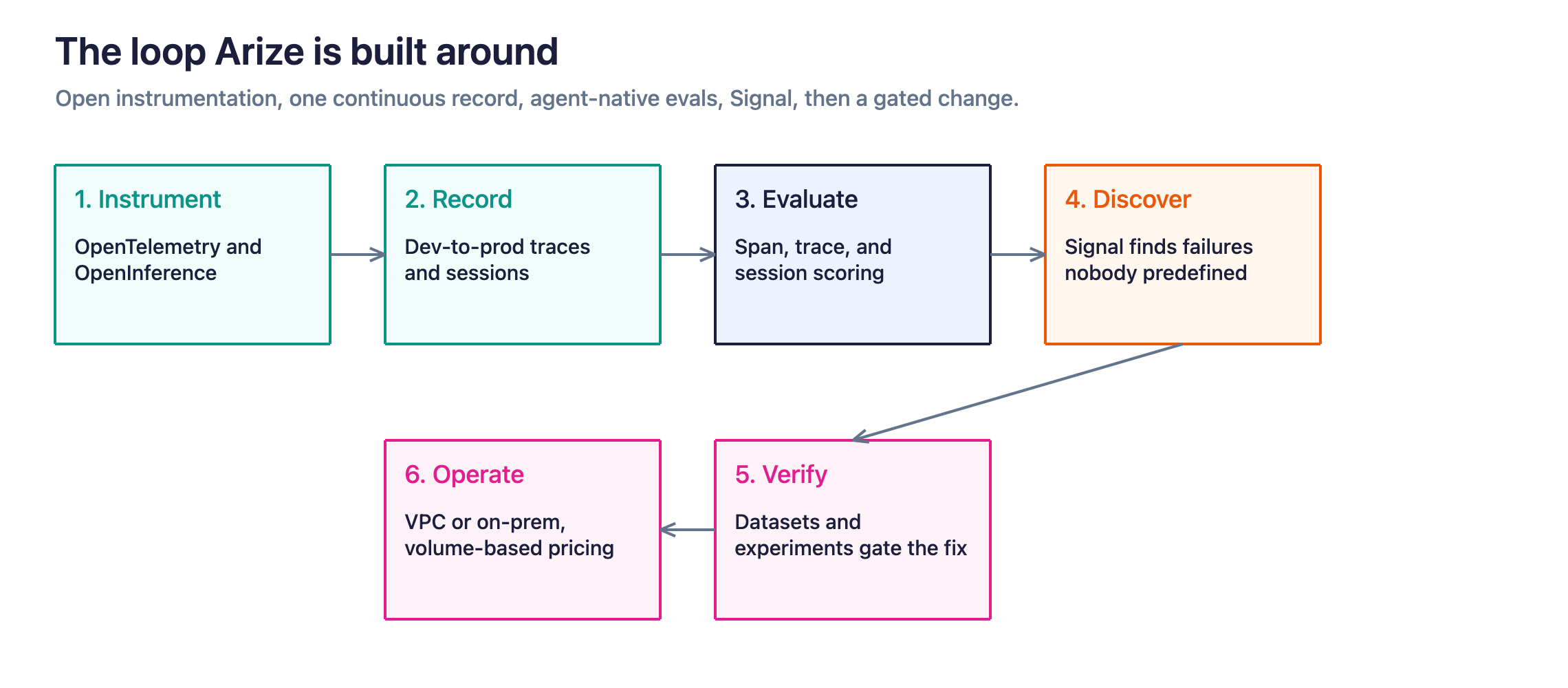 The same strengths show up in every comparison above:
- One continuous record from development through production.
- Open instrumentation on OpenTelemetry and OpenInference, with 30+ auto-instrumentations instead of a proprietary format or a single framework.
- Agent-native evaluation down to individual paths and sessions.
- Failure discovery through Signal, which surfaces problems nobody thought to define.
- Deployment on your terms. Arize AX runs in your VPC or on-prem with the control plane included.
- Volume-based pricing that scales with spans and data volume rather than seats or the number of evaluations run against each trace, backed by infrastructure designed for high-volume production workloads.
The Arize AX platform page walks through each in depth.
Related reading
- LangSmith alternatives
- Langfuse alternatives
- Braintrust alternatives
- LLM and agent evaluation platforms
- What is an agent observability platform?
- Self-hosted AI observability
- AI observability pricing
- Best AI agent debugging tools
- AI agent tracing and evaluation
- What is AI engineering?
Arize alternatives FAQs
What are the best Arize alternatives?
The strongest alternatives each own a slice of the lifecycle: LangSmith for LangChain-native teams, Langfuse for self-managed open source, Braintrust for pre-release prompt iteration, Helicone for lightweight logging and cost tracking, and Fiddler for governance programs. None cover the full development-through-production record that Arize is built around, so the right pick depends on how narrow the job stays.
Is there a free alternative to Arize?
The closest free option is Arize’s own Phoenix, which is open source, self-hosts as a single service, and includes the complete feature set with no usage caps. Langfuse offers an MIT-licensed core with a free cloud tier, and most commercial alternatives offer free tiers with volume limits.
Who are Arize’s main competitors?
In AI observability and evaluation, the names that come up most are LangSmith, Langfuse, and Braintrust, with Helicone competing on lightweight logging and Fiddler on governance. The head-to-head pages cover the three closest matchups in depth: Arize vs. LangSmith, Arize Phoenix vs. Langfuse, and Arize vs. Braintrust.
When does an alternative genuinely make sense over Arize?
When the job is a slice and stays a slice: a team permanently inside one framework, a workflow that never leaves prompt iteration, or a need limited to request logs and spend. Once an AI system carries real traffic and the team needs online evals, failure discovery, cross-team review, and recurrence tracking, fewer of the alternatives keep up, and that operating stage is where Arize is strongest.

