

TL;DR
- Governance cost follows what an AI system can do, not just how often it runs. Agents that can access sensitive data, change state, execute code, or take regulated actions need stronger controls, more evidence, and more review.
- Prompts are not security boundaries. Consequential actions need application-level permission checks, scoped credentials, approval gates, transaction limits, and a tested way to contain failures.
- Budget for the evidence required to explain a production run. Traces, evaluations, retention, redaction, access controls, and human review all add recurring costs beyond model usage.
- Every meaningful model, tool, policy, or workflow change can trigger another governance cycle. Evaluation, regression testing, approval, and release work should be treated as recurring operating costs.
- Use production data to replace planning assumptions over time. Track workflow authority, trace volume, retention, reviewer hours, change frequency, and incident costs so the governance budget reflects the system you actually operate.
A product team may first discover that a model update has broken production through a burst of customer tickets. Workflows still complete, but some return stale outputs or repeat behavior associated with the previous model.
Now the team has to determine which version ran, whether cached content or persisted state affected the response, what customers received, and why existing controls failed to catch it.
Every hour spent reconstructing that incident adds to the operating cost of the system. It also creates a governance problem when the team cannot explain which version ran, why its behavior changed, or which control should have caught it.
AI governance and security spending covers the controls and operating practices that make incidents like this traceable and containable in LLM and agent observability practices. Total cost depends on what the system can access, how much harm an incorrect action could cause, how frequently the system changes, and how much evidence the organization needs to retain.
What do AI governance and security cover?
AI governance and security establish the ownership, controls, and operating boundaries around an AI system, including who is responsible for it and which actions it may perform in production. Teams enforce those limits through role-based access, scoped credentials, approval gates, versioned model releases, deployment tests, monitoring alerts, and emergency shutdown procedures.
Teams apply these controls from model approval through data access, testing, deployment, production monitoring, incident response, and evidence retention. Named owners approve changes and stop production use when the system becomes unsafe.
Product and delivery teams use version records, traces, access decisions, and incident logs when a model update changes production behavior. The records help teams identify what changed and decide whether the system remains safe to operate.
How much does AI governance and security cost?
AI governance and security costs rise with the number of production systems and the consequences of a failure. A product team responsible for one customer-support agent needs a named owner, scoped access, release checks, and enough production evidence to investigate unexpected behavior. An enterprise operating AI across regulated workflows must fund the same ownership and enforcement work throughout the organization.
First-year AI governance spending usually falls into four visible areas: people and ownership, implementation and integration, platforms and infrastructure, and ongoing operations. The table below shows what each category pays for and what tends to increase the cost.
What are the main AI governance costs?
| Major cost area | What the organization pays for | What usually increases the cost |
|---|---|---|
| People and ownership | Product owners, security reviewers, legal review, engineering time, and operational support | Additional applications require more ownership, review capacity, and support coverage. |
| Implementation and integration | Access controls, approval workflows, release checks, application instrumentation, and connections to existing systems | Custom infrastructure and fragmented identity systems require more engineering work. |
| Platforms and infrastructure | Observability software, evaluation compute, trace storage, data redaction, and evidence retention | Higher traffic and longer retention periods increase recurring usage costs. |
| Ongoing operations | Production monitoring, incident investigation, policy updates, access reviews, and employee training | Higher-risk applications require stronger review and faster incident response. |
A useful planning model is:
Annual AI governance cost = shared program costs + system-specific controls + production evidence + evaluation and human review + change-related work + incident responseEach component grows for a different reason. The rest of this guide explains the variables teams should measure for each one.
Notably, planned costs do not capture every expense that appears after a launch. The example therefore keeps a 30 percent reserve for extra review, incident investigation, provider changes, audit evidence, legal review, and recovery. The reserve is an illustrative planning assumption, not an Arize customer benchmark, and teams should replace it with their own operating data as those costs become measurable.
Build better agents with Arize
Trace, evaluate, and learn. Build agents that work with Arize AX and start tracing your runs today.
Prefer open source? Try Arize Phoenix for self-hosted, open source agent observability.

How AI governance costs grow across the AI lifecycle
Governance costs grow whenever an AI system gains another model, tool, credential, data source, or production workflow. Each change creates another behavior to test, permission to restrict, signal to monitor, and incident path to investigate.
When a team publishes an internal agent, its agent harness connects model calls to tools, context, state, permissions, and recovery behavior. The first bill may include only model usage and infrastructure. The operating budget must also cover credential security, production monitoring, execution records, and a tested way to stop the system before one bad run creates uncontrolled spending.
METR disclosed a recent example in August 2026. An agent orchestration dashboard contained a model-provider API key and a fail-open authentication flaw that exposed the application publicly. Attackers used the stolen credentials for three weeks and consumed inference credits worth approximately $600,000, although METR had received those credits without charge.
The incident created governance costs throughout the system’s lifecycle:
- Before deployment, a security review could have rejected the public application because it stored a reusable provider credential.
- During operation, a hard spending limit could have contained the exposure before three weeks of unauthorized usage accumulated.
- During detection, complete request and cost reporting could have separated hostile traffic from normal evaluation volume.
After discovery, METR had to revoke access, rotate credentials, preserve system images, investigate the incident, and revise its deployment controls.
The same cost pattern appears when recovery work exceeds the model bill. In 2025, a Replit coding agent deleted SaaStr’s production database during an active code freeze, affecting 1,206 executive records and more than 1,196 company profiles.
Development and production shared the same database, while written instructions against further changes lacked technical enforcement. Replit responded by introducing automatic separation between development and production databases, with the agent restricted to the development environment by default.
The agent reliability gap becomes a cost problem when an acceptable final output hides an expensive, unsafe, or unauthorized execution path. Enforced permissions limit the possible damage, while complete traces reduce the time required to identify the affected version and reconstruct the failure.
Governance spending should follow the system’s authority throughout its lifecycle. Teams should fund each control when they add the capability it governs, then verify that control under realistic production conditions.
What drives AI governance and security costs?
The total cost follows the number of consequential AI workflows an organization must control and later explain. Model count provides a weak estimate because one model can support several agents with different data, tools, permissions, users, and release schedules.
Teams should estimate shared program costs separately from system-specific controls, production evidence, release work, and human operations. Each category grows according to a different characteristic of the deployed system.
How does the number of AI systems affect governance costs?
Governance cost attaches to what a deployed AI system can access, change, and prove after a run. A single model endpoint may support several applications, but those applications do not share one control boundary when they use different data, tools, permissions, or approval rules.
A customer support agent that drafts responses from public help content creates a different operating burden from an agent that can read account records and issue refunds. An internal research assistant that searches public documents also changes materially when it gains access to confidential sources.
The underlying model can remain identical while the required identity controls, review steps, evidence, and incident procedures change.
Teams should therefore count the workflows whose authority or evidence requirements differ enough to require separate control decisions. Each consequential workflow needs a named owner, an approved purpose, scoped access, release evidence for material changes, production monitoring, and a defined response when the system exceeds its boundary.
Shared infrastructure can lower the cost of governing several systems in an AI model lifecycle. Common identity services, instrumentation, evaluation infrastructure, and incident procedures can support many applications. System-specific controls still remain where an application can reach different data, perform different actions, or require different evidence to explain what happened.
How does an AI system’s authority affect governance costs?
An agent’s authority often changes the budget more than its request volume. A research assistant that reads public documents creates a smaller control surface than an agent that can issue refunds, modify permissions, execute code, or operate production infrastructure.
The required controls increase as the system receives greater authority:
- Public or internal retrieval: Teams restrict approved sources, evaluate groundedness, and monitor whether retrieved evidence supports the response.
- Sensitive-data access: Teams add identity controls, field-level redaction, access logging, retention limits, and reviews of where trace data will be stored.
- Reversible state changes: Teams verify the resulting system state, preserve transaction records, test rollback procedures, and prevent duplicate actions during retries.
- Irreversible or regulated actions: Teams require explicit approvals, deterministic policy checks, strict transaction limits, and immediate containment procedures.
A prompt or written instruction alone cannot reliably enforce those boundaries during execution. The application must check permissions before each consequential action and reject operations that exceed the approved scope.
The budget should therefore follow the potential consequence of an incorrect action. Teams need to identify which resources the agent can reach, which actions require approval, which changes can be reversed, and which owner can stop production access.
How much production evidence must teams collect and retain?
Governance requires enough evidence to reconstruct what the system attempted and what changed afterward. That evidence becomes more expensive as agents create longer traces, carry larger payloads, run more evaluations, and retain records for longer periods.
One customer request may create several model calls, retrieval steps, tool invocations, retries, and evaluator results. The team may also need to preserve the release identifier, policy version, approval decision, token usage, execution cost, and verified outcome.
Arize’s AI observability pricing guidance identifies the workload characteristics required for a realistic estimate. Teams should measure monthly traces, spans per trace, payload size, evaluation frequency, retention period, and the number of people who require access.
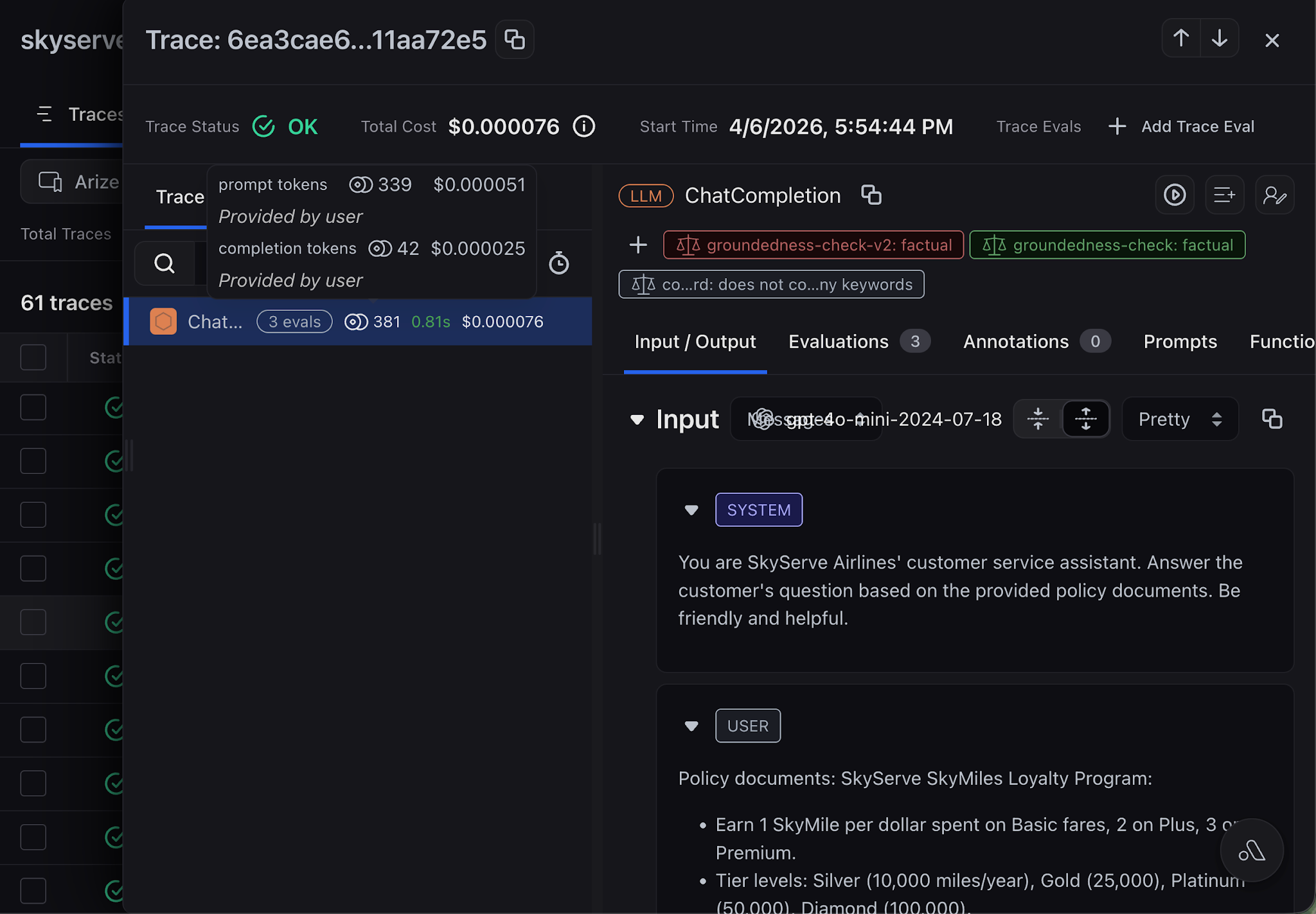
Arize AX cost tracking uses documented OpenInference attributes for token counts, model identity, provider identity, and calculated cost. Teams can inspect the total cost of one agent run and identify which model calls created the largest share.
That trace cost represents only the measured model usage. The wider evidence budget also covers ingestion, storage, redaction, evaluation, access control, investigation tooling, and retention.
Complete capture may be necessary when an agent changes customer records or performs regulated work. Lower-risk traffic can use sampling when the retained traces still cover important workflows, uncommon failures, and unusual cost patterns.
How do model and workflow changes affect governance costs?
Every behaviorally significant change creates another governance cycle. Teams must determine what changed, which risks it affects, what evidence the new version requires, and who can approve its release.
Annual governance cycles = planned releases + provider-driven changes + policy revisions + incident-driven fixes − overlapping triggers counted in the same cycle
Count each distinct review or release cycle once when several triggers lead to the same governance work.
Model aliases and managed APIs can change behavior without an application deployment. Tool providers can also change schemas, authentication requirements, or response behavior while the agent code remains unchanged.
EvalOps connects the candidate, dataset, evaluators, and release policy to the final deployment decision. A continual learning process turns confirmed production failures into regression cases, so the next release can test the behavior that failed in production.
A system released twice each year creates a different operating burden from an agent updated every week. The budget should include recurring evaluation and approval work instead of treating validation as a one-time implementation expense.
How much does human review add to AI governance costs?
People define acceptable risk, approve sensitive actions, investigate ambiguous failures, and accept responsibility for policy exceptions. A realistic budget separates routine quality review from approval work and incident investigation because each requires different expertise and response times.
Routine review should use the least expensive method that can make the decision reliably.
Arize’s LLM as a Judge guide explains how teams define evaluation criteria in plain language and apply an evaluator across traces, spans, sessions, or datasets. Arize AX records the evaluator definition, model configuration, result, and explanation so teams can inspect the judgment and repeat it against another release.
Automated evaluation reduces the cases that require manual inspection when teams validate it against trusted human labels. Teams should measure agreement on a representative sample, examine disagreements by failure type, and recalibrate the evaluator after model, prompt, tool, or policy changes.
Teams can estimate routine review work from observed production volume:
Monthly review hours = monthly sessions × review rate × minutes per review ÷ 60

100,000 monthly sessions × 2% sampled = 2,000 reviews

2,000 reviews × 10 minutes = 20,000 review minutes

20,000 ÷ 60 ≈ 333 reviewer hours per month
Multiply those hours by the fully loaded cost of the reviewers performing the work. Then budget separately for evaluator calls, rubric development, calibration, escalations, and incident investigation.
The estimate still excludes rubric development, evaluator calls, calibration, user appeals, approval queues, security investigations, policy changes, and post-incident remediation.
Complete traces reduce the time required for manual review and incident investigation. Reviewers can identify the applied policy, evaluator result, approval decision, tool activity, and resulting state without rebuilding the record from support tickets.
Budget owners should replace every planning assumption with measured production data as the program matures. The most useful inputs are the number of consequential workflows, system authority, evidence volume, change frequency, reviewer hours, and incident frequency.
What are the hidden costs of AI governance?
AI governance costs extend beyond software and implementation. Teams also need to budget for production evidence, human review, provider changes, incident investigation, legal work, and recovery.
AI governance budgets often account for platform software, implementation, staffing, and routine operations while underestimating the costs that appear later in security, compliance, support, legal, and engineering work.
The planning model below uses an illustrative 30 percent reserve for hidden operating and risk costs. This percentage is a planning assumption derived from the hypothetical allocation, and every organization should replace it with estimates based on reviewer workload, evidence volume, release cadence, and incident exposure.
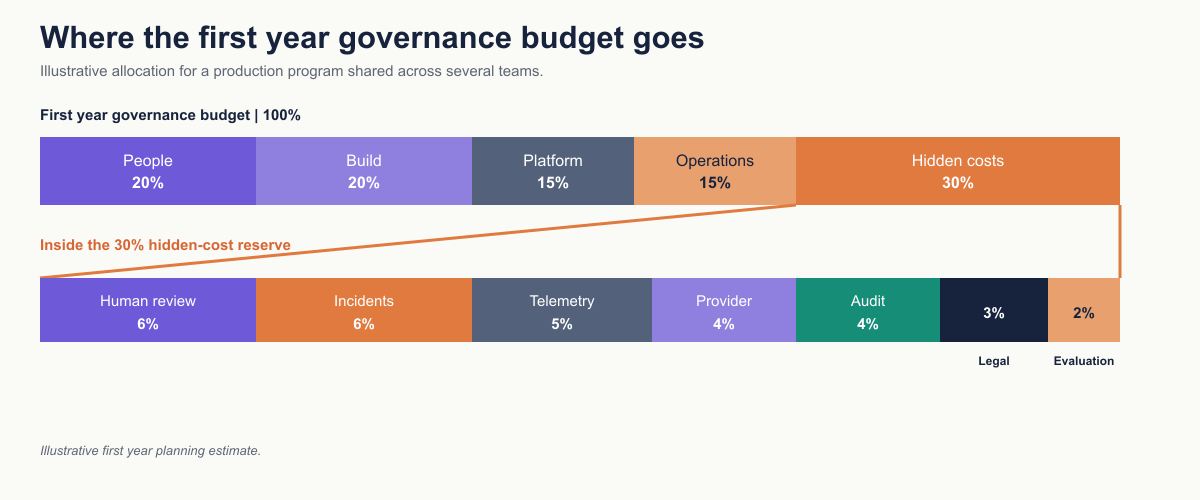
How much do AI monitoring and review cost?
Production evidence generates recurring work before any incident occurs. Teams pay to collect traces, inspect sensitive data, run evaluators, store records, retrieve audit evidence, and route uncertain cases to qualified reviewers.
The monthly cost can be estimated from five measured workloads:
Routine evidence cost includes telemetry processing and retention, evaluator model calls, human review hours, access review and audit evidence hours, and customer assurance or investigation work.
How do model changes increase AI governance costs?
Provider changes can force evaluation and approval work outside the product team’s release schedule. A model retirement may require a new model selection, prompt changes, tool testing, regression evaluation, security review, updated cost limits, and other production approval.
Anthropic’s model deprecation record shows how quickly that work can arrive. Claude Opus 4.1 was deprecated on June 5, 2026, and retired on August 5, 2026. Claude Sonnet 4 and Opus 4 were deprecated on April 14, 2026, and retired on June 15, 2026. These dates applied to Anthropic-operated platforms, while Amazon Bedrock and Google Cloud set separate retirement schedules. Any application still using those model identifiers needed to migrate before retirement because Anthropic states that requests to retired models fail.
Teams should estimate migration cost for each affected application from observed labor and release-delay hours.
How much can AI incidents add to governance costs?
An incident creates costs after the model failure itself. The team must investigate the event, establish what the system did, and show which control failed.
IBM’s 2026 Cost of a Data Breach study examined breaches at 602 organizations between March 2025 and February 2026. AI-enabled malicious breaches averaged $6 million, compared with a $4.99 million global average across the study.
IBM separately reported that 92 percent of organizations reporting an AI-related breach lacked what the study classified as proper AI access controls. Because every sampled organization had experienced a breach, these figures measure incident severity and do not estimate annual expected cost.
Once production data is available, teams should stop treating the 30 percent reserve as a fixed assumption and replace it with the actual costs they observe for review, provider changes, incidents, legal work, and recovery. The annual comparison should include normal operating cost, measured change work, and expected incident exposure.
How to build a realistic AI governance and security budget
Start with one deployed AI system, not a company-wide estimate. Define its intended use, owner, data access, tool authority, approval path, and containment path. Repeat the exercise only when another system carries meaningfully different authority or requires different evidence.
Teams collect different cost inputs as the system moves from design to production. The sequence below shows when each input becomes available.
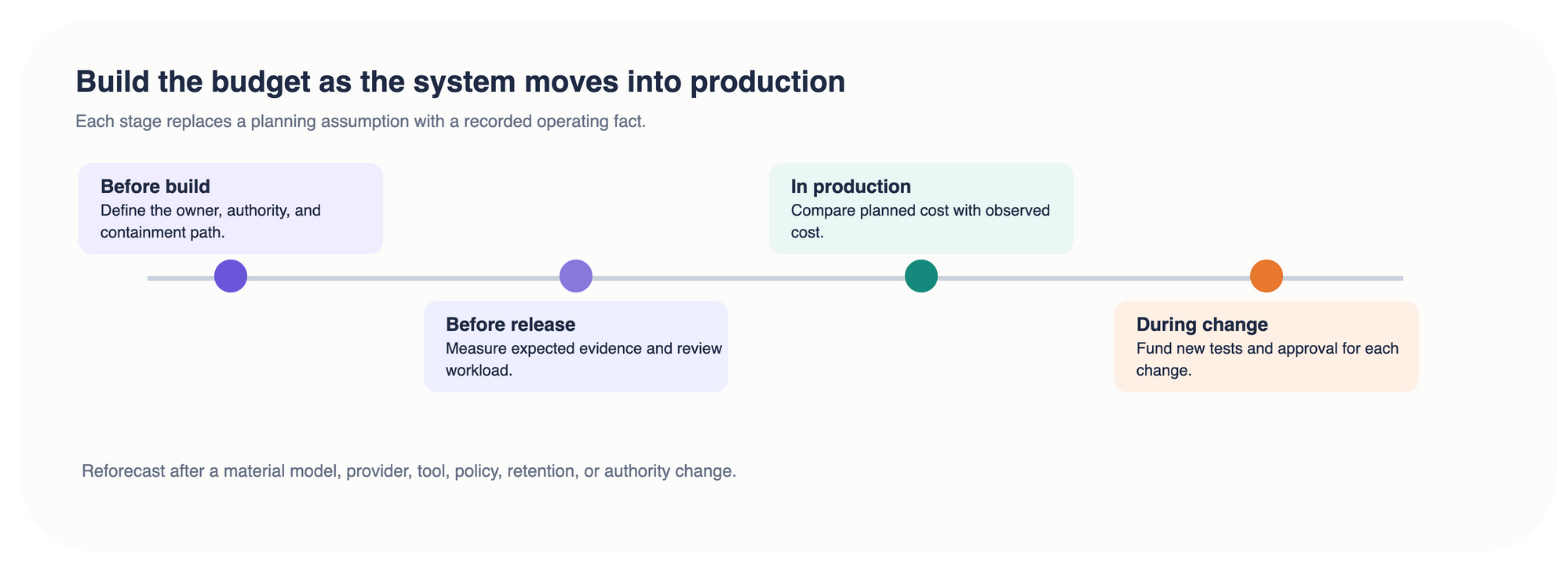
Before release, price the baseline evaluation, security review, release decision, and record of what that decision covered. Record the intended use, data access, tool authority, approval path, and containment path alongside that evidence. Each material change can require the same work again.
In production, forecast from representative traffic rather than a software price card. Record trace and payload volume, evaluation calls, reviewer queues, retention, access administration, and escalation evidence.
During a material change, record which model, provider, tool, policy, or incident changed the release path. The forecast should include the evaluation, approval, and investigation work that follows that change.
Each month, compare expected spend with observed storage, evaluation, reviewer, and investigation cost. Re-forecast after every material change so the budget describes the system operating now.
How observability and agent evaluation support AI governance
Effective AI governance depends on having enough evidence to understand what happened, evaluate whether the system behaved as intended, and verify that a fix works. Observability and evaluation provide that evidence.
After all, a governance process is only as useful as the evidence behind its decisions. Access rules, approval gates, transaction limits, and emergency containment still belong to the application and its owners, while Arize keeps the execution and evaluation evidence around those decisions connected.
When a failure reaches production, reviewers need to reconstruct the path that produced it. Arize AX tracing lets them move through model calls, retrievals, tool use, inputs, outputs, latency, and span metadata as one execution; Sessions keeps the earlier conversational context attached when the behavior developed over several turns, and trace-level cost tracking shows whether the same path also created unexpected spend.
The same production evidence can then become part of the release process for the fix. Representative failures can move into a regression dataset and be exercised against current and proposed configurations through Agent Experiments, while the Evaluator Hub keeps the evaluation criteria reusable and versioned across those comparisons.
At production scale, Signal can group recurring failure patterns into issues with supporting examples, helping reviewers decide where to spend attention and which cases should feed the next regression set. Arize supplies the evidence and evaluation workflow around governance decisions; the application and its owners remain responsible for enforcing permissions, approvals, transaction limits, and containment.
The canonical guides for the practices in this budget are on the resources hub. Shorter field notes are on the blog, and the terms used here are defined in the glossary.
Frequently asked questions about AI governance and security costs
How much should a team budget for AI governance and security?
A team should budget from the consequential workflows it operates. Start with what each workflow can access or change, then estimate the evidence, review workload, access administration, and lifecycle changes that authority requires.
A customer-support agent that can change an account record needs a different operating budget from an internal assistant that only reads public documents. Use measured trace volume, retention, reviewer hours, and change cadence to replace an early planning range.
Is observability enough for AI governance?
Observability records execution evidence, but governance work assigns ownership, defines access boundaries, sets release conditions, and gives someone authority to contain an incident.
Observability cannot approve a refund, restrict a credential, block a tool call, or stop a deployment. Retaining traces and evaluation results still creates recurring evidence cost, because the team must store, inspect, and secure those records.
Can an LLM judge replace human review?
An LLM judge can handle calibrated, recurring checks such as groundedness, relevance, or task completion. The team should compare its scores with a reviewed sample, record the disagreement pattern, and update the evaluator when its judgment drifts.
Human reviewers still define the rubric, inspect disagreement patterns, and decide which cases require escalation. High-consequence decisions still need an accountable person, even when the evaluator passes the case.
How often should a team revisit its governance budget?
Review the budget monthly against production evidence. Reforecast when a provider retires a model, a new tool changes the agent’s authority, a policy changes, or an incident exposes work the original estimate missed.

