
A surrogate model is a simple, readable model trained to imitate the behavior of a more complex or inaccessible one. You send inputs to the original model, record what it predicted, and then fit something legible on that record: a linear regression, a shallow decision tree, a rule list, a generalized additive model. The surrogate becomes a stand-in. Whatever it says about how inputs map to outputs is your working account of what the original model is doing.
Two details define the technique, and both get skipped in casual descriptions. First, the surrogate is trained on the original model’s predictions, not on ground truth labels. A model trained on labels is just a second model. A model trained on predictions is an approximation of a decision function. Second, a surrogate is judged on fidelity, meaning how closely it reproduces the original model’s outputs, not on accuracy against reality. A surrogate that scores 0.94 against the original model and 0.61 against the labels is doing its job.
Teams reach for a surrogate when they cannot get inside the original model. You inherited a scoring service with no source code. The model runs behind a vendor API. The training environment is gone and all you kept was a table of inputs and predictions. In any of those cases you cannot compute SHAP values directly, because SHAP needs either the model object or many extra forward passes. A surrogate gets an explanation from prediction logs alone.
Build better agents with Arize
Trace, evaluate, and learn. Build agents that work with Arize AX and start tracing your runs today.
Prefer open source? Try Arize Phoenix for self-hosted, open source agent observability.
Key takeaways
- A surrogate model is fit to another model’s predictions, which is what separates it from an ordinary model fit to labels.
- The metric that matters is fidelity to the original model, not accuracy against ground truth. Report it or the explanation is unfalsifiable.
- Surrogates are the fallback when the original model is inaccessible and direct attribution methods such as TreeSHAP or Deep SHAP are not available.
- The same word means something different in engineering, where a surrogate is a cheap emulator of an expensive simulation.
- A surrogate is only faithful in the input region you sampled, which is why it is weak evidence for regulated decisions.
How to fit one
- Collect inputs that reflect production traffic.
- Score every input with the original model and keep the prediction.
- Train an interpretable model on those predictions as the target.
- Measure fidelity on held-out inputs.
- Quote the fidelity number every time you read the surrogate.
Global surrogates and local surrogates
A global surrogate tries to approximate the entire decision surface with one readable model. That is ambitious. If a gradient boosted ensemble were reproducible by a depth-4 tree, you would have shipped the tree.
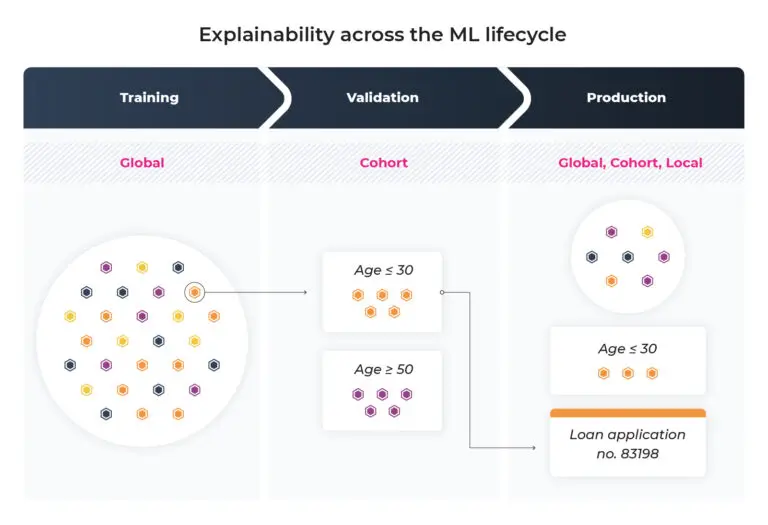
A local surrogate gives up on global coverage and approximates the model in a small neighborhood around one prediction, where even a linear fit can be close. That is exactly the design of Local Interpretable Model-agnostic Explanations, or LIME: perturb the input, score the perturbations with the original model, and fit a weighted linear model nearby. LIME is a surrogate method, just a local one. The tradeoff between these views is the same one described in global, cohort, and local model explainability, and it decides which questions you can answer.
The other meaning: emulators for expensive simulations
Outside machine learning, a surrogate model is a cheap approximation of something expensive to evaluate: engineers sample simulation runs and fit a Gaussian process or neural network to the results, then use that fitted model for design sweeps. The two senses share a shape: something costly or opaque gets replaced by something cheap and readable, and the exercise depends on how well the replacement tracks the original.
Where surrogates mislead
Coverage. A surrogate learns the original model only where you sampled. Push it into a region your input set never covered and it will still return a confident answer built from nothing.
Correlated features. When two inputs move together, the surrogate can attribute the decision to either one and fit equally well. Swap which one it picks and the story you tell a stakeholder changes while fidelity does not move.
Regulated decisions. Adverse action reasoning and model risk documentation need an account of the model that produced the decision. A surrogate gives you an account of an approximation, and its faithfulness depends on the data window it saw. If you have access to the model, use a direct method such as TreeSHAP instead and keep surrogates for triage. The broader tradeoffs across methods are laid out in the prevailing explainability methods.
Surrogate thinking with LLMs and agents
A hosted language model is the extreme case of an inaccessible model: no weights, no gradients, only text in and text out. Direct attribution does not transfer, because a prompt has no fixed set of named features. Fit a small interpretable model over structured request properties, such as prompt length, retrieved document count, or route, and have it predict refusals, bad scores, or high cost. Quote fidelity to the behavior. When you need the sequence of events rather than a correlation over metadata, record the run and score each step, which is what tracing and evaluating an agent covers. For guidance on testing agent behavior, see agent evaluation.
FAQ
What is the difference between a surrogate model and the original model?
The original model makes the decisions. The surrogate exists only to describe those decisions in a form a person can read, and it is trained on the original model’s outputs rather than on labels. Nothing in production should be served by the surrogate.
How do I know whether a surrogate model can be trusted?
Measure fidelity on held-out inputs: R-squared for continuous outputs, agreement rate for classifications. There is no universal cutoff, but a low number means the surrogate has invented a simpler story than the model is actually following, and any explanation you read off it is unreliable.
Is LIME a surrogate model?
Yes. LIME fits a weighted linear model to perturbations around a single prediction, which makes it a local surrogate. The general form people call “the surrogate model approach” usually means the global version fit across the whole input space.
When should I use SHAP instead of a surrogate?
Whenever you can reach the model. Direct methods give attributions for the model itself rather than for an approximation of it, and there are fast exact implementations for tree ensembles. Surrogates are for the case where the model is genuinely out of reach.
What is a surrogate model in engineering and simulation?
A cheap statistical model fit to a small number of expensive simulation runs, then used in place of the simulator for optimization and design sweeps. Gaussian processes are a common choice because they return an uncertainty estimate along with each prediction, which tells you where to run the real simulation next.