

Chapter summary
Last updated August 13, 2026.
TL;DR
- A practical AI model lifecycle has seven stages: define, design, build, evaluate, release, operate, and retire. Frameworks group these activities differently, so the stage count matters less than the controls and evidence at each transition.
- Manage the complete release rather than a model file alone. For an agent, that includes the model identifier, prompts, tool schemas, permissions, retrieval configuration, orchestration code, evaluators, and runtime settings.
- Preserve three connected records: an inventory of AI systems, technical lineage for each release, and a decision log containing evaluations, approvals, incidents, and retirement actions.
- Evaluation should match the system and the user outcome. Predictive models need task metrics, calibration, slice analysis, and robustness tests. LLM applications and agents also need semantic evaluation, tool and trajectory checks, repeated-run testing, and product outcome measures.
- Production monitoring needs more than drift. Observe system health, data and model behavior, application quality, and business or user outcomes.
- No single tool has to own the entire lifecycle. Registries, pipelines, evaluation systems, observability platforms, and governance workflows need to share stable identifiers and preserve the links between artifacts.
- For production agents, automate investigation without bypassing controls. Signal can group recurring failures from traces, Agent-as-a-Judge can evaluate nuanced or emerging behavior, managed agents can investigate repository context and propose reviewable changes, and full-agent experiments can verify the complete harness before release.
If you want the short version, skip to the eight-step starting checklist.
Last updated August 3, 2026. Arize publishes this guide and includes its own products where relevant. Confirm current product capabilities against documentation during diligence.
Shipping an AI system is usually easier than explaining it six months later. Which prompt version is serving traffic? What retrieval index does it depend on, and who approved the release?
AI model lifecycle management is the set of technical and governance practices used to control an AI system from initial use-case definition through design, development, evaluation, deployment, monitoring, improvement, and retirement. It connects the artifacts engineers need to reproduce and debug a release with the evidence product, risk, security, and compliance teams need to understand why it shipped.
The word model can be misleading. For a predictive machine learning system, the trained model is the central artifact. For an LLM application or agent, behavior also depends on prompts, model endpoints, retrieval, tools, orchestration code, memory, policies, and permissions. Effective lifecycle management tracks the complete system and the release bundle that produced its behavior.
This guide covers the seven lifecycle stages, the evidence each stage should produce, which software category owns which record, and what changes when the system is an LLM application or agent.
For agent systems, the lifecycle is also becoming more active. A governed continual learning loop makes that activity explicit by requiring versioned evidence, validation, promotion, and rollback. Traces and evaluations can feed workers that surface recurring failures, create new evaluation signal, investigate likely causes, and propose candidate changes. A controlled agent improvement loop still preserves the release discipline described in this guide: every proposed change needs a versioned candidate, evaluation evidence, human review where risk warrants it, and a controlled deployment.
What is AI model lifecycle management?
AI model lifecycle management is an operating discipline for keeping AI systems traceable, testable, releasable, observable, and governable throughout their useful life.
In practice it comes down to questions you can answer about any system you run:
- What AI systems are in development, testing, production, or retirement?
- Who owns each system, and what user or business outcome is it supposed to produce?
- Which exact code, data, model, prompt, retrieval, tool, and policy versions make up the current release?
- What evaluation evidence supported the deployment decision?
- What is happening in production, and which component caused a failure?
- What conditions trigger review, rollback, retraining, reconfiguration, or retirement?
The lifecycle is both technical and organizational. Source control, experiment tracking, registries, CI/CD, tracing, evaluation, and monitoring provide the technical evidence. Ownership, risk classification, approval criteria, human oversight, incident response, and retention policies determine how that evidence gets used.
The managed unit depends on the system
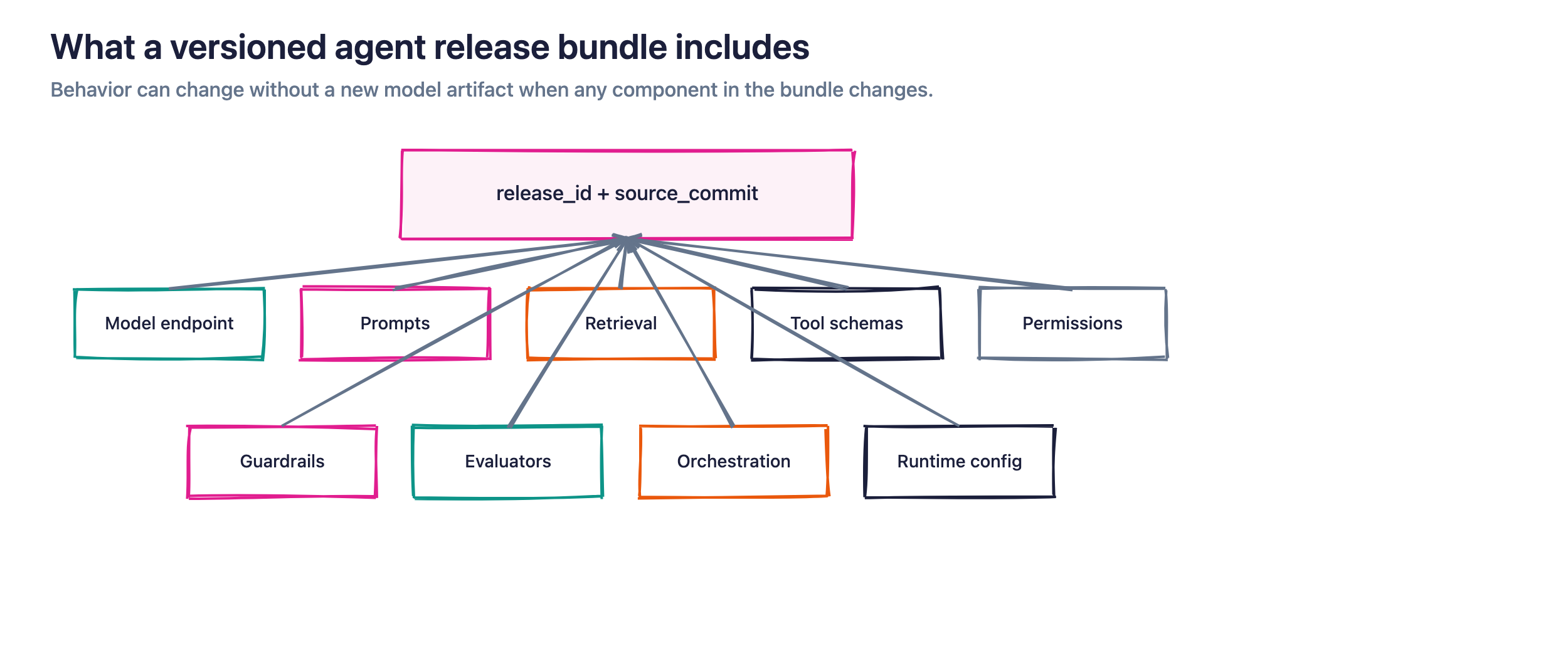
| System type | Primary managed unit | Components that also need lineage |
|---|---|---|
| Predictive ML model | Trained model artifact and inference pipeline | Training and validation data, feature definitions, preprocessing, environment, thresholds |
| Fine-tuned or self-hosted foundation model | Model weights, adapters, tokenizer, and serving stack | Base model, training and alignment data, training recipe, quantization, safety controls |
| LLM application or RAG system | Versioned application release | Model endpoint, prompts, retrieval corpus, embedding model, chunking, reranker, guardrails, evaluator versions |
| AI agent | Versioned agent or harness release | Everything above, plus tool schemas, permissions, memory behavior, routing, retry logic, termination conditions |
| Third-party AI capability | Vendor service configuration and integration release | Contracted model or API identifier, region, data handling terms, SDK version, fallback behavior, provider change history |
A model registry can be the system of record for a trained artifact. It is rarely sufficient as the only record for an agent whose behavior changes after a prompt edit, a tool permission update, or a new retrieval index.
Build better agents with Arize
Trace, evaluate, and learn. Build agents that work with Arize AX and start tracing your runs today.
Prefer open source? Try Arize Phoenix for self-hosted, open source agent observability.

The seven stages of the AI model lifecycle
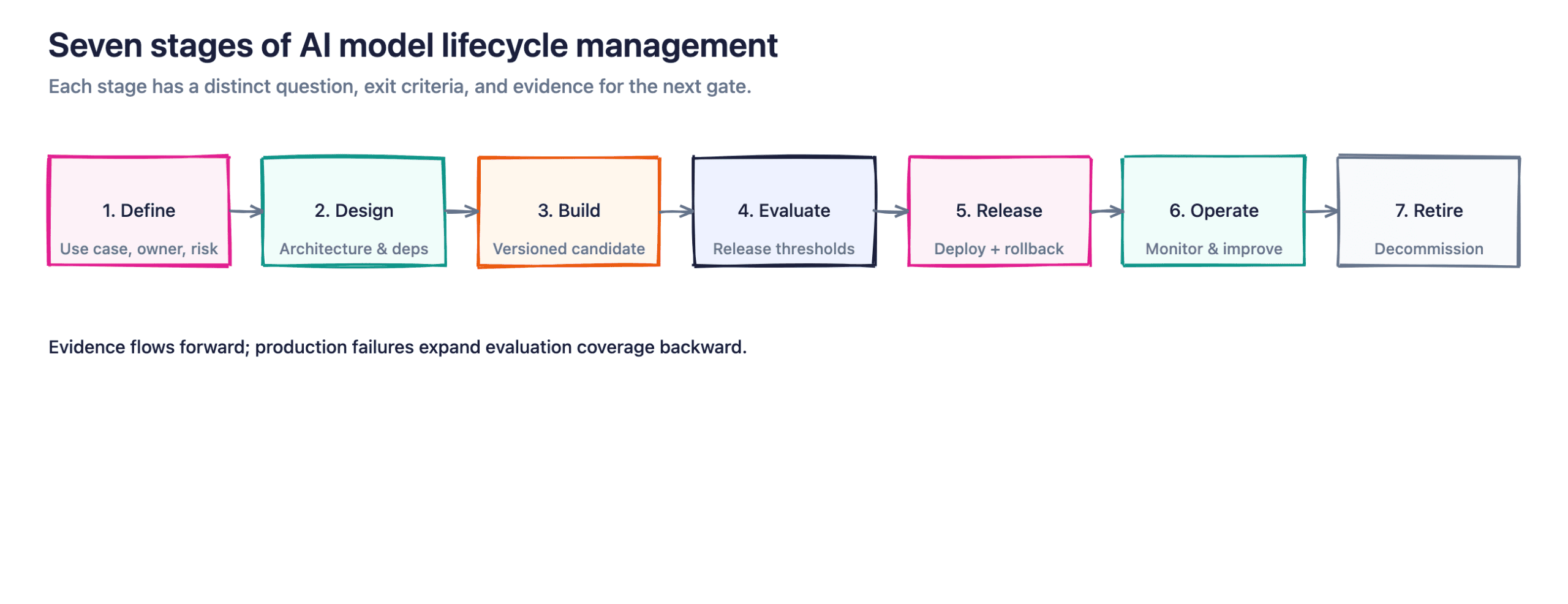
There is no universal stage count. Cloud providers, standards bodies, governance teams, and ML platforms group the work differently. The seven-stage model below is useful because each stage has a distinct engineering question, a clear exit condition, and evidence that links to the next stage.
| Stage | Core question | Minimum evidence before advancing |
|---|---|---|
| 1. Define | What problem should this system solve, for whom, and under what constraints? | Intended use, owner, success measures, risk classification, fallback, evaluation plan |
| 2. Design | What data, models, tools, infrastructure, and controls will this require? | Architecture, dependency and supplier record, data plan, threat model, observability plan |
| 3. Build | Which exact artifacts and configuration produced this candidate? | Versioned code, data or corpus references, experiment metadata, dependency lockfiles, release manifest |
| 4. Evaluate | Does the candidate meet functional, quality, safety, and operational requirements? | Evaluation dataset, evaluator versions, results by slice, known limitations, approval decision |
| 5. Release | Can the system be deployed safely, observed immediately, and rolled back? | Immutable release identifier, rollout plan, deployment record, telemetry validation, rollback procedure |
| 6. Operate | Is the deployed system still producing acceptable technical and product outcomes? | Dashboards, alerts, traces, online evaluations, incidents, feedback, improvement decisions |
| 7. Retire | Has traffic stopped, access been removed, and evidence been retained or deleted correctly? | Decommission record, replacement mapping, access revocation, retention actions, final review |
1. Define the use case, owner, and risk
Lifecycle management starts before data collection or prompt design. The team needs a concrete statement of the user problem, the system boundary, the expected outcome, and the consequences of failure.
Intake is finished when you can answer these in writing, and not before:
- Who uses the system, and who may be affected by its output or actions?
- Does it provide information, recommend a decision, make a decision, or take an action?
- What is the intended use, and which uses are explicitly unsupported?
- What product, quality, safety, latency, and cost measures define success?
- What happens when the system is uncertain, unavailable, or wrong?
- Who owns the product outcome, the technical implementation, and the risk decision?
- Which data classes, regulated domains, or external providers are involved?
Risk classification should reflect the actual use context. The same summarization model is low risk when condensing internal meeting notes and much higher risk when summarizing clinical information that influences care. For application risk classification, assess the deployed system and its intended use rather than inferring risk from the underlying model alone.
If you cannot state the cost of a wrong answer here, you cannot set a release threshold in stage 4. Every gate downstream inherits the numbers written in this stage.
Exit criteria: a named owner, a documented intended use, an initial risk tier, measurable success and failure conditions, and approval to proceed with design.
2. Design the system, data, and dependency graph
The design stage identifies every component that can change system behavior and decides how the team will version, secure, evaluate, and observe it.
For a predictive model, design covers data sources, labels, feature definitions, split strategy, model family, serving mode, and ground-truth latency. For an LLM application, it covers the model provider, prompt hierarchy, retrieval pipeline, tool APIs, output schemas, policy checks, and human escalation path. An agent adds state, memory, permissions, retry behavior, and termination conditions.
| Component | What you version | What breaks when you don’t |
|---|---|---|
| Data sources and datasets | Snapshot ID or query, ownership, licensing, retention | You cannot tell whether a performance drop came from the model or from an upstream schema change |
| Base model or model service | Pinned model ID, endpoint, region, versioning guarantee | A silent provider alias update looks like a regression in your own code |
| Prompts and prompt hierarchy | Content-addressed prompt version | Two releases score differently and nobody can reconstruct which prompt ran |
| Retrieval pipeline | Corpus snapshot, embedding model ID, chunking and reranker config | You cannot reproduce a groundedness regression after a re-index |
| Tool schemas and permissions | Schema bundle digest, permission profile, side-effect class | An agent gains write access through a schema change nobody reviewed |
| Orchestration and guardrails | Code commit, routing rules, fallback paths, policy config | Routing changes shift traffic to a different model with no release record |
| Runtime environment | Image digest, packages, hardware, region, network boundary | A dependency bump changes tokenization or numerics and the eval suite never ran |
| Telemetry and evaluation | Instrumentation version, evaluator versions, sampling rate | Production behavior cannot be tied back to the approved release |
Treat lineage as a dependency graph rather than a single model version. Third-party model APIs need supplier controls. Record how the provider handles prompts and outputs, whether data is retained or used for training, which regions process data, how model aliases can change, what deprecation notice is offered, and what fallback exists if the service changes or becomes unavailable.
Many AI-specific risks are much harder and more expensive to remediate after deployment because they originate in architecture, permissions, and trust boundaries. An agent holding a write-scoped token does not become least-privilege because you added a guardrail in front of it. Cover training-data poisoning, prompt injection, retrieval poisoning, insecure output handling, model and package supply-chain risk, excessive agent permissions, secret exposure, and unsafe tool side effects where relevant.
Exit criteria: an architecture and dependency record that identifies every component the team must version, test, secure, and monitor.
3. Build, train, fine-tune, or configure the candidate
The build stage produces a candidate release and enough metadata to explain how it was created.
For trained models, reproducibility requires more than hyperparameters. Record the code commit, data snapshot or query, feature pipeline version, package and container versions, random seeds, deterministic settings, training configuration, hardware where it affects results, model artifact, and evaluation inputs.
Seeds alone do not guarantee bitwise reproduction across accelerators, libraries, or distributed runs. Nondeterministic kernels, reduction order, library versions, and runtime configuration can all produce differences even when the seed is fixed. Experiment tracking helps, but it does not replace source control, data versioning, or artifact storage.
For LLM applications and agents, the release record also needs to capture configuration outside the model itself. Prompt versions, generation parameters, retrieval configuration, tool schemas, permissions, evaluator versions, and runtime settings can all change behavior without a new model artifact.
When a provider does not expose immutable model versions, record the most specific identifier available, the endpoint and region, request parameters, SDK version, timestamps, and any provider metadata returned with requests. Exact reproduction may still be impossible if the hosted service changes internally, but the record narrows the search during regression analysis.
A release manifest gives every team one identifier for the system that was evaluated and deployed:
release_id: support-agent-2026-08-03.1
source_commit: "8f2c1b7a49d3e6c05b1f8a2d7e4c9b06f3a1d2e5"
runtime:
  model_provider: "provider-name"
  model_id: "pinned-model-or-endpoint-id"
  runtime_image_digest: "sha256:..."
  generation_config_ref: "config/generation-v9.yaml"
  generation_config_digest: "sha256:..."
prompts:
  system_prompt_version: "support-system-v17"
  routing_prompt_version: "router-v6"
  prompt_bundle_digest: "sha256:..."
tools:
  schema_bundle_ref: "schemas/support-tools-v12.json"
  schema_bundle_digest: "sha256:..."
  permission_profile: "support-read-write-v3"
retrieval:
  corpus_snapshot: "help-center-2026-08-01"
  embedding_model_id: "embedding-model-id"
  retrieval_config_ref: "config/retrieval-v8.yaml"
  retrieval_config_digest: "sha256:..."
policy:
  guardrail_config_ref: "config/guardrails-v5.yaml"
  guardrail_config_digest: "sha256:..."
  response_schema_ref: "schemas/support-response-v4.json"
memory:
  state_config_ref: "config/memory-v2.yaml"
  retention_window: "30d"
evaluation:
  dataset_version: "support-regression-v12"
  evaluator_versions:
    - "task-completion-v4"
    - "policy-adherence-v3"
    - "tool-selection-v2"
Exit criteria: a candidate with a stable release identifier and traceable links to its code, data, configuration, dependencies, and development evidence.
4. Evaluate and validate before release
Evaluation asks whether a candidate is fit for its intended use. The metric set should follow the decision and the cost of failure, not the algorithm category.
Predictive models: evaluate against the real decision
A classification system may require precision, recall, ROC AUC or precision-recall analysis, calibration, and threshold analysis. Under severe class imbalance, precision-recall curves or average precision are often more informative than ROC AUC, particularly when false positives and false negatives have different costs. Check calibration separately because ranking metrics do not tell you whether predicted probabilities are well calibrated.
Which combination matters depends on the product. A fraud model that ranks transactions, a triage model that triggers escalation, and a churn model used for campaign targeting have different costs and operating points even though all three are classifiers.
Three checks deserve particular attention:
- Calibration. If predicted probabilities feed threshold-based decisions, poor calibration can silently distort the operating point.
- Slice analysis. Overall performance can hide severe regressions in important segments. Define critical slices in advance and evaluate them separately, subject to enough examples to make the estimate meaningful.
- A simpler baseline. Compare the candidate with the current production system or a non-ML alternative. Added model complexity should earn its operational cost.
Round out the plan with robustness testing for missing, delayed, corrupted, or shifted inputs; leakage checks; a split strategy that reflects deployment conditions; fairness analysis where outcomes affect protected or vulnerable groups; and latency, throughput, memory, and cost constraints.
LLM applications: evaluate at the component and system level
LLM evaluation combines several methods because no single evaluator reliably measures every behavior.
- Use deterministic code for schemas, required fields, exact values, numeric ranges, tool arguments, executable tests, latency limits, authorization boundaries, and known invariants.
- Use reference-based scoring when a trusted answer, label, document, tool, or final state exists.
- Use model-based evaluators for semantic criteria such as correctness, relevance, groundedness, completeness, or policy adherence, and validate important evaluators against human-labeled examples.
- Use human review for ambiguous, specialized, novel, or high-impact cases.
- Use production and user signals to discover failure modes that the original evaluation set did not anticipate.
The distinction between pre-production and production evaluation matters. Pre-production evaluation gates a candidate against known requirements and known failure classes. Production evaluation helps find what the gate did not cover.
Agents: evaluate outcomes, actions, and trajectories
An agent can return a plausible answer after selecting the wrong tool, inventing a parameter, ignoring an error, or failing to produce the required change in the external system.
Agent evaluation therefore inspects observable behavior at several levels:
- Outcome: Did the task complete, and did the environment reach the expected state?
- Decision: Did the agent choose the appropriate workflow, model, tool, or escalation path?
- Action: Were tool arguments valid, supported by the request, and authorized?
- Trajectory: Did the agent take a valid and reasonably efficient path without loops or unnecessary calls?
- Recovery: Did it handle missing information, tool failures, conflicting evidence, and partial completion correctly?
- Reliability: Does behavior remain acceptable across repeated runs and realistic variations?
- Efficiency: Did it stay within latency, token, tool-call, and cost budgets, including cost per successful task?
Evaluation does not require access to hidden reasoning tokens. Teams can evaluate traces, tool calls, intermediate outputs, state changes, and final results.
Agent behavior can also vary across runs. Use repeated trials where nondeterminism materially affects the release decision, and account for sample size, uncertainty, failure severity, and critical-case regressions rather than relying on one average score.
Avoid tuning and approving against the same small dataset. Maintain a versioned regression suite that grows from production failures, and keep a separate holdout or periodically refreshed challenge set for final release checks. Evaluators are part of the measurement system, so version and validate them alongside the application.
Agent-as-a-Judge: evaluate nuanced and emerging behavior
Traditional LLM-as-a-Judge evaluators work well when the team can define stable criteria and map the required inputs in advance. Agent-as-a-Judge is useful when an evaluator needs to inspect a multi-step trace, select the relevant spans, and reason across tool calls, retrieval, state, and outputs. In Arize AX, teams describe the scoring criteria in natural language and an agentic harness reads trace data at run time, then writes results back as versioned evaluation columns.
Use agentic evaluation for trajectory quality, recovery behavior, multi-field judgments, and failure modes that are difficult to express as a fixed template. Keep deterministic checks for schemas and invariants, use conventional LLM judges for stable high-volume criteria, and retain human review for uncertain or high-impact cases. The resulting labels can feed monitoring, datasets, and experiments.
An agentic judge is still part of the measurement system. Version its instructions, harness, model, tools, labels, and output schema; calibrate important results against human annotations; track disagreement and drift; and require any candidate change it recommends to pass the same release gate as every other change.
Write the gate as configuration, not prose
“Meets release thresholds” is not an enforceable release criterion. Put the gate in configuration so every candidate is evaluated against the same requirements.
The values below are illustrative:
# ci/release-gate.yaml
dataset: support-regression-v12
repeat_runs: 5
gates:
  - metric: task_completion
    evaluator: task-completion-v4
    min: 0.92
  - metric: policy_adherence
    evaluator: policy-adherence-v3
    min: 1.0
    scope: policy_cases # 40 cases, no exceptions
  - metric: tool_selection_accuracy
    evaluator: tool-selection-v2
    min: 0.95
    slices:
      - billing
      - account_access
  - metric: latency_p95_seconds
    max: 4.0
  - metric: cost_per_successful_task_usd
    max: 0.08
fail_on:
  - any_critical_severity_regression_vs: support-agent-2026-07-20.3
Notice what this gate does not contain: a refund-specific slice. At this point, support-regression-v12 does not include examples of the procedure-change failure that will later appear in production.
That is not a reason to abandon release gates. It is a reminder that an evaluation gate can only test the cases and requirements represented in its dataset. Production failures should expand that coverage over time.
Exit criteria: documented evidence that the candidate meets its release thresholds, known limitations are understood, critical failures have owners, and the appropriate reviewer has approved deployment.
5. Release and deploy with rollback and telemetry
Deploy the exact release that passed evaluation. Rebuilding from a branch after approval can produce a different artifact and break the evidence chain.
The deployment record should link the release identifier to the target environment, infrastructure configuration, approval, rollout time, and active traffic share.
Choose the rollout pattern based on the potential harm, the authority available to the system, traffic volume, and how quickly a failure becomes visible.
For read-only systems with fast feedback, a small canary may be appropriate. The starting percentage should be sized to the potential impact rather than treated as a universal number. Read-only systems are generally easier to contain because they do not mutate system state, but rollback cannot undo incorrect or harmful information users have already seen or acted on.
For systems with write access or delayed feedback, shadow execution, sandboxed tools, internal-user allowlists, bounded permissions, and transaction limits can provide evidence before the system is given broader authority.
For irreversible or high-value actions, keep human approval or equivalent transaction-level controls in the path until the system has demonstrated the level of reliability required by the use case.
Before exposing production traffic:
- Verify that logs, metrics, traces, and evaluation metadata carry the release identifier.
- Test rollback, fallback, containment, and kill-switch behavior.
- Confirm that agent tools use least-privilege credentials and appropriate approval boundaries.
- Validate input and output schemas, privacy controls, and retention behavior.
- Confirm alert ownership and incident runbooks.
- Record any manual configuration that remains outside automated deployment.
For agents with write access, progressive delivery should limit both traffic and authority. A canary agent with access to every customer record may still have a large blast radius even if only a small percentage of requests reach it.
Exit criteria: the approved release is deployed, telemetry is flowing, ownership is clear, and rollback or containment has been verified.
6. Observe production behavior and improve the system
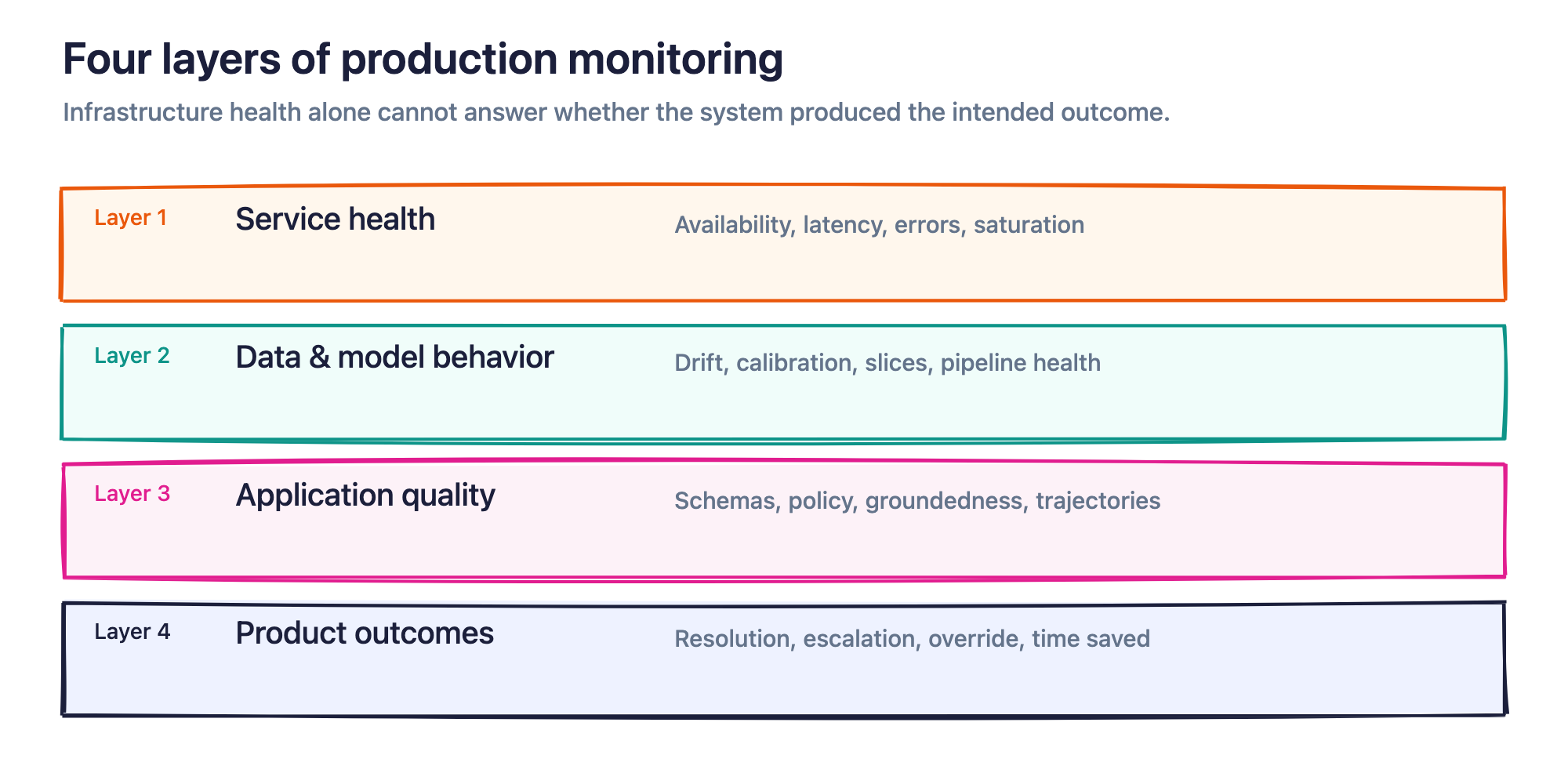
Monitor four layers.
Layer 1: Is the service up and responsive?
Track availability, error rates, latency distributions, throughput, saturation, queue depth, retries, timeouts, dependency failures, and resource use. These signals show whether the application is functioning as a service.
Layer 2: Has the data or model behavior shifted?
For predictive systems, monitor schema changes, missing values, range violations, feature and prediction distributions, realized performance when ground truth arrives, calibration, important slices, and data-pipeline health.
Drift is a diagnostic signal, not proof that the system is wrong. Input drift may have no material effect on outcomes, and performance can degrade without obvious input drift if the relationship between inputs and targets changes. Use drift to prioritize investigation, then confirm impact with ground truth, proxy outcomes, slice analysis, or controlled evaluation.
Layer 3: Is the application still behaving correctly?
The same behavioral dimensions used before release also matter in production. What changes is where and how frequently the checks run.
Put deterministic enforcement controls in the synchronous path where a violation must be blocked: authorization checks, schema validation, tool allowlists, transaction limits, required confirmations, and similar invariants.
Semantic evaluators can run synchronously where their latency, error rates, and failure behavior have been validated for that use. Otherwise, run them asynchronously on a documented sample and use their results to trigger investigation.
For example:
| Check | Placement | Typical coverage |
|---|---|---|
| Output schema, required fields, authorization, tool argument validity | Synchronous | 100% |
| Transaction limits, tool allowlists, required confirmations | Synchronous | 100% |
| Groundedness, semantic policy evaluation, task completion, trajectory quality | Asynchronous or validated inline evaluation | Sampled or use-case dependent |
| Human annotation for evaluator calibration | Offline | Small, targeted sample |
Layer 4: Did the system produce the outcome the product wanted?
Measure outcomes such as resolution, completion, conversion, escalation, user correction, abandonment, manual override, downstream error, or time saved.
These measures often have causes outside the AI system, so interpret them alongside traces and controlled analysis rather than treating them as direct labels for model quality.
Every alert needs a defined baseline, threshold, owner, severity, and runbook. Avoid automatically retraining a model or changing a prompt because a distribution shifted. A trigger should begin an investigation or candidate build; the updated system still has to pass evaluation and release controls before promotion.
The production loop, walked through once
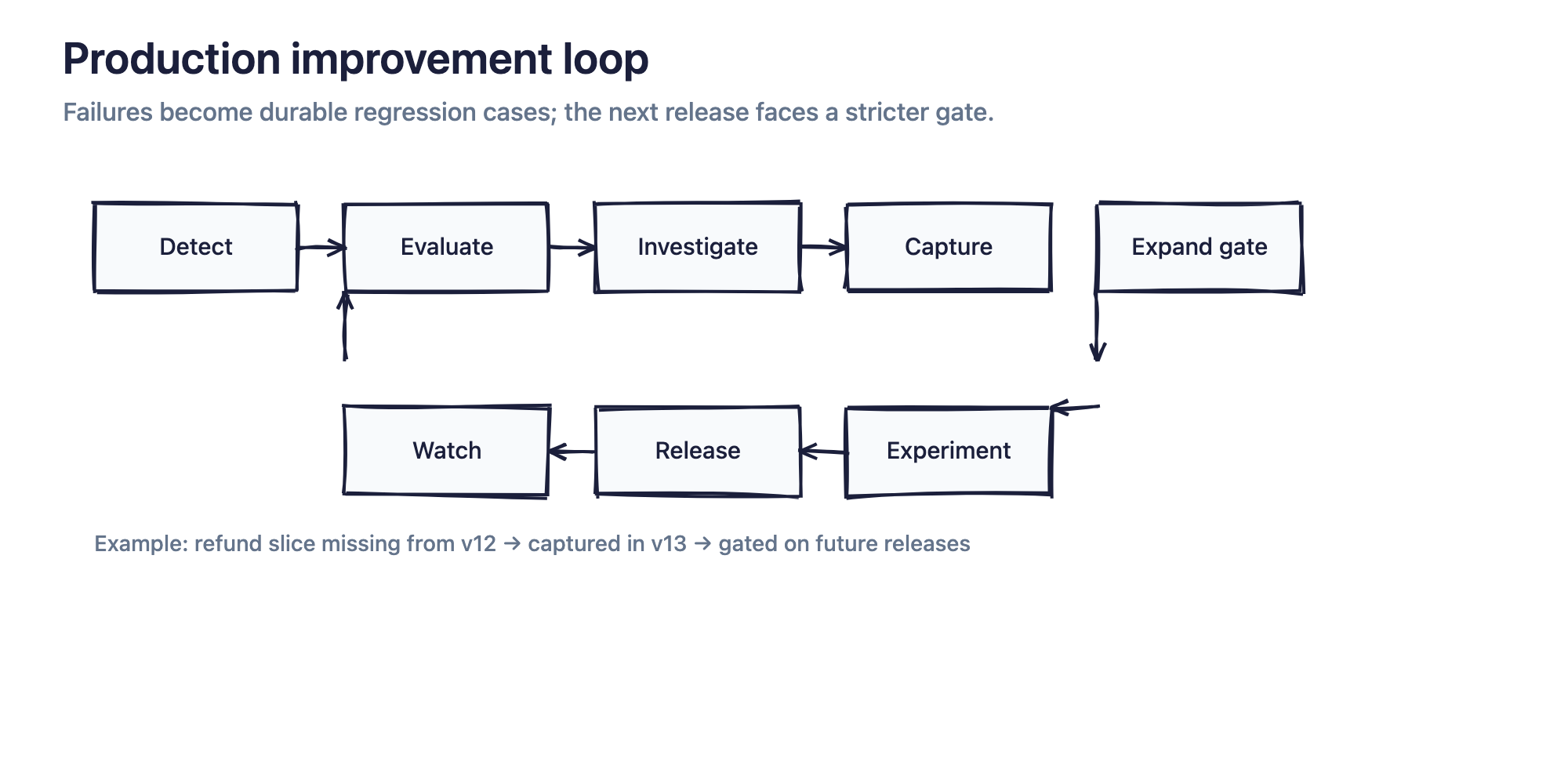
Consider the support agent from the release manifest above.
The August 1 candidate changes two pieces of retrieval configuration:
retrieval:
- corpus_snapshot: "help-center-2026-07-15"
+ corpus_snapshot: "help-center-2026-08-01"
- retrieval_config_ref: "config/retrieval-v7.yaml"
+ retrieval_config_ref: "config/retrieval-v8.yaml"
The v8 retrieval configuration includes a change to chunking behavior.
No model, prompt, or tool schema changes. The candidate passes support-regression-v12: aggregate task completion is 0.94, above the 0.92 threshold, and the billing and account-access tool-selection slices remain above their gates.
What v12 does not contain is a set of cases covering a particular class of refund requests affected by the help-center procedure change. The release therefore passes the tests that exist while still carrying an untested failure mode.
After deployment, the loop looks like this:
- Detect. Production monitoring surfaces a cluster of refund sessions with a higher-than-baseline rate of issue_refund calls and abnormal trajectories. The signal comes from user outcomes and trace behavior rather than a generic model-health metric.
- Evaluate and classify. Trace-level evaluation identifies a repeated retrieval-to-tool-selection failure. Procedure content is not being surfaced as expected, and in some affected sessions the agent selects issue_refund when it should escalate.
- Investigate. The team compares the affected traces with the release manifest and repository configuration. The evidence points to the changed chunking behavior in retrieval-v8 as the likely cause of the retrieval regression.
- Capture. The affected production traces are reviewed and converted into durable regression cases. The dataset advances from support-regression-v12 to support-regression-v13.
- Expand the gate. The new dataset introduces a refund-specific slice for tool-selection accuracy:
- dataset: support-regression-v12
+ dataset: support-regression-v13
gates:
  - metric: tool_selection_accuracy
    evaluator: tool-selection-v2
    min: 0.95
    slices:
      - billing
      - account_access
+     - refunds
- Experiment. The team tests a candidate retrieval fix against support-regression-v13, comparing it with the production baseline across task completion, tool selection, trajectory quality, latency, cost, and the newly captured refund cases.
- Release and watch. The candidate that passes the updated gate is reviewed and deployed through the normal rollout process. Production monitoring then tracks the specific refund failure class to verify that the fix holds under live traffic.
The important point is not that slice-level evaluation would automatically have caught the original failure. It would not have, because the relevant slice was missing from the test set.
The lifecycle works because production reveals a failure class, that failure becomes durable evaluation evidence, and the next release is held to a stricter gate.
Automation can shorten detection, classification, investigation, and experiment setup. It should not bypass the evidence or approval required to promote the next release.
Exit criteria: there is no final exit while the system remains active. This stage produces incidents, datasets, candidate improvements, re-approval decisions, and eventual retirement triggers.
Two configuration changes can alter system behavior
For an LLM application or agent, the model itself may remain unchanged while the surrounding system changes materially.
In the support-agent example, the relevant release diff is:
retrieval:
- corpus_snapshot: "help-center-2026-07-15"
+ corpus_snapshot: "help-center-2026-08-01"
- retrieval_config_ref: "config/retrieval-v7.yaml"
+ retrieval_config_ref: "config/retrieval-v8.yaml"
There is no model change, prompt change, or newly trained artifact.
The release passes support-regression-v12, including its existing tool-selection slices, but production reveals a refund-specific regression that the suite did not represent. The affected traces are then incorporated into support-regression-v13, which adds refund cases and explicitly gates that slice on future releases.
A small configuration diff therefore deserves the same release discipline as a code or model change.
The broader lesson is that evaluation coverage is cumulative, not complete. Pre-production tests protect against known failure classes. Production evidence identifies additional ones. A mature lifecycle turns those failures into versioned regression cases so that the same class of defect becomes harder to ship again.
7. Retire the system and preserve the right evidence
Retirement is a controlled production change. In a planned retirement, route traffic to a supported fallback before revoking credentials. During a security or safety incident, immediate containment may require revoking authority first.
-
- Route users and dependent services to a replacement or supported fallback.
- Notify downstream owners about schemas, features, APIs, or output tables that will disappear. The consumer reading your model’s output table without telling you is the one that breaks.
- Disable endpoints, scheduled jobs, credentials, agent tools, and write permissions. Scheduled jobs are the component teams forget, and a forgotten job keeps a retired model in production.
- Remove the system from active routing and on-call coverage.
- Update the inventory status and record the reason for retirement.
- Archive the release manifest, evaluation evidence, approvals, incidents, and deployment history for the required retention period.
- Delete data, embeddings, traces, and artifacts where retention or contractual obligations require deletion.
- Review whether the retirement revealed reusable lessons for intake, architecture, evaluation, or monitoring.
An inactive model that remains callable, scheduled, or credentialed is still an operational and security risk. Retirement is complete when the team can demonstrate that the system no longer serves traffic or holds authority.
Exit criteria: traffic and access are removed, dependent systems are accounted for, and evidence has been archived or deleted according to policy.
The three records that connect the lifecycle
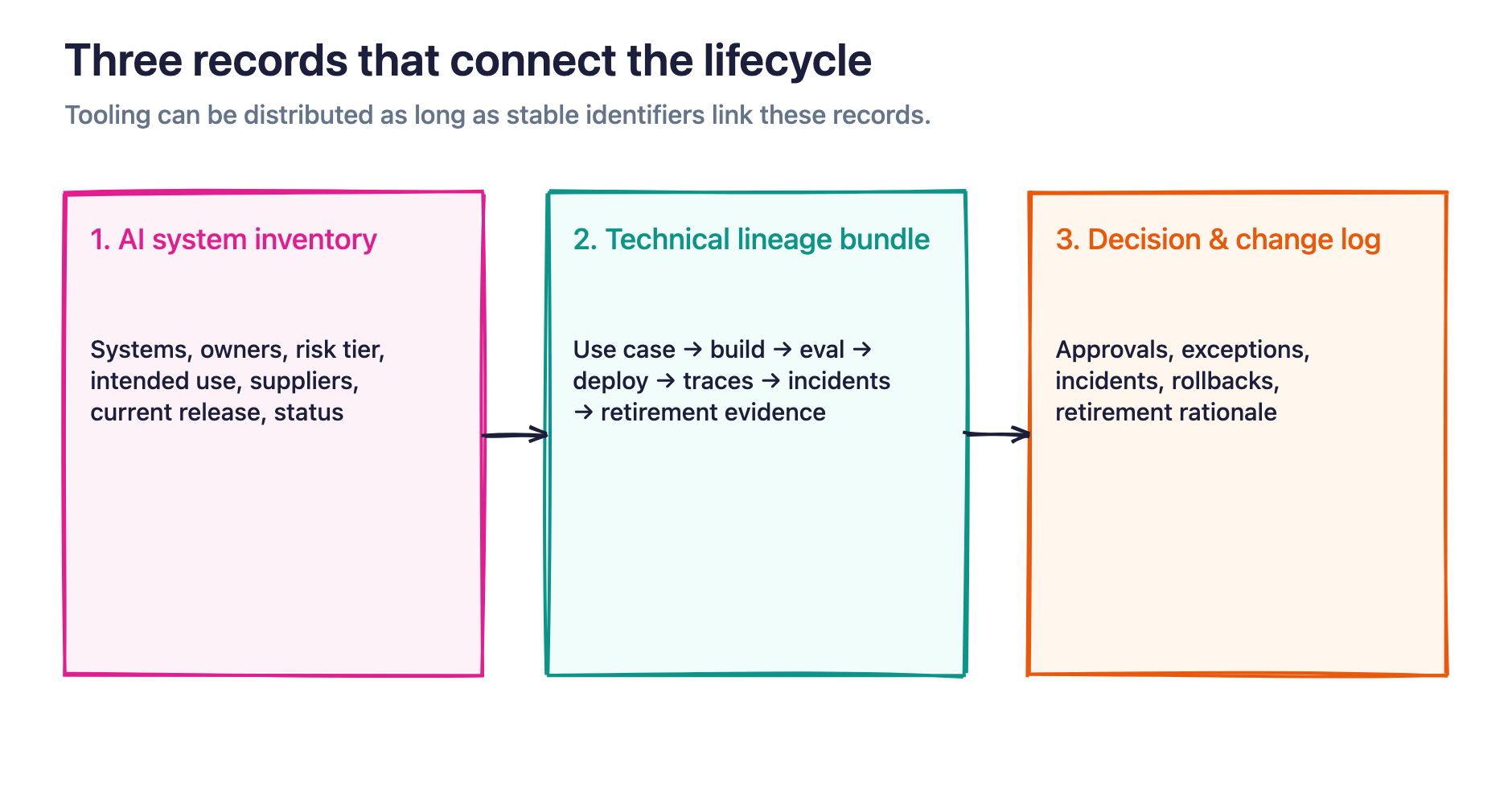
Tooling can be distributed as long as three records stay connected.
1. AI system inventory. Lists AI systems across development, testing, production, suspended, and retired states, with intended use, owner, business process, risk tier, affected groups, data classes, suppliers, current release, deployment locations, review date, and status. Include third-party and embedded AI capabilities, not only models you trained. Third-party and embedded AI capabilities create lifecycle and governance obligations of their own, even when the organization did not train the model. The exact technical, contractual, and legal duties depend on the system, use case, organizational role, and jurisdiction.
2. Technical lineage and evidence bundle. Connects a deployed release to the artifacts and configuration that produced it:
use case -> data and dependencies -> build -> evaluation -> approval -> deployment -> traces and metrics -> incidents -> retirement
The bundle can live across Git, a data catalog, an experiment tracker, a registry, an artifact store, CI/CD, an observability platform, and a governance console. Stable identifiers and durable links matter more than forcing every artifact into one database.
3. Decision and change log. Records why a candidate advanced, stayed, rolled back, or retired, linking evaluation results, exceptions, reviewer approvals, incident decisions, risk acceptances, and follow-up work to the relevant release. Audit logs cover the system side; the decision log covers the human side.
An approval you cannot trace to an eval run is a signature. An eval run you cannot trace to an approver is a dashboard. Incident review needs both, and you find out which one is missing at the worst possible time.
How lifecycle management changes for LLM applications and agents
Traditional ML lifecycle diagrams center on a trained artifact. Most application teams building with foundation models do not train the model they use. Their highest-impact changes happen in the surrounding system.
The provider controls part of the lifecycle
With a hosted model API, the provider controls training, alignment, patching, and infrastructure. The application team still owns model selection, integration, evaluation, fallback, data handling, and the user outcome. Vendor due diligence, change monitoring, and continuous evaluation reduce the risk created by the parts of the lifecycle you cannot observe.
Small non-model changes still require release discipline. As the support-agent example above shows, a retrieval corpus or configuration change can alter system behavior without changing the model or prompt; the same applies to tool descriptions, retrieval filters, permissions, and model aliases.
The unit of analysis depends on the outcome
A single model response is one step in a workflow. Traces expose retrieval, routing, model calls, tool calls, retries, custom logic, and errors. Sessions capture behavior across related turns or interactions. Evaluation and monitoring should match the scope at which the user or downstream system experiences the outcome. Depending on the product, that may be a span, trace, workflow run, transaction, job, or multi-turn session.
Test coverage is finite while inputs are open ended
Held-out evaluation sets stay useful for repeatable comparisons and release gates. They cannot cover every user input, model variation, tool response, or environment state. That gap is why the production loop in stage 6 exists, and why the regression suite has to grow from real failures rather than imagined ones.
How self-improving agents change lifecycle management
Self-improving agents use the same lifecycle as other AI systems, but they can participate in parts of it. A worker can read runtime evidence, create or apply evaluation signals, investigate likely causes, generate candidate code or configuration changes, and start experiments. The managed unit remains the versioned agent or harness release, and every candidate still needs lineage, evaluation, approval, deployment, and rollback.
The governance surface shifts toward permissions, triggers, sandboxes, review gates, and audit trails for the workers operating the loop. High-impact or irreversible actions should remain subject to human approval. A controlled improvement loop keeps engineers responsible for policy and promotion while agents take on repetitive inspection and analysis.
Agents change external state
An agent can send a message, change a record, execute code, purchase an item, or operate infrastructure. Lifecycle controls have to cover permissions, approval boundaries, idempotency, transaction limits, rollback or compensation, and confirmation that the claimed action actually happened.
None of this removes the validation gate. It changes what the gate evaluates. The release candidate becomes the complete system bundle, and the evidence includes component checks, end-to-end outcomes, trajectories, repeated-run reliability, security boundaries, and production-readiness tests.
AI model lifecycle management vs. MLOps, ModelOps, LLMOps, and AI governance
Vendors use these terms interchangeably. The distinctions matter when you are deciding which team gets paged and which tool is the system of record.
| Discipline | Primary focus | Common scope |
|---|---|---|
| AI model lifecycle management | The complete path from proposed use through retirement | Cross-functional controls and evidence spanning intended use through retirement |
| MLOps | Reliable, repeatable development and operation of ML systems | ML development, testing, deployment, monitoring, retraining, infrastructure automation, and governance |
| ModelOps | Enterprise operationalization across many model types and business units | Enterprise model portfolio management, promotion, monitoring, governance, and operational control |
| LLMOps and agent engineering | Development and operation of LLM applications and agents | LLM and agent development, evaluation, deployment, tracing, cost management, and iteration |
| AI governance | Policies, accountability, risk, and compliance across AI use | Inventory, policy, accountability, risk, approvals, compliance, and oversight |
The categories bleed into each other, so do not choose a tool by its label. MLOps platforms ship governance controls, and governance platforms ship technical monitoring. Choose by asking which records each tool owns, which controls it enforces, and how it connects to the rest of the lifecycle.
The NIST AI Risk Management Framework organizes risk management around Govern, Map, Measure, and Manage, and treats it as an iterative practice embedded across design, development, deployment, use, and evaluation rather than a one-time checklist. A lifecycle should work the same way: risk management, documentation, security, and human accountability recur at every stage.
What software supports AI model lifecycle management?
The market has overlapping product categories. Start with the operational question your team cannot answer, then identify which system of record should answer it.
| Software category | The question it should answer | Representative tools and platforms |
|---|---|---|
| AI governance and lifecycle workflow | What AI systems exist, who owns and approved them, and which policies apply? | ModelOp, IBM watsonx.governance, Credo AI, GRC platforms with AI modules |
| Experiment tracking and registry | Which data, code, parameters, and artifacts produced this candidate, and which version is approved? | MLflow, Weights & Biases, cloud model registries |
| ML platforms and pipelines | How is the system trained, packaged, deployed, scaled, and rolled back? | Amazon SageMaker AI, Google Cloud Vertex AI, Azure Machine Learning, Microsoft Foundry, Databricks, Kubeflow, DataRobot |
| AI observability and evaluation | What happened in a run, is quality changing, and which component caused the failure? | Arize AX, Phoenix, Fiddler, and other tracing and evaluation platforms |
| Data, metadata, and lineage | Which datasets, features, documents, and transformations feed the system? | Data catalogs, feature stores, lakehouse catalogs, OpenLineage-compatible systems |
| Serving and runtime control | Which version is receiving traffic, under which policy, with what rollback path? | Cloud serving products, KServe, Seldon, gateways, feature-flag and deployment systems |
Category snapshot as of August 2026. Capabilities move quickly, so verify current scope during diligence.
What to validate in each category
The category label tells you less than the evidence model underneath it. For each candidate, check the following:
- AI governance and lifecycle workflow. Does it cover third-party AI and agents, not just trained models? How flexible is the workflow, what integrations pull in technical evidence, how does policy mapping work, and can you export an audit package?
- Experiment tracking and registry. Does it capture dataset and code lineage, immutable artifacts, approval states, and the environment? Critically, does it version prompts, tool schemas, and other non-model configuration, or does it only understand model files?
- Platforms and pipelines. How much cloud and runtime lock-in does it create? What deployment targets, CI/CD integration, registry semantics, and serving and monitoring coverage does it offer?
- AI observability and evaluation. Does it cover traces and sessions, online and offline evals, evaluator versioning, recurring issue discovery, agentic evaluation for multi-step criteria, and full-harness experiments? If it runs managed workers, check sandboxing, permissions, human review, auditability, data retention, and deployment options.
- Data, metadata, and lineage. Look at snapshot semantics, ownership, quality checks, training-serving consistency, retrieval corpus lineage, and retention.
- Serving and runtime control. Look for progressive delivery, traffic routing, authorization, rate limits, audit logs, rollback, and multi-model or multi-provider routing.
Capabilities overlap and change. MLflow now spans experiment tracking, model registry, evaluation, and GenAI tracing. Cloud platforms combine pipelines, registries, serving, monitoring, and governance. Evaluate the workflow and the evidence model rather than assuming a category label defines the product boundary.
No single platform needs to replace the rest of the stack. A workable architecture uses a governance console for inventory and approvals, a registry for artifacts, CI/CD for promotion, an observability and evaluation platform for runtime evidence, and stable release identifiers to connect them.
How Arize fits into the lifecycle
Arize publishes this guide and is one of the platforms named above. Product capabilities and packaging change, so confirm current details against the documentation during diligence.
Arize sits in evaluation, observability, and the improvement loop:
- LLM applications and agents: Arize AX provides tracing, span-, trace-, and session-level evaluation, datasets, prompt workflows, online evaluation, production monitoring, and experiments across complete agent runs.
- Continuous investigation: Signal reviews production traces, groups recurring failures into ranked issues, and attaches trace evidence, proposed cause, and suggested next steps.
- Adaptive evaluation: Agent-as-a-Judge uses an agentic harness to read trace context at run time and score nuanced, multi-step criteria without requiring a fixed column mapping. Results can be reused across monitoring, datasets, and experiments.
- Managed improvement workflows: Managed Agents can investigate failures in sandboxes, use skills and repository context, create evaluation labels or dataset rows, and propose branches or pull requests for human review. Agent Swarms provides a central view of sessions and automations.
- Full-agent verification: Agent experiments compare outputs, traces, tool use, retrieval, latency, trajectories, and evaluation results across candidate and baseline runs.
- Voice applications: Arize AX supports observing, replaying, searching, and evaluating audio sessions alongside transcripts and multimodal traces.
- Open source: Phoenix supports tracing, evaluation, datasets, experiments, and prompt iteration, and runs locally or self-hosted.
- Open instrumentation: OpenInference supplies AI-specific semantic conventions and instrumentation on top of OpenTelemetry. Phoenix and Arize AX receive trace data over the OpenTelemetry Protocol (OTLP), and OpenInference instrumentation works with any OpenTelemetry-compatible backend, which reduces dependence on a proprietary trace schema.
- Deployment: Arize AX is available as a managed service, with self-hosted Kubernetes deployment on the Enterprise plan for organizations that need the platform in their own environment.
Arize does not replace source control, a training pipeline, model serving infrastructure, enterprise use-case intake, legal attestation, or a complete governance, risk, and compliance workflow. Teams that need formal attestation should link the technical evidence from Arize to their governance record and approval process.
For the current product workflow and release details, explore the Arize AX Changelog.
A minimum viable lifecycle you can implement now
You do not need a platform program before improving lifecycle control. Start with one production system and make its evidence chain complete.
- Create a system record. Name the owner, intended use, users, risk tier, current deployment, external suppliers, and product outcome.
- Define the release bundle. List every behaviorally significant component and give the bundle a stable release identifier. Use the manifest in stage 3 as a starting schema.
- Build a representative evaluation set. Cover supported tasks, common traffic, important segments, edge cases, policy boundaries, and known production failures. Keep a separate holdout for release decisions.
- Write the release gate as configuration. Combine deterministic checks, task metrics, semantic evaluation, safety and security tests, latency and cost limits, and manual review where risk warrants it. Put real numbers in it.
- Instrument before the next release. Carry the release identifier in metrics, logs, traces, evaluation results, and incidents so production behavior ties back to the approved bundle.
- Run a rollback and containment drill. Verify that the team can route traffic away, disable tools, revoke credentials, and identify affected users or records.
- Close the feedback loop. Review failures continuously or on a schedule, group recurring patterns, create or refine evaluation signals, add durable regression cases, let managed workers investigate and propose candidate fixes where appropriate, test the complete agent system against the baseline, and require review before release.
- Retire one obsolete system. Use the exercise to find missing owners, credentials, dependencies, retention rules, and archive procedures.
You will know this worked the first time someone asks what changed and you answer with a release ID instead of a Slack search.
What the 2026 EU AI Act schedule means for lifecycle planning
The EU AI Act is not a lifecycle framework, but its requirements raise the value of lifecycle evidence. Risk management, data governance, technical documentation, record-keeping, human oversight, accuracy, robustness, cybersecurity, and post-market monitoring all depend on records produced during engineering and operations.
Regulation (EU) 2026/1744, the Digital Omnibus on AI, entered into force on July 27, 2026. It changed several application dates:
- Chapter III, Sections 1, 2, and 3, with the exception of Article 6(5), apply from December 2, 2027 to systems classified as high risk under Article 6(2) and Annex III.
- The same sections apply from August 2, 2028 to systems classified as high risk under Article 6(1) and Annex I.
- The AI literacy obligation in Article 4 has applied since February 2, 2025. The omnibus revised its wording to require providers and deployers to take measures supporting staff AI literacy rather than guarantee a specific level for any individual.
- Article 50 transparency obligations generally fall under the AI Act’s August 2, 2026 application date. The omnibus gives providers of relevant generative systems placed on the market before that date until December 2, 2026 to comply with Article 50(2).
The deferral does not make every documentation or logging obligation live today. The specific high-risk requirements, including record-keeping provisions inside the deferred sections, follow the new 2027 and 2028 dates. Other laws, contracts, internal controls, and AI Act provisions can still require action now. Our guide to what AI engineering teams should monitor for EU AI Act compliance covers the operational side.
For engineering and product teams, the practical response is to build the inventory, lineage, evaluation, monitoring, and decision records now. Those capabilities take time to integrate across development and production, and they improve reliability whether or not a particular deadline applies to you.
This section is a technical planning summary, not legal advice. Confirm your role, system classification, geographic scope, and current obligations with counsel.
Frequently asked questions
What are the stages of the AI model lifecycle?
A practical AI model lifecycle has seven stages: define the use case, design the system, build or configure the candidate, evaluate it, release and deploy it, operate and improve it, and retire it. Risk management, security, documentation, and human accountability apply across every stage.
What are the best AI model lifecycle management tools?
No single tool covers the full lifecycle well, so most teams assemble a stack from six categories: governance and workflow (ModelOp, IBM watsonx.governance, Credo AI), experiment tracking and registry (MLflow, Weights & Biases, cloud registries), ML platforms and pipelines (Amazon SageMaker AI, Vertex AI, Azure Machine Learning, Databricks, Kubeflow), observability and evaluation (Arize AX, Phoenix, Fiddler), data and lineage (catalogs, feature stores, OpenLineage-compatible systems), and serving and runtime control (KServe, Seldon, gateways). Choose based on which record each tool owns and whether the tools share stable release identifiers.
What tools offer complete oversight of the AI model lifecycle?
Complete oversight comes from connected records rather than one product. You need an inventory that lists every AI system including third-party ones, technical lineage that ties a deployed release to its data, code, prompts, and configuration, and a decision log that records approvals, incidents, and retirements. A governance platform typically owns the inventory, a registry and CI/CD own lineage, and an observability and evaluation platform owns runtime evidence.
How do you ensure traceability across ML lifecycle stages?
Give every release an immutable identifier at build time and carry it through evaluation results, deployment records, logs, metrics, traces, and incidents. Version every component that changes behavior, including datasets, prompts, retrieval configuration, tool schemas, and evaluator versions, and record content digests rather than mutable version labels. Traceability fails most often because the release identifier is missing from production telemetry, not because a tool is missing.
How do you ensure reproducibility across the AI model lifecycle?
Record the code commit, data snapshot, feature pipeline version, package and container digests, seeds, deterministic settings, training configuration, and hardware. Seeds alone do not guarantee bitwise reproduction across accelerators, libraries, or distributed runs. For hosted model APIs, exact reproduction may be impossible, so record the most specific model identifier, endpoint, region, parameters, SDK version, and timestamps available.
How is the ML lifecycle different from the AI model lifecycle?
The machine learning lifecycle usually centers on a trained artifact: data collection, feature engineering, training, validation, deployment, and monitoring. The AI model lifecycle covers the same stages but treats the managed unit as the complete system, which for an LLM application or agent includes prompts, retrieval, tools, permissions, and orchestration alongside the model. The stages are the same; the release bundle is larger.
What is model lifecycle management software?
Model lifecycle management software helps teams inventory AI systems, track versions and lineage, record experiments and evaluations, control approvals and deployments, monitor production behavior, and preserve retirement evidence. These capabilities usually span several tools rather than one product.
What should a model registry track?
A registry should track the artifact or release identifier, owner, status, versions, lineage, evaluation results, approval state, deployment history, and relevant metadata. For LLM applications and agents, the registry or a linked release manifest also needs prompts, retrieval configuration, tools, permissions, evaluator versions, and orchestration code.
How is AI model lifecycle management different from MLOps?
MLOps is the engineering discipline for reliably building, deploying, monitoring, and updating machine learning systems. AI model lifecycle management is the broader operating model that connects those practices to intended use, ownership, risk classification, third-party dependencies, evaluation evidence, human approvals, incidents, and retirement. The categories overlap, so the distinction is organizational rather than a hard technical boundary.
Is model monitoring the same as model lifecycle management?
Model monitoring is one part of lifecycle management. Monitoring observes a deployed system, while lifecycle management also covers intake, design, versioning, evaluation, approval, deployment, change control, and retirement.
How do you manage the lifecycle of an LLM application?
Version the complete application release, including the model endpoint, prompts, retrieval pipeline, tools, orchestration, policies, and evaluators. Test the release on a representative dataset, deploy it with tracing and rollback, evaluate sampled production behavior, and turn production failures into regression cases.
Do AI agents need a different lifecycle?
Agents use the same seven stages, but the managed unit and the evaluation methods change. Teams need to version tools and permissions, evaluate observable trajectories and final environment state, test recovery and repeated-run reliability, and monitor task completion and side effects across traces or sessions.
Does data drift mean a model needs retraining?
No. Drift shows that a distribution changed relative to a baseline. It does not prove the change harmed performance. Investigate with ground truth, proxy outcomes, slice analysis, and controlled evaluation before deciding to retrain or replace a model.
Can one platform manage the entire AI lifecycle?
Some platforms cover many stages, but most production stacks still use several systems for code, data, experiments, registries, deployment, observability, evaluation, and governance. The critical design requirement is a stable release identifier and durable links between those systems.
Does the EU AI Act require AI model lifecycle management?
The Act does not prescribe a product category called model lifecycle management. Its requirements for high-risk systems include risk management, data governance, technical documentation, record-keeping, human oversight, accuracy, robustness, cybersecurity, and post-market monitoring. A well-designed lifecycle produces much of the technical evidence needed to support those obligations.
What is Agent-as-a-Judge in AI lifecycle management?
Agent-as-a-Judge is an evaluation method in which an agentic harness reads trace data at run time and applies natural-language scoring instructions across the relevant spans and context. It is useful for nuanced, multi-step criteria such as trajectory quality, recovery, and tool use. Teams should version and calibrate it like any other evaluator, and pair it with deterministic checks and human review where risk warrants it.
How do managed agents close the AI lifecycle feedback loop?
Managed agents automate investigation and analysis around a production system. They can read traces and evaluations, gather repository or tool context, create labels or datasets, and propose code or configuration changes. They should operate in controlled sandboxes with explicit permissions, produce reviewable artifacts, and leave release approval and deployment gates intact.
What does self-improving mean in AI lifecycle management?
A self-improving agent uses production evidence to propose and validate changes to its harness, prompts, tools, or workflows. In a governed lifecycle, traces become evidence, evaluators classify behavior, agents investigate or propose candidates, experiments verify them, and people or policy gates approve deployment.
Next steps
Pick one production model, LLM application, or agent and trace its current release from intended use to production evidence. Write the release manifest, run a representative evaluation, confirm that telemetry carries the release identifier, and test rollback.
For an open-source workflow, run Phoenix locally or self-host it to collect traces, build datasets, run evaluations, compare experiments, and manage prompts.
Arize AX is the relevant offering for teams that need managed observability and evaluation infrastructure for production AI systems, scheduled online evaluation workflows, enterprise controls and support, or a supported enterprise deployment of AX in their own Kubernetes environment.

