

Why prompts deserve engineering rigor
Most teams start with prompts as throwaway strings — pasted into Slack, embedded in code, copied between notebooks. That works until any of these become true:
None of these surface as code errors. The application still returns a 200, the trace looks fine, and the user gets a worse answer. Treating prompts as engineering artifacts is how you prevent this class of failure.
What rigor unlocks, once it’s in place:
- Safe iteration. Change a prompt, see the score delta on real data, then promote or roll back.
- Reproducibility. Every past version is recoverable. Bug reports against
prod-v1.2are answerable. - Deploy without redeploy. Move a tag in the Hub instead of pushing code to swap the production prompt.
- Regression detection. CI catches prompt or model changes that hurt eval scores before they ship.
- Collaboration. Subject-matter experts and engineers iterate on the same artifact, not parallel copies.
The prompt iteration cycle
The whole point of the platform’s prompt machinery is to make this cycle fast and safe: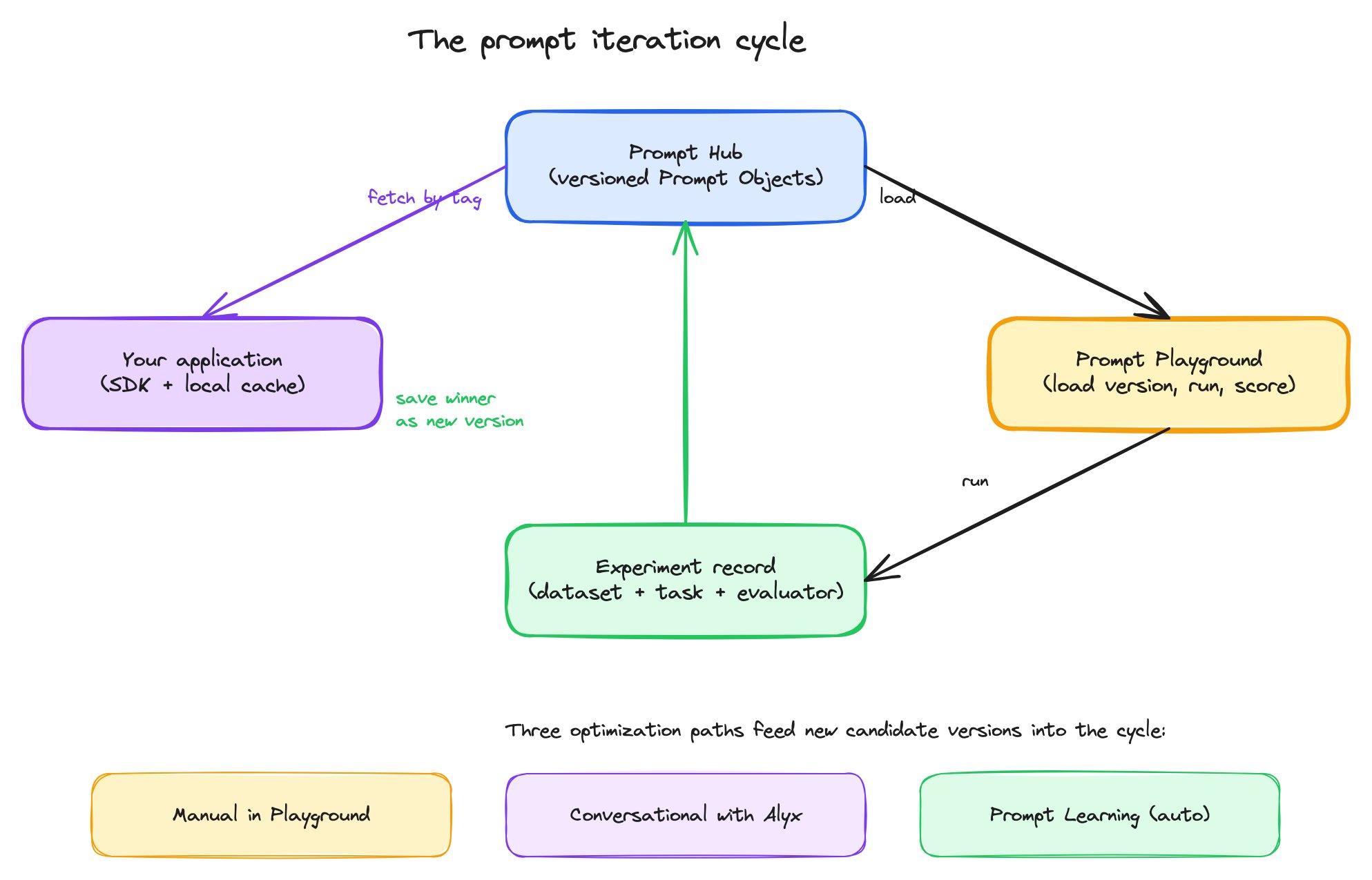
The prompt iteration cycle — Hub → Playground → Experiment → Hub — with the three optimization paths branching off the iteration step.
- The Prompt Hub stores the current version of every prompt your team owns.
- The Playground loads any version from the Hub and runs it against a dataset, with evaluators attached, so you can measure quality on real data.
- An experiment captures one such run as a comparable record — same dataset, same evaluators, different prompt versions side by side.
- The winning variant gets saved back to the Hub as a new immutable version, optionally tagged (
production,staging, etc.). - Your application reads the tagged version via the SDK — no code deploy needed when the prompt changes.
- Optimization — manual edits in the Playground, conversational refinement with Alyx, or fully-automated Prompt Learning — feeds new candidate versions back into the cycle.