

Z.ai, MiniMax, and Meta as Built-In Providers
September 2 – 8, 2026 Available in arize-phoenix 20.6.0+ (Z.ai), 20.8.0+ (MiniMax), and 20.9.0+ (Meta); provider constants in @arizeai/phoenix-client 7.8.0+ and @arizeai/phoenix-cli 1.17.0+ Three providers that previously needed a custom OpenAI-compatible endpoint are now built in. Pick them in the playground, save them on prompts, and use them for PXI sessions. Token prices ship with them, so cost tracking works without manual setup.- Self-hosted deployments can gate them with
ZAI,MINIMAX, andMETAinPHOENIX_ALLOWED_PROVIDERS. - New models on existing providers:
gemini-3.8-flashon Google (20.6.0+) andgpt-6-astraon OpenAI (20.8.0+), with reasoning controls and pricing.
Prompt Playground
Compare models side by side
Custom AI Providers
Point a provider at your own gateway
Filter Traces by Error Status and Latency
September 3 – 8, 2026 Available in arize-phoenix 20.8.0+ (server), arize-phoenix-client 3.5.0+ (Python), and @arizeai/phoenix-client 7.10.0+ (TypeScript) Both SDKs now takeerror, min_latency_ms, and max_latency_ms when listing traces, so “which
traces errored and took more than a second?” is one call instead of a page of traces filtered in
your own code.
errorcuts both ways.truereturns traces with at least oneERRORspan, matching the UI indicator.falsereturns only clean traces, which is what you want when sampling healthy behavior for a dataset.- Latency bounds are inclusive and apply to the trace, not its spans.
- The SDKs fail fast. An older server reports an upgrade requirement instead of silently returning unfiltered traces, and inverted bounds raise client-side.
Filter Expressions
Filter spans, traces, and sessions with the query DSL
List Traces for a Project
The full set of query parameters
PXI: Tabbed Settings and Slash Command Suggestions
September 2 – 8, 2026 Available in arize-phoenix 20.6.0+ (settings) and 20.9.0+ (suggestions)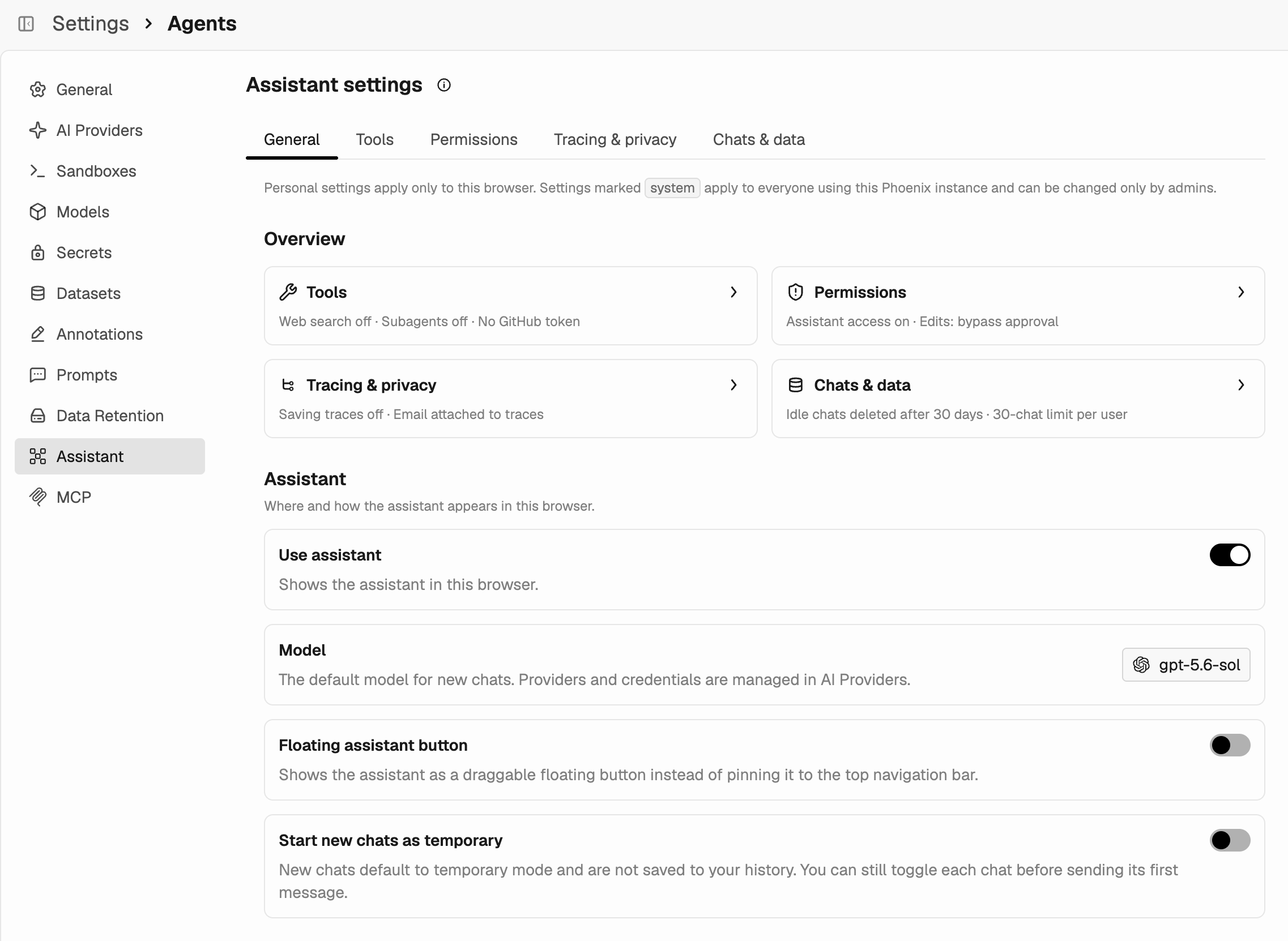
- Assistant settings are five linkable tabs — General, Tools, Permissions, Tracing & privacy,
and Chats & data — each with its own URL under
/settings/agents. Settings for capabilities your deployment has turned off stay hidden. - The chat input suggests a slash command that fits what you have in context. Open a chat with a span attached and the placeholder points at the command for that situation.
PXI
Configure the AI engineering agent built into Phoenix
MCP Server on FastMCP 4
September 3, 2026 Available in arize-phoenix 20.7.0+ The mounted MCP server at/mcp moves to FastMCP 4 and the stateless protocol, which removes a
class of reconnect problems. Nothing changes for clients on the default code-mode surface.
- Progressive disclosure is gone.
list_tool_groupsandenable_tool_groupno longer exist. WithPHOENIX_ENABLE_MCP_CODE_MODE=false, every/v1operation is advertised as its own tool. - Analytics SQL errors read properly, so a bad query comes back as an actionable message.
Remote MCP Server
Connect an MCP client to Phoenix
Delete Traces from a Project over REST
September 2, 2026 Available in arize-phoenix 20.6.0+DELETE /v1/projects/{project_identifier}/traces clears traces from a project while keeping the
project and its configuration, so ingestion continues against the same project afterward.
- The time window is required.
start_timeandend_timebound the deletion as[start_time, end_time). Naive datetimes are read as UTC. - Spans and orphaned sessions go with them. Sessions that still have traces outside the window survive.
Delete Traces from a Project
Endpoint reference
Data Retention
Expire traces on a schedule instead
Additional Improvements
September 2 – 8, 2026 Available in arize-phoenix 20.6.0+ and arize-phoenix-client 3.5.0+- Project token totals stop double-counting. Only leaf LLM spans count now, so frameworks that nest an LLM span inside another no longer inflate the dashboard headline.
- Metadata cells filter the table you are on. Clicking a metadata value in the traces table appends to the traces filter, not the span filter.
- Faster filtered trace and session queries. Filter lowering correlates every quantifier, which on PostgreSQL turns a statement timeout into an index probe.
- Annotation uploads validate every ID column up front, so an invalid
document_positionfails with a clear error instead of a confusing one later. - PXI stops retrying doomed GitHub calls. A
401or403is terminal and reports that the token’s scope or repository access needs checking. - Experiments no longer finish early. A dispatched work item counts as in-flight from the moment it leaves the queue.
- Tool definitions carry their names on PXI’s own LLM spans, so its traces read cleanly in span details.
- Question counts hold steady while a PXI question streams in.